Storm on the Prairie

Strange weather afoot – rain, wind, tornado.

If you have never lived on the prairies or traveled through the vast middle section of the U.S., you have missed some majestic land and sky. The weather can change in an instant, you might see it coming, you might not. Flat, lonely, filled with a terrible beauty.

Gouache, of course!

The Bridge

Take a look at this!

NOT a landscape!

This is really unusual for me – buildings and people intimidate me. However, by painting nearly every day I am gaining confidence in my abilities.

Also, the use of extremes in light and dark are another oddity for me, as well as the limited palette, the colors of which were primarily cad yellow and violet of some variety. White, too, along with some sienna, ocher, and ultramarine.

Painting really means learning a lot of things: how to use color, composition, brushwork. It is here that using a wide, flat brush to paint the buildings rather than my usual preferred rounds that I was able to achieve 90% of the painting. I was rather surprised by myself, and the result.

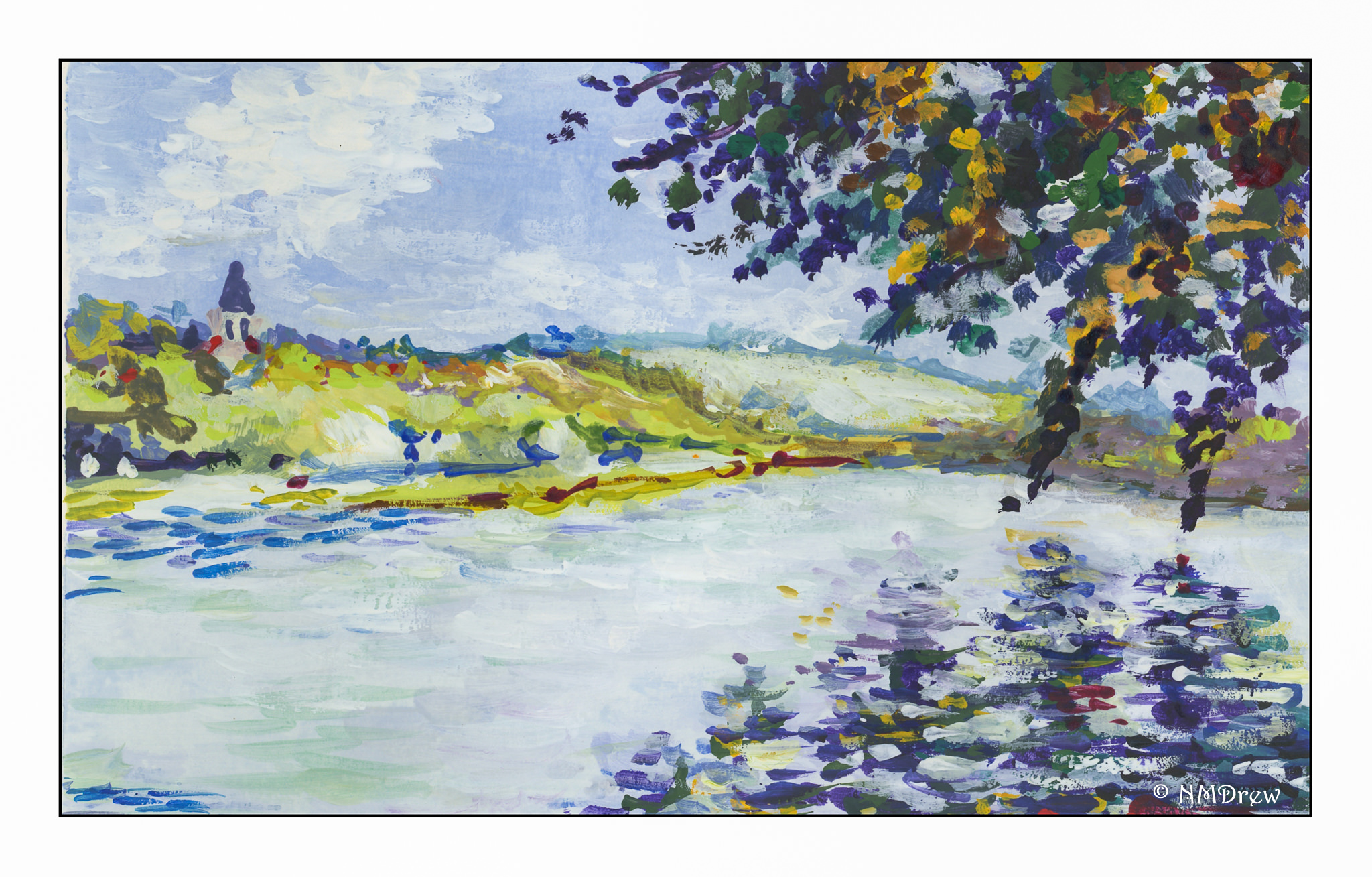
The View of the Seine at Herblay – Another Signac Study

As mentioned the other day, Paul Signac was known primarily for his Pointillism – the application of colored dots in painting to convey depth and light. Signac’s work is very graphic and structured, but he also used the same approach of color to produce paintings more of an Impressionistic flavor. The one below, The View of the Seine at Herblay, is the study for my practice piece above.

The first painting I did using Pointillism as the “style” I started by just laying on dots!  With a bit of paper to cover, only using dots became time consuming and tedious.  Thus, with this piece, I laid down broad swaths of the primary colors, essentially blues and beiges before applying dark colors for the leaves and reflections, and from there began the dot process.  As gouache is never permanently dry, I could go back in and lay in colors on top of others, as well as mush them together a bit.  Squishy good fun!  A firmly pointed round brush did the trick, using both the tip as well as the side of the brush.

Close looks at Signac’s painting show he did merge and blend his colors, as I did. I expect this was a quick sketch or a practice piece, or just a casual plein air painting for the joy of being outside. His other works that are more Pointillisticky have a very different quality. I think I will attempt to copy one of those in the not too distant future.

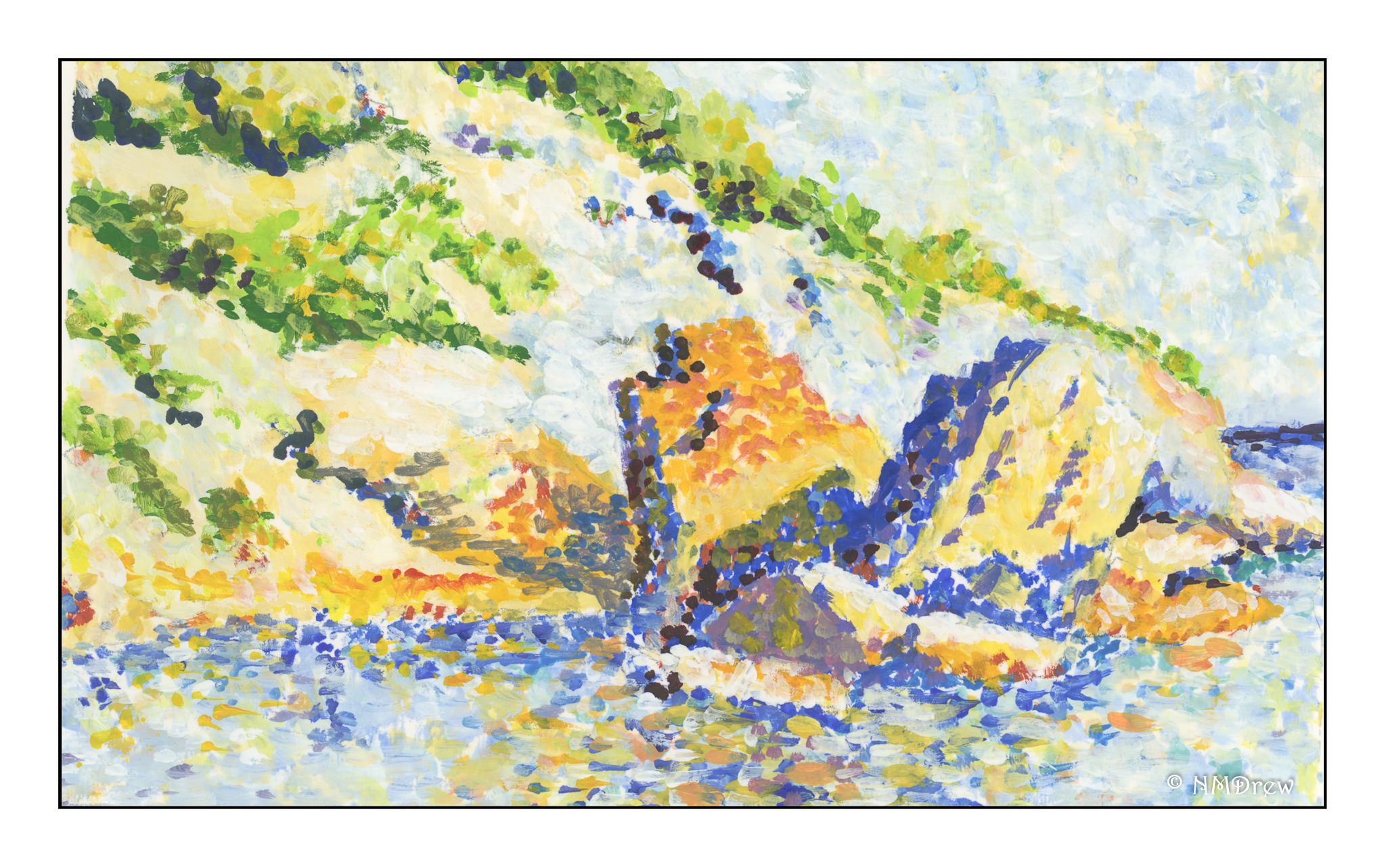
Cassis, Cap Lombard – Detail Study from a Painting by Paul Signac

After putzing around with attempts to emulate some of Monet’s Impressionistic paintings of Etretat, I muddled around and found the works of Paul Signac, a Neo-Impressionist and Pointillist. These two schools espoused dabbing, using complimentary colors and such to create a sense of light and movement. They are rather delightful to my eye – I am a magpie at heart – and the vibrant colors and energy of these painters fascinates me.

Here, I decided to see what I could do with a detail of Paul Signac’s painting, which you can see below. His rocks, or whatever they are, and their reflections in the sea caught my attention. My reflections are not very good. As a first attempt to try pointillism, I just started with making dots on the unpainted paper. In reality, the best way to start would have been to laid down solid areas of underlying color, and then build upon that with the dots.

If you look at Signac’s painting, you will see the use of orange and blue in the shadows – reflected light in the shadows. What I also found fascinating is his use of different shades of blue – ultramarine, cobalt, and cerulean in particular. Together with varying shades of orange, yellow, and ochre, he created the stone reflections. I found this very hard to do, but think I get the idea!

More to come. The purpose of copying or interpreting Signac’s work (and Monet’s) is to get a better sense of color. With pointillism, the colors are applied individually. Doing this myself, I begin to appreciate the purity of color when juxtaposed with another.