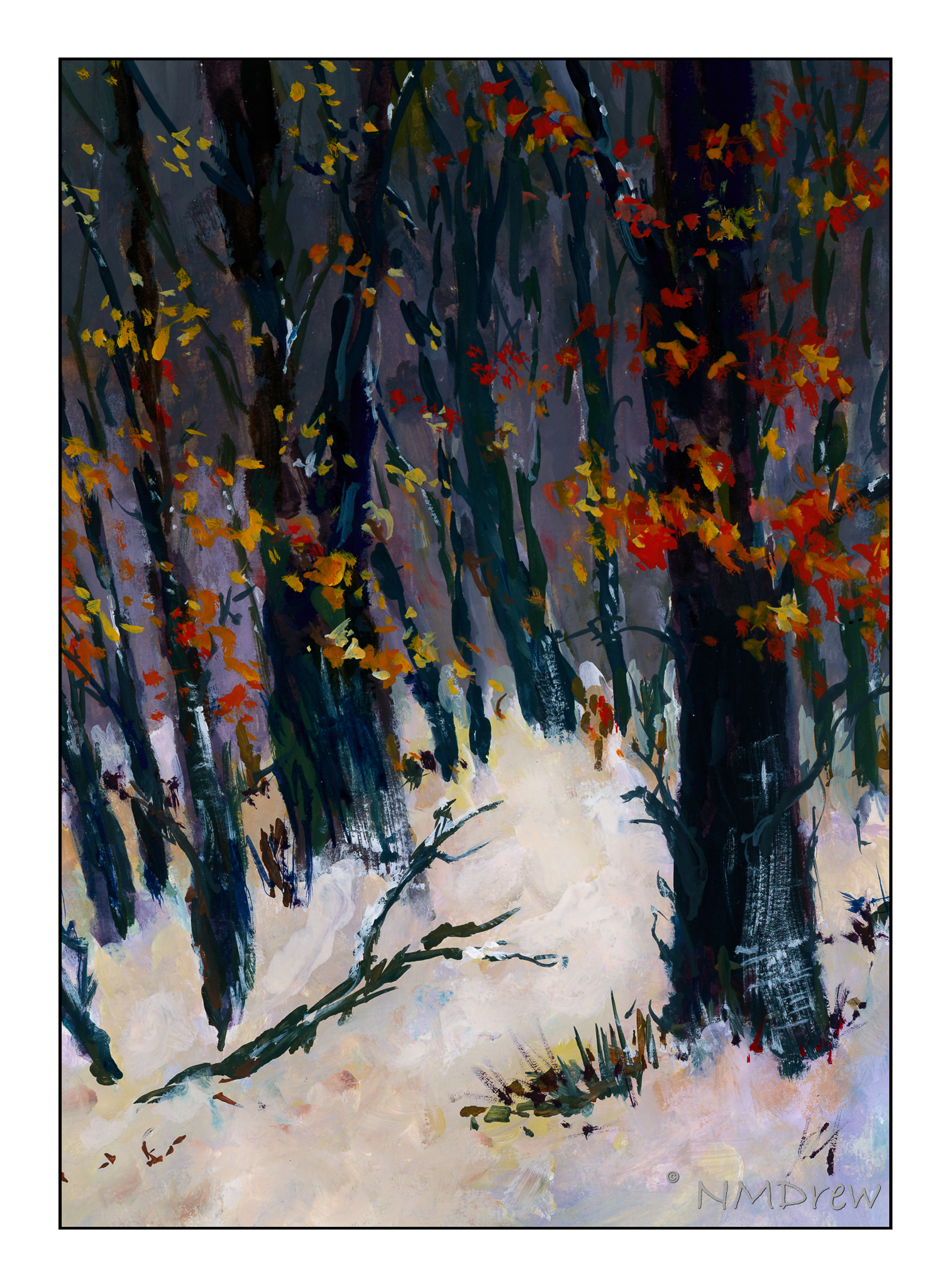
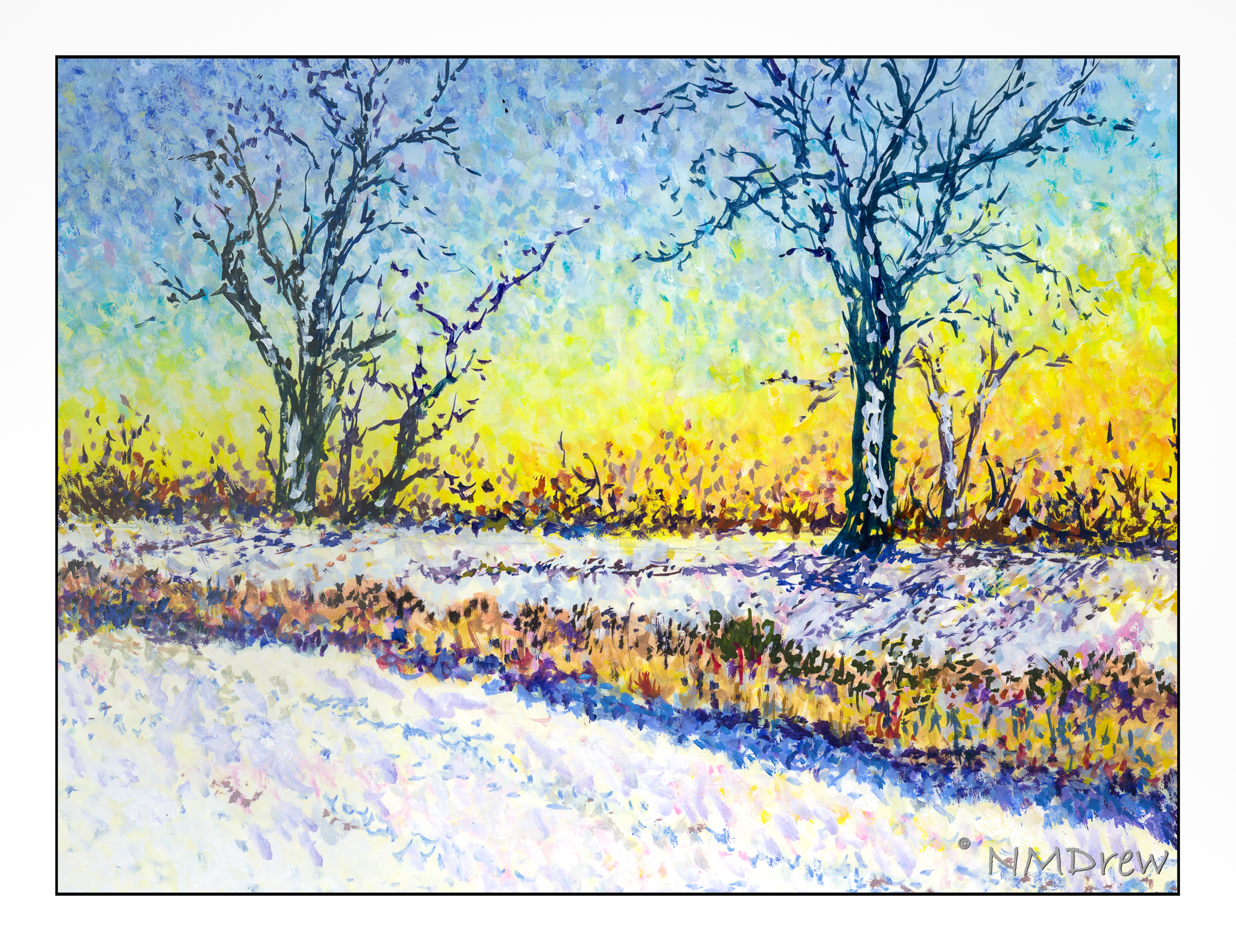
I try to paint every day, and in general, I seem to accomplish this. I have been working mostly in gouache and watercolor. There are times when I make studies – try to copy – the works of people I admire, or do an exercise in a “how to” art book. You learn from both. Other times, I just make something up or interpret something I have seen. Landscapes are always my favorite subject. These are some of the things I have done over the last two months, not in any particular order.
Tag: gouache
From the Roadside
How many times I have driven through the wild country of the US, stopped on the roadside just to gaze at the land around me? When I lived in Colorado, I did this whenever I could. I do it here, too, in California, and whenever we take a driving trip through wild and lonesome country. Life here can be harsh and isolated, but can you imagine yourself on horseback (I do!) and slowly traversing these wild and open places?
More winter, more gouache. A limited palette of white, phthalo blue and green, ultramarine blue, a bit of red, and black and purple.
It’s Winter
It’s a pleasantly warm day today – bare feet and a nap on the patio kind of pleasant day. Still, I long for cold and gloomy weather, real winter weather. I know, I know – if I was living in the middle of it, I would think differently.
That said, a gouache in a more painterly manner than pointillism, up in the mountains somewhere, looking on to the distant dusting of snow. Gloom. Snow. Cold. Yeah! Don’t go wading in the river, either! Just enjoy it, and then return home to hot cider and a fire.
Moonlight Night in Boulogne – Gouache Study After Theo van Rysselberghe
One of the totally fun things about studying a school of painting is exploring its members! Who is this person? Oh, I like that painting! And then, off on a trail of discovery. I am finding a lot of painters I like, many from the post-Impressionist schools of Pointillism. These same painters move not only into Pointillism, but other ways, or schools, of painting that appeal to me in their composition and their colors.
Still, sticking with Pointillism, today’s study is from a painting by Theo van Rysselberghe, a Belgian painter who does lovely work. Here, a study of a moonlit night of a harbor. Boats, sails, reflections, silhouettes, lights, and even a few human beings. Van Rysselberghe’s interpretation of the night, the light of the moon, and the colors used to express the night are so interesting. The lack of light, artificial light, and moonlight all create an atmosphere at once pleasing and rather mysterious. My own agenda has learning to paint the night effectively a high priority.
My own painting is nowhere as good as van Rysselberghe’s, but that is not the point. The focus is on the colors of the night, the blues, the darks – purple? black? phthalo blue? mixtures of all kinds? There is a luminescent quality to even the darkest colors, as well as a brilliance to the lightest that is not quite white, but a pale, pale yellow.
The dots are also more than dots. Brushwork is not only circular dabs of color, but also horizontal lines that are done perhaps with the side of a round brush (mine were!). When I copy a painting, I try to see the brushwork. Gouache does a decent job for copying paintings, but the paintings I have been copying are in oil and certainly oil paintings are much larger than my 9×12 studies, and consequently more subtle.
Terrasse de Meudon – Gouache Study After Paul Signac
I must say, Signac does make a lot of cheery, colorful paintings! Not only are his colors great, but his compositions are often so interesting. Here, another study, mine perhaps more colorful than the original. It is always hard to tell when you look at something on a monitor. Even my scans are often off, needing some color adjustments before a final jpg is created. Age can often cause colors to deteriorate in oils, too, as the varnish yellows and dims the original.
What really attracted me in Signac’s work below were the lavenders, greens, and blues. So many shades! Additionally, I really tried to look into how he juxtaposed colors, such as the oranges mixed in the blues and lavenders of the paved surfaces of the foreground. The warmth of the scene in the middle ground plays a pleasant contrast to the cool, shady canopy of the trees at the top of the painting.
I am learning a bit each time I copy a painting in the Pointillistic school. Colors are distinct from one another. Even when a work is not a “dot” painting, I am beginning to get a better sense of color and shapes, contrast, and so on. Much of this is just sitting around in my subconcious, and sometimes, with an original painting, it manages to escape.