
Lately I have been looking at pictures of Scotland. Bright white houses with few windows seem to be a norm here, and in watercolor they provide a brilliant spot that lets the watercolorist leave the paper untouched. This skill is actually important in watercolors as bright white paper needs to be worked around. There are tricks to retaining white paper, such as using a resist of some kind, but to master the skill of retaining white paper without anything but practice is both frustrating and rewarding.
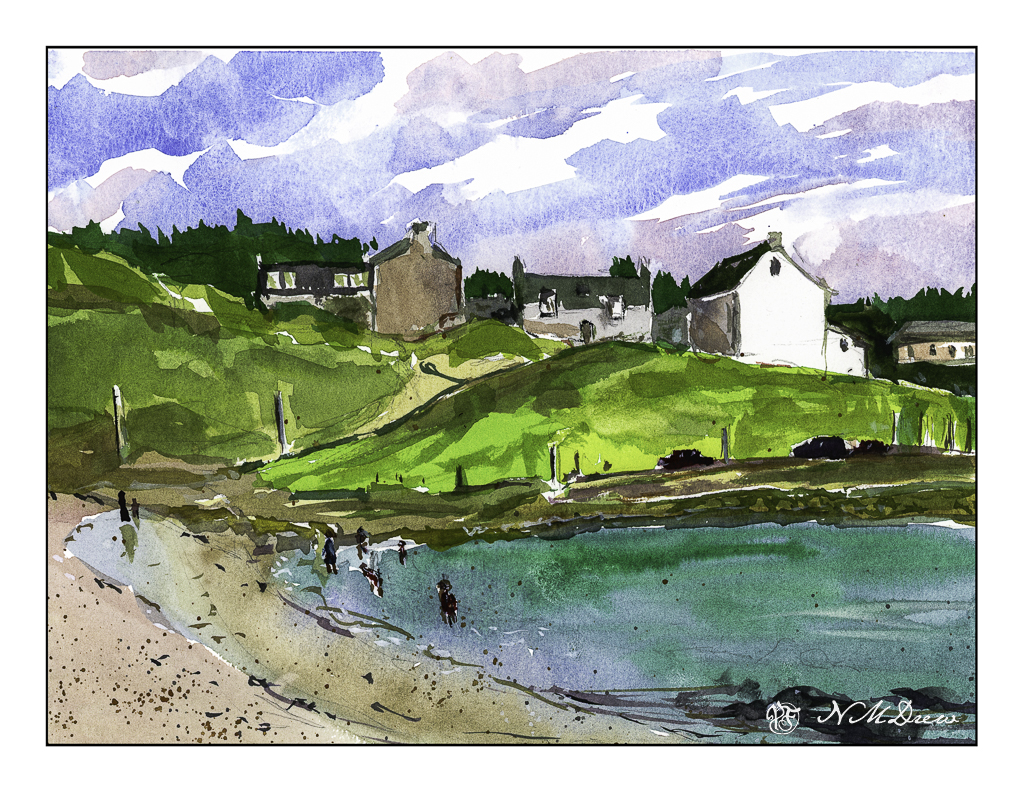
I would say it is pretty obvious which house is white paper, but if you look carefully, you will see the building on the right has some white paper remaining untouched as do some of the windows to the left of the white building. The sky, too, has untouched areas of white for clouds. The large masses of colors also have bits of white here and there. This breaks up things and makes it more interesting to look at. I left white around the bathers, too, but some of them ended up getting soaked – not by the sea but by me and my watercolor brush!
After I did this painting I started thinking about English watercolors. In the 20th century, two famous painters, Edward Wesson and Edward Seago, are well known for their broad areas of color that create detail by shape and form more than a painstaking approach. This works especially well, I think, for landscape, but for urban scenes, it is more difficult. Nonetheless, the lone bright house in the landscape makes for a lovely study. I plan more of these in the not-too-distant future.
Hahnemuhle CP 140# / 300 gsm paper; 9×12.


 Ink, Yarn & Beer