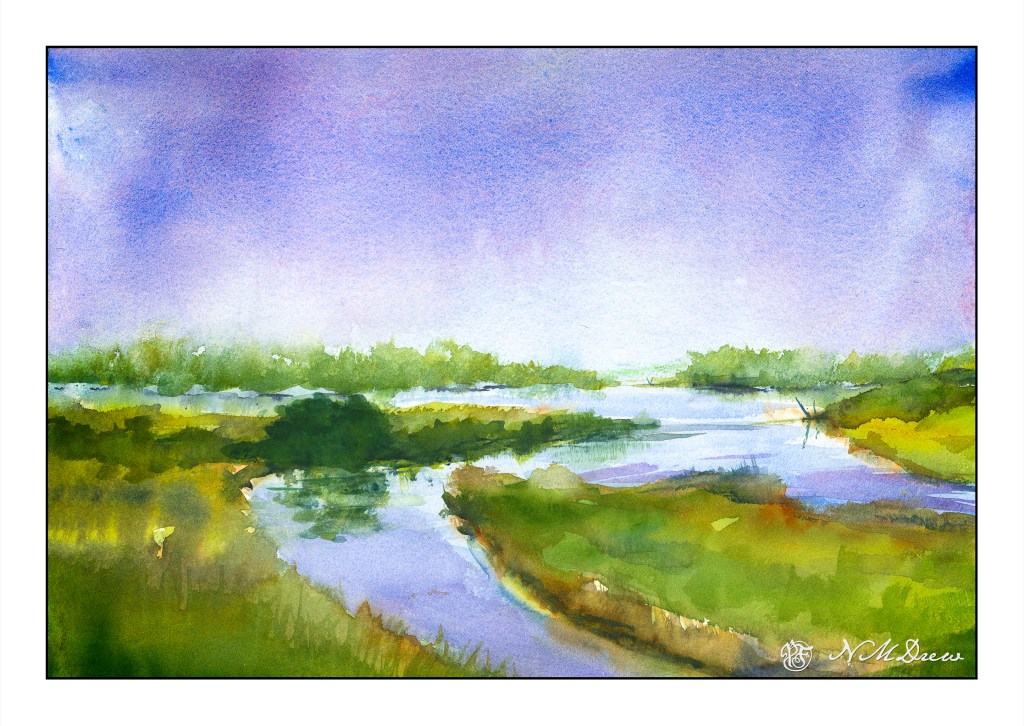
Tribute

This wet-in-wet is drawn from imagination and inspiration by the Dutch watercolorist Edo Hannema. I just love his mastery of water and color and wet paper! There is a peaceful quality to his paintings of the Dutch landscape.

Painting like this demands thought and deliberation and patience. Timing is also critical. Painting wet-in-wet requires risks and experience. Too wet, everything just blurs. Paint wet paint which is wetter than the still damp colors result in blooms which can destroy a painting in now time. The rule is drier paint into wet paint – that on your brush must be drier than the stuff on the paper. Blot your brush if in doubt.

Oops! Just noticed that the horizon is dead center . . . compositional error! And that big green blob is also a mistake – tried to fix it – but since this is time for true confessions, I may as well own up. 😉

This is one of my more successful wet-in-wet paintings. Usually there is a big cauliflower bloom somewhere – sometimes I can hide it, but it feels really good not to have one this time! Remembering the trick of drier onto wetter was a good thing.

For the first time, I am painting on 300# paper. This is Kilimanjaro CP from Cheap Joe’s. With such a heavy paper, lots of water can be used. 140# warps but this stayed virtually flat. I like this paper a lot – certainly will be getting more of it.

An Afternoon’s Study

After spending the last month working small – on 7×10 paper – and using both gouache and regular watercolor, I felt the need for something big and expansive!  This means broad strokes, rapid washes, focusing and thinking ahead at the same time.  That is what I find when I work with really wet watercolors, and much of this study was done with washes bleeding into another.

Not feeling especially original, and totally delighted that Edo Hannema uploaded another tutorial after a few months absence from YouTube, I decided to follow along with his video.

If you are not familiar with Edo Hannema, he is a watercolorist located in Holland. As Holland is a very flat country, he is much influenced by skies and extensive landscape. Water is also a strong element in many of his landscapes.

For me, it is a real pleasure to follow his practice videos, in part because I live in such a dry part of the world! Additionally, he is candid about what he is doing. For instance, if he doesn’t like a bit of his painting, he says it right out loud. As someone who struggles to paint and make my watercolor look good, it is so reassuring to find other painters get as frustrated or annoyed as I do when something doesn’t go the way I want it to. At one point in his video he talks about the tall tree in the left center of the painting. “I hate this!” I can understand that frustration. When the houses nearby don’t go as planned, he tells the viewer to make the best of the situation. That is what you have to do in watercolor.

As you can see, my sky is quite violent compared to his gentle one – I kept getting blooms for some reason, and struggled to get rid of them.  Another element of my own painting was my determination to keep my brushes clean!  World Watercolor Month 2019 really brought that point home to me.  I managed to do it pretty well.

Daily practice takes work.  Tomorrow, I hope to work on gouache color swatches, using whites to create variations in tonality of a given color, as well as working with complementary colors to achieve greys.  That should prove to be an interesting adventure.

A Dutch Landscape – After Edo Hannema

Today was a day of “firsts.”  I decided to paint a big painting for me – 16×20 inches.  I also chose to use a more professional paper than I have been; here, 140# cold press Arches.

I wanted to test out how Arches handles water – lots of water.  Hannema is the master of the wash and wet paper approach.  His current paper is Saunders Waterford, which is different, of course, from Arches.  I think the Arches handled the water really well.  I, on the other hand, still need to master my washes.  Blooms are visible here and there, and I need to learn how to control those or eliminate them if I find them later on.

The palette of colors I used was initially what Hannema used:  ultramarine blue, alizarin crimson, burnt sienna, and raw sienna.  Because I did not like greens I was getting, I threw in some sap green.  If I had used yellow ochre, perhaps my greens would have been more satisfactory – something to make a mental note of to try next time around.

I always learn from a video.  As I have mentioned, water is one thing I am working on, along with buildings.  Today, I wanted to just work with a new paper and a lot of water.  The study was successful altogether methinks.

Below is Edo Hannema’s painting tutorial:

Mists and Blurs

Wetness in watercolor varies.  There are times when a very dry brush on dry paper is necessary to give sharp, clear edges to an object.  Then there is wet-on-dry wherein washes are applied to dry paper with a lot of water.  And finally, wet-in-wet, where wet color is applied to wet paper.  As the paper dries, the color behaves differently.  There is so much to learn in watercolor!

Of late, I have been painting with a lot of water and a lot of color.  It’s a challenge, but daily painting is yielding better results overall.  Not every day, but overall!  Yesterday, I watched a number of videos, and did two studies based on videos by Rick Surowicz and Edo Hannema.

This one is from an early video by Surowicz.  He used some frisket, but my bottle was not working, so I painted without it.  I really needed it as his style is not just wet, but sopping wet!  He uses a fine mist sprayer to scoot paint around.  The result can be quite nice as you build layers of colors on layers of color.  I did this painting on Strathmore 400 paper, a paper I don’t especially like, so I was quite pleased with how it handled all the water.  The palette consisted of three colors – sap green, indanthrene blue, and a bit of Indian red.

Edo Hannema is a master of the wash.  I enjoy using his videos as study guides.  The above painting is my favorite of the two I did yesterday.  The palette was limited to raw sienna, burnt sienna, cobalt blue, ultramarine blue.  The green was a mixture of cobalt and raw sienna.  One thing I really like about Hannema’s videos is he tells you when he thinks he makes a mistake, or needs to fix something in his painting, as well as tips on using colors.  It’s rather like eavesdropping on the artist.

I decided to look at mists and soft edges because the other day Rick Surowicz posted a video about mist rising below a mountain ridge – Overlook:

This was a good video to watch on how to create a mist or fog.  He also has another one called Misty Lake which was the one I used in my above studies:

Edo Hannema is a master at wet-in-wet techniques, which are great for fogs and soft effects.  The horizon of this painting video demonstrates this quite well.  The thing that is especially fun about the video below is the fact he took a painting he did of this scene in the summer and converted it to winter:

I find using practice videos helpful in learning techniques.  They are also helpful in thinking about how I paint versus how I want to paint.  Like many beginners, I put in far too much detail, and my own impatience impairs final results far too often.  Letting the paper dry is important, and I am learning to do that – my hair dryer is hanging within easy reach!  Leaving white paper is getting more “natural” in feeling, so I am thinking ahead as well.

Nowadays, I find I am plotting out paintings in my head.  Daily painting is another big step forward as I now have the time to spend on it without a million other things demanding my time weighing me down with guilt – chores and duties or the pleasures of a hobby.

Wet Work

I read too many spy novels!

So, if this isn’t about the darker sides of life, what is this about?  It is about watercolor painting.  As you may recall, I have been trying to work on my drawing and painting, between other life activities.  While I try to do one or the other daily, it doesn’t happen.  The thing that is happening is a beginning of focusing on various elements of watercolor.  Rather than just paint, I began to focus on retaining white space.  White space in watercolor is the paper itself – that is the only way to get a “true” white when painting, unless you put in white paint, such as a white gouache.  Many people frown on this.  So, retaining white means you paint around white areas, which have to be considered as you lay down color, or using a rubber-based frisket.  The frisket is great as you can paint right across it once it dries.  Both methods have their advantages and disadvantages.

In addition to retaining white space, I have added another focus in my painting.  Watercolor paper is painted on when wet or dry.  Painting wet-on-dry means applying paint to a dry paper.  Wet-in-wet means prewetting the paper, or painting onto paper where a wash is still wet.  Wet-in-dry allows for hard edges.  Wet-in-wet allows the paint to blur and blend, and how much it does this is dependent on the wetness of the paper and the slope of the easel.

The above picture was from a photo I took at the Monterrey Bay Aquarium of jellyfish floating around in their water.  The aquarium is backlit, and the light shines through the diaphanous membranes of the fish.  This was simply ink, followed through with a bit of color.  Drawing the jellyfish was fun – and in the lines of the tentacles, it almost became a dance with the jellyfish.

The jellyfish were drawn with a very fine point pen.  The Joshua Tree was done with a thick, permanent ink pen, about 0.5 in diameter (I think).  Here, the ink was used to create texture, with watercolor being secondary.

This is the point at which watercolor, ink, and white space became a focal point. I think these are a variant of snowbells, and they are found in the shade beneath trees. In such dim light, the white flowers are strikingly in contrast to the mulchy undergrowth, and in photos often are rather flat in appearance. This drawing demonstrates that flatness, but with the whiteness of the flowers preserved.

From the flatness of the line and watercolor drawing, I now worked on creating white in a dark painting. The flowers themselves look very flat because the paint I used to create – try to create – a 3D effect just pooled. The white is now filled with flat paint, which creates a flat picture. Here, the paint was applied wet onto dry paper, and the result is a bunch of hard edges. It is this realization that made me move into working a lot with wet-in-wet.

The pictures above are more attempts at preserving white, and working wet into wet. Probably the most successful one is the painting of the winter sky with the silhouetted tree.  Click on one of the paintings to cycle through the images in a slide show.

From the deliberate paintings I moved to wetting the paper thoroughly with water for the first of the two paintings above – soaking the paper with my brush, painting into the wet paper, and then painting again into the wet paint. The fir trees were more deliberate.  Here I tried to work with white space and with snow, trying to capture ways in which white can be interpreted with paint.  Again, click on one of the paintings to see the slide show.

While doing all these paintings, I started thinking about watercolorists whose work I admire, and who, I know, did wet-in-wet particularly well. Winslow Homer is one of the best watercolorists of the 1800s, and his skies have always appealed to me. The painting above is my rendition of his painting The Palm Tree, Nassau. I changed a few colors and compositional elements, but I used this as an exercise to study how Homer may have painted. He used wet-in-wet on the sky; white space for the waves and tower, and varying techniques for the palm trees and foreground.

Besides trying to understand how an artist created a painting, I also searched YouTube for artists working wet-in-wet. I came across Edo Hannema’s channel and was so impressed! He is a master of wet-in-wet, as well as working with white space. I learned a lot from observing and copying his examples; this painting may be from one of his videos or an interpretation of one I saw online – don’t recall. I think seeing his work, and copying his exercises, has started my being able to move forward. I plan to follow his lessons more in the near future. His paintings have a lovely simplicity as well as demonstrate a finely honed skill in wet-in-wet. He is from Holland, so many of his paintings show very flat land, which for me is fascinating as I live in an area with a lot of hills and mountains and valleys.

Finally, I did this one today. I was up at oh-dark-thirty, having my coffee, and thinking about all the things I have been painting over the past few weeks. It was time to try to paint something that used a lot of wet-in-wet, had a modicum of white space, and finally wet-into-dry, meaning wet paint applied over dried paint. I am pleased with what I have learned, from copying other artists’ works to my own experiments. Everyday is an exciting new adventure, and out of all of my interests and hobbies, watercolor is the biggest pleasure of all.

Below is a gallery of all the above paintings, and a couple of others as well.  Enjoy!