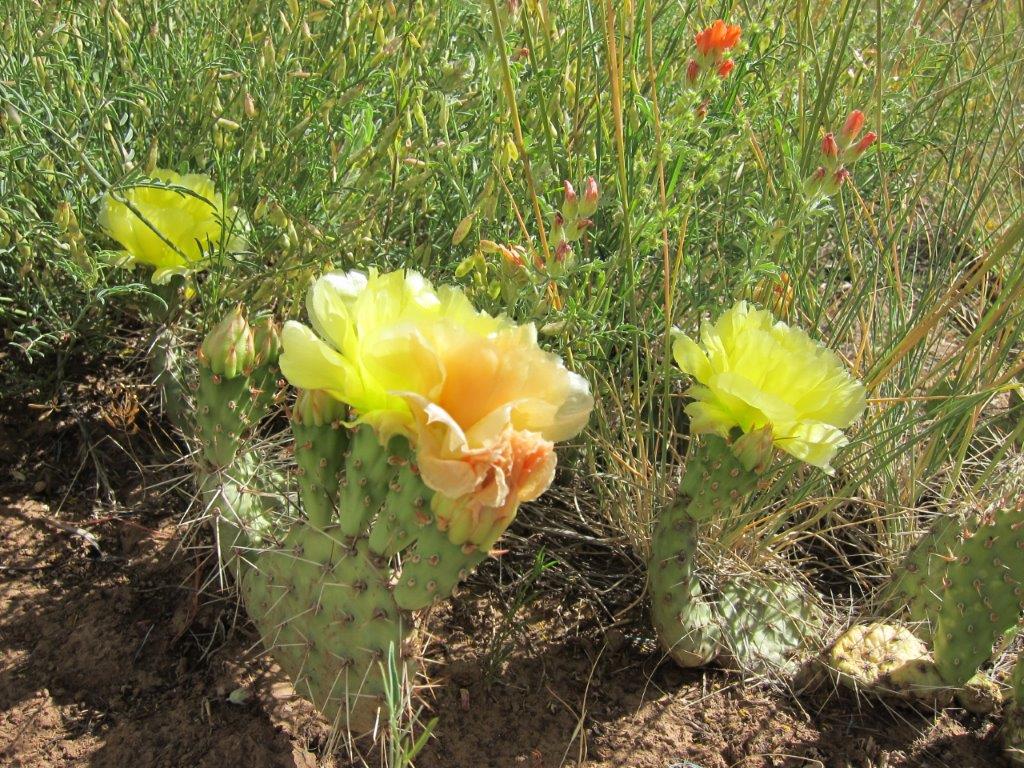
My sister lives outside Durango, CO, on 40 acres of high desert. Scrub oak, cacti, deer, and all sorts of things roam about. Today she sent some photos of the flowers in bloom around her place. Some prickly pears were in bloom, so here is the photo she took.
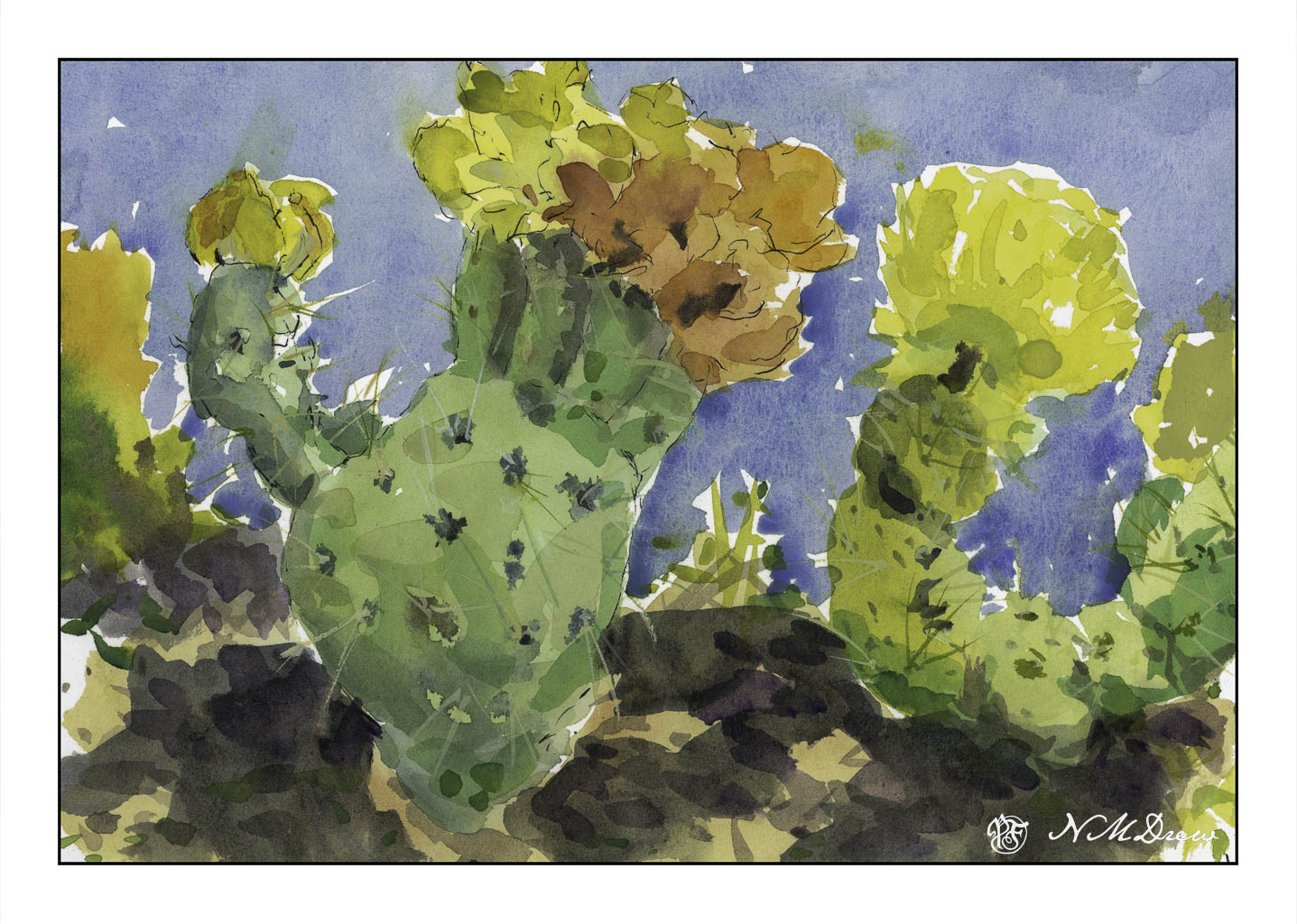
The plants in her area are similar to the ones here in California where we live. There are hillsides covered with prickly pear cacti out here, and as our climate is warmer, they bloom earlier than in Colorado at 8000 feet. This is my painting of her photo.
I outlined the big cactus plant on the left with ink and then painted it. The others I did with direct watercolor. Combining outlines with free form painting is rather fun, and a good way to continue practicing. I think the outlines made for a more successful cactus but not having outlines also makes it very important to look at shape and value. Practicing both in the same painting is rather an interesting process.
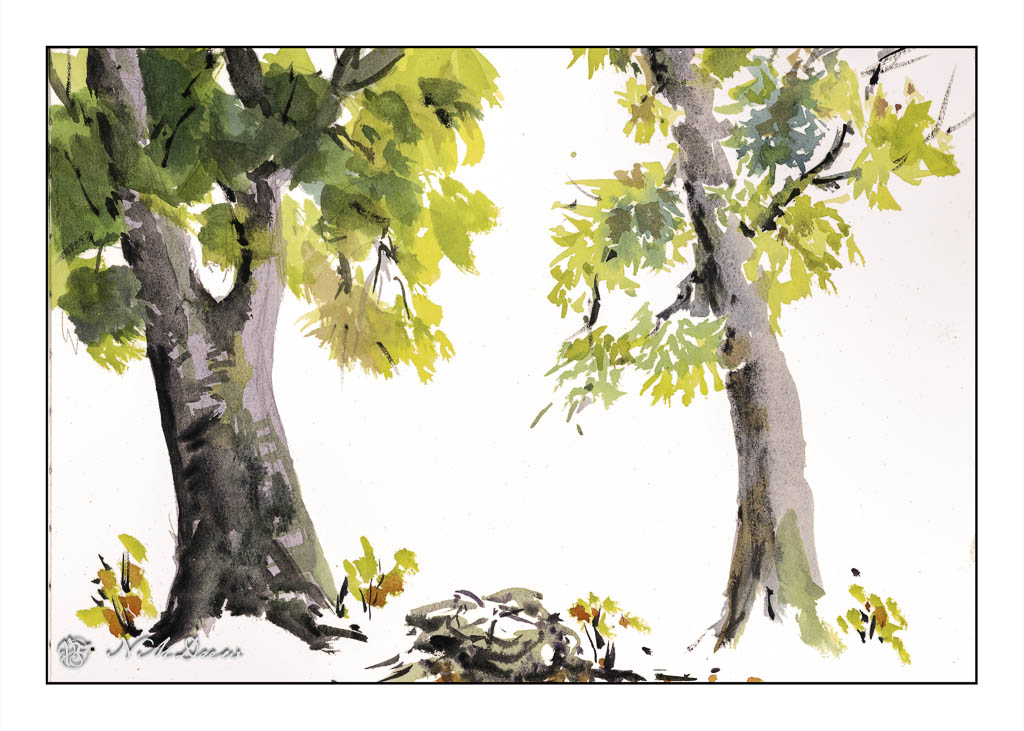
I am trying out different ways to paint plein air in my back yard, which is nothing of any beauty being just dirt and podocarpus trees (also called plum pines). It is going to cost an arm and a leg and a first born child to get it done the way I want, but such is life. In the meantime, use it to my advantage – like lots of container plants!
Anyway, I set up a plein air easel on a tripod I just bought for $20.00 and it did a good job. I clipped my large sketch book to the easel and put a lightweight travel watercolor palette on it. I sat on my travel stool. These details are for a future post.
I painted one podocarpus tree with outlines and more traditional ways of applying color in layers; that is the one on the left. The one on the right is direct watercolor. In the middle is a stump in direct watercolor and a few sketchy little camphor tree shoots from the root system still in the dirt.
I painted both trees to practice both ways of painting as well as to check out the plein air set up. With the tripod low to the ground, I could put water and such on the ground next to me. The plein air palette and sketchbook were propped up on the easel attached to the camera tripod. I sat on my stool. Everything was fairly comfortable, within reach and easy to get. The height was good. I think I might not want to sit down for a long time while painting, but it is something I want to experience.
So, though the painting subject is podocarpus trees, the real focus for painting was the plein air set up. It worked pretty good. I have another easel to use, and I think I am beginning to get a nice set up for my future career as an old lady painter in the countryside or patio, depending . . . .
Watercolor is wet. It needs to dry. In a studio setting or classroom, a lot of people use hair dryers. You see it on videos all the time – brrrrrrr! But, outdoors, unless you have an outlet and a long extension cord, and want to annoy yourself, you just sit and wait for air and evaporation to get to work.
In Saguaro Land
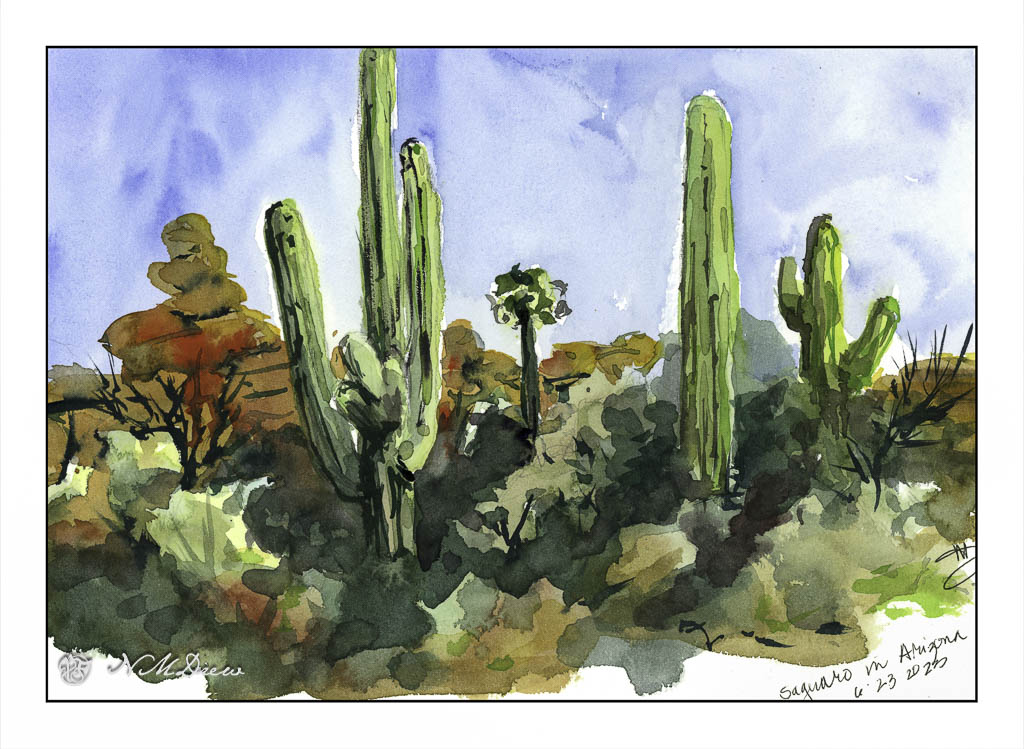
I opened up my big sketchbook – each page is about 9×12 inches – and it was a spread across the two sheets. Above, a more traditionally done sketchy watercolor. I did a basic pencil drawing and then applied color.
Last month we drove from north of Los Angeles out to Tucson for our Global Entry interviews. En route we drove through portions of the southwest I have not yet seen, driving east from San Diego along Hwy 8, at times just north of the Mexican border. The land was sparse and beautiful in a fierce way, and before we reached Tucson we drove through the Sonoran Desert, home of the mighty saguaro cactus.
What can I say? They are tall and strange, reaching upwards to 40 feet, with arms and branches against mountains and skies filled with drama. It was beautiful. As we were on a long drive – 8.5 hours – we didn’t stop. I took a bunch of lousy pictures out of the window, and these are the basis for the above painting. An impression, not a reality, although you know these are saguaro if you have ever seen one.
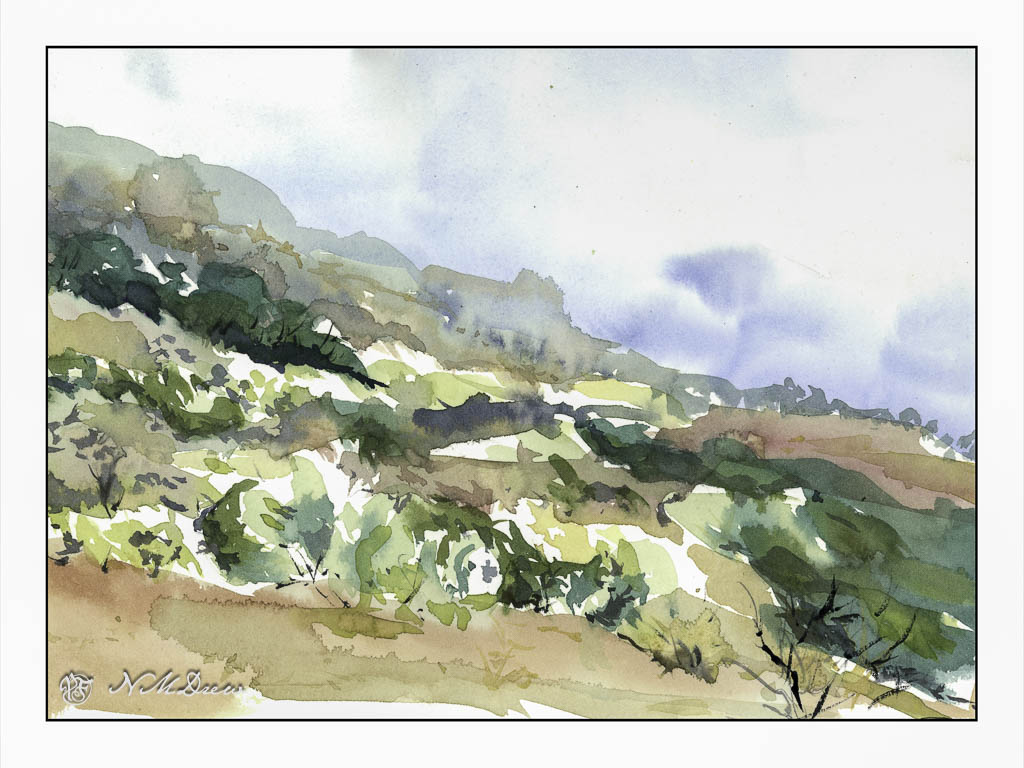
This painting had to be painted in stages, so my thoughts were what to do while waiting? I decided to do some direct watercolor and use a photo I had taken of the local landscape.
Below Mount Clef in Wildwood Park
Direct watercolor has no lines, and I have found it a wonderfully fresh way to see the world and to paint. It is also a challenge not to make mud, not to get carried away, and to think strategically. For me, the real challenges are negative painting and values. Because I am making sketches in a sketchbook and not something “serious” on a sheet of expensive paper, the direct watercolor and the more traditional studies are gaining traction.
I am learning a thing or two in my old age, and there is something to be said for that. Today’s painting was very satisfying. I spent it outside at the picnic table, a few supplies, a dog at my feet, and a kicked-back-who-gives-a-damn approach. And, I don’t think either of these paintings is half bad.
This past week has been spent sewing, learning software, socializing, keeping appointments, and going to Santa Monica via the canyons. Fun stuff. Today, though, the urge to paint came upon me – it really is part of my identity, for better or worse.
For some reason I am obsessed with boats of late – trying to get their shapes and such. I figured a dinghy on water, reflections and all, would be a good place to begin. Boat shapes are hard in some way, but if you create a series of rectangles, the curves and such are easy to create. I drew this one in my watercolor sketchbook, and there were a lot of pencil marks. In the end I needed a bit of definition, so added blackish paint lines here and there.
My sister asked me if I ever paint from real life or outdoors. Seldom will I do either, but I have been doing my garden plants, so I decided to do my podocarpus trees along the back wall, and added some imaginary grass to replace the dirt and roots. (I need to cut these all done, have the yard dug out, and then re-landscape. What’s a couple of million bucks?)
After these, drawn ahead with pencil on the paper, I decided to work on what is referred to as “direct watercolor” – a phrase invented by Marc Taro Holmes. This is when you paint directly on the paper – no prelim drawing, no pencil lines. You put pigment on paper and off you go.
The first subject is the large grouping of banana and palm trees across the street from me. I wanted to catch the light, so I began with the beige of the banana plants, and then began creating shapes with negative painting and then adding more colors and so on. The negative painting is easier to do with direct watercolor, I think.
And finally, more of the orange lilies I have. This time I included the pot! I began this painting with the pale beige of the wall, creating leaf shapes by negative painting. I wanted to catch the light and sparkle on these complex plants. They are lighter at the top, and get darker as you move down and to the left. The patio is covered with light and shadow from the sun through the leaves of the overhead trees.
Nothing spectacular, but a good way to spend some time outdoors, seated at the picnic table, and playing around.
I’ve been playing with gouache of late, but really have missed watercolor and its transparency. Yesterday I thought I would sit down to do some painting, but it never happened. Today, out on the patio reading a book, I looked around at all the plants, and realized, duh! There is a lot to play with out here!
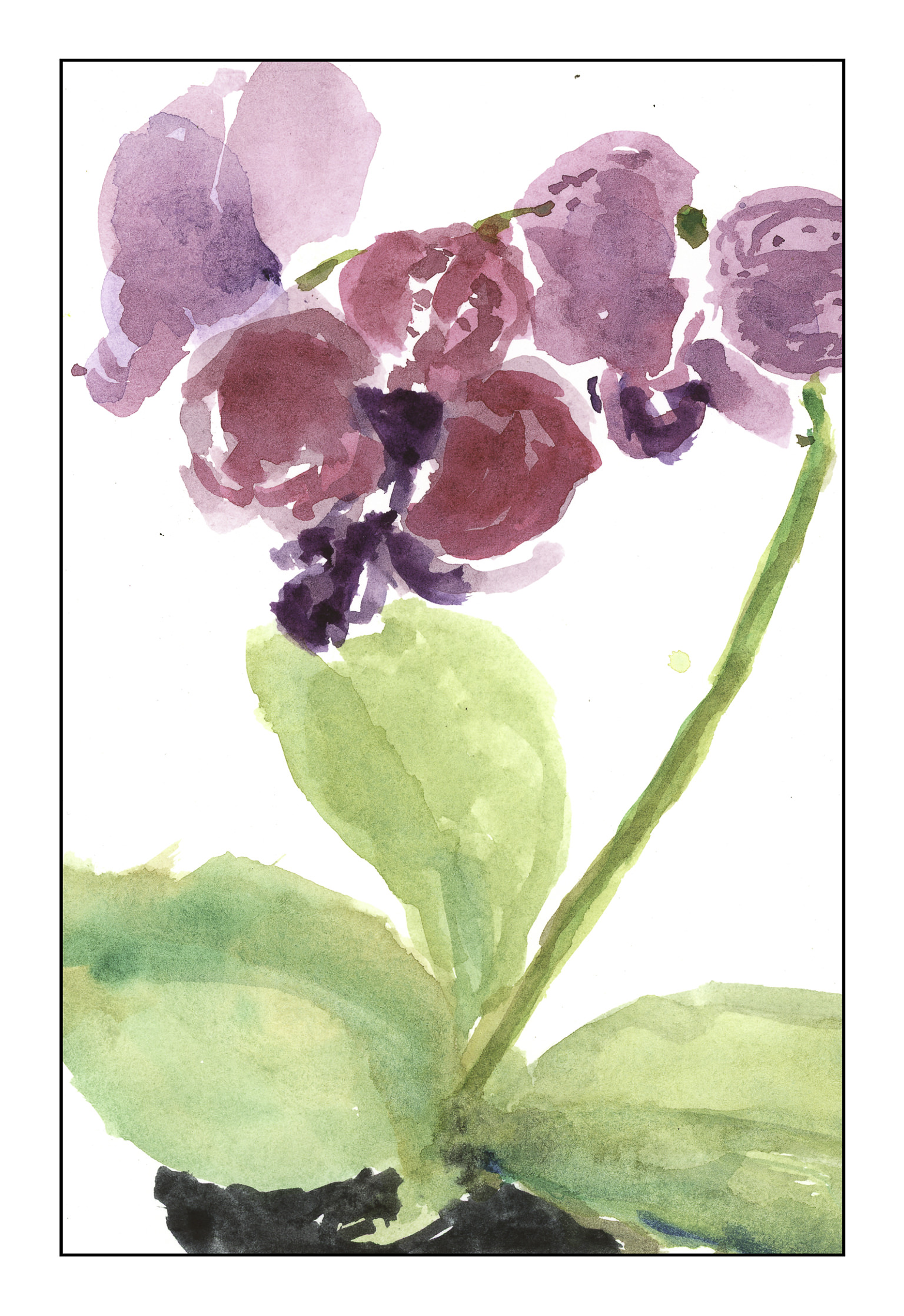
I’d moved all my orchids outside to water and air out a bit. This is the last of the blooming phalenopsis, so I painted it – no pencil or preliminary value studies – just direct watercolor and let it happen. I can tell by the awkward handling of the paint I am out of practice; as well, the paper is not the best, but that is what sketch books are for.
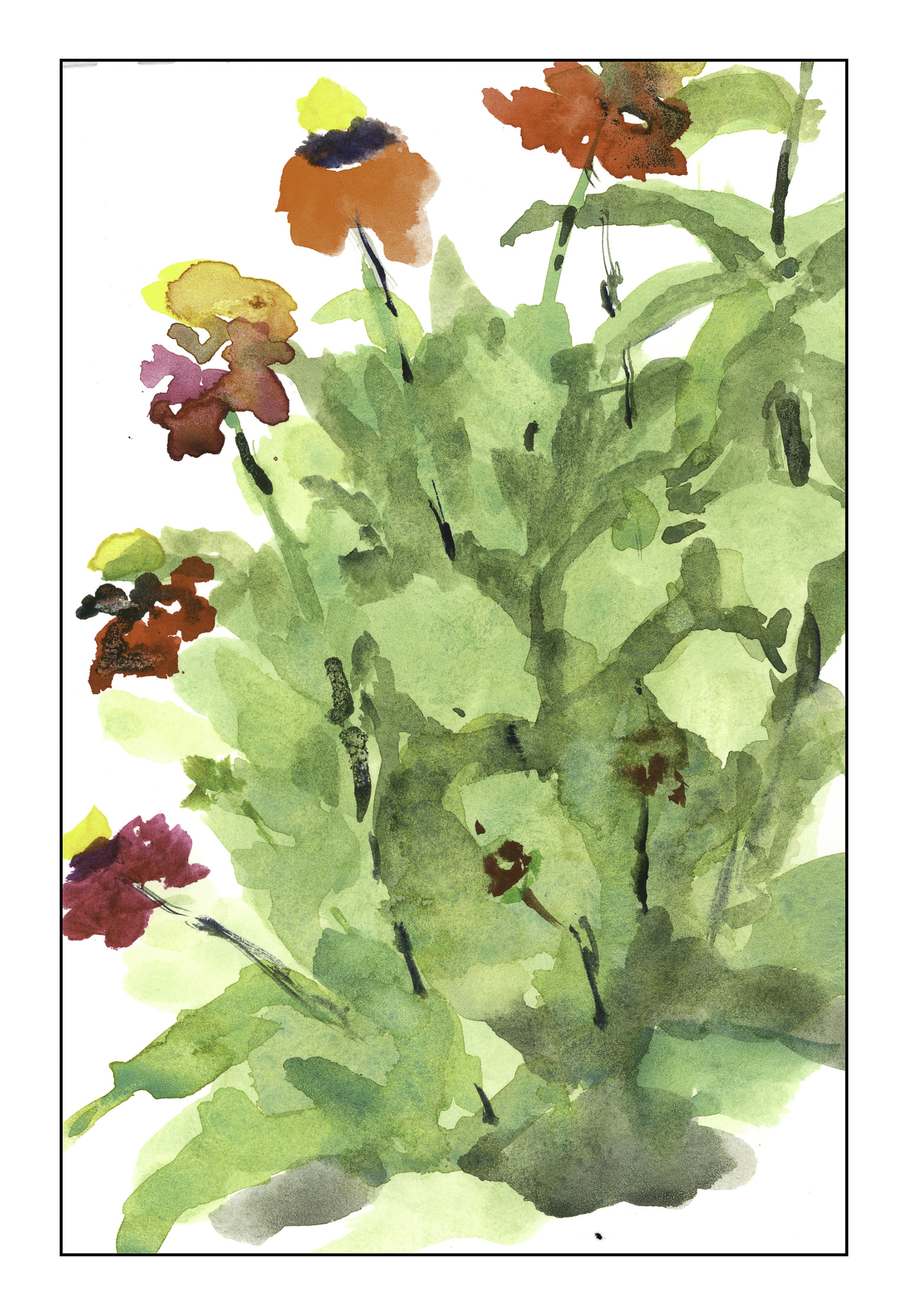
About 6 weeks ago I took all my old and new flower seeds and planted them helter-skelter. These are zinnias, plants which are notorious for wilting with not enough water – like in a couple of hours they can look like they will just fall over – but come back miraculously with a bit of help. Totally crack me up – such simple flowers to be so demanding. Kind of nervy. Anyway, what I like about them is that they have beautifully shaped leaves, lovely stems, and smallish bright flowers that burst out of all the green surrounding them. Here, a bit better handling, with a use of negative painting to create the leaves and perhaps a bit of dimension.
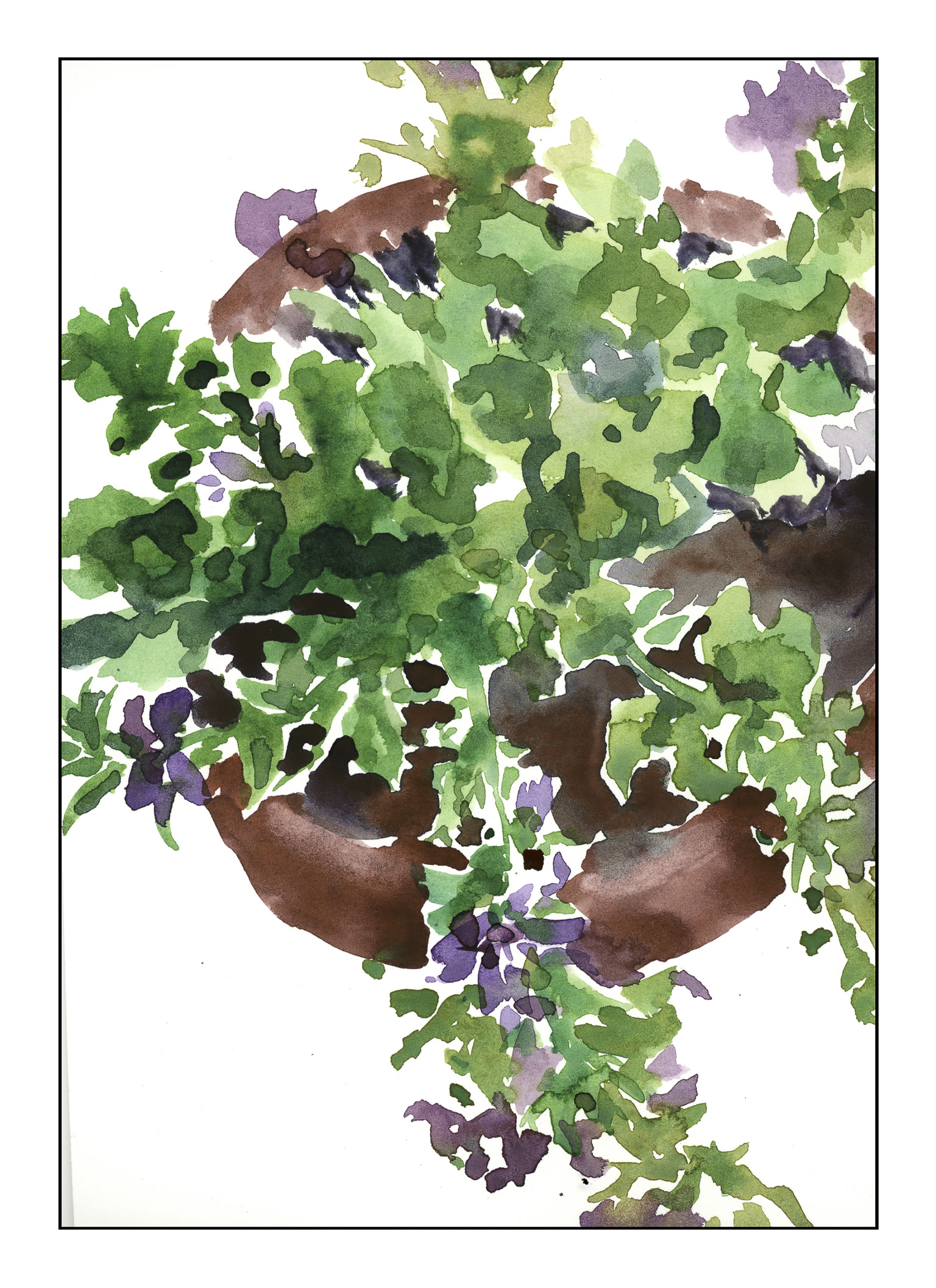
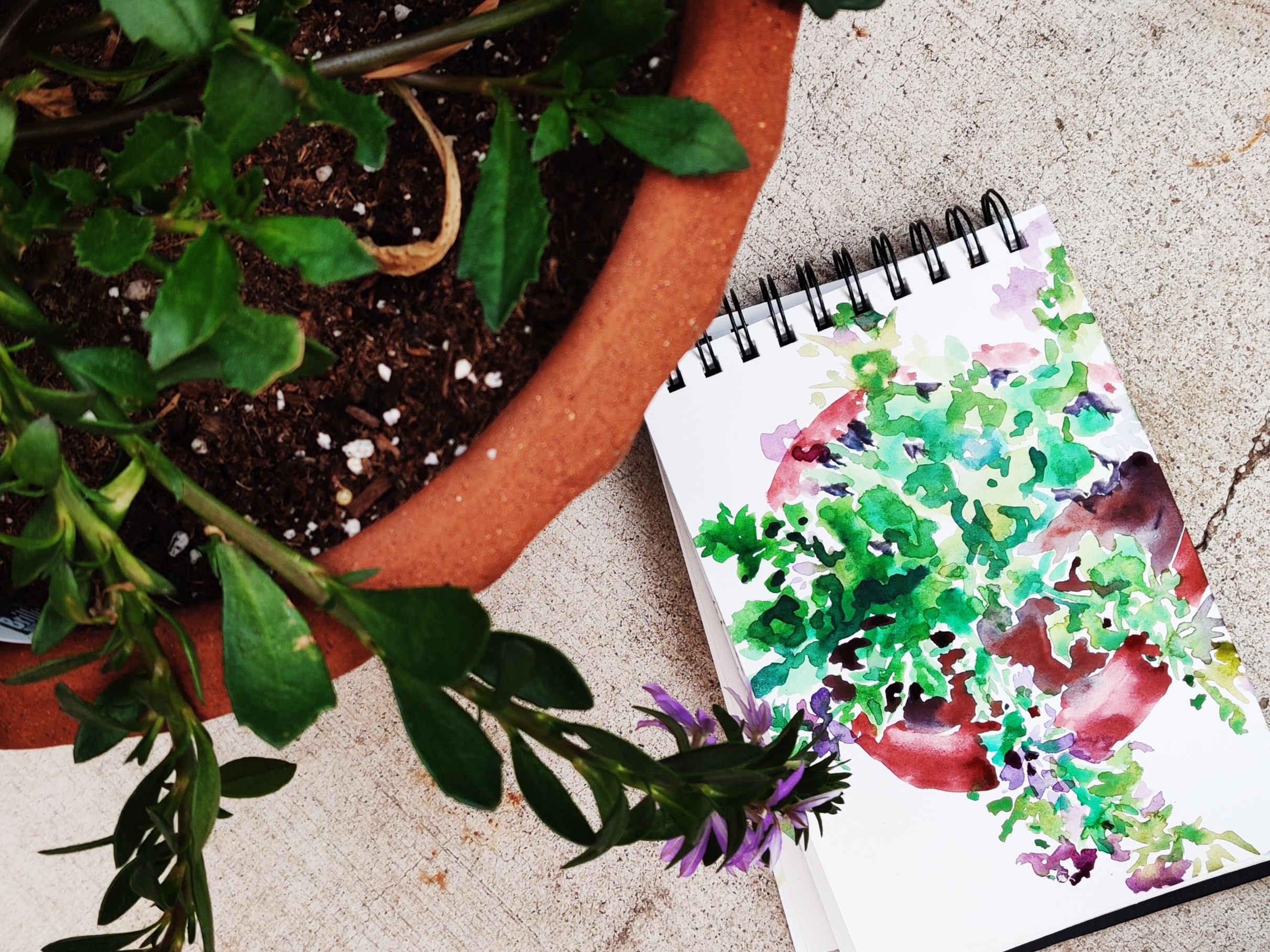
Finally, my favorite of the bunch. Brush control and forethought. Here I was perched on a rather tall chair, looking down onto the pot of scaveola, a sort of creeper from what I can observe. It has a variety of leaf shapes, and the purple flowers sort of send out petals from behind the leaves in a peek-a-boo fashion. I took a photo of this for Instagram, but you can also see the photo below of plant and sketch, taken with my phone.



 Ink, Yarn & Beer