North Coast

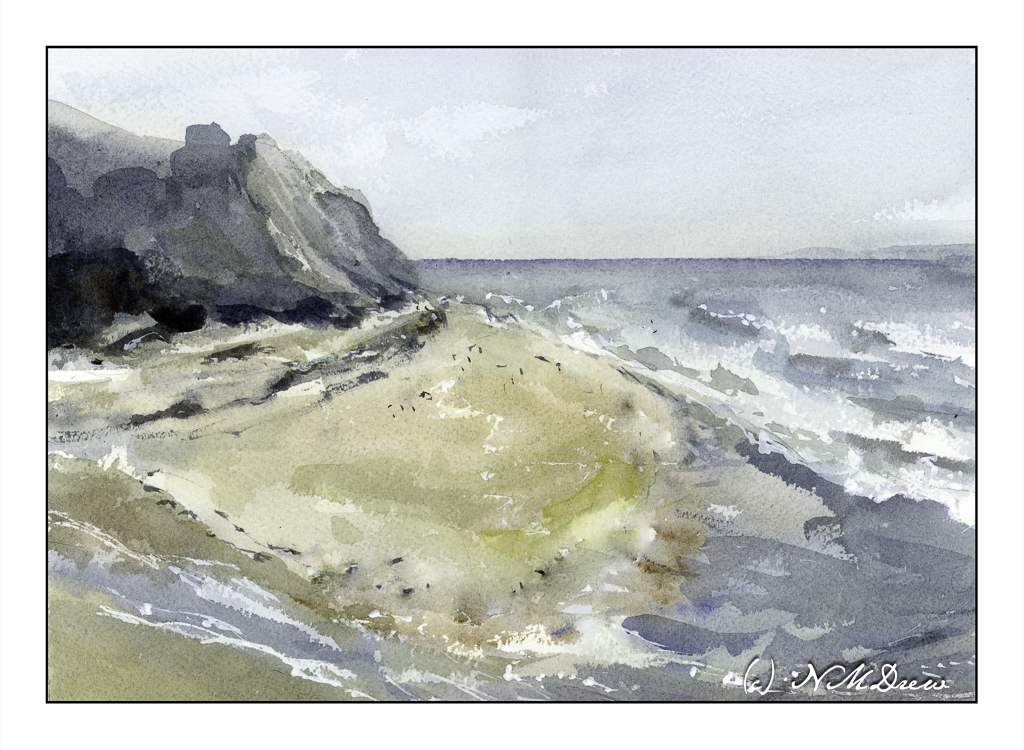
Once more – should I put something in or take it out!?!? The original of this painting, along the northern coast of California, is originally painted with a small island offshore. Looking at it I didn’t like it – perhaps too close to the tree on the left overhanging the beach. Thanks to Photoshop, I removed it.
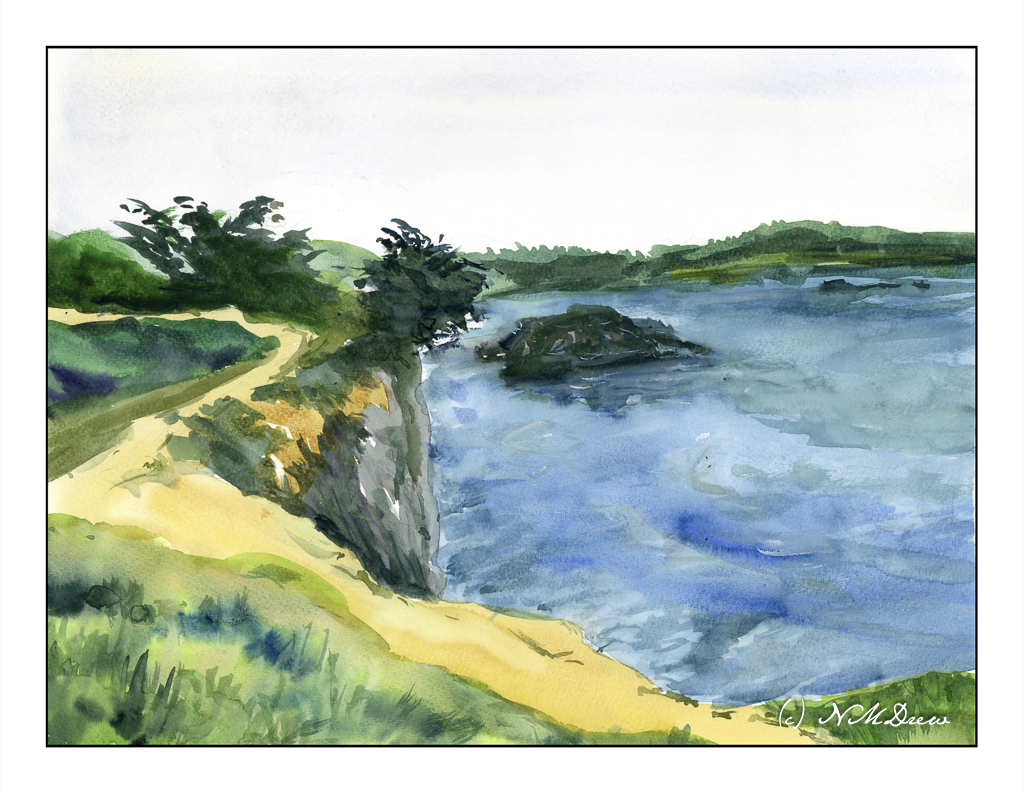
The above painting is the one that exists in the real world. The one below is the one edited with Photoshop’s “generative fill” – poof! No island.

Because I am feeling kind of spartan these days, sometimes I think I have too much in a painting. Maybe it goes along with limiting my palette of colors?

And my palette? A bit more expansive than the previous, but the subject matter seemed to need a bit. I used umbers, sienna, ochre, Indian yellow, phthalo blue, a touch of ultramarine, a bit of dioxazine purple, and Hooker’s green.

My technique was to use oodles of water as I wanted to see how well the Bockingford non-cotton paper would hold up. It did quite well! Every large area – sky, ocean, land above the cliff – was wet with clean water, and then painted with the colors. The sky had one wash, but the ocean had multiple wet washes. The land in foreground and distance had a big wash later accented with dry on wet.

I am also pleased with this painting, even with my thoughts about the island.

St. Cuthberts Mill, Bockingford 140# CP, 12×16.

And what are your thoughts – island or no island?
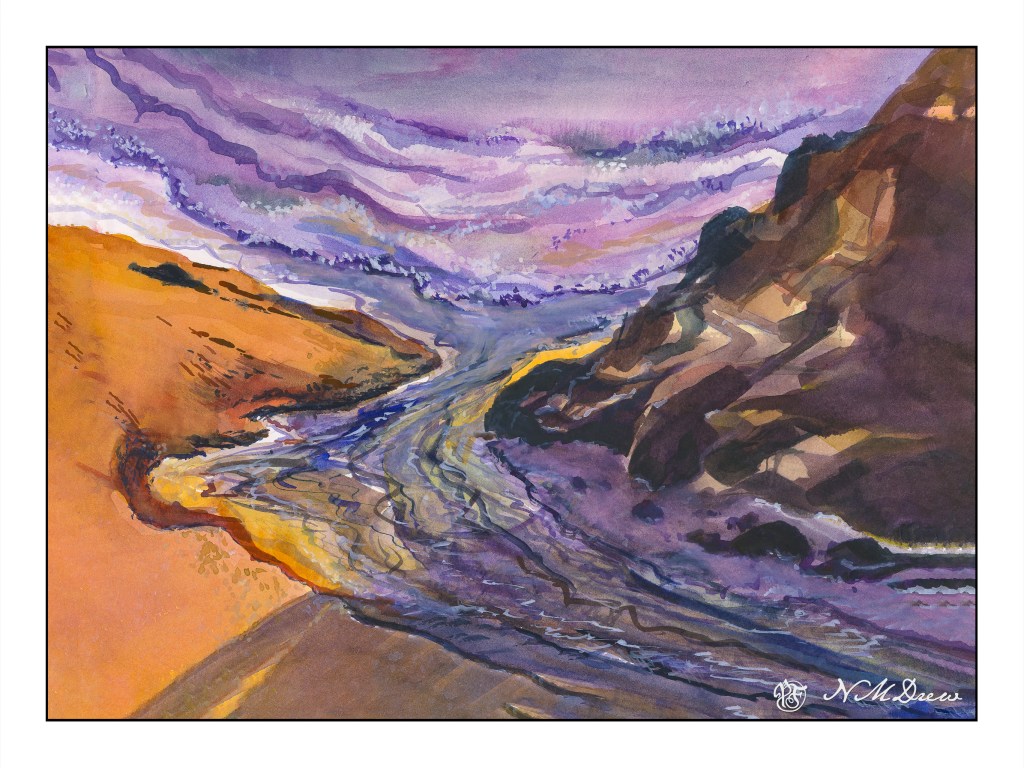
Outgoing Tide

After considering the intensity of colors of my last posted painting, I thought about trying something a bit more subtle. In landscapes that usually means fog and damp – and that can be a challenge in itself. Muted colors, subtle gradations, diffused light, soft edges – with watercolor, a lot is chance and a lot is forethought, and a lot is knowledge acquired by experience. I see each watercolor painting as an experiment and adventure and while sometimes things “just happen” or I am too impatient, a bit of thinking ahead doesn’t hurt.

Here, a pretty limited palette of indanthrene blue,ultramarine blue, yellow ochre, burnt umber, and perhaps a dab of this or that. I use carbazole violet often when I make deep darks, sometimes a bit of ivory black to neutralize a color a bit. Here, I also used a bit of liquid frisket to keep some areas of paper white, such as in the water and along the shore. Titanium white gouache also was applied intermittently for a bit of bright white.

Watercolor, 10×14, Arches Rough 140#.

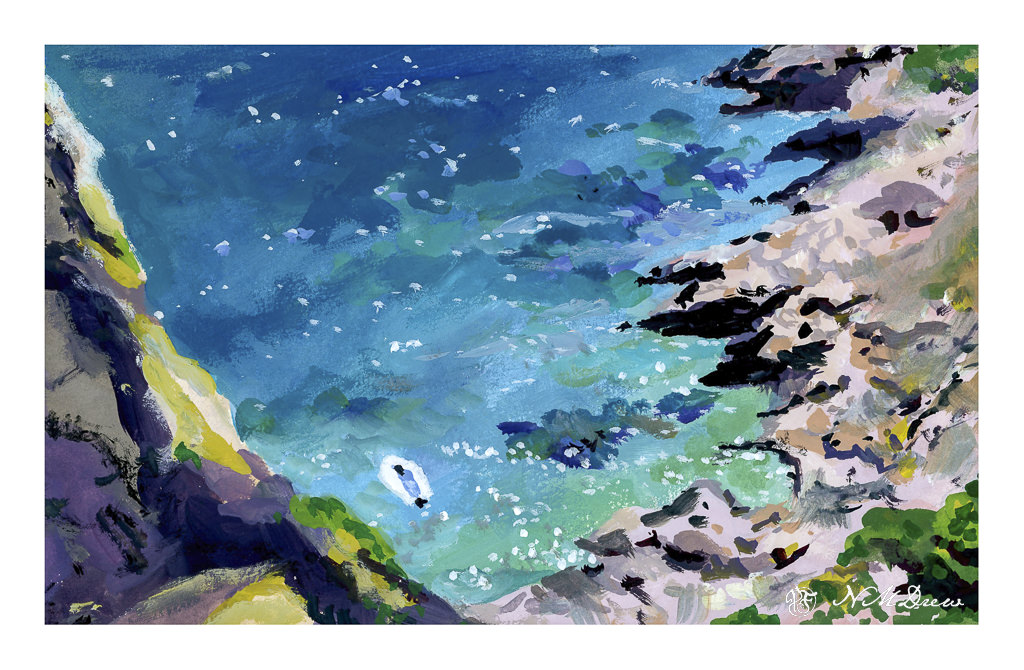
1. The Cove Below

Siena Blue did a series of 30 gouache studies – and she/he did a beautiful job! Inspired, I have decided to do a series of gouache paintings over the next several days, but I am not setting myself a goal as to how many. Gouache can be returned to easily enough as the paint re-wets quite well. As I have not worked in gouache lately and my life is going to be rather crazy over the next few weeks, it seems like the perfect medium for playtime.

So, a view looking over the edge of a cliff (I assume) taken somewhere on Capri – thus states the Pixabay description. As it is now summer, a rocky coastline, and a moored sailboat on a turquoise sea is quite a pleasant thought!

When I first began exploring gouache I found the work of Lena Rivo, observed her YouTube videos and took her short course. Both really helped me get a sense of how gouache works – it’s not watercolor nor oil or acrylic – and has an odd opacity that takes some getting used to – the colors are unique in many ways as there is a lot of white filler in the colors. Good quality gouache paints are opaque and cover well. All of my colors here are the same Lena Rivo uses, made by Holbein.

Gouache, about 8×10.

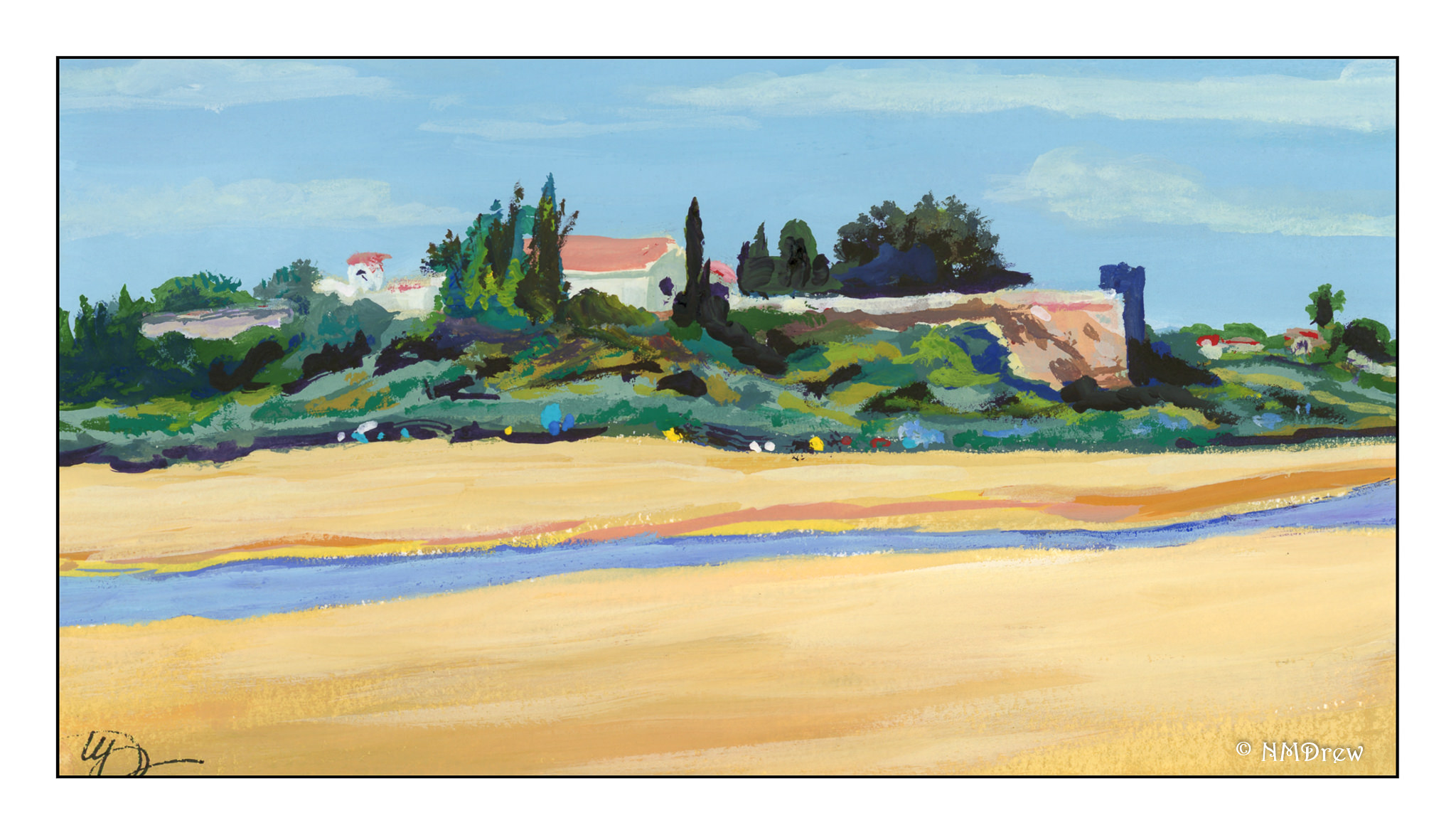
Estuary


This is a pretty small painting – but most gouache paintings are as the medium almost seems to demand it.  After the disastrous flowers of the other day, the feeling of overworking my paints, I decided to simplify.  Yesterday’s beach scene is a good example of simplification.  And today is a bit more complex of a painting, but it is still simplified.

To simplify things, I looked at the big areas.  This meant the sand in the foreground, the sky, and the masses which make up the middle ground, both light and dark.  Those were laid in first.  From there, more details in a middle stage, and final details – the small stuff – were done.  This also matched the brushes I used – big to medium to small.  “The Three Bears” and the Goldilocks effect.

I also was a lot calmer when I did this painting, and I was in the studio, not in 85F weather with a steady breeze to dry out my paints and raise my temper!  Lesson learned there.