Estuary

Estuaries are important connections between rivers and fresh water to the sea. The land may be marshy, the water brackish, and adapt to the influx of waves and sea water and the outward movement of fresh water. Consequently, the estuary provides high levels of nutrients in both the water and the sediment, creating highly productive habitats. Plants, animals, birds, fish, and all sorts of life thrive in the estuaries.

Additionally, the estuaries form a protective barrier between land and sea, but with the loss of estuaries, the damage from the sea increases. A good example of this is in areas where hurricanes and other fierce storms sweep inland, causing great damage – estuaries can survive such storms and recover, but further inland where the land and water are not adapted for saltwater, valuable land may be lost.
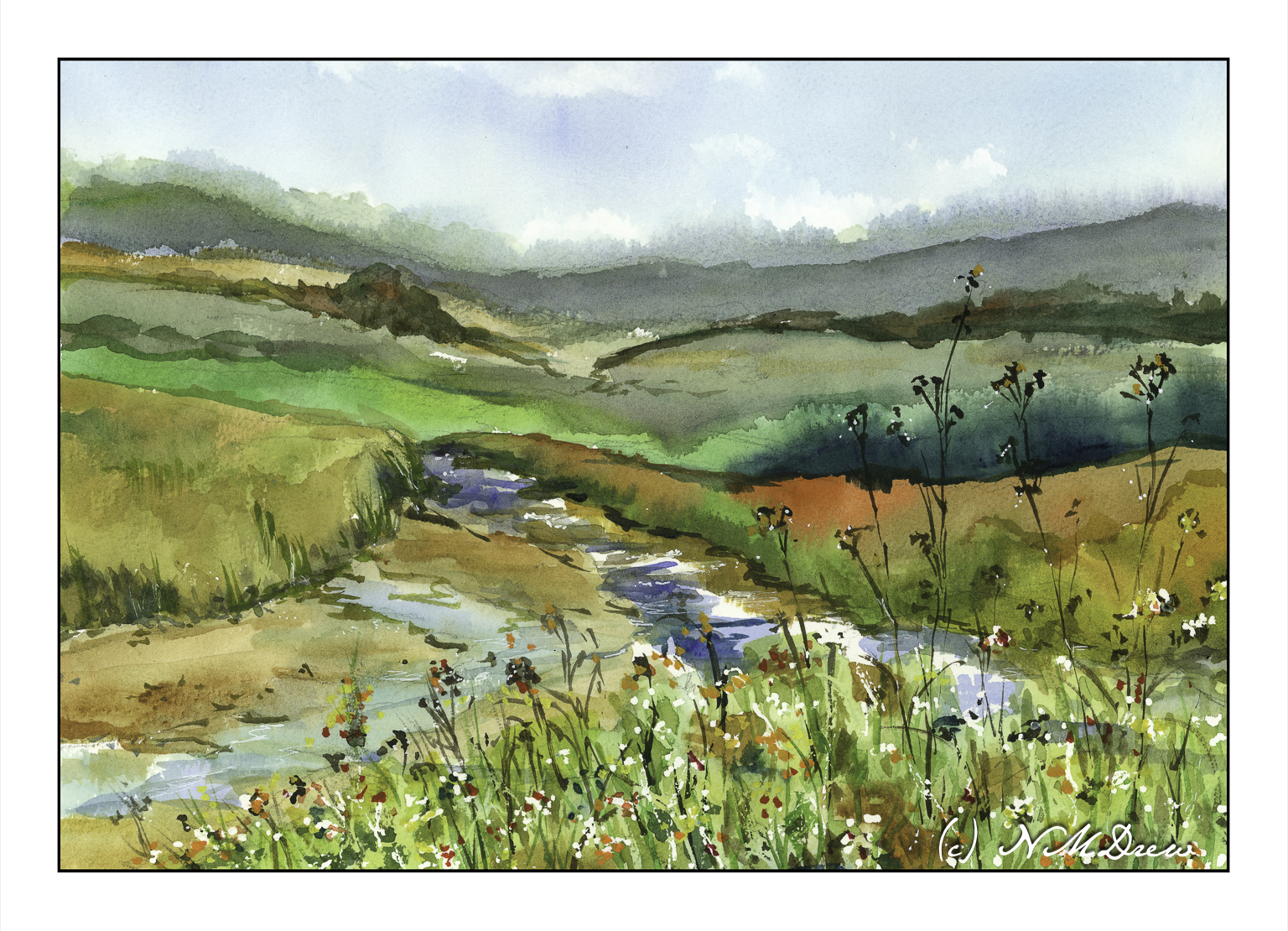
Estuaries are found worldwide. In northern California, the Pescadero Marsh Natural Preserve is found near San Francisco, and offers a wonderful environment for hiking and observing birds and plants. Currently, many trails are closed, but the visit to Pescadero State Beach is beautiful, as are many of the beaches found the length of the coast of California.

And, if you didn’t know, all beaches are public in California, so even if someone’s house fronts the shoreline, the beach is there for all. There may be a couple of exceptions to this law, but by and large, no one can tell you that you cannot walk along the shore.

Watercolor, Arches Rough 140#, 12×16.
North Coast

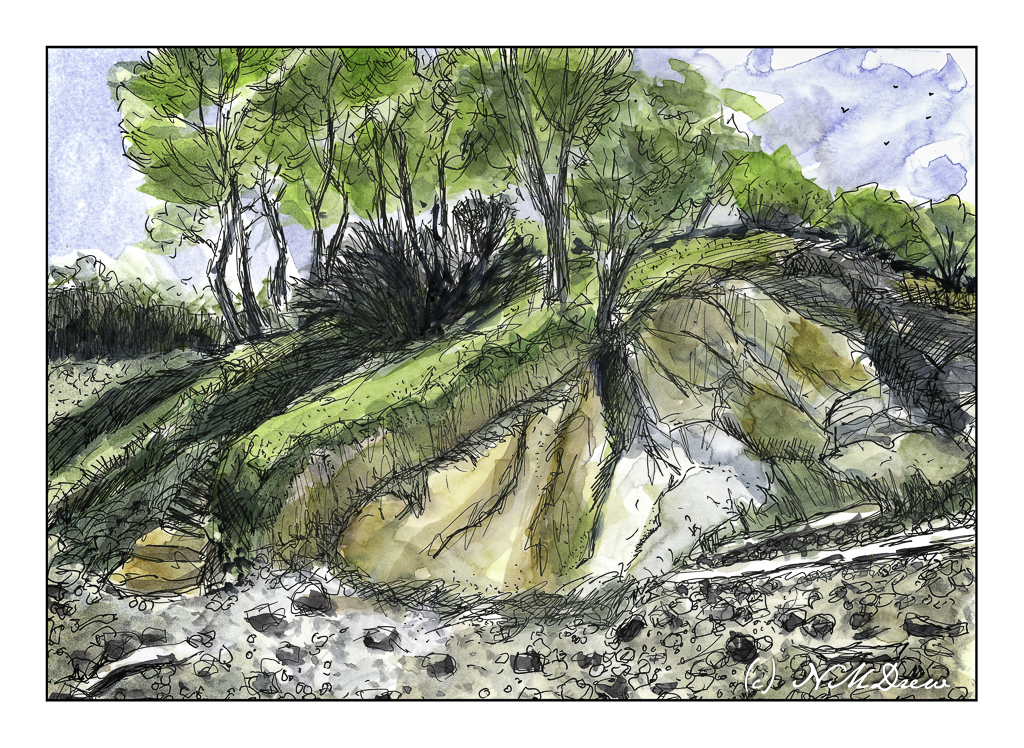
Rocky coastlines are always fascinating because the first time I ever saw the ocean was along a wide, sandy beach with gentle waves. Not so here! You can see the debris – fallen trees stripped to bare logs, rocks, erosion. You can only imagine what it is like during a storm.

Years ago, we drove up the California coast, heading into Oregon and points north. It seems once you hit the central coast, about 100 miles from where we are, the coastline begins to change. Highway 1 leads into Big Sur, that fabled and beautiful land, and it is here you see rugged cliffs. Then, north of San Francisco, you move into the wide beach sands of Stinson Beach and move further along to the rugged Mendocino coast and then beyond. This picture is based on a photo I took there years ago – no idea where we were, but it was stunning.

Ink, watercolor, bristol paper.

Incoming Storm – Mt. Tamalpais

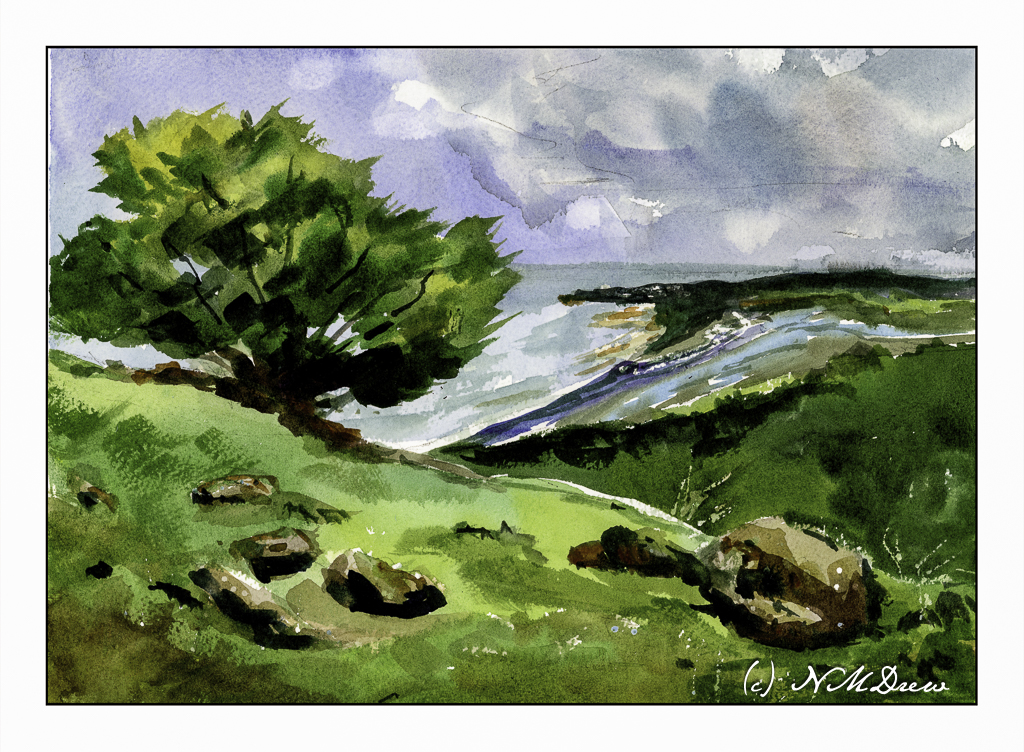
I do love the views and hills of Mt. Tamalpais year round! The views are amazing, the ocean not too far away, and the sky and weather always different throughout the seasons.

The sky in this painting was sort of an area to play with. Sky in watercolor is done with as soon as you lay it down. For the most part, that is!

Painting a sky is usually thought about and then laid in with a fair amount of water and color, avoiding areas for clouds, letting colors bleed, and all sorts of tricks such as blotting up color with cotton or tissue to make clouds. It’s a lot of fun! Here, I did go back in and lift some paint in the right side of the sky, re-wet it, and then laid in more color. It is okay but did not really work. Still, I did salvage it more to my liking.

Next, the foreground. I like my tree and grasses and rocks. The mid-ground with the trees is also to my liking. The land between the mid-ground and the horizon is too colorful and too bright – it should be a bit lighter and perhaps a bit more neutral.

Overall, I am fairly pleased with the results here. I tried to work as directly with color and water as possible. I used a bit of frisket in the rocks and in the foreground to maintain a bit of white.

As I said above, I try to paint with my colors very directly. This means mixing up large puddles of color and painting from that puddle, adding other colors as I move along with my wash to create variety. It requires a bit of thought as well as knowing what colors work together and so on. I mix these colors on my palette often before applying any to the paper.

Many people lay down glazes and work with layers in their watercolors, but I find that, while pretty, those methods of painting create a rather tame look. A lack of freshness is the only way I can describe it. On the other hand, my approach is quite challenging as I don’t build up colors but try to work with thick, rich colors and pray a lot. As a result, my watercolors tend to by quite gaudy, I think!!

Watercolor, Arches 140# Rough, 11×14.

A Palm Tree, ii

After my satisfaction with yesterday’s watercolor and my ongoing interest in palm trees, I thought about a couple of things. First, I need to get over my fear of buildings. Second, I need to paint more palm trees! So, I decided to use a photo I took awhile ago and posted here to use as subject matter. Below is the original photo which was taken at the Santa Barbara Zoo, near the condors (I think). The zoo itself is a wonderful resource and is always undergoing change and development. I’ve been going there for decades and always like it as it is large enough for a good visit and small enough so you don’t have to move in for a few days!

A Palm Tree

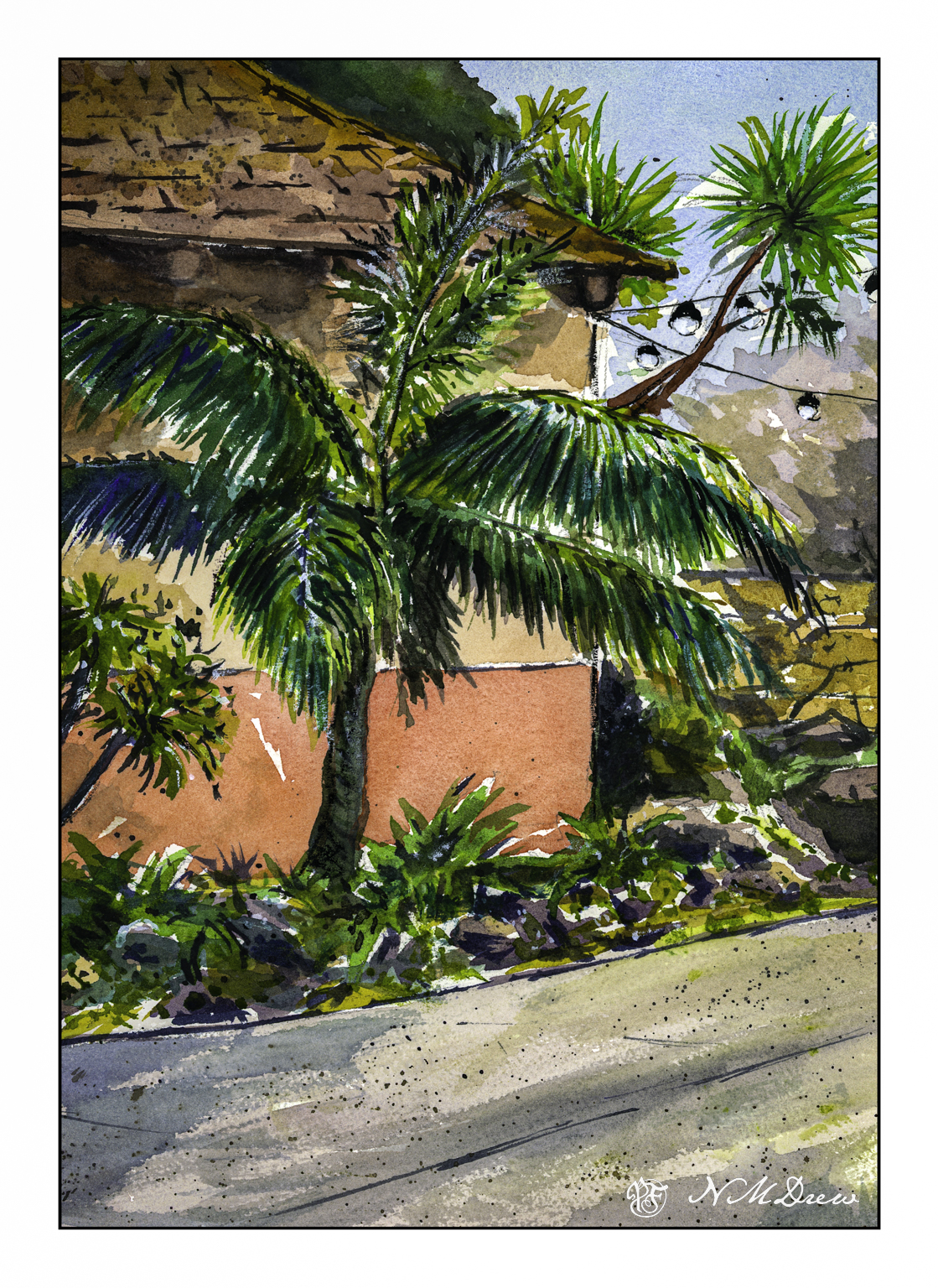
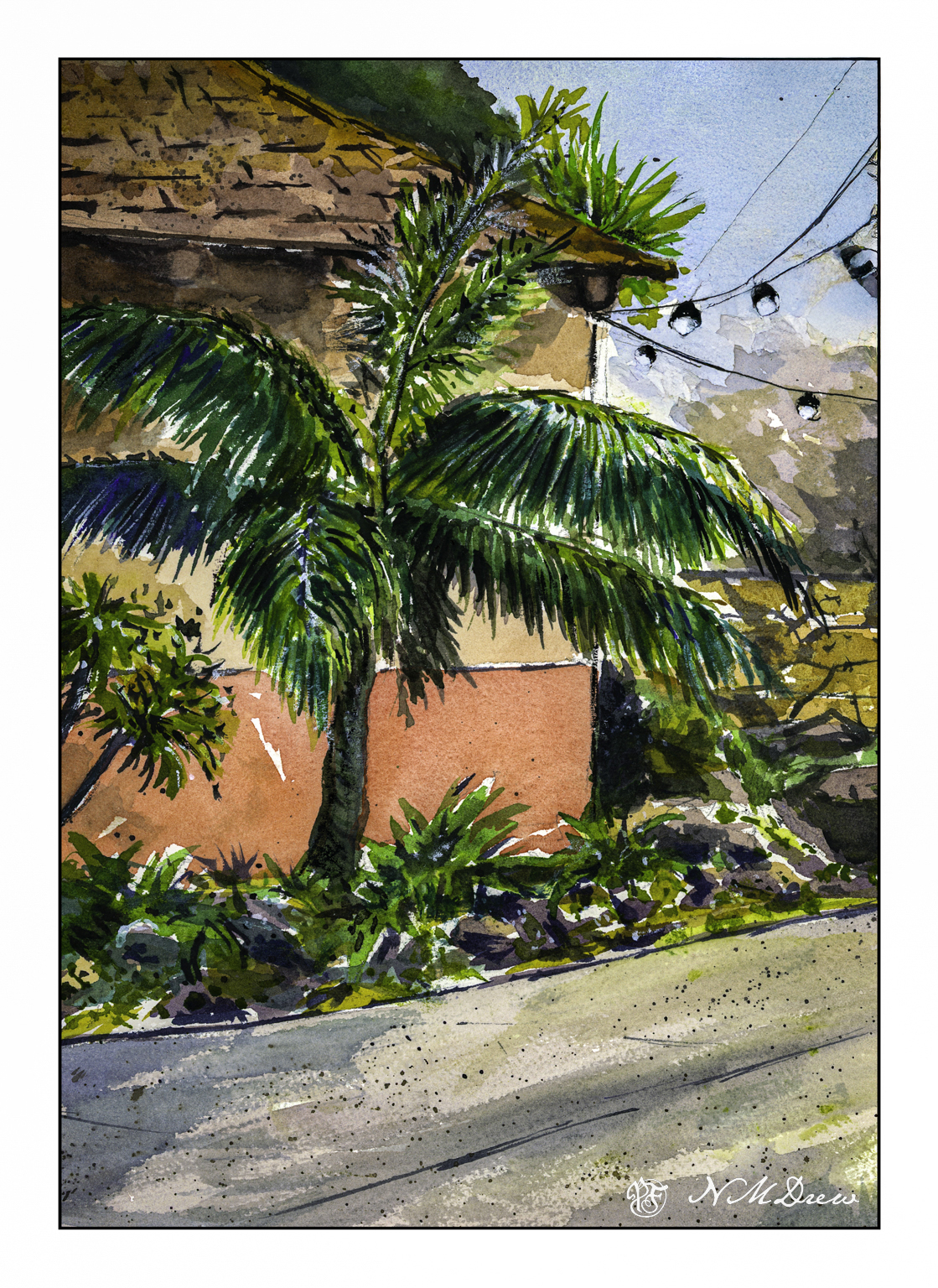
The photo itself is nothing especially exciting but it does give a good display of palm fronds. I am not sure what species this palm is, but it so classical! As well, there are some dracena palms on the right by the lights, which are very different in growth pattern that the one front and center.

Part of me wanted to make the painting simpler, but I also wanted to suggest a bright, sparkly day. The photograph was of a rather hazy day so I had to use a bit of imagination to get the fronds to catch the glittery appearance such palm fronds can have, especially in intense light with a bit of a breeze.

Overall, I like the way this painting turned out. I had to do a bit of glazing to tone things down here and there. Splattering helped for texture. White gouache to do a bit of glare here and there. Yesterday’s painting of an adobe reminded me how easy buildings can be, and today, though simple areas exist in the form of walls, the roof was a bit mossy from the damp of being a few blocks from the Pacific Ocean.

As a quick after thought, I think that the palm tree – the dracena – emerging from the right side of the building is perhaps unnecessary. Into Photoshop and tree removal very poorly done with generative fill – just because I can and could.

Watercolor, Arches 140# CP paper, 9×12.