Fog Monster #2

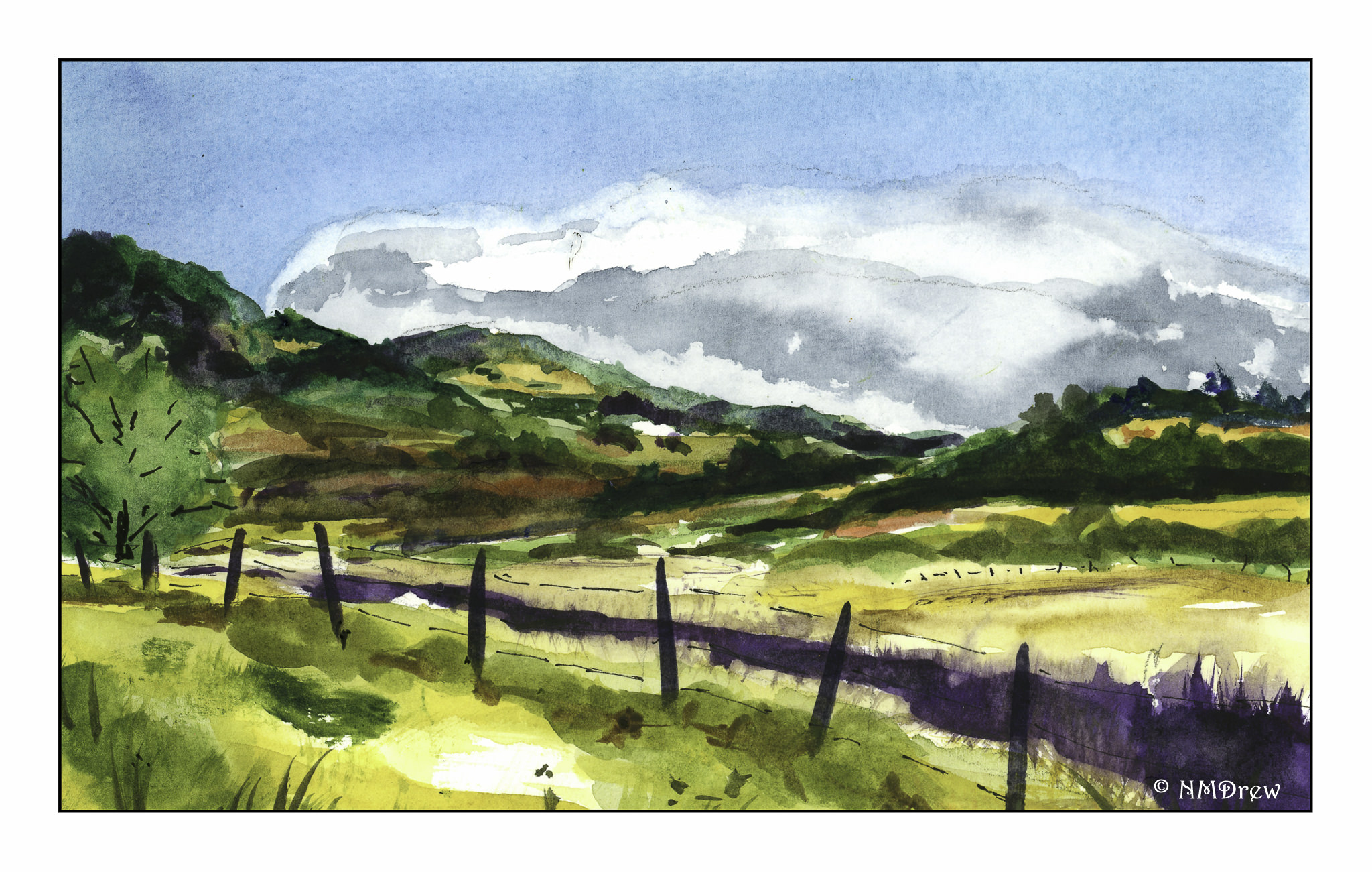
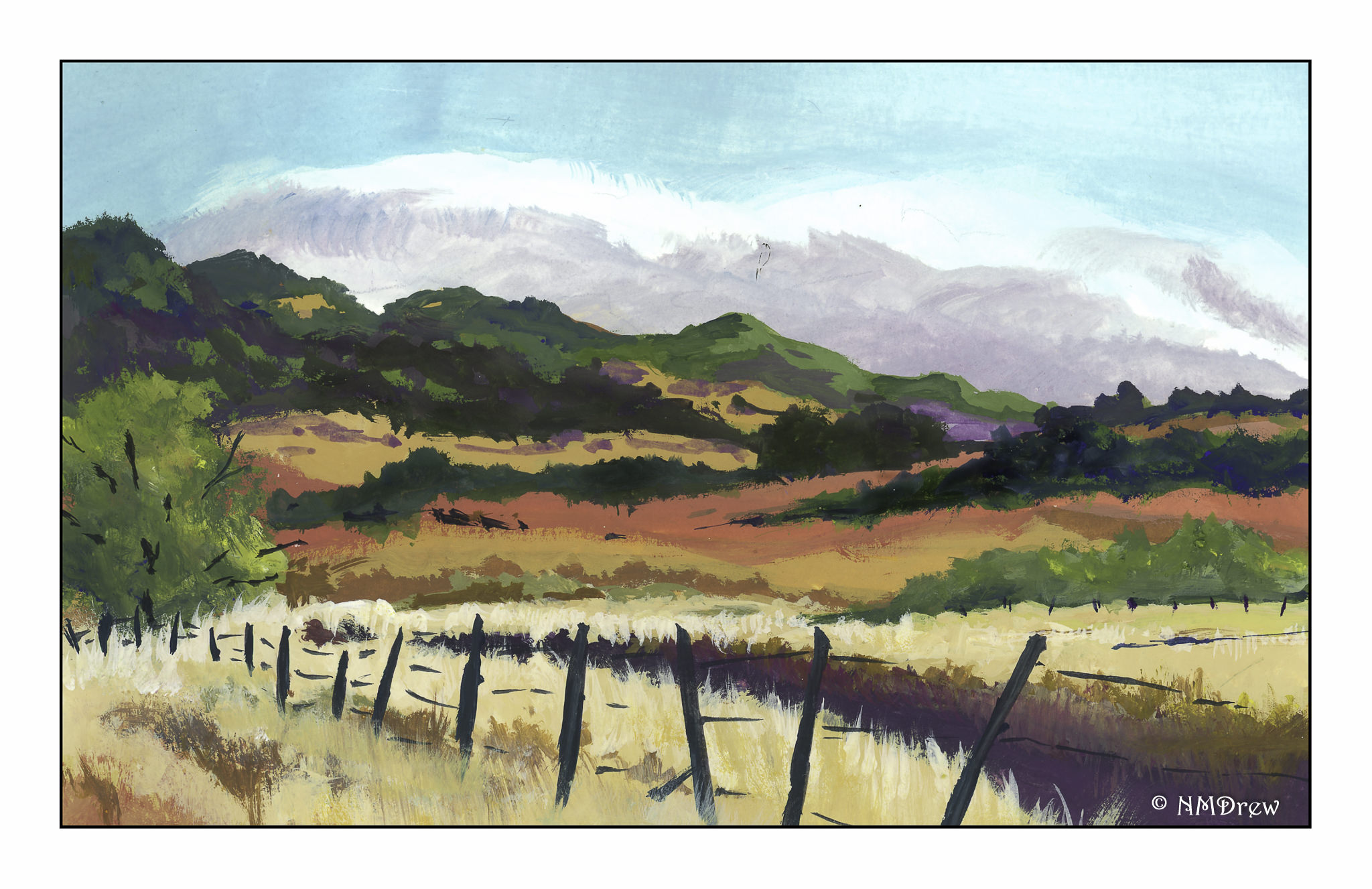
For some time I have considered the possibility of doing two studies for each painting, one in watercolor and the other in gouache.  Today’s painting is exactly that.  I took the same study in gouache (yesterday) and painted it in watercolor.  It was a really interesting experience!

First, I am doing all these studies in a 7×10 sketchbook.  The paper is not really good for really wet watercolors, but is very nice for gouache.  Knowing this, I kept my paper as unsaturated as possible, but also worked to use wet-in-wet where I thought necessary, such as in the sky and fog bank, but being very careful about the amount of water I used.  In other areas I did small, quick forays into wet work, but kept it to a minimum while allowing for bleeds, or coming back to work a bit more, such as on the right side where the grasses are in contrast to the road (lower right side).

Problems continue with depth.  The middle ground hills and the ones against the fog are muddled into each other.  While I made things simpler in the distance, the colors remain the same in intensity.  Atmospheric perspective needs a bit of boost in this one.

Look forward to more of these studies.

Fog Monster #1

The California coast depends on the fog that rolls in from the Pacific during the late spring and summer – and other times of the year, probably – for its ecology.  Plants collect the damp of the fog as a primary water source, and at times it makes the coastal areas, and inland valleys, rather damp and dreary.

Here, we call it “May Grey” and “June Gloom” and “The Fog Monster” – and believe me, when you live in a coastal city in July, and the sky is cold and damp, you cannot help but agree with Mark Twain when he said, “The coldest winter I ever spent was a summer in San Francisco.”

You see the coastal fog rolling over the foothills toward the inland valleys.  I tried to simplify my palette and fields of color to suggest distance.  The sun is coming from the viewer’s right, so I also worked to make it evident on the distant hills.  I used a lot of dry brush in the foreground, and basically worked from top to bottom so that the distant layers would be overlaid by the middle and foreground.  The only thing that wasn’t quite in that sequence were the fence posts.  Once they were established, dry brush to represent grasses was employed.

California Back Country

Even though summer is moving through July, soon into August, the rains we had over the spring are still leaving waves of color in the hills of the California back country.  Usually at this time of year beige is the predominant color, and in really dry years, a dark dirty brown.  This summer is a delight of colors – pale compared to spring – with wildflowers still hidden amongst the grasses.

WWM #18: Clouds

Where I live, in the dry hills of the Central Coast of California, clouds are really, honestly a rarity.  Most days the sky is a clear, steady blue.  In the fall and spring, and sometimes into the summer, though, the seasons shift.  The rainy season brings in moisture, clouds form, and the sky suddenly has a life of its own.  In May and June, the coastal fog moves in, and sometimes you have a competition or a dance between the two – soft, cool fog close to the ground, and clouds at higher altitudes.  As the fog breaks up, you see the blue sky and clouds above the shifting fog.

This is from a photograph I took a long time ago when I first started doing digital photography.  A small group of us would get together to go for an easy hike, many times in the evening.  Hummingbird Trail is where the original photo was taken, admittedly way over-processed in HDR, but the intensity of the colors held true.  I tried to capture this in my painting, along with the shifting fog and clouds.  I also tried to work on distance by applying a light glaze of a dulling blue grey wash to the distant hills, as well as decreasing details to indicate perspective.

Clouds are so much fun to do in watercolor!  Who is to say your clouds don’t look real?  There are so many mysteriously beautiful in the natural world, but few are as shifting and as ephemeral as clouds.