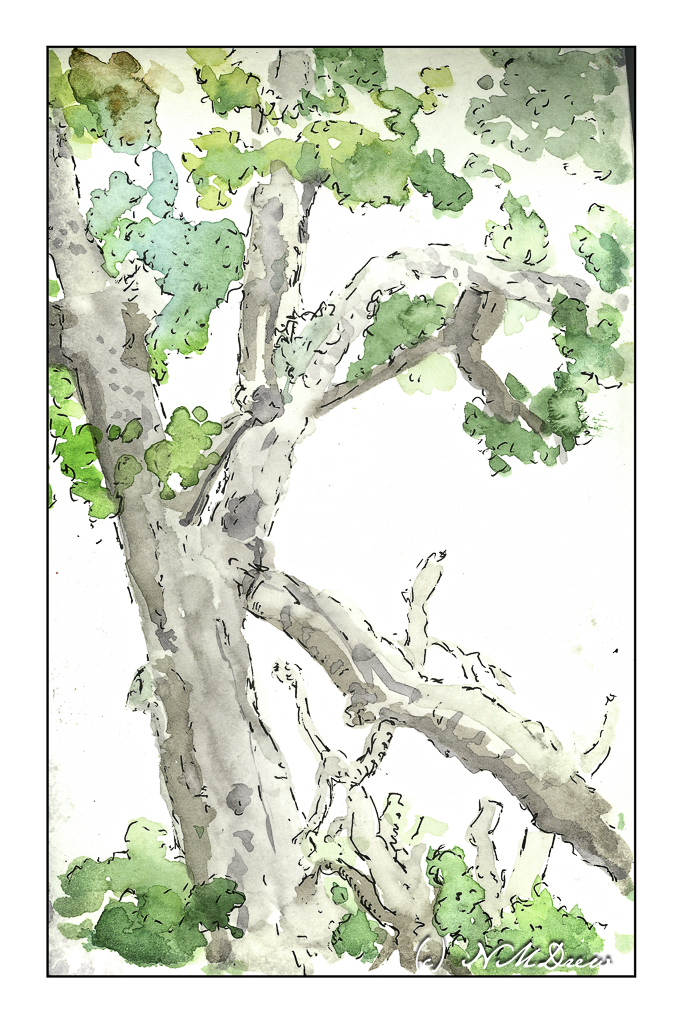
Afternoon Sketches

Late afternoon I met up with a friend at a nexus for a series of hiking trails to do some afternoon plein aire sketching. She brought a paper and pencil, I brought ink and watercolor. We walked about 30 yards down a flat trail and settled in what could appear to be an isolated area as the trail curved into an oak woodland at the lower edge of a hill. The later afternoon sun gave lovely shadows, areas of light and dark, and the oak trees were especially beautiful in that light.

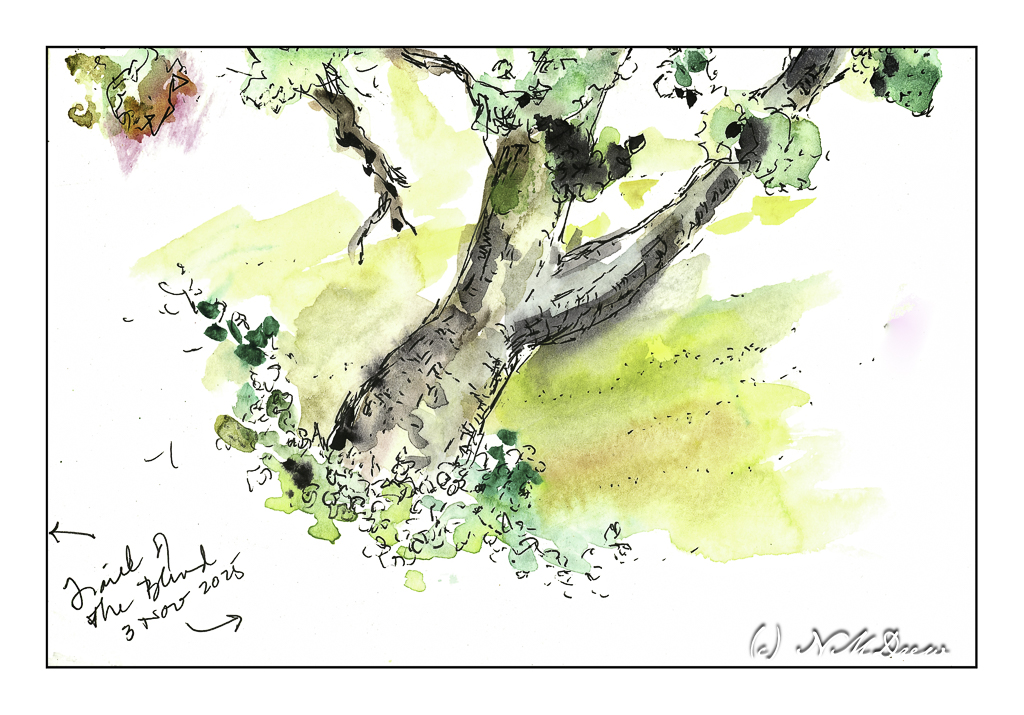
This is my “warm up” sketch. I always like to play around with what I am working with to see how ink and watercolor and paper all interact. Most importantly is how the watercolor and paper work together. This sketchbook is designed for watercolor sketching, and it worked well. Here I started out with the ink and then worked with the paint. After all was dry, I went back in for some touch-up with the pen.

For this one, I painted the tree shapes with light washes. Then came the leaves. After that, some ink, back to paint, then finally ink.

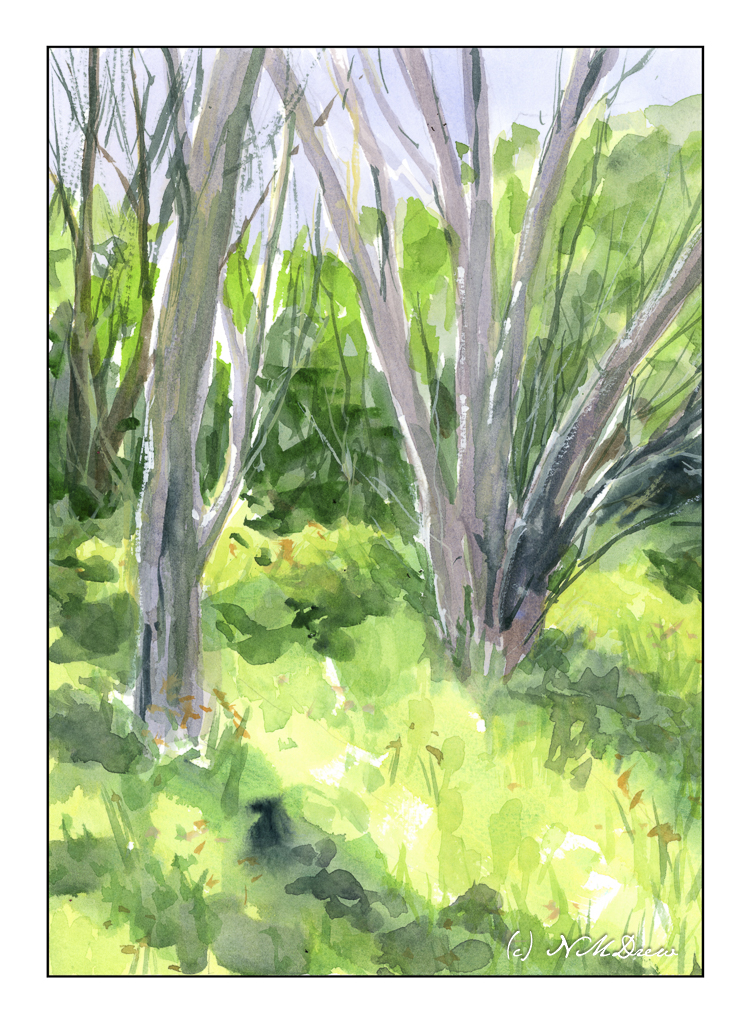
The second painting is my “serious” one whereas the “play” painting was testing my tools. We spent two hours sitting in the woods, yakking and drawing, taking a few photos, chatting with passersby on bike and foot. At 5 pm the sun was going down, so pack it in, hike that long distance out, and say our good-byes.

Ink, watercolor, 5×7 on watercolor paper.

La Bee on Rose (Colored Flower)

La Bee on Rose (Colored Flower)

I haven’t done any photography in awhile other than a snap or two out of my window. Yesterday, off to the local botanical garden with a new photo buddy. It was really nice to get outdoors again to take pictures, to sit and look and savor all the details the end of summer brings, from the last of the summer flowers to the turning of the leaves.

First stop here was this little brushy bush with red flowers. I don’t recall the name of the plant, but there were bees everywhere (in case you haven’t figured that out!). I had a 24-200 Z mount lens on my Nikon Z6ii, so I had no real macro lens, but at 200mm, I could keep my distance and wait for a bee. I cropped the photo considerably to show the bee and flower. And then this morning I thought up this rather bad title.

Nikon Z6ii, Nikon Z mount 24-200mm lens.

Estuary

Estuaries are important connections between rivers and fresh water to the sea. The land may be marshy, the water brackish, and adapt to the influx of waves and sea water and the outward movement of fresh water. Consequently, the estuary provides high levels of nutrients in both the water and the sediment, creating highly productive habitats. Plants, animals, birds, fish, and all sorts of life thrive in the estuaries.

Additionally, the estuaries form a protective barrier between land and sea, but with the loss of estuaries, the damage from the sea increases. A good example of this is in areas where hurricanes and other fierce storms sweep inland, causing great damage – estuaries can survive such storms and recover, but further inland where the land and water are not adapted for saltwater, valuable land may be lost.

Estuaries are found worldwide. In northern California, the Pescadero Marsh Natural Preserve is found near San Francisco, and offers a wonderful environment for hiking and observing birds and plants. Currently, many trails are closed, but the visit to Pescadero State Beach is beautiful, as are many of the beaches found the length of the coast of California.

And, if you didn’t know, all beaches are public in California, so even if someone’s house fronts the shoreline, the beach is there for all. There may be a couple of exceptions to this law, but by and large, no one can tell you that you cannot walk along the shore.

Watercolor, Arches Rough 140#, 12×16.

North Coast

Rocky coastlines are always fascinating because the first time I ever saw the ocean was along a wide, sandy beach with gentle waves. Not so here! You can see the debris – fallen trees stripped to bare logs, rocks, erosion. You can only imagine what it is like during a storm.

Years ago, we drove up the California coast, heading into Oregon and points north. It seems once you hit the central coast, about 100 miles from where we are, the coastline begins to change. Highway 1 leads into Big Sur, that fabled and beautiful land, and it is here you see rugged cliffs. Then, north of San Francisco, you move into the wide beach sands of Stinson Beach and move further along to the rugged Mendocino coast and then beyond. This picture is based on a photo I took there years ago – no idea where we were, but it was stunning.

Ink, watercolor, bristol paper.

Incoming Storm – Mt. Tamalpais

I do love the views and hills of Mt. Tamalpais year round! The views are amazing, the ocean not too far away, and the sky and weather always different throughout the seasons.

The sky in this painting was sort of an area to play with. Sky in watercolor is done with as soon as you lay it down. For the most part, that is!

Painting a sky is usually thought about and then laid in with a fair amount of water and color, avoiding areas for clouds, letting colors bleed, and all sorts of tricks such as blotting up color with cotton or tissue to make clouds. It’s a lot of fun! Here, I did go back in and lift some paint in the right side of the sky, re-wet it, and then laid in more color. It is okay but did not really work. Still, I did salvage it more to my liking.

Next, the foreground. I like my tree and grasses and rocks. The mid-ground with the trees is also to my liking. The land between the mid-ground and the horizon is too colorful and too bright – it should be a bit lighter and perhaps a bit more neutral.

Overall, I am fairly pleased with the results here. I tried to work as directly with color and water as possible. I used a bit of frisket in the rocks and in the foreground to maintain a bit of white.

As I said above, I try to paint with my colors very directly. This means mixing up large puddles of color and painting from that puddle, adding other colors as I move along with my wash to create variety. It requires a bit of thought as well as knowing what colors work together and so on. I mix these colors on my palette often before applying any to the paper.

Many people lay down glazes and work with layers in their watercolors, but I find that, while pretty, those methods of painting create a rather tame look. A lack of freshness is the only way I can describe it. On the other hand, my approach is quite challenging as I don’t build up colors but try to work with thick, rich colors and pray a lot. As a result, my watercolors tend to by quite gaudy, I think!!

Watercolor, Arches 140# Rough, 11×14.