Bouquet

I am not a fan of what are called “heavy body” acrylic paints. They are thick when they come out of the tube and need to be thinned with water or medium. Even with a Masterson palette to help keep them moist, acrylic paints dry too fast for my liking. It always feels like a race against time when I use them.

Enter fluid acrylics. They are not “heavy body” but come in pourable containers. The paint is the consistency of thick cream. A drop or two may be all I need or want, and while they do dry quickly, they are very easy to mix together into the colors I want. Smooth blending a brushwork is far more easily accomplished with fluid acrylics.
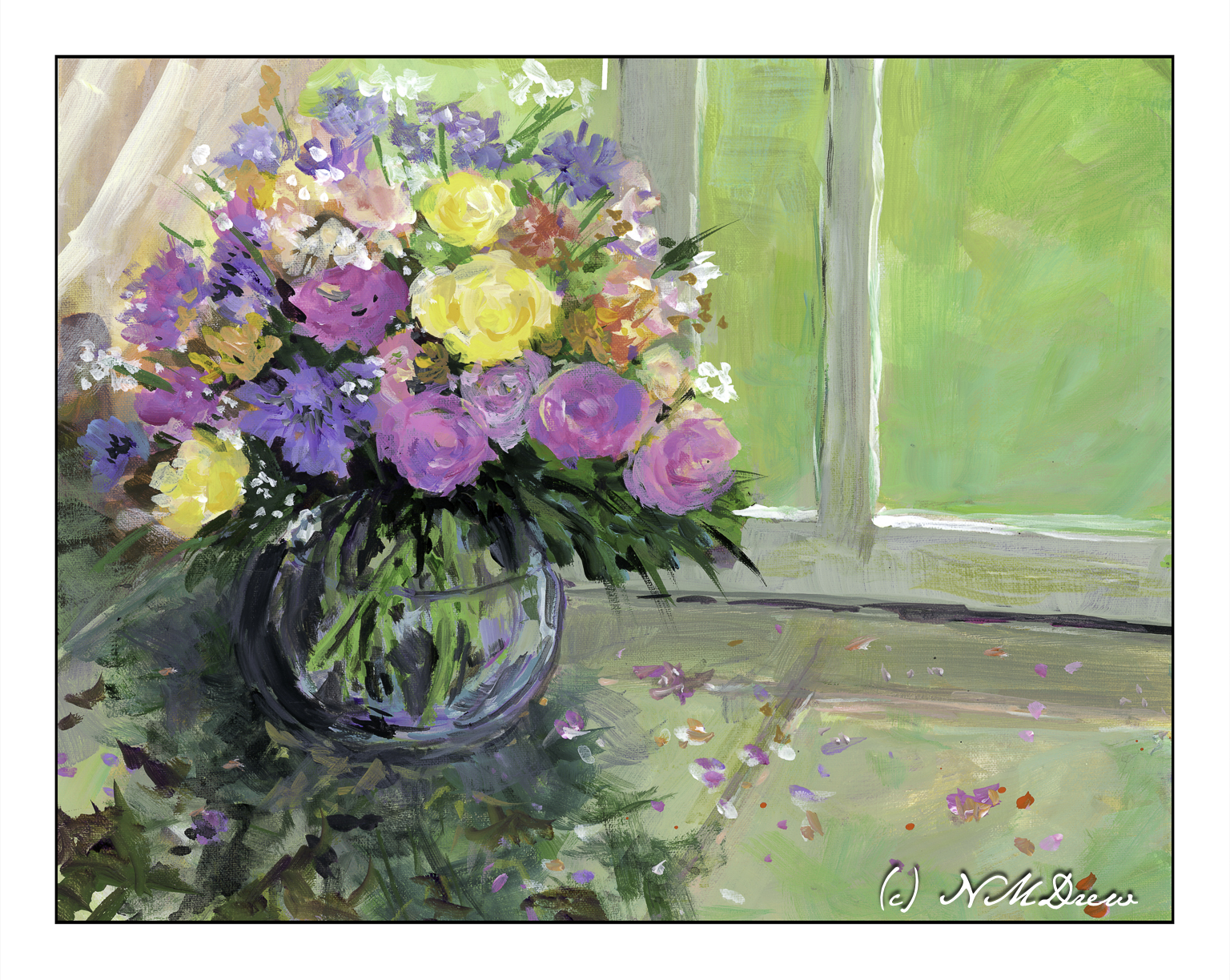
I spent about 3 days painting this because I had to correct mistakes and change this and that. All this is done with the fluid acrylics (Golden makes them, and Liquitex has their own equivalent, as do other manufacturers), a bit of color at a time. While the time element before they dry is still there, I don’t feel the waste of using too much paint – I am pretty good at figuring out how much I need before they dry on the palette. An advantage of acrylic paint over oils is that they do dry quickly, and a painting can be worked on in multiple dry layers throughout the course of the day. Hair dryers help to speed up the drying, too!

Acrylic paints can dry within 5-10 minutes, or even sooner, which is what I find so frustrating about them when using the heavy body ones, and drove me to give up on them altogether. I switched to oils, which I really enjoy, but using these fluid acrylics is a lot of fun, and I can work more quickly.

So, a bouquet. I am not totally sure if this painting is a “success” or not. Parts of it seem a bit peculiar once I see the painting as a scan. I like the window and green that is beyond the glass, as well as the window frame itself. The flowers are decent, but perhaps need more contrast and drama. The glass bowl is also okay. However, the “shadow” area in the lower left seems to not quite belong.

Whatever! I will leave it as is, generally pleased with this attempt.

Fluid acrylic paint (Golden and Liquitex), 11×14 Fredrix canvas pad, unmounted.
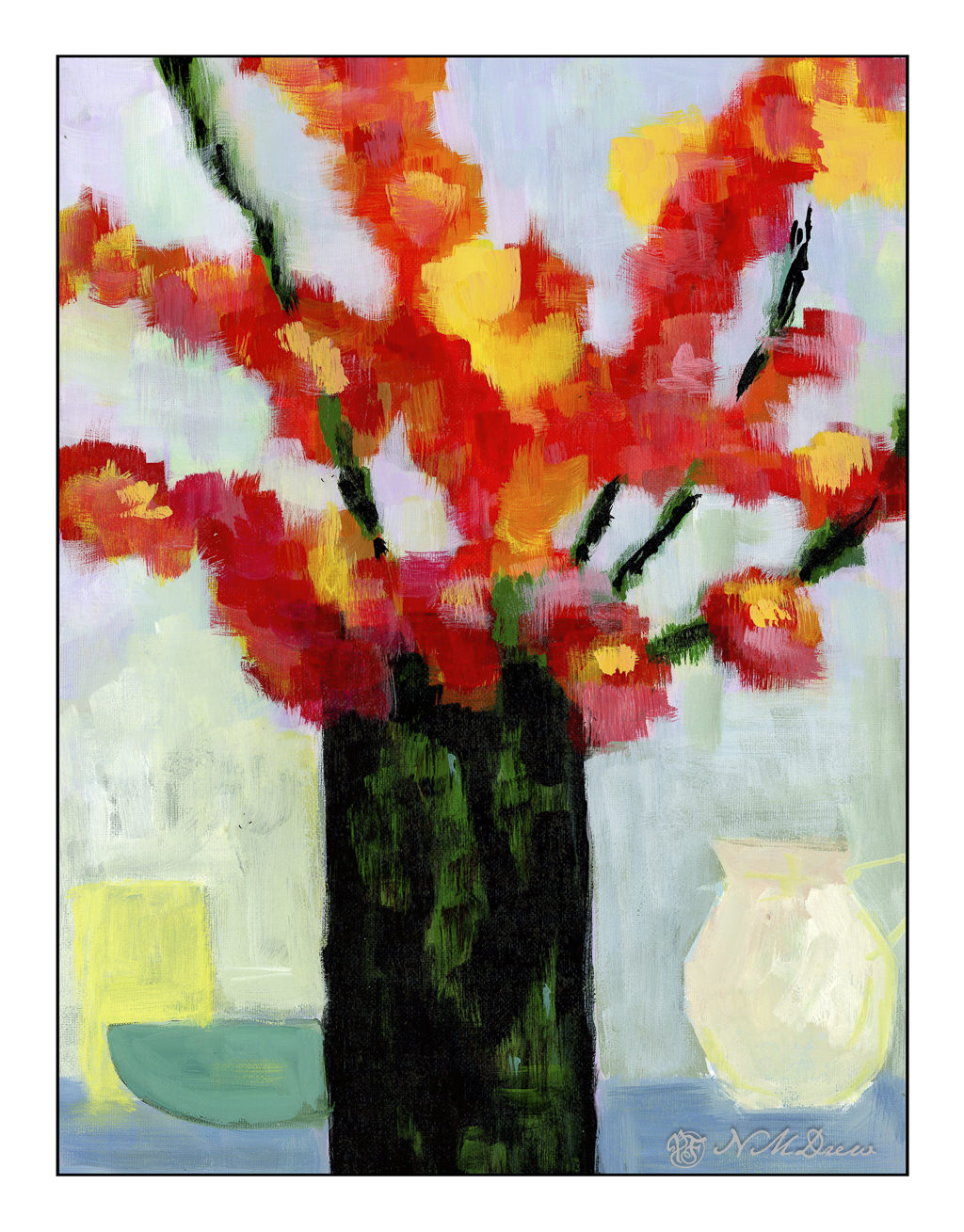
Gladioli

In seems to me that a “style” is not something I have. You can recognize many painters by how their work looks, but I am all over the place. This is not really by design, but more by learning by trying to figure out how they might do something. I started out here by trying to do an abstraction of a vase of gladioli, inspired by varied modern painters, but in the end I ended up doing most if it by shaping the flowers, background, and vase with vertical and horizontal strokes.

Using fluid acrylics, I painted with wet paint, and as time went by, used the brush to blend the drying paint. Some glazes were used, too. When I finished the vase, background, and bouquet, the background was pretty empty. So, simple geometric shapes – a bowl, a glass, a pitcher. I wanted them pale to blend into the background but still distinctive. The results seem to work.

11×14, cotton canvas on board, fluid acrylics.

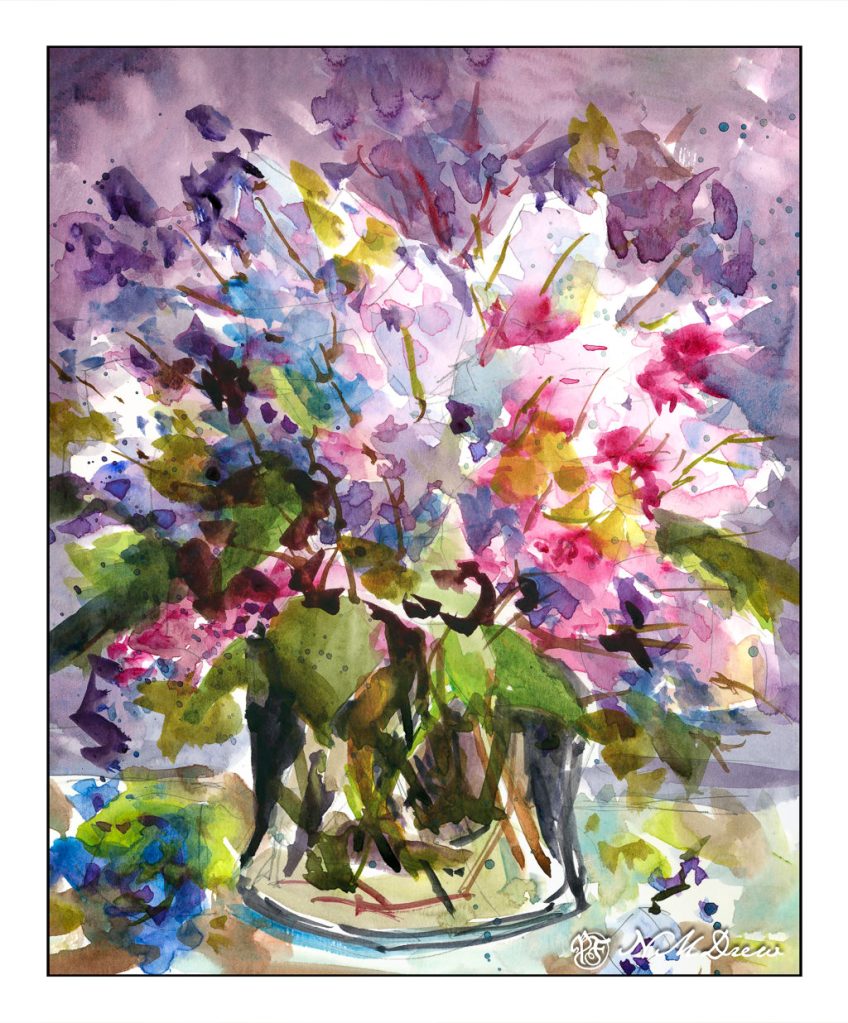
Lilacs

Negative painting? Check.

Loose style? Check.

Masses of color to create suggestions of shapes? Check.

I am pleased with this painting – there are areas which could be better, but is any painting actually “perfect”? Certainly not in watercolor!

Lilacs are one of my favorite spring flowers. Their fragrance is heavenly and a welcome sight as winter fades away. Sadly, it seems hybridizing them for a coastal SoCal climate is not successful.

I drew the flower masses in pencil, creating general shapes. A few pointy leaf shapes. A glass vase. Dropped petals. From there, the rest happened with lighter washes of color, white areas left behind, and eventual deepening shades of lavender, purple, and pink. Some blue, too. It sort of happened all over rather than section by section.

And then my next painting was a complete disaster!!

Splotchness

Another floral study following a YouTube video. This one is by Lois Davidson, whose technique is much different than the “Bowl of Roses” video.

I rather liked this one. There were some little things in doing it that I hadn’t done before. I’ve sprinkled colors onto wet paint, but never dropped in sprinklings of water. That was fun. Also, the sheer joy in painting splotchy flowers is always a delight but I did have to think a lot more than it looks – working light to dark requires forethought and patience. To me, watercolor painting is like haiku – it takes a lot more work than it appears to need!

This is on Arches CP 140# – as always! – 9×12.

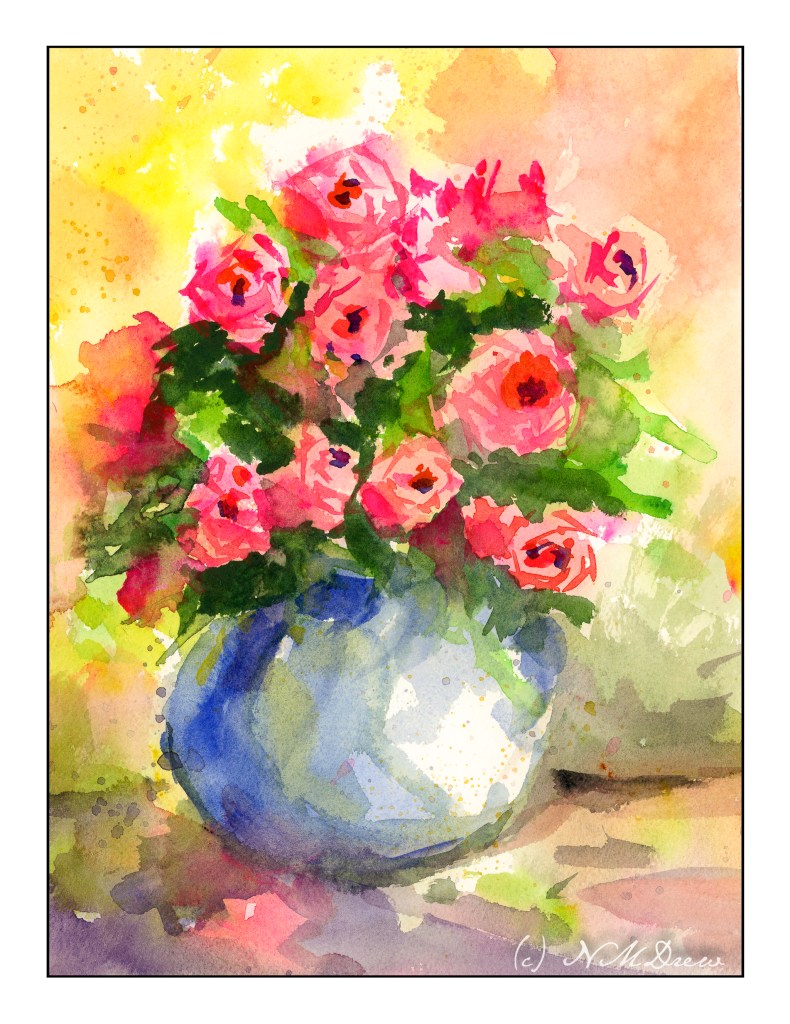
A Bowl of Roses

The above study was fun to do, but I had a lot of help in the form of (what else?) a YouTube video. Videos are such good ways to see what a person does, and how they paint. To me, watching the methods an artist goes about accomplishing something is one of the biggest ways to learn.

The video I used was one by a YouTuber called “Draw with Shiba.” There are a lot of good videos on his channel, and none of them are so difficult you cannot learn something. As my goal is flowers I found this video of his quite helpful.

Our images sort of match, sort of don’t. His paper seems to hold on to water more than mine does (Arches) so he can lift color from the sides of the roses. He also begins with a lot of wet-in-wet. In this video, he wets the paper entirely with a brush before he paints, and then drops in color so it blurs into all the major areas of the paintings. In other videos he simply drops water droplets onto his paper, thus controlling areas as he disperses the water with his brush. He paints, flat, too, from what I can see.

Overall, I enjoyed this video. The flowers are roses (thumbs up there!), the vase is simple, and the entire painting covers a lot of techniques. I liked the way in which he lifted the paint and painted the roses. I learned a bit and produced a painting that doesn’t make me cringe. I tried to apply a lot of the techniques here to my flower flop of yesterday, and some worked, some did not, but that is life. Live to paint another day!