Into the Desert

The southeastern corner of California is primarily desert. The land varies. There are hot springs, mountains, little rainfall, sparse vegetation. Days can be hot, nights can be cold. Within it are contained major parks and areas, which include Mojave National Preserve, Joshua Tree National Park, Death Valley and the Anza Borrego Desert State Park. Farming here is supported by irrigation from the Colorado River, but as times go by, the Colorado is not able to support farming as it once did. Despite its rather hostile environment – at least to people in some ways – this part of California is stunning. Its austere beauty is something perhaps not appreciated initially, but with time and observation, it becomes a magical landscape. There are towns, too, where you can stay to visit and learn a bit about the desert and its land and people.
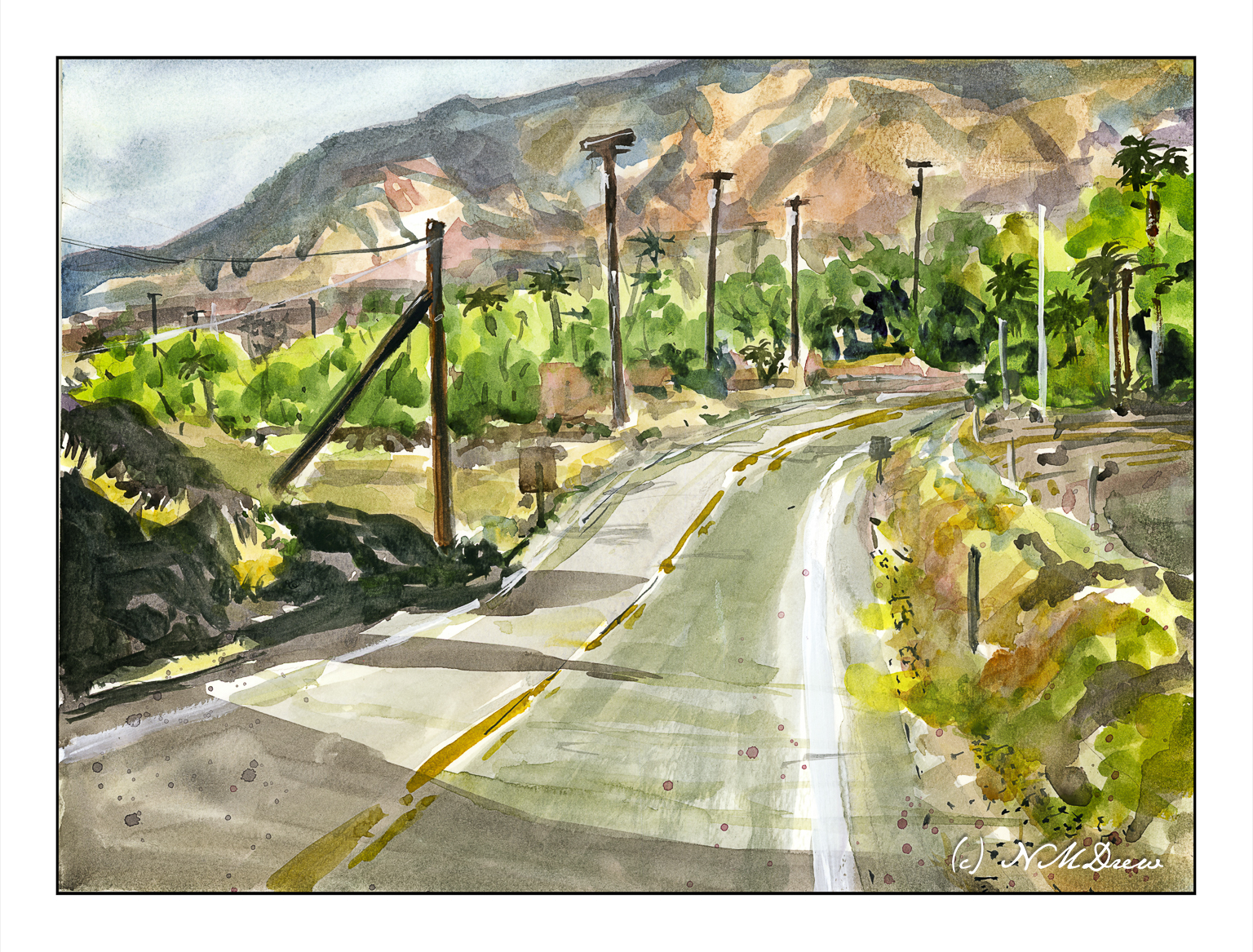
This afternoon was a sort of what-do-I-want-to-do day. I really didn’t know. The winds are up right now, and anything done outdoors would require hanging onto everything. So, an indoor watercolor rather than an outdoor oil painting was my choice. And as far as any planning – well, let’s just say I did this on the proverbial wing and a prayer.

Overall, I blocked in the major color areas, using lighter colors. First came the sky, then the mountains of blue and orange brown. The road was limned in, along with the greens of the vegetation. Once dried, details were added. I used the hair dryer a lot! Finally, white gouache here and there, splatters of reddish and bluish paint, and here we are.

I am quite surprised that it turned out as well as it did – at least in my opinion!

Watercolor, Bockingford 140# CP, 12×16.
Deep Winter

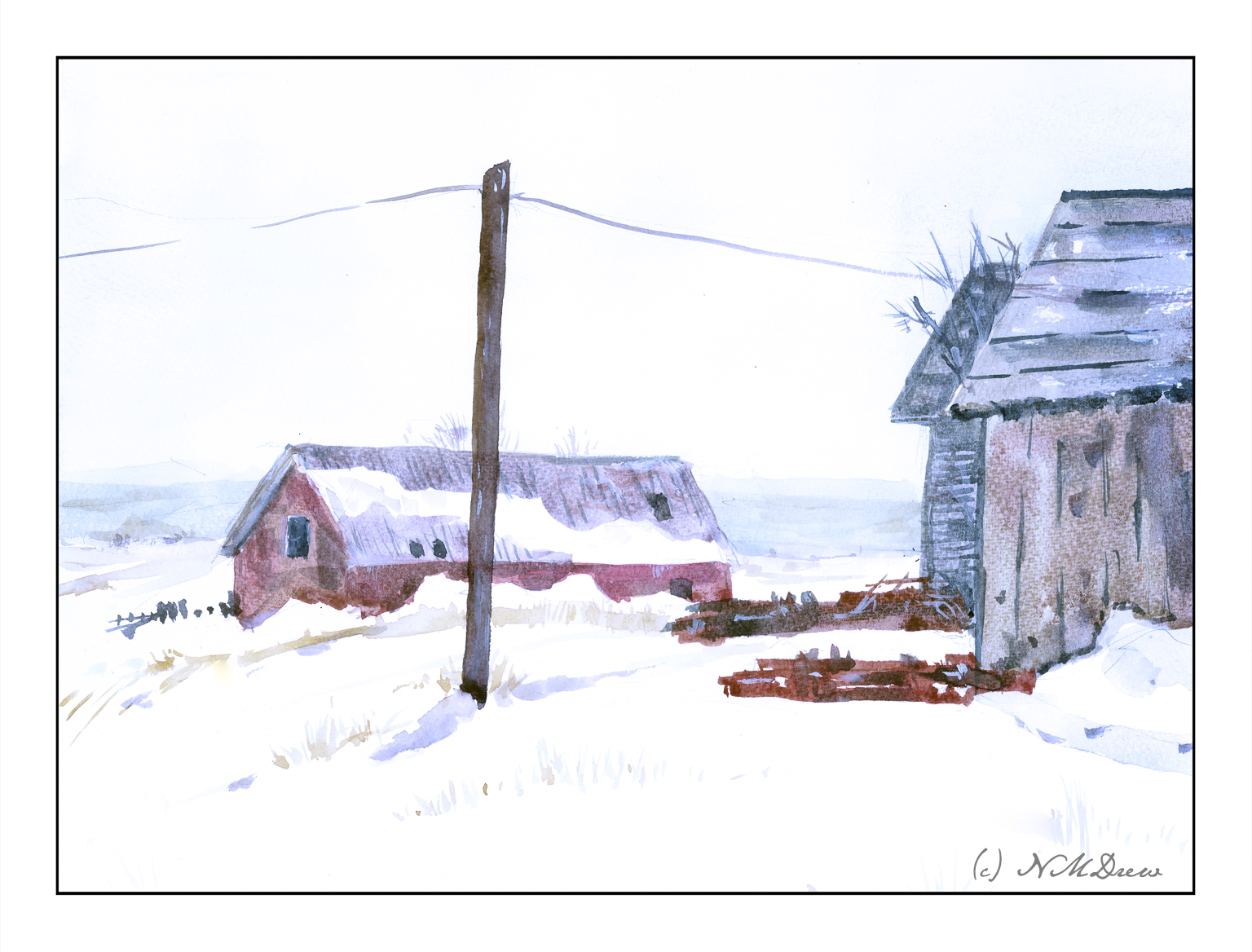
The Great Plains stretch from Canada south to the tip of Texas and into Mexico. It is essentially a high plateau of prairies and grasslands, a vast flat country swept by winds. The Rocky Mountains form the western border and the woodlands of the midwest form the eastern edge. Tornados are not uncommon, and unpredictable weather is the norm. Rain is sparse, increasing as the plains roll eastward.

When we moved to California from New York, we drove across the plains in the dead of winter. Often the weather was windy and the air was frosty and misty. Stubble fields were seen, with remnants of corn or wheat pushing through the snow. It can be very desolate and lonely, but indescribably beautiful in a rather terrifying way.

Here I have tried to catch that loneliness. I used a limited palette for the most part consisting of cerulean, lemon yellow, and alizarin. Payne’s grey and burnt sienna helped with the darker areas. Patience was needed here, from applying the very thin washes and letting them dry, to carefully considering how paint the wooden buildings. I painted on it throughout this morning and early afternoon, in between exciting stuff like dishes and laundry!

Bockingford 140# CP paper, 16×20, watercolors.

North Coast

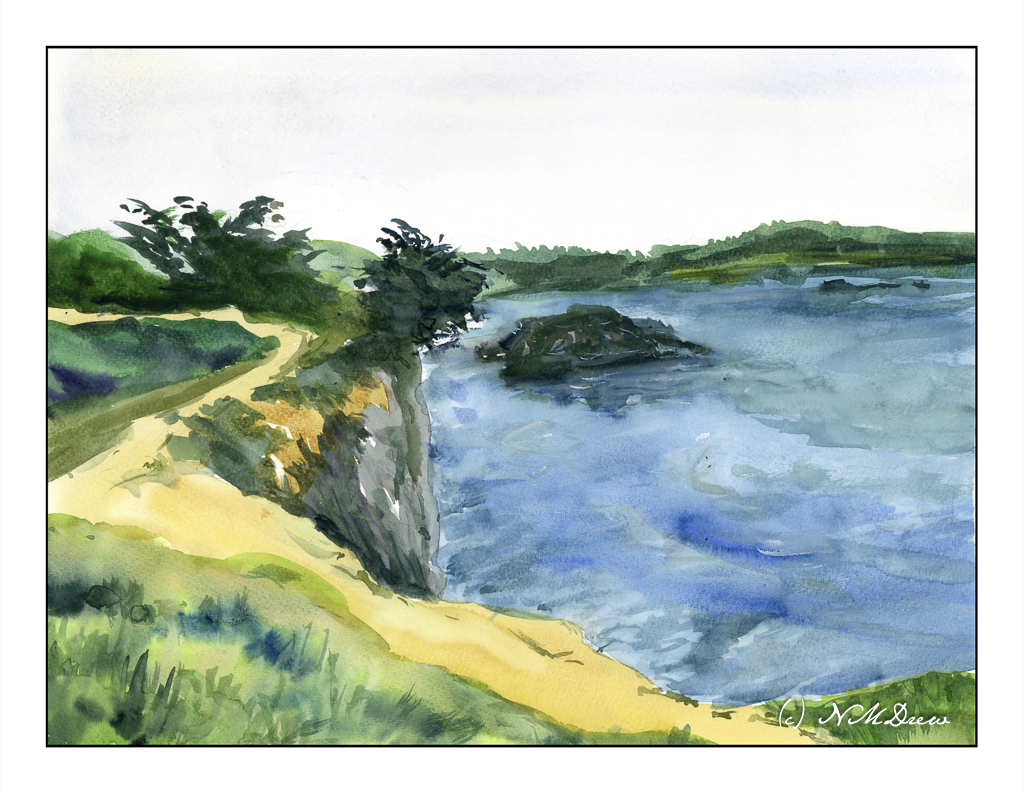
Once more – should I put something in or take it out!?!? The original of this painting, along the northern coast of California, is originally painted with a small island offshore. Looking at it I didn’t like it – perhaps too close to the tree on the left overhanging the beach. Thanks to Photoshop, I removed it.

The above painting is the one that exists in the real world. The one below is the one edited with Photoshop’s “generative fill” – poof! No island.

Because I am feeling kind of spartan these days, sometimes I think I have too much in a painting. Maybe it goes along with limiting my palette of colors?

And my palette? A bit more expansive than the previous, but the subject matter seemed to need a bit. I used umbers, sienna, ochre, Indian yellow, phthalo blue, a touch of ultramarine, a bit of dioxazine purple, and Hooker’s green.

My technique was to use oodles of water as I wanted to see how well the Bockingford non-cotton paper would hold up. It did quite well! Every large area – sky, ocean, land above the cliff – was wet with clean water, and then painted with the colors. The sky had one wash, but the ocean had multiple wet washes. The land in foreground and distance had a big wash later accented with dry on wet.

I am also pleased with this painting, even with my thoughts about the island.

St. Cuthberts Mill, Bockingford 140# CP, 12×16.

And what are your thoughts – island or no island?

Snow in the Sonoran Desert

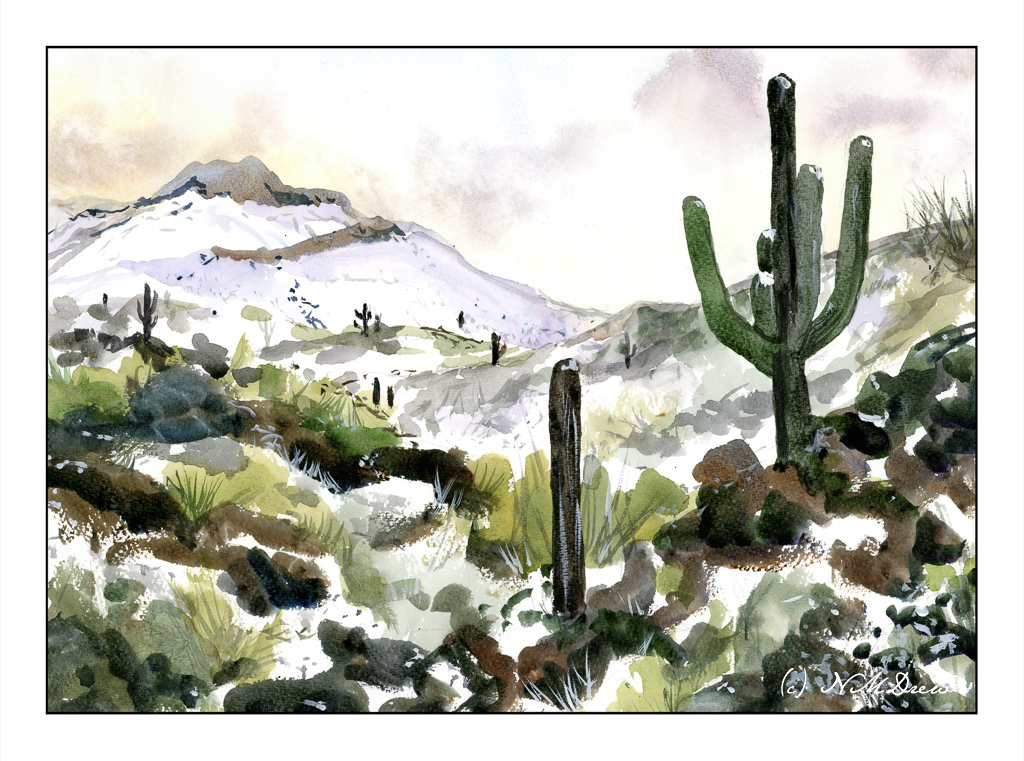
It seems appropriate to do a version of a western snow scene, and what better place than the Sonoran Desert? It is a bit closer to home than New York. I always find snow in the desert or places I don’t think of getting snow to be absolutely fascinating.

Once more, I am using a limited palette. Here, umber, ultramarine, Payne’s grey, and Hooker’s green for the landscape. The sky is ochre with some Indian yellow, quinacridone rose, and cerulean. Some of the Indian yellow is also present in the landscape, partly to lighten things up and to make some variations. Titanium white gouache is used here and there as well.

I am beginning to find limited palettes of color a lot of fun! When I am painting with them, I have not set out to use a triad of colors (such as a red, yellow, and blue), but picked the colors based on my need to succeed, at least in my head, in creating the painting I want. At some point, I will try primary triads, but that may be for warmer weather. Right now it is winter, and winter I shall paint!

In addition to a limited palette, I am also using larger brushes overall and abstracting details into shapes. Pale, pale washes, as for the sky, are also some of my goals. The scan, once more, is not as good as it could be, but in general the stronger colors are well portrayed.

My paintings are getting better, I think. At least I like them better than many others I have done. Yesterday’s painting was meh, but if I consider that 3 out of 4 have pleased me so far, I must be winning. 🙂

Watercolor, limited palette, St. Cuthberts Mill, Bockingford 140# CP, 12×16.

Winter Hill

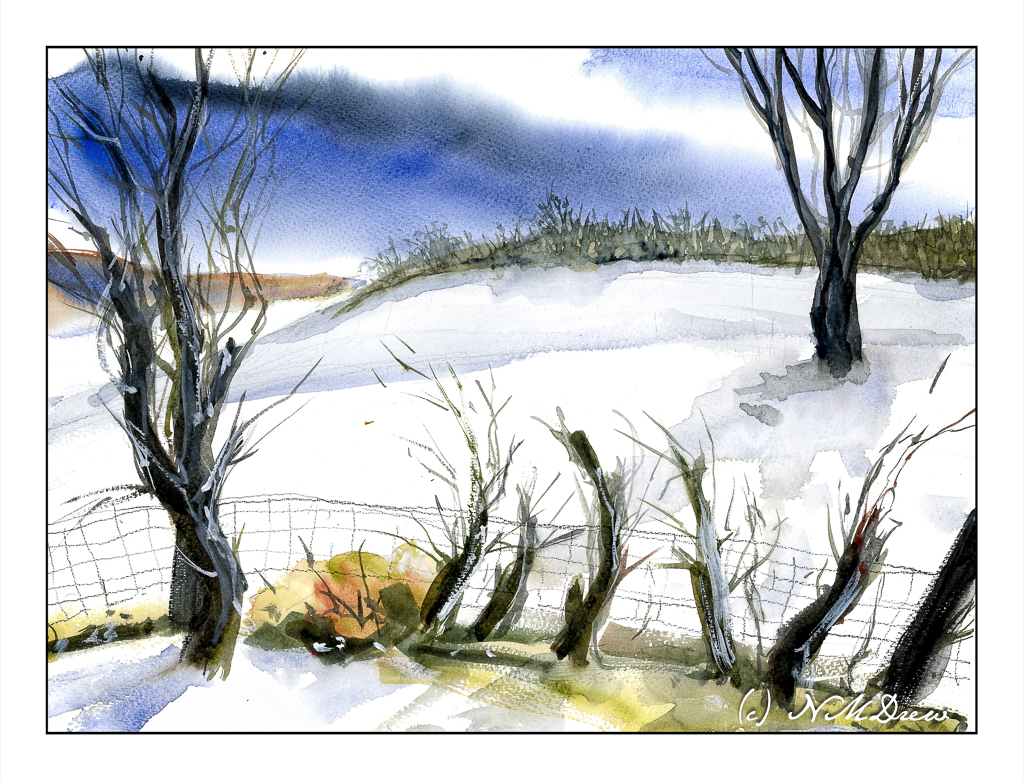
I am working really hard to simplify my paintings. Winter scenes are perfect for this as I have to keep large swaths of paper white and untouched. Contours of the land are suggested by some blues and such for shadows. Additionally, I am trying to keep my brushwork fairly direct and using the brush’s qualities to dictate the result. A bit of a challenge!

This scan seems to be decent, too, as far as matching the painting’s colors.

I added some new colors to my palette for this painting. In addition to ultramarine blue, burnt sienna and Payne’s grey, I added some Winsor Newton brown madder and olive green, and McCracken black by Daniel Smith. I also used some white gouache for the snow on the right hand tree and in the viney-like things in the foreground along the fence. Altogether I am working toward getting comfortable with a limited palette. Winter lends itself well to this.

The wire fence was drawn in with colored pencil – a warm and cool grey.

St. Cuthberts Mill, Bockingford paper, 140# CP, watercolor.

A Bit Later

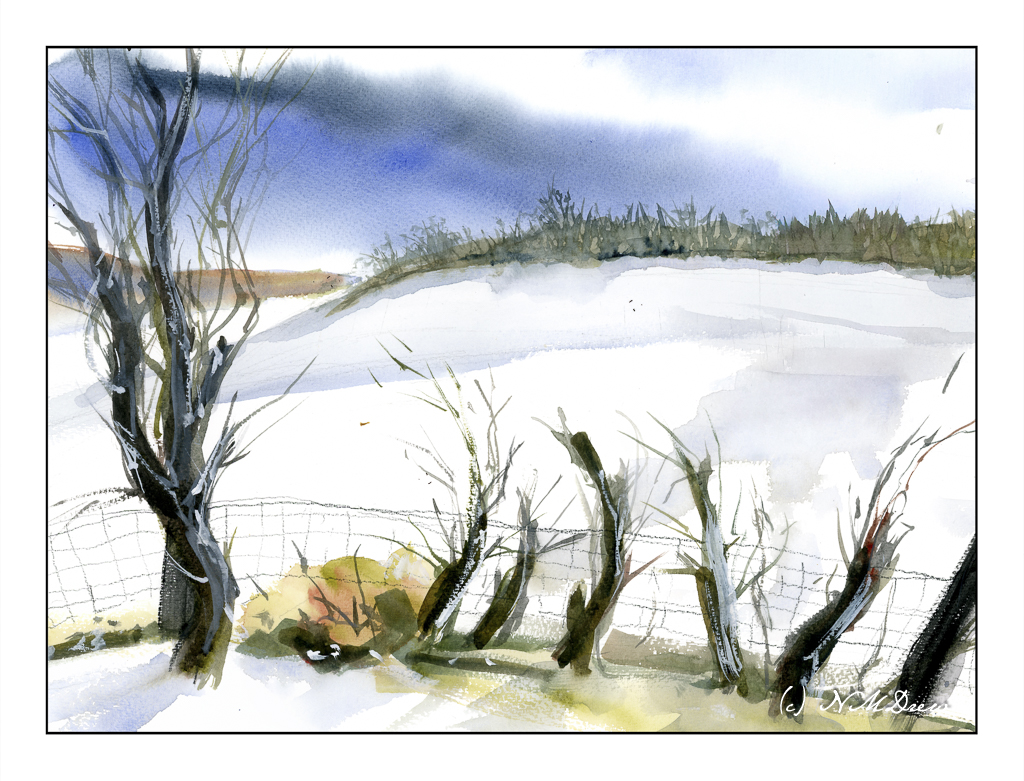
Now, a bit later, I wondered if that tree on the right was okay. I wondered if it was needed. I don’t think so. Here is the painting without the tree!

Thoughts?