Daisies, Daffodils, and Basil

With a break in the cold and rain, a relapse of my cold, and sheer need to get out into the afternoon sunshine (74F! – 23.3 C!), I sat down and listened to Lord Peter Wimsey on Audible, pulled out a pan of paints, and looked around me. There are a lot of daffodils in various pots, a bunch of daisies, and a basil plant I just bought. The rains have kept me from replacing and modifying my drip system, but as today we probably had the last of the seasonal rain, it is time to reset them as as well as clean up various beds.

This potted basil was the first bit of painting. I wanted to focus on the lights and darks, the shadows and bright spots. It is quite a complicated bit of greenery to paint – enough detail to get depth and separation of leaves, as well as a sense of the direction of light. Pencil first, and then a try at a bit more than a lick and a promise. Not great, but I did accomplish a bit of what I wanted.

Once the basil was done, the paper was flipped over. I have a huge pot where some spring daisies are just jumping up with an enthusiasm that always frustrates my own when I try to paint them! I tried to paint them as masses – but the white daisies are very clear in shape, white with bright yellow centers – and all this in a field of varying green. The sun was in and out behind the clouds, so the two patches look a bit different. Again, complexity being simplified. The one on the right is my favorite as it feels somehow “cleaner” if that makes any sense.

And then, the daffodils. The one on the left is better than the one on the right; the spiky leaves are okay. What I focused on here were colors and their shapes, not a daffodil. The same with daisies on the right. This meant I did not use pencil, but painted directly.

Altogether, a few hours in the afternoon spent playing and relaxing. Some success, some failure.

Watercolor, 9×12 Arches CP 140# paper.
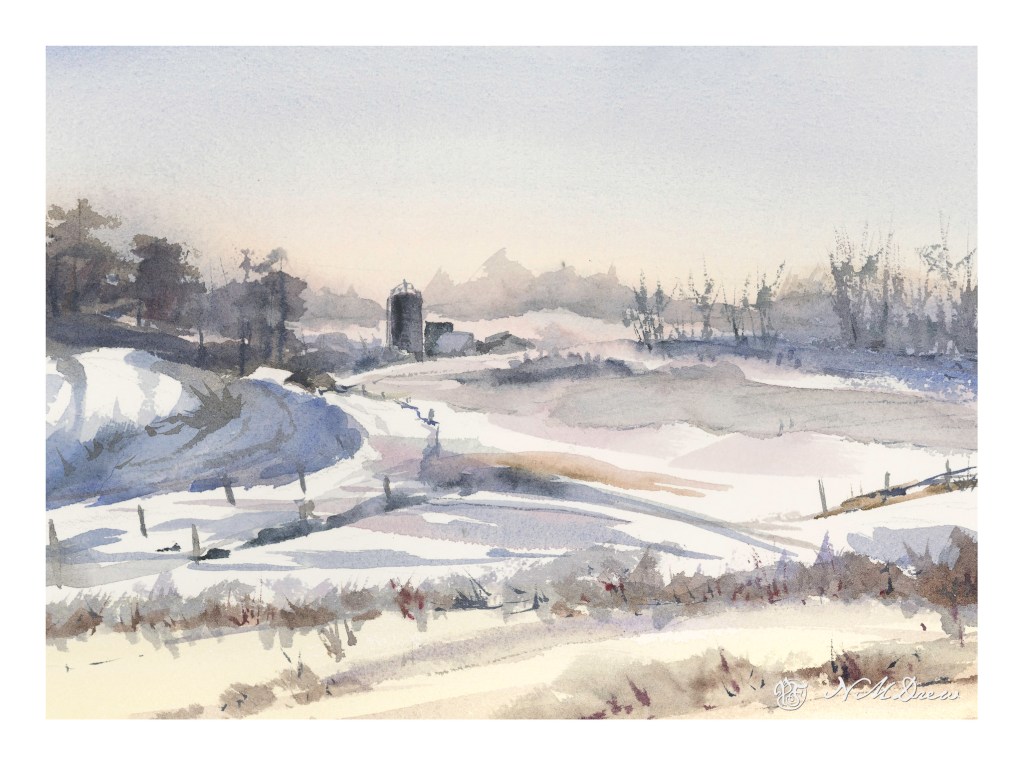
Winter in Hill Country

I needed a change of pace – a way to relax – after yesterday’s very intense painting of buildings and people. It’s nice to visit familiar territory. But, I was not without goals. Here I worked on subtle gradations and color change in the sky; misty / soft trees in the horizon using moist paper to blur and indicate distance; a couple of buildings with subtle rooftops; snow. On Arches CP 140#, 9×12.

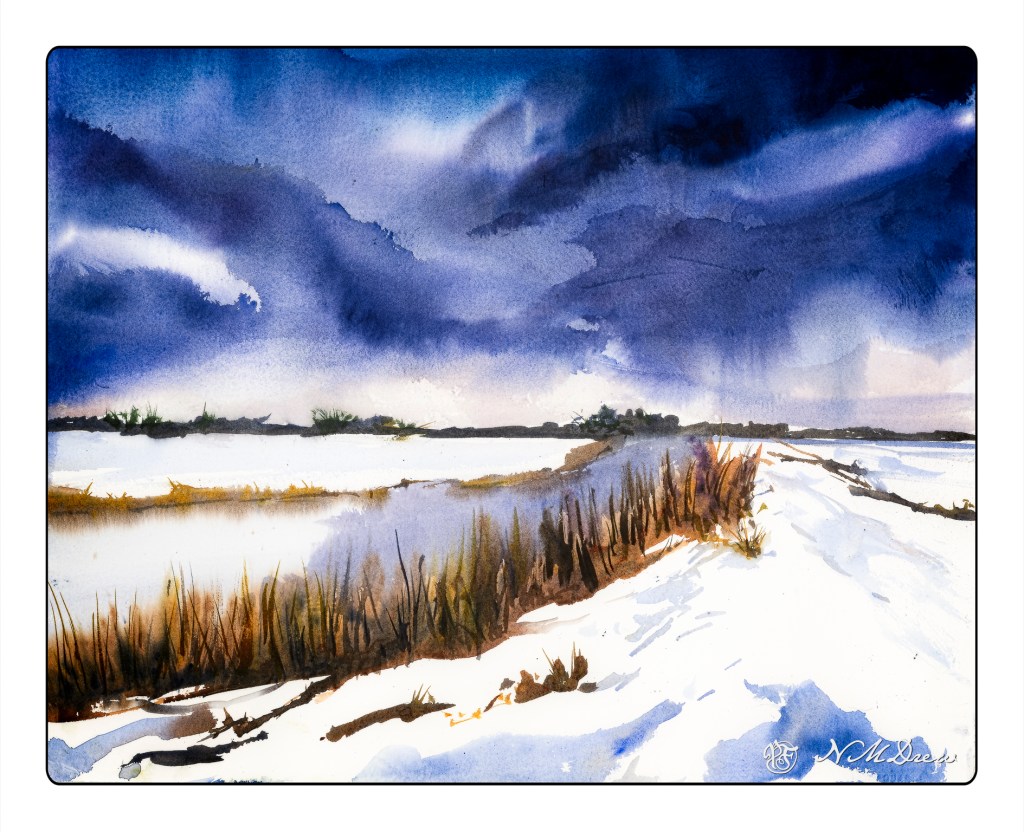
Winter Storm

When I first started to paint in watercolor – like when I was a teenager! – the advice was to use a brush bigger than what you think you need. Yeah, right. Over the years, I have resisted this, but lately I have been doing the majority of my painting with a 1.5 inch flat brush. From there, different brushes with different ideas in mind.

Here, 16×20 CP 140# Arches. I sponged the entire paper with water and then set in the sky. From there, the water and grasses along the shore, working to get blurring of colors into the wet paint. Then, the horizon with the same 1.5 inch brush. I let it dry.

From that point, it was a matter of thought. Initially, the sky dried to a pale color, so I laid in more dark paint for the sky, using a spray bottle to move the paint around, and holding the painting by hand, tilted the paper this way and that to run the paint in various directions.

Looking at it upside down always gives a new perspective, sometimes good, sometimes not. I added some dry brush for the weeds, and used a wet mixture of blues for the snow shadows. I also painted a darker version of the same snow blue into the distant water, moving it into the weeds / reeds. Then, more dry brush once the water had dried to overlap the paint I applied.

This is a stronger painting than some of my more more recent ones, and I will credit the large, flat brush forcing me to work simply. It’s actually much more fun, and easier, in many ways, because I am not getting finicky to the point of crazy.

Progress is being made!

Wetlands

Another wet-into-wet painting, but this time with more challenges and a longer painting period. As before, 140# Arches CP paper.

The goal of this painting was to get away from trees and aim for seeing how using a very wet piece of paper could be worked for skies and water along with plant life, from rushes and grasses to distant trees. The style itself lends itself more to softness in general, but with judicious brushwork and glazes, more defined areas were achieved. I also used white gouache to represent a tasseled top to the tall reeds (or whatever) in the middle right of the painting; I realized I might have achieved an airier effect by splattering some frisket in the areas I wanted white.

I painted the majority of the picture last night, working glazes over areas more defined to blend them in more harmoniously. Dry brush was used for the the foreground and in areas where a rough edge was needed to show plants.

I don’t think this painting is as good as the one I did previously. The contrast is not good enough to convey distance – too strong of colors were used to paint the reeds and trees in the horizon. I do like the colors and softness, though. Another point of focus was to create a point of focus! I tried to use birds, warm colors in the center of the painting, a bit of a vignette around the edges, and other visual tricks to lead the eye somewhere. Again, I don’t think I had much success. As well, the sky and land do not seem to match.

I did accomplish a few things I set out to do – wet-into-wet with some control for sky and plants and water. Doing it is a lesson in itself, and each painting teaches something. I worked on the painting last night and then refined it this morning. I had more patience than I usually demonstrate when painting in watercolor. Why is that? Is it because watercolor is wet and watery and seems to demand a bit of speed?

Anyway, more to come, more to learn.

Early Morning

Another wet, wet painting in watercolor.

Here, I wet the paper, and then began putting in areas of color, beginning with the sky in the central part of the painting, and then blobbing down the foliage in the foreground and the distance. The line of the slope was separated from the horizon beyond. As things dried, I blobbed on more colors, and continued to work wet-into-wet as the paper dried. In the end, I was able to draw the trunks of the distant trees without their blurring using diluted colors of the darker tree trunks.

It’s really hard to describe how to do a painting like this. In doing these kinds of paintings I am finding it is necessary to have a sense of the composition itself – lights, darks, soft shapes, hard edges. It is also necessary to think about negative and positive space while painting, as well as the overall effect desired. I worked light to dark, and strove to keep the earliest colors as separate as possible from others. In the end, I used glazes to unify areas with color as well as worked with thick paint and a very dry brush for some detail.

140# CP Arches, 16×20. It took about 3 hours to work on, using time in between to dry the paper with a blow dryer or let the water get absorbed into the paper so softer edges could be achieved.

Of the 3 “splish splash” paintings I have done, this one is my favorite. This technique works very well for areas with a lot of foliage, but what about ocean scenes, skies, and so on? That is next on my agenda for this method.

This was a lot of fun – I hope you like it!