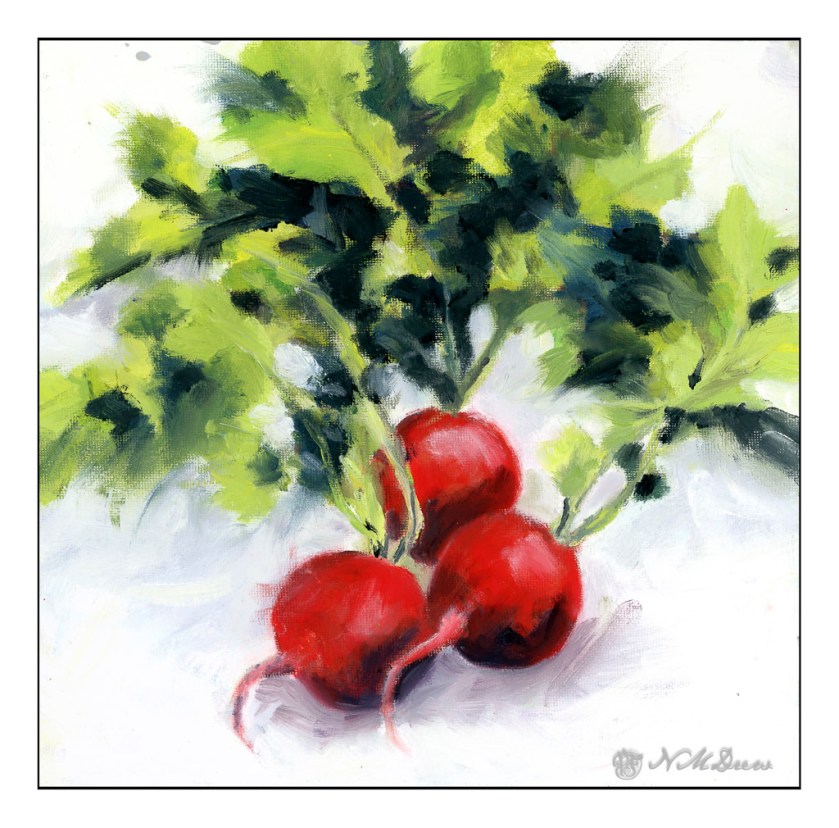
This painting took forever! And it is only on a 10×10 inch canvas! I used oils and labored over it for about 3 class sessions while it dried in between. The upper left corner is still drying.
I am quite pleased with it, so will leave you with that.

This painting took forever! And it is only on a 10×10 inch canvas! I used oils and labored over it for about 3 class sessions while it dried in between. The upper left corner is still drying.
I am quite pleased with it, so will leave you with that.
I might do more drawings of my container garden as the next few days pass, but it’s hard to tell. The heat is up here with it in the mid-90s F, so sitting outside to sketch is an early morning thing rather than a mid-day thing.
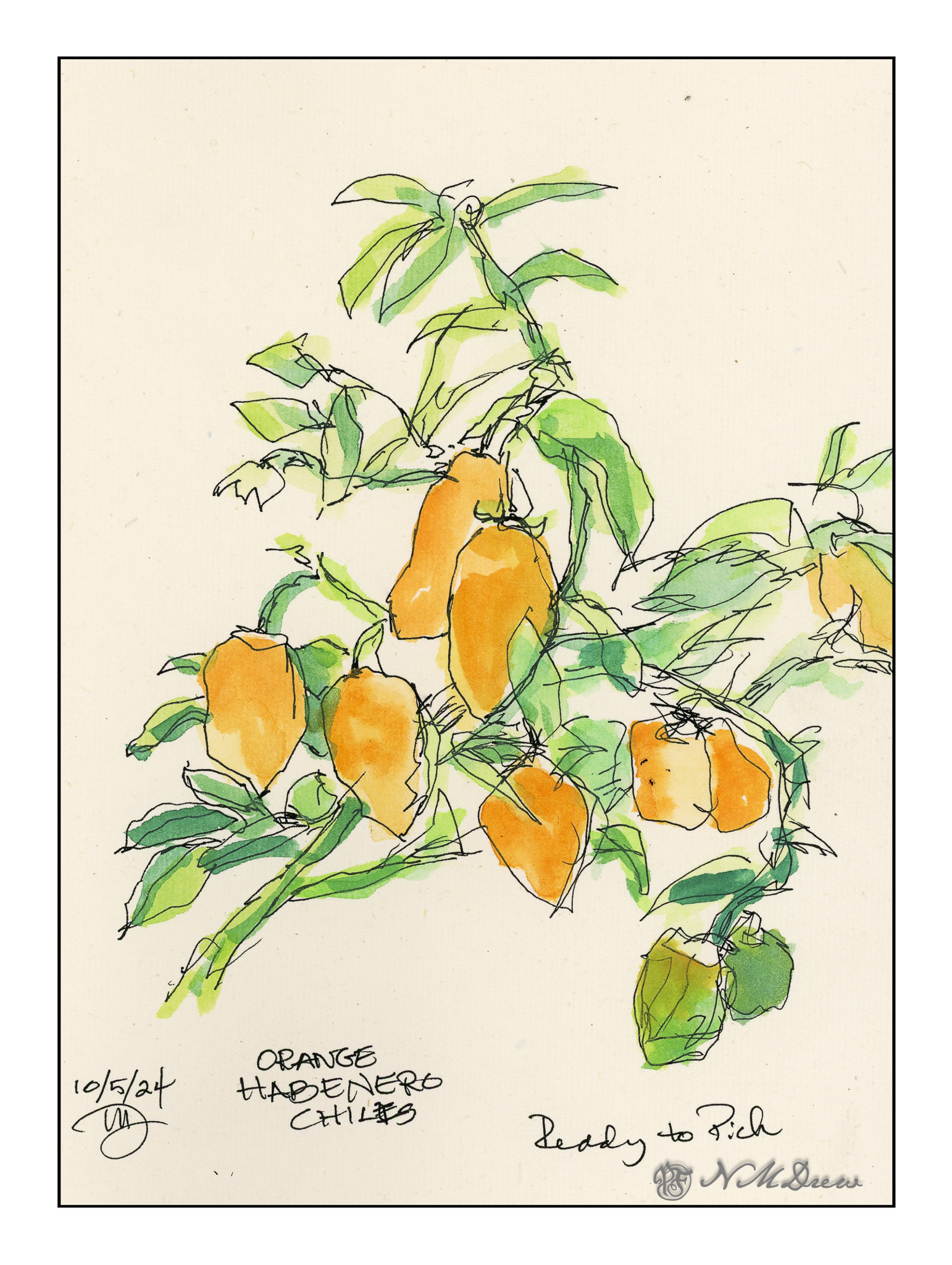
My vegetable garden this year had some oldies which I know work well, and some new ones, some of which worked and some of which aren’t worth the effort. Above, orange habanero chilis. We usually do pretty well with these.
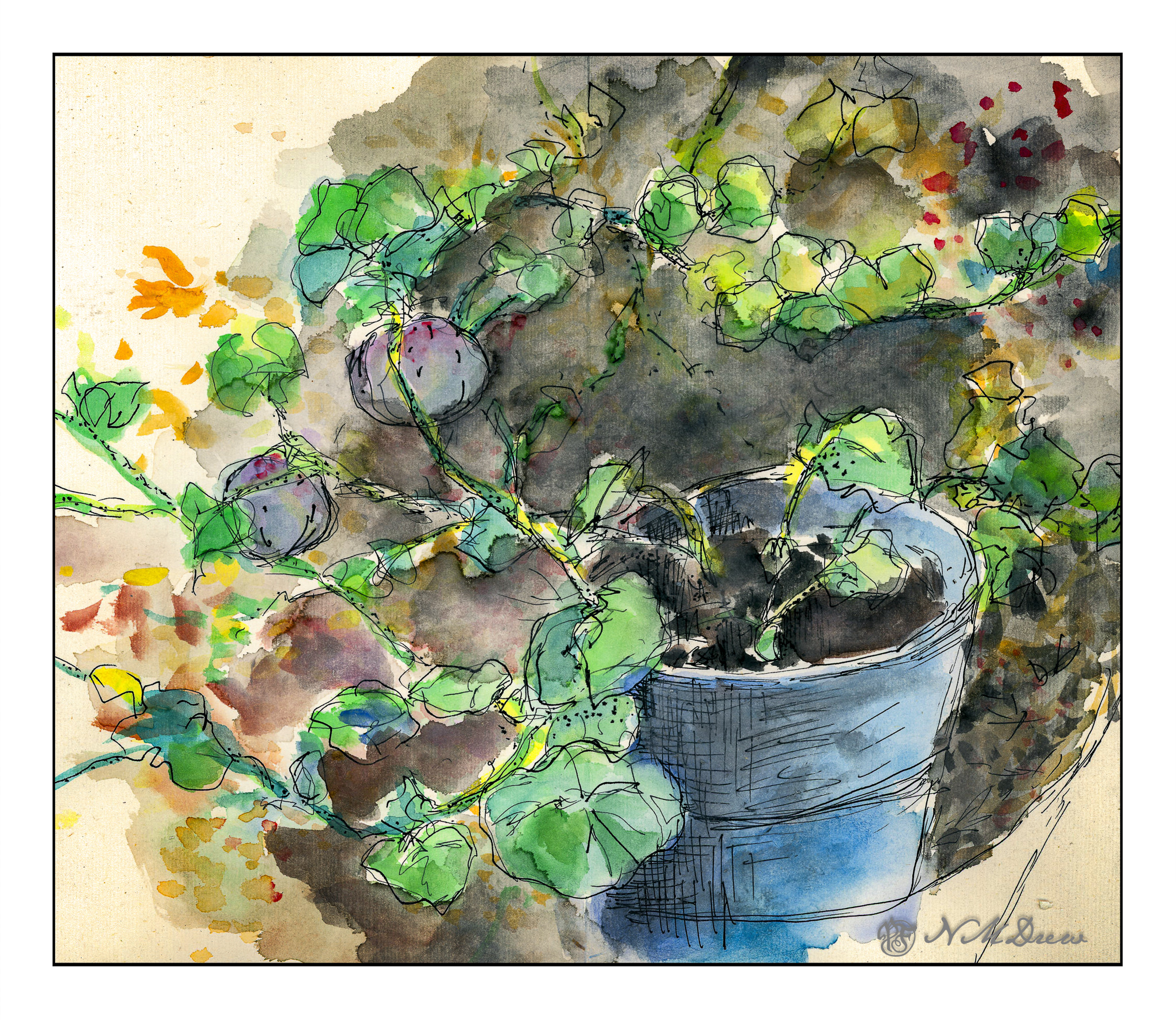
This drawing is of my heirloom Strawberry Crown Squash, a hard winter squash. I planted a bunch of seeds in a 20 gallon pot, and pulled all but 4 out. I have never planted winter squash, much less in a flower pot, but they seem to have done quite well. The vines grew and flourished and produced a lot of flowers. The vines were about 20 feet long each and moved across the dirt of the back yard with the sun.
But, I only have 2 winter squash for all that! I haven’t harvested them yet, but expect I will in a few days. I wonder if I need to learn about the art of winter squash gardening – but why?! Pumpkins are so prolific!
I don’t have room for a garden as I don’t have any place that isn’t lawn or just dirt. The back yard is a disaster as I still need to remove 11 or so trees whose roots jut out at all angles in the back yard. Until the trees and roots are gone, to the tune of a small fortune, container gardening it is.
These were sketched in a fan-fold Chinese sketch book. The paper is a creamy yellowish color, a bit tan, and very absorbent. It sucks color up so I had to do a bit of scrubbing to even lay in a wash of any size. Scanning, too, was difficult and that can be seen in the drawing of the winter squash. The differentiation between the dirt and squash leaves is not as muddied as it is here.
Watercolor and ink on paper.
In early July I flew into Bend, OR, to visit an old college friend. We drove to the coast, staying in Newport, at an area known as Nye Beach. One of our outings was a trip to the Yaquina Head Lighthouse. The area was beautiful and we spent some time in the visitor’s center as well as wandering around. Of course, photos had to be taken.
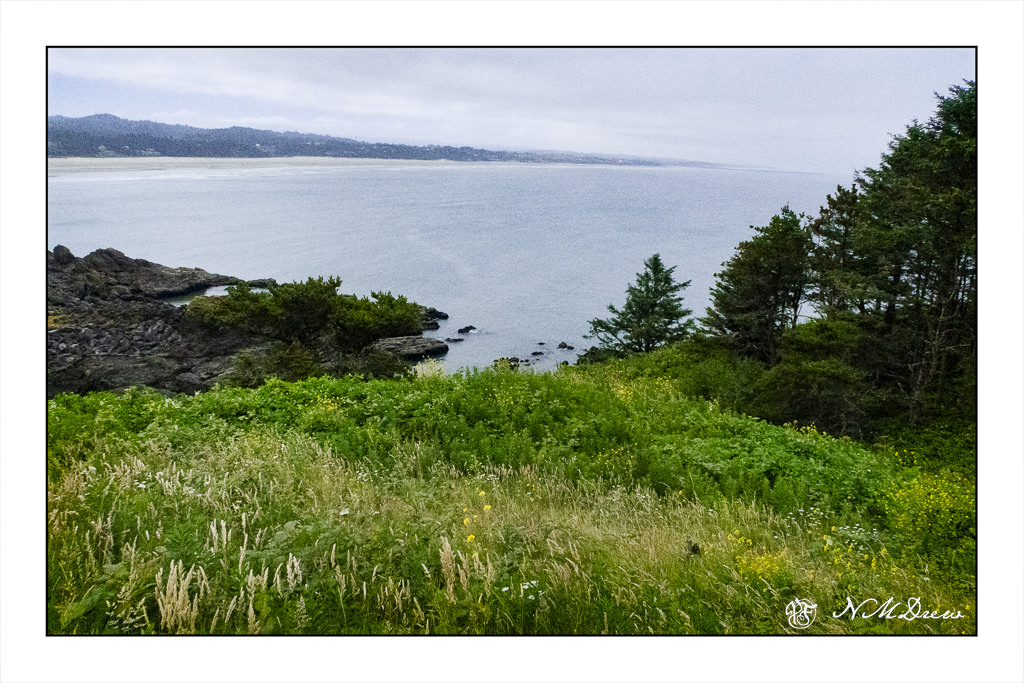
The day was overcast and rather cold and gloomy – I think maybe 60F at the most in the dead of summer! Wind, too. Despite that, it was a great place to be, in part because of the whole area is so different than Southern California, as it is very lush in summer, rather than our drying vegetation and overall beige coloring. Here, the view is from a pathway leading toward the lighthouse, looking across the cove to Newport. You can see the wide expanse of beach, which is very flat, leading to another headland where I think another lighthouse may be found.
Every Tuesday I spend about 2-3 hours in my painting class. We paint what we want, but have a wonderful pair of teachers who give good advice. Classmates are friendly. Altogether, it is a good place to spend time for many things. I thought this photo would make a good landscape, so I decided to paint it. Initially, I had used acrylics, but it was flat and uninteresting, and the graphic effect I was trying to achieve wasn’t there. Acrylics may be painted over with oils, but not vice-versa, so I already had the colors, values, and mood laid out – and the oils proved far more satisfactory in the end.
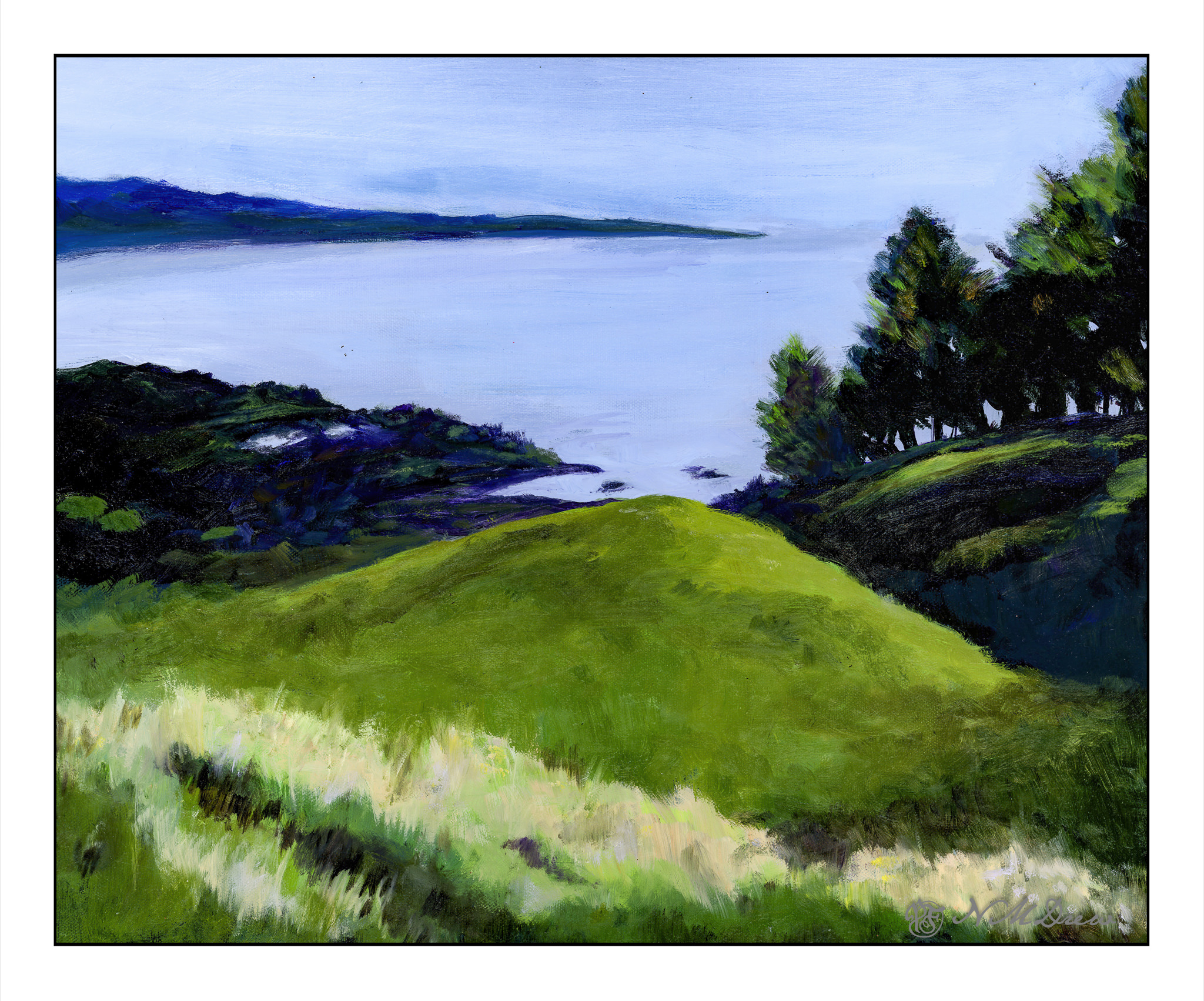
Scanning art work is always a crap shoot and I had to do this a few times to get it to my liking. I did manage to capture mood and color. The overcast day dulled the original greens but in post with my photo, I brightened things up to my liking. It may be that the dull colors of my SoCal surroundings really make me push the greens, but the photo was the basis of the painting, even if not reflecting reality quite as it was.
I spent about 3 classes doing this painting, reworking it several times, especially the foreground. In the end, I am rather pleased. It is a bit gloomy and dark, but so is the photo.
Oils, 16×20 stretched cotton canvas.
Tomorrow is a family gathering, quite possibly the first since last year. This morning I cleaned up clutter and sorted out things, did all the first-of-the-month stuff, and so on. Meanwhile, the esposo is working from home and making both beef and chicken barbacoa in between saving database lives. I have already run around town collecting goodies, as have other family members, so we call enjoy a bit of a feast and each others’ company tomorrow with good food and good company.
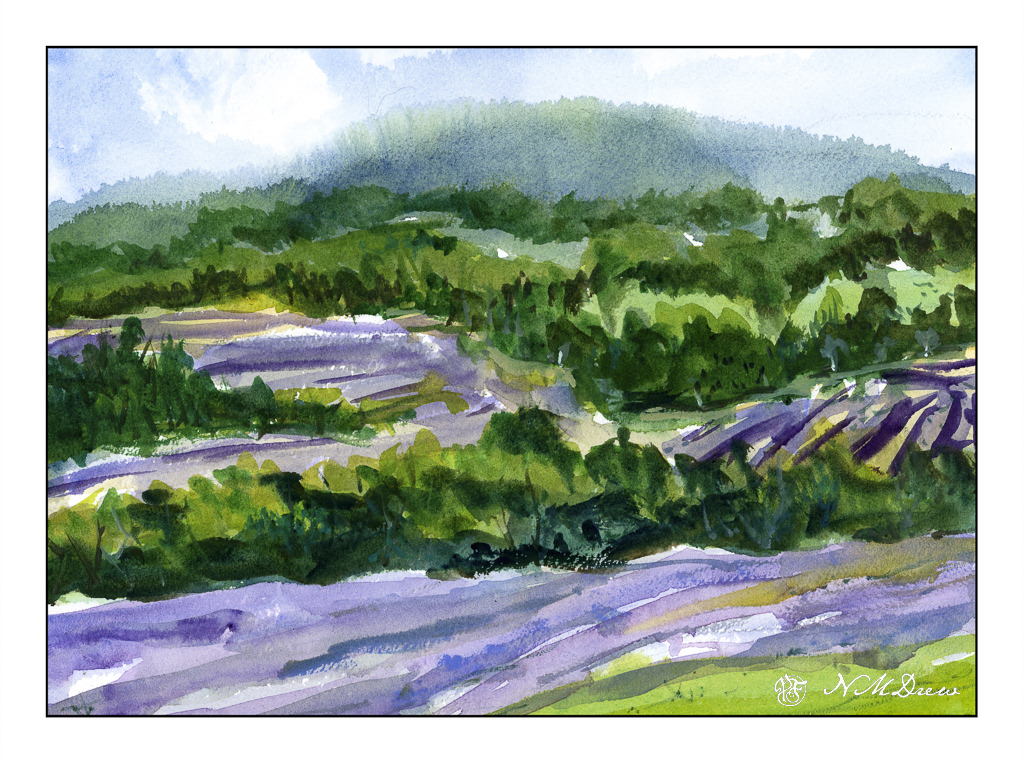
Of course, a girl can only do so much and then the painting gods and goddesses beckon. Once more, lavender fields call, so here some are for your enjoyment.
Technique was primarily wet, beginning with they sky and distant mountain and trees, letting things bleed into each other. I like the misty effect and sense of distance it creates, as well as the suggestion of tree-covered hills. From there, greens and lavenders, lines and directional shapes. Final details were some dry brush lines in the foreground and in the tree shapes to create texture and vertical movement. I used a large mop brush (#6, Princeton Neptune) for the entire painting until the end. At that point, I took a small stiff brush to add some of the finer lines and dots.
Part of me thinks I could have done a bit more of a light lavender color, but overall, I am pleased with this painting.
Watercolor, Arches 140# CP paper, 9×12.

Sometimes we ignore one hobby for another. Photography is one of those. My focus of late is on other adventures, but looking through old photos – digital or analog – is something always worthwhile. All looks different from the distance of time. Here, some daffodils taken last spring with my Nikon Z6ii and 50mm lens, and modified to match this morning’s mood, which is rather grey and gloomy and monochrome with a bit of color.

