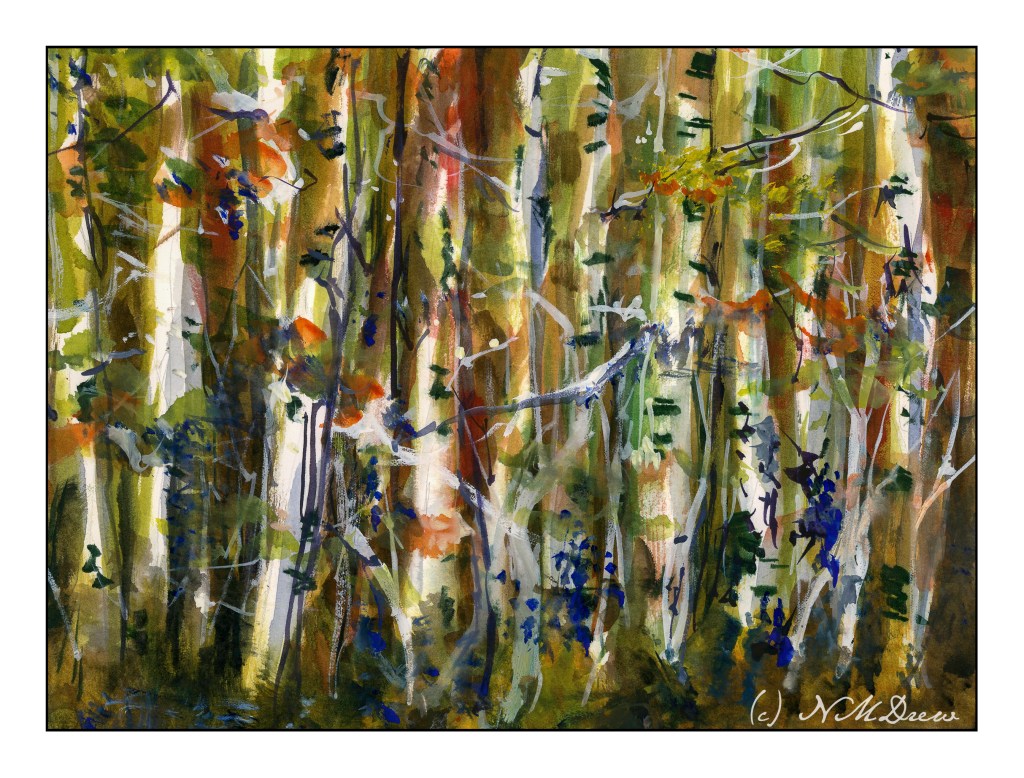
Another adventure in negative painting. As I have mentioned earlier, trees are a very good way to practice negative painting.
Here, I painted around the white trunks, and then more tinted trunks. I couldn’t find myself getting rigidly graphic with this, and just did a splish-splash approach. I also think I did a fairly decent job of moving from a dark, shady forest floor to a more sunlit canopy.
In the end, I used some white gouache, too, and rather like the vibrational energy of it all.
Another floral study following a YouTube video. This one is by Lois Davidson, whose technique is much different than the “Bowl of Roses” video.
I rather liked this one. There were some little things in doing it that I hadn’t done before. I’ve sprinkled colors onto wet paint, but never dropped in sprinklings of water. That was fun. Also, the sheer joy in painting splotchy flowers is always a delight but I did have to think a lot more than it looks – working light to dark requires forethought and patience. To me, watercolor painting is like haiku – it takes a lot more work than it appears to need!
A long time ago I realized that, when trying to figure things out, I had a better and more honest sense of the problem if I asked myself “What?” Not “Why?” or “How come?” – those just elicited emotions, not thoughts, not a rational sequence that could handle emotions and thoughts. Often feelings of inadequacy and thoughts of being wrong or inferior came along with the “Why?” and “How come?”
“What?” does not produce emotional reactions and a need to defend. Instead, it is a moment to pause, to think, to follow things back to whatever the source. For example: I am angry. “What caused me to get angry?” After that comes and answer, and from that answer another “What?” can follow. It can be a long or short journey, but I find it brings about understanding of myself, a stepping into the world of another person or an event, and not feeling as if the world is collapsing around me because of my inadequacies, real or imagined.
Just the other day I read a study about reducing stress. I can’t remember where I found it,but it applied the same principle – word choice. Stats I recall showed that there was a 25% reduction in stress with people saying “Let it go” to themselves for three minutes. On the other hand, better results were from “Let it be.” Those stats showed a 45% reduction in stress.
Think about it. “Go” means action, decisions, choices, right and wrong. “Be” means to exist: It is.
Our mental life is how we see the world. “Mental” implies thought, but includes emotion. Emotions are all sorts of things, from paranoia to joy, and can be caused by experience as well as brain and body chemistry. We are very complex, and far more complex than we even know, although our knowledge grows.
Some famous person in 17th century England had mental problems – for the life of me I cannot recall who. However, I found the comments about him, perhaps even by him, mentioned the need to have a disciplined mind to cope with his problems. Was he bipolar? No idea. In those days, reasons for mental problems varied, from satanic possession to poor humors. But the life of the mind can rescue and help. I believe today we would call it “Rational Emotive” for therapy, or “Emotional Intelligence.”
Whatever it is, the internal dialogue can reward and punish. Learning how to listen and how to have meaningful internal conversations can color our viewpoints, our reactions, and our choices.
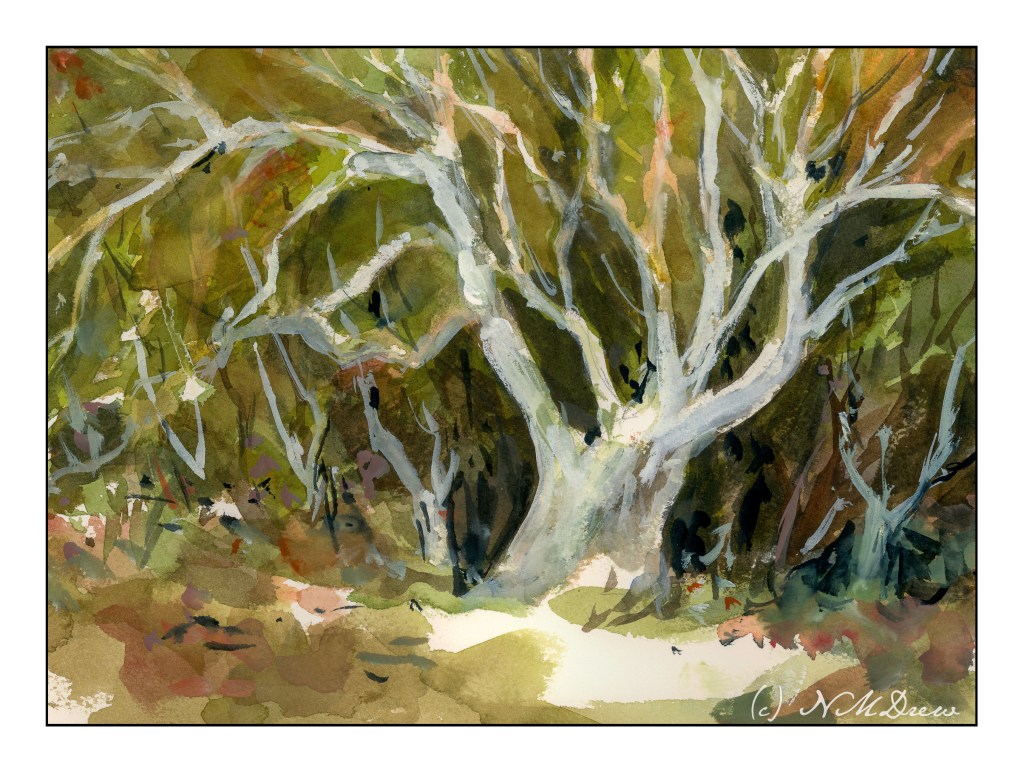
Negative painting is painting around a shape. Positive painting is painting an actual shape. The first is hard to do. The second less so, but the skill of negative painting is necessary and can produce some pretty dramatic results. It is also a skill if you don’t want to use liquid frisket to block off areas to keep white. Positive painting sounds easy, but it ain’t. (My flower paintings are evidence of this!)
A common exercise to show the learner how to do negative space is to paint a tree, paint around it in a light wash, draw another tree on the colored wash, and then paint around this, until you have a lot of trees ranging from white to the varying values of the wash. Sterling Edwards has a lengthy but very good video about this method:
While I know about negative painting, and have stated it as one of my goals, along with flowers (which benefit from the skill of negative painting), I thought this was a good one of the many I watched. What I liked was how he blends his paint inward.
Anyway, I did trees. Rick Surowicz is also a master at negative painting, and if you look at Edwards’ paintings, and those of Surowwicz, you will see both apply the same techniques. In my painting, I used Arches 140# CP, 9×12. I outlined the tree, and then painted around it. At some point I was frustrated and decided to do some painting with white gouache, on both the primary tree and then adding others.
Overall, I rather like the effect, particularly after adding the gouache. I think it enhanced the painting rather than making it just another annoying experience! I used to be quite rigid about not using gouache, much less gel pens or diluted acrylics in my watercolors, but rules exist to be broken, and I expect purists would call this “mixed media” – but that no longer bothers me as much as it used to. Watercolors they are (water soluble), so watercolors these remain.
We can all agree that homegrown tomatoes are the best! I also have some lettuces.
Even with water restrictions in place, we are able to do some gardening. The drip system is working well in the front yard. This weekend we will install the emitters on the patio plants. Not all will get water as some are at the end of their lives. We also need to decide how much water to give each pot.




 Ink, Yarn & Beer