A Class with Rick Surowicz: “Abandoned” (Day 3)

One thing that makes Surowicz’s online YouTube videos, and now his class “Abandoned”, is the fact he is very informative about color mixing.  Color is essential to convey distance – foreground and background – light, warmth.

Today I worked through 4 studies of color, using for the greens cerulean blue, raw sienna, burnt sienna, and then some pyrrol red to help temper the green.  The neutral color is made up of burnt sienna and ultramarine blue.
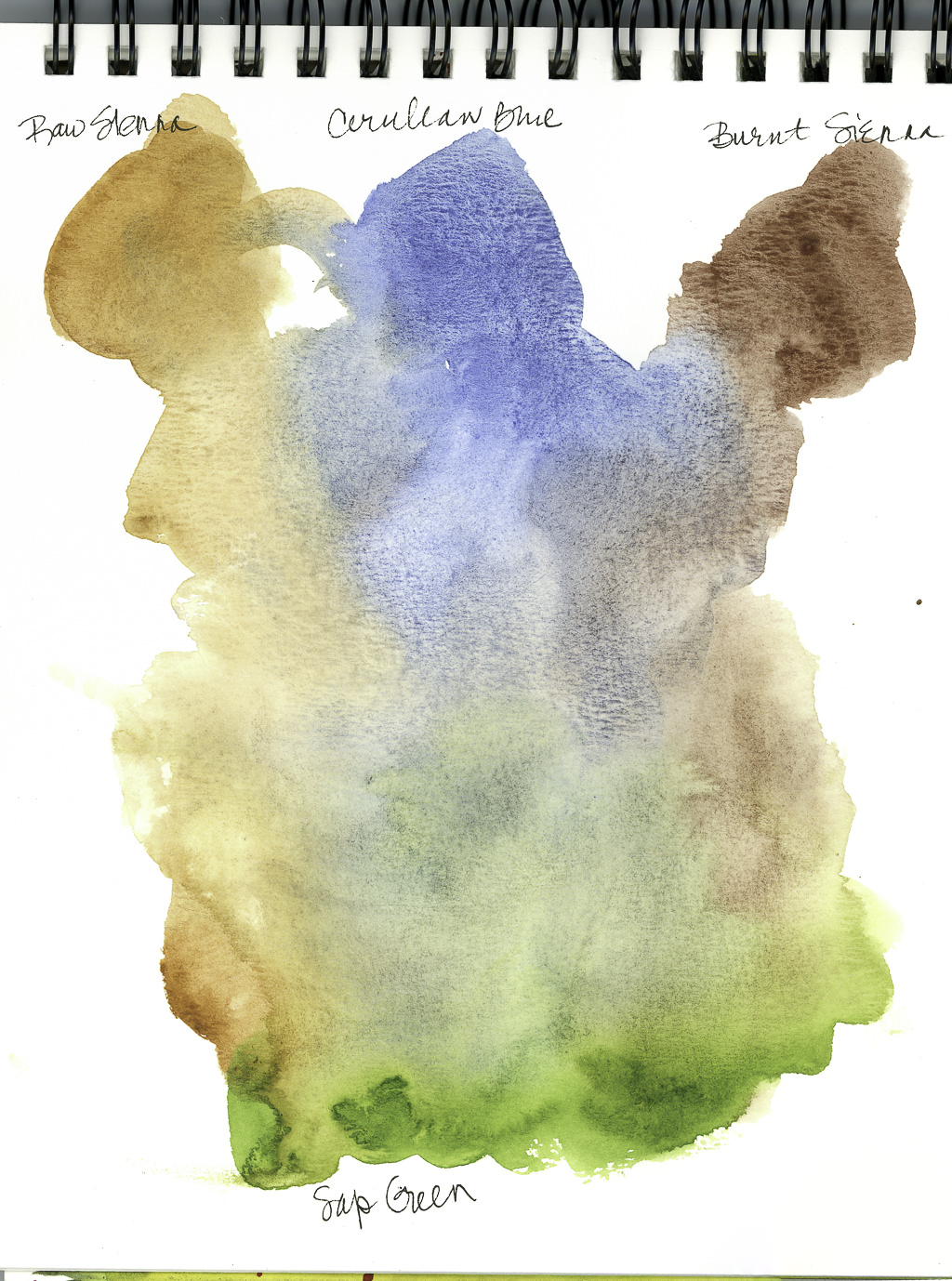
This scan is of the first study.  The cerulean and siennas were at the top, sap green at the bottom.

Surowicz says he mixes his color on the palette, which he demonstrates, using large areas to get a lot of color.  He rinses his brush, blots his brush, and varies the amount of color on a brush to determine how light (more water) or how dark (less water).

These little swatches show not only color that is strong, but how they merge and blend when more water is added.  The studies are for warm and cool greens, but I find it hard to determine them.  The following studies are supposed to demonstrate the warmth and coldness a bit more.
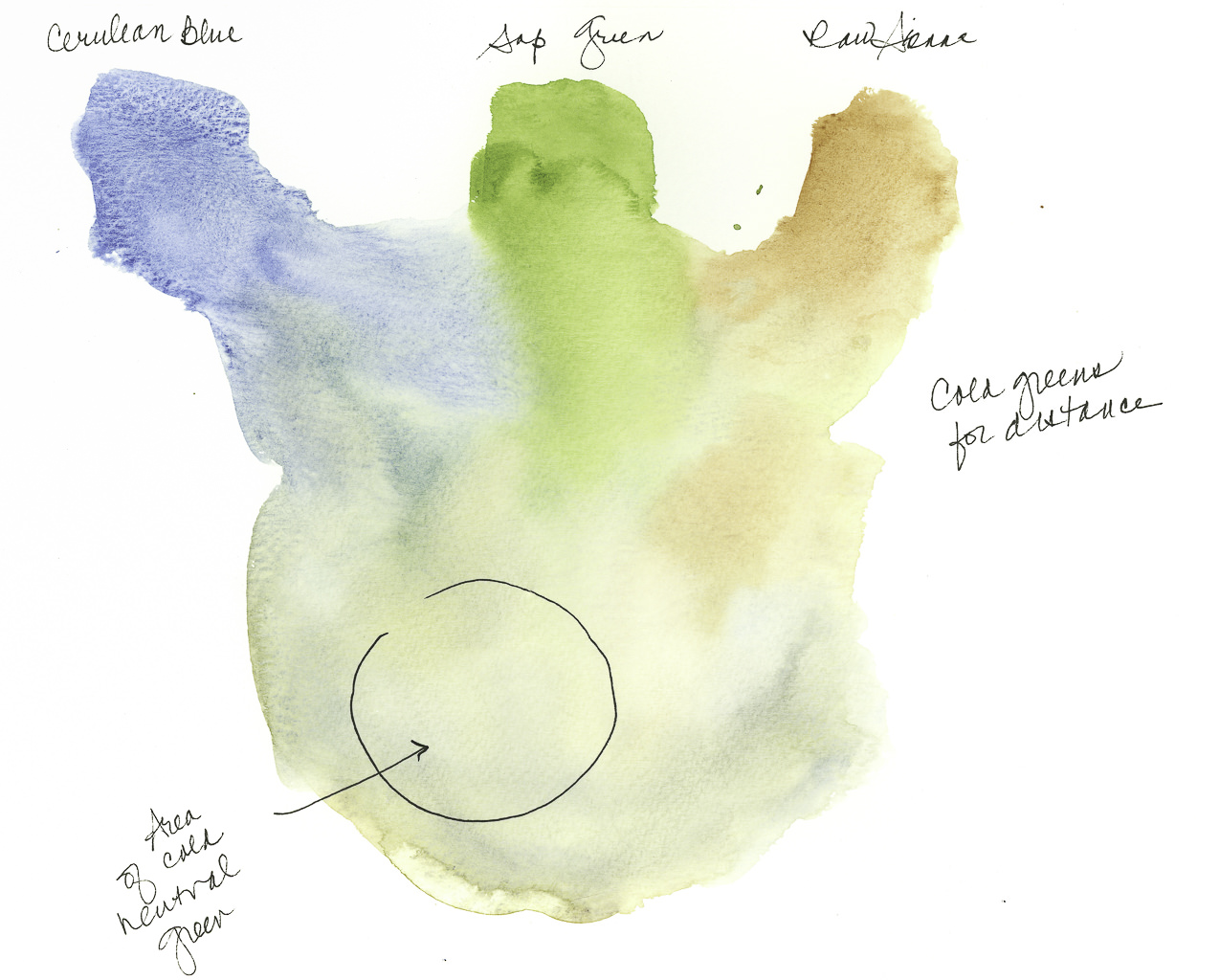
Here we have a formula for a cooler green mixture:  Cerulean blue, Sap Green and Raw Sienna.  The area circled is demonstrably a cold green.

Here we now have a formula for a warm green:  Raw Sienna and Sap Green.  The addition of the Cerulean Blue is what makes the mixture cold.  The two colors by themselves create a warm green, and the formula is not one I would have considered prior to this class.  The Pyrrol Red is used to move the green to a more neutral state (red and green are complementary, and can negate each other when combined), but more green may be needed to return it to green – Pyrrol Red is intense! The red is also warm, so the green remains warm, even if neutral.

Finally, the well-known (at least to watercolorists) combination of Burnt Sienna and Ultramarine Blue.  This is one of the most useful color combinations as it can range from pale to almost black.  Many watercolorists use the two as a replacement for black.

Thoughts

This section of the class is really valuable to me.  I actually can see the warmth and coldness of the greens in these color combinations.  That is very important.  Conceptually it is very important for me as I lack depth perception and am a magpie when it comes to colors.  Subtlety is not in my vocabulary.  However, that doesn’t mean I do not have an appreciation of soft colors – they just are not my first choice!  The neutral tones with the Burnt Sienna and Ultramarine Blue are some of my favorites, but it was a good study to remember the softness they can achieve as well.

Note

Because of Inktober 2019, I may not get a chance to view “Abandoned” every day and practice, but I don’t want to allow more than one day pass between sessions.  I am really into this class and enjoying it a great deal!

The Muddy Palette

Before I knew that gouache works best fresh out of the tube, I filled a palette up just as I do with watercolors.  Let’s face it, paint ain’t cheap, so I wet these paints over and over.  Finally, most of the colors are used up and it is into the sink to soak for now!  In the future, fresh paint.  That will be a really new event for me because I don’t tend to paint like that.  I made swatch cards of all my gouache colors (more than 20, less than 1000), so I plan to use those as I consider paints in future paintings.

WWM #12: Blossoming

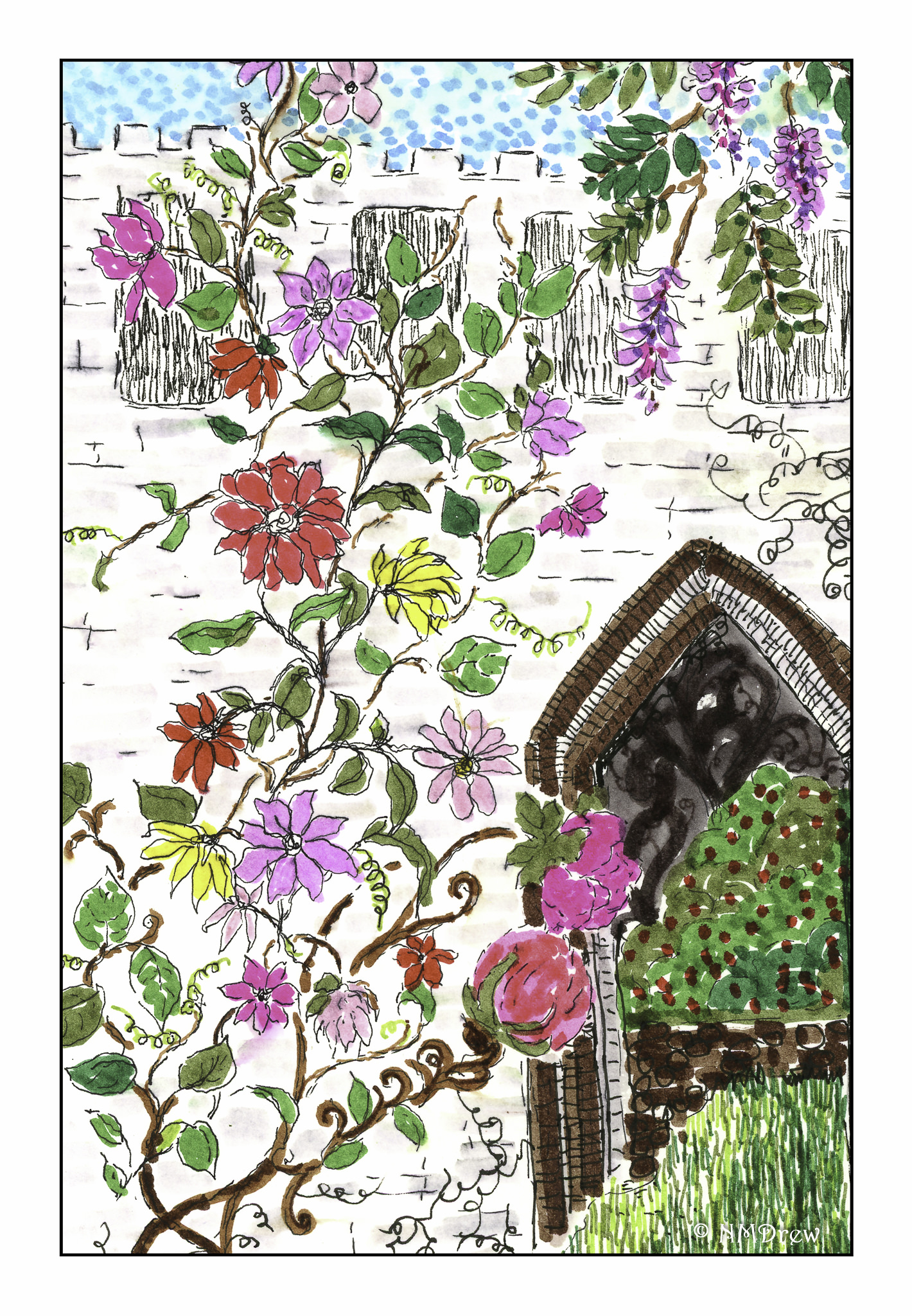
Old country houses, castles, abandoned churches – all returning to the earth – and the abundance and destructiveness of nature, relentlessly taking over that which is not cared for, in Nature’s own fecund rabidity.

Okay, enough of that!  Rambling vines and roses, grapes, trellises – flowers cascading everywhere in profusion and fragrance.  That’s my kind of garden.  If there is a relic or two along with the plants, I think that is a pretty cool mix!

WWM #9: Shadow Play

Today is another gouache, and I will say it is beginning to feel a bit “natural” to be painting in gouache.

Doing all the waves the other day got me in touch with that sensuous quality the paint has when it has a specific texture, as well as the dry brush effect when a bit of scrubbing is needed, and when the paint is very thin.  Each requires  different ways in which the paint is controlled, by how much water is added, what is below the layer of paint you are adding, and what you anticipate adding later.

One thing I did learn in today’s painting is the value of the hair dryer – I used it so much in this painting, nearly after each layer of paint.  This got the paint as dry as it should be and it kept me from working more quickly than is appropriate for gouache.  The result was much more pleasing in my opinion and a lot less frustrating.

In painting this window scene, I wanted to accomplish a couple of things.  One was a more “painterly” style – a bit looser than say the butterfly of yesterday.  The other was to see if I could express the varying light of the shadows as the flowers were buffeted in the breeze.  If you think about how shadows move, they flutter, getting lighter at times, getting darker, as the breeze moves the flowers on the sill.

WWM #7: Shiny Things

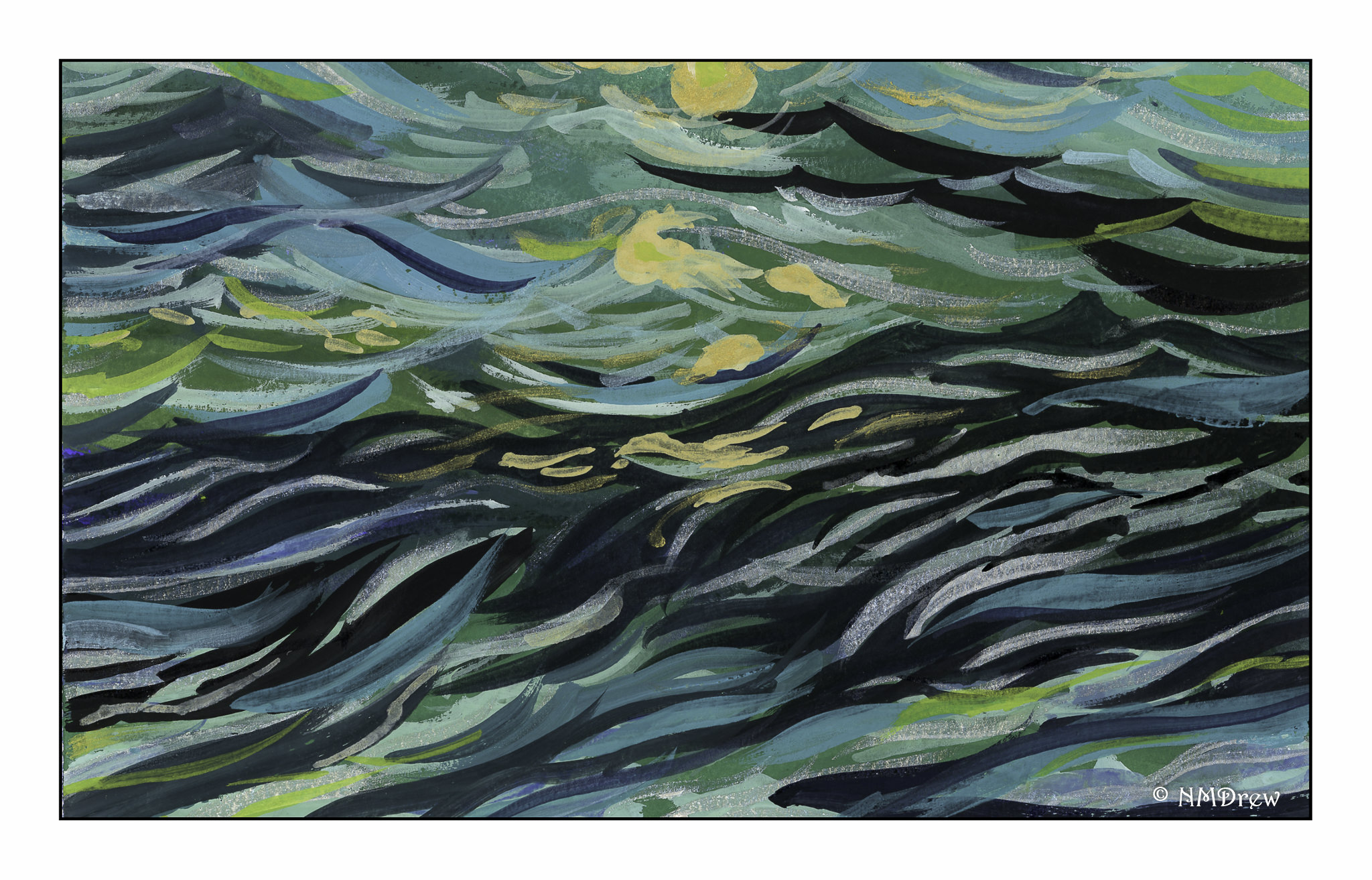
Shiny things . . . like a magpie, we are all drawn to things that glitter and glisten.  But what to paint, and in gouache?  In watercolor, perhaps a metal spoon or bowl, complete with sunshine glinting.  In gouache, though, the possible deepness of color as well as having a few metallic paints, I thought of water.  Water is always shiny, at night with reflected lights, during the day as the sun and clouds pass overhead.  Even when the weather is foul, water reflects and shines.  Painting this was a rather sensuous experience, which is perhaps why I am enjoying gouache more and more . . . and water is certainly so on a warm summer day.