Playing with Paper and Watercolors

I have had a tablet of Strathmore’s Vision watercolor paper, 140# CP, lying around for some time but did not try it out until today. There are some things I liked about and some I didn’t like. Strathmore watercolor papers and I do not get along at all for watercolor painting, yet I really like them for acrylic and gouache. The papers’ textures never agree with me and with the Vision sizing seemed questionable. Canson XL is another watercolor paper I don’t like for watercolor painting but really enjoy for a lot of other things.

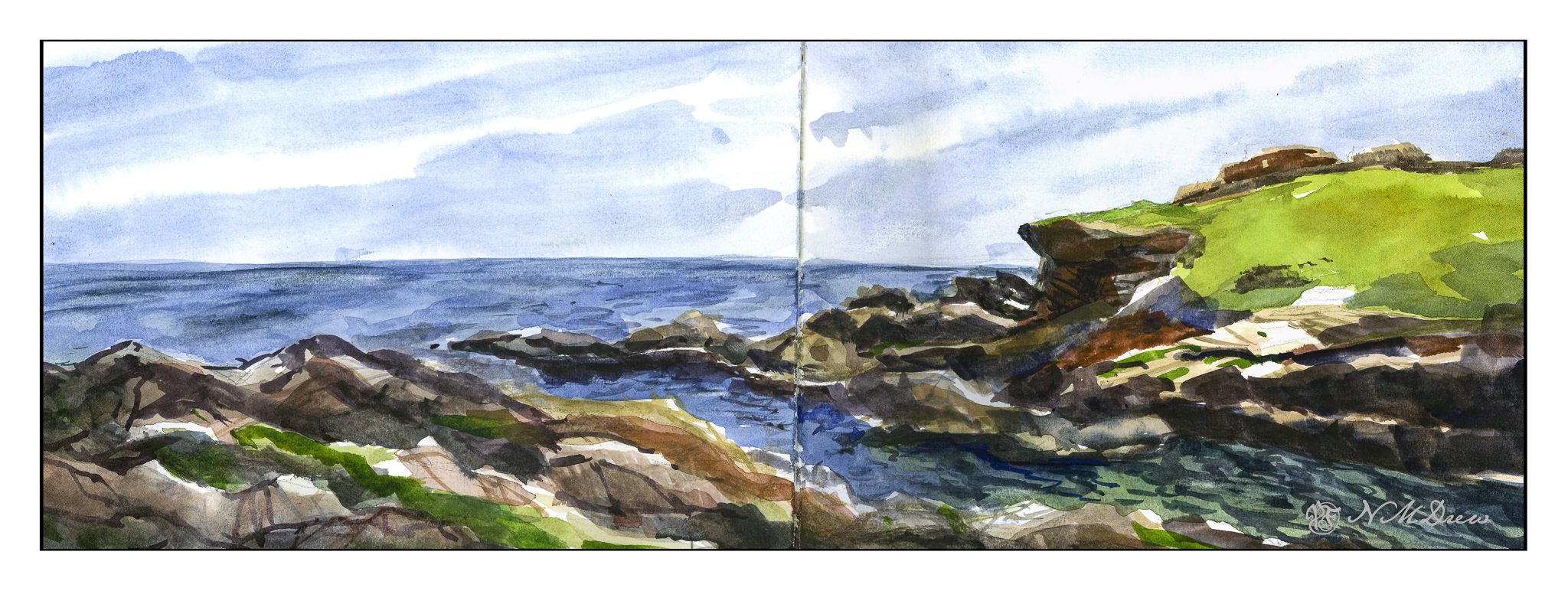
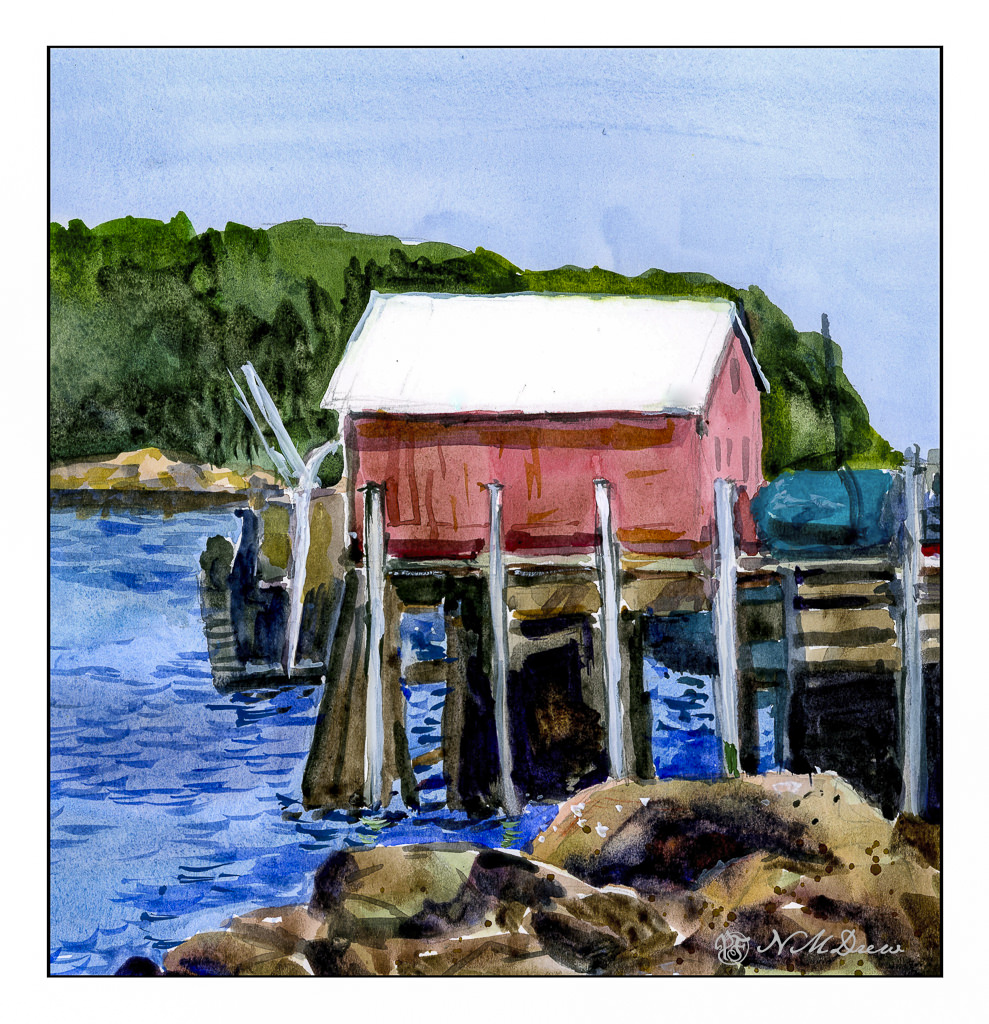
This is the first study I did – simple, free-flowing watercolor. The purpose was to lay down color with a bit of density, not overworking either paper or painting. I found it handled direct painting without any lifting or scrubbing quite well. I could paint over dried paint easily – such as where the darker blue wave shapes are – and add gouache to create a bit of sea spray or foam. Blending colors into each other as I moved the brush along in a wash worked well, too. Off to a good start!

This was the second painting. As with the first one, I did direct painting for the most part – specifically the middle and foreground – and used many of the same techniques I used in the first one. However, on this one, I did the sky differently to see how a specific technique could work with this paper.

Clouds are white, right? Well, yes and no. Upper clouds can be quite bright and the paper is usually left untouched in watercolor to show it. To paint a sky with clouds you can use a lot of techniques, but here I chose to wet the paper around the cloud shapes and drop in the blues for the sky and then move the paint around a bit. Once dried, I dropped fresh water into the cloud shapes, at the lower ends, and then added greyish blues to represent the shadow on the underside of the cloud. I have not really worked with this technique, but I have been meaning to check it out, so this seemed to be the perfect opportunity.

I think Vision paper might be able to handle this technique for painting clouds, and I want to practice this technique more before deciding it will or won’t work with this paper. I know that scrubbing the paper will mess it up and as a result I have to be prepared to work very directly. This keeps a watercolor fresh and clean rather than overworked and ugly.

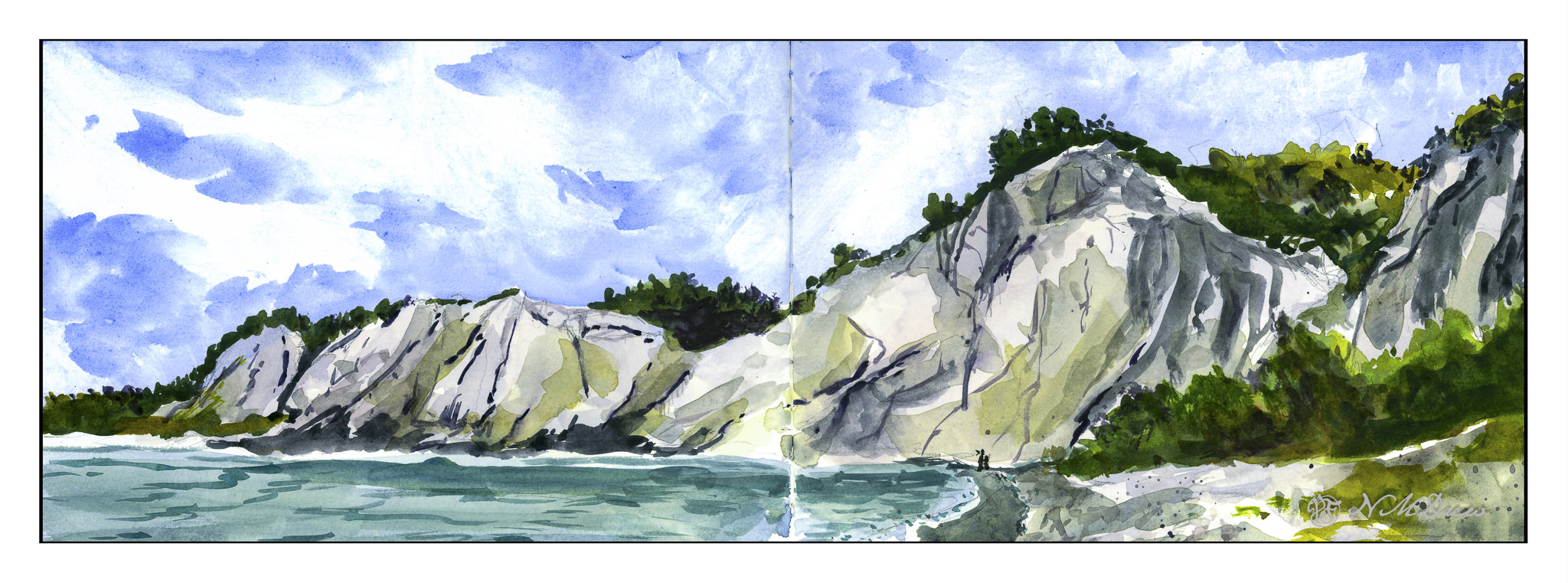
Here, I tormented the paper! I laid down a wash on the upper portion of the painting and then scrubbed out the paint for clouds. Then I came in a few more times and did the same. Some of the paper peeled a bit with the harsh treatment. This is good to know – how much damage can I do??

From there, I did the middle and foreground. The middle ground was pretty directly painted in one go, meaning one layer of color for the most part. I like the way this paper allows heavy paint to merge and blend as it makes for more interesting color areas. The foreground water and reflections is a series of washes, one laid atop the other once the underlying one is dry. I think in some areas I did up to 5 layers of glazing. Other areas I did a bit of wet-in-wet without a lot of scrubbing – just a gentle swipe of the brush.

Now here comes a complaint. In the lower right area of the painting you can see what looks like a thumb print. This is not – it is an area where the paper sizing is not good. You can also see problems with sizing around the upper and right edges of the paper. Poor sizing can ruin many a painting, and this is why professional watercolorists and amateurs alike go toward 100% cotton rag papers from reputable manufacturers.

Overall, I like this paper. I think it is really good for direct painting. Pleasingly, the paper does not buckle and ripple with fairly wet paint, but I have yet to lay down a traditional wash that covers a large area of the paper. That will be another experiment for a future posting. The sizing issue bugs me, but that is okay as this tablet of paper was not expensive. I prefer Vision to the Canson student watercolor paper for a lot of reasons, but in particular the way it handles pigment on its surface. I can see using this paper for practice, for studies, for preliminary work on a “serious” painting. Would I recommend it? Yes – but with some caveats.

Today has been a lot of fun. Being immobile is making me quite dull and uninterested in doing anything, but at least the boot is making life a lot less painful. Yesterday morning I met up with a friend, hobbling a short distance and then basking in the beautiful outdoors for several hours with a good bit of chit chat, croissants, and delicious coffee. Socializing and watercolors always make my day . . .

Watercolor, Strathmore Vision student paper, 140# CP, 9×12.

Lands End, SF

I think every country has some form of a “land’s end” – at least if it borders on water, like an ocean. Lands End in San Francisco, CA, is a park overlooking the Pacific Ocean and part of the Golden Gate National Recreational Area. It’s a beautiful, wild, windy place – and it has a ridge of Monterey Cypress as well.

Note: Click on the image to enlarge.

I did a quick sketch in pencil, just to get the general shapes of the trees and the land. I put in the tree trunks first as I wanted to be sure I knew their placement along the land. I used a mixture of blacks and greys, pale to dark, but initially light to indicate placement. From there, the foliage and the land. Once established, detail began, with dry brush strokes for vegetation and later for the leaves on the cypress. More than anything, I wanted a loose, windswept look with a sense of direction and sky.

Planning a loose painting takes a bit of forethought. I put in the tree trunks first, then some foliage and land. The sky was done after all these with a large, soft flat watercolor brush. Final touches came after all was dry. I made this into a panorama, spanning 2 pages of my sketchbook, to give a sense of expanse. In the end, I was rather pleased with this.

Koi pan watercolors, watercolor, about 8×18.

California Coastal Cypress

Stuck at home for the most part because of my ankle, I need to find things to do. It turns out that my ankle, while a mess of historical injuries, has no tears in the soft tissues. That is good. However, my heel bone has “microfractures” from the hard landing dodging the car last month. This is a bone bruise, and it is painful! I finally got into see the orthopedist, got a walking boot, and return in a month. The boot makes a big difference though it does take some getting used to wearing and using. I have to be careful not to pitch forward or backward. And you can hear me coming a mile away – squish, squeak, squish, squeak.

Of course, painting is the first choice! I am still tired intermittently from Covid, but I don’t have brain fog (at least I don’t think so), and look for things to enjoy but not be a source of frustration. Thus, ink and watercolor.

The Monterey Cypress is a tree that is common along the northern central coast of California. It is shaped by the environment as it moves with the wind and seems to grow away from the prevailing winds. To me, this quality is what makes it so beautiful and eye-catching. The coast is also subject to foggy days, damp and dreary, even in the height of summer.

Carbon ink, watercolor, Koi pan paints, about 8×10.

Flower Farm

Since my return from Oregon, a lot has happened, much of which just threw life into chaos. I still have a messed up ankle which limits my ability to walk a lot – couch surfing became a major part of my life because Josh and I got covid. I don’t recall being so sick but luckily I got Paxlovid and that seemed to make a major turnaround in how I was feeling. Josh didn’t, but he recovered although he is still coughing. With covid and a bad ankle, TV was my friend, as was endless sleep. Before we got covid, though, we had to put our lovely dog Smudge to sleep – but that is a story for another time perhaps. We just miss her.

My energy levels have been really inconsistent, some days I sleep a lot, others I feel like my old self. The biggest issue has been getting back into our lives – doing what we like to do and completing them. Josh has been insulating the garage, and I have been thinking about things to do. Finally I had the energy to clean up the house a bit, and the studio, and finally to just get it together enough to fill a pen with ink and find some paper and paint.

I did a pencil sketch first, and then inked in the above using Carbon Ink by Platinum. Very nice stuff! You can put it into a pen and draw without too much worry about clogging up your pen. I think it is a pigmented ink, but I may be wrong. It is different from writing ink because of its intensity and being waterproof, which most inks are not. After inking in the drawing and letting the ink dry, I erased my pencil sketch and scanned the image.

From here, just find the right pan paint set. This is one by Koi, and as it got a good review, I thought I would try it. It is inexpensive, but the colors are really nice and have a clarity and beauty that many cheap watercolor sets lack. Very pleased with the results – good transparency combined with richness of color.

It always feels good to get back to what you like, doesn’t it? Slow steps. I am so bored with not feeling good and hobbling around! Hopefully the visit to the orthopedist – delayed because of covid – will not indicate surgery for messed up tendons and sloppy joints. Ah, well.

Carbon ink, 100% cotton paper, Koi watercolor pan paints; about 8×10.

Oregon Coastline – Your Thoughts?

The Pacific Northwest – Oregon, Washington – has some of the most dramatic and beautiful coastlines. I could easily spend a summer just exploring them. The rock formations, deep beaches, wildness all hold such an appeal. Any rugged coastline fascinates me, and perhaps someday I will get to spend weeks in Maine, Nova Scotia, and other places of such beauty.

Today, I decided to revisit Oregon from a trip awhile ago. Sea stacks run out into the Pacific, some merely rocks, other crowned with pine trees. Take a look at the two paintings below – the same, but with a bit of variation.

This is the painting as it now stands – but what do you think of the one below?

They don’t vary a great deal – and I am not going to tell you what I did – but if you have some thoughts as to which you like, and why, let me know.

Meanwhile, painting this, I worked really hard to create a sense of depth. The photo I used was an overcast and rather murky day. The distant sea stacks were not much different in value than the nearer ones; the coast itself was a bit brighter. Overall, the light was flat here and twas a bit hard to conceptualize it altogether. I am fairly pleased with it, but as with any painting, I see areas for improvement, some I like, some I think are great, etc. Anyone who paints knows this!

Watercolor, CP 140# paper, about 10×12.