I like Nik Software, and own all of their programs, interfaceable with Lightroom. For a lark, I downloaded their Windows version of Snapseed. Quick and easy, this is a great tool for anyone looking for some fun. $19.99 here.


I like Nik Software, and own all of their programs, interfaceable with Lightroom. For a lark, I downloaded their Windows version of Snapseed. Quick and easy, this is a great tool for anyone looking for some fun. $19.99 here.
A whole day spent outdoors taking pictures! A first in the photo safari department for me.
I went with a friend, another novice in photography, and for both of us, it proved enjoyable and challenging. There is nothing worse than going out to shoot pictures with someone not doing the same – you know who I mean . . . the person who “patiently” waits for you to do whatever, “sneaking” glances at the wrist watch, sighing, texting.

The first stop was the Ventura Marina, and a walk south toward McGrath State Beach and the estuary of the Santa Clara river. The tide was out, halfway between high and low; the beach was broad and long, mostly deserted except for a few strollers and fishermen. The estuary is home to many birds, and provides breeding and feeding grounds. Gulls, terns, pelicans all roost here, and others I cannot identify. We set up our cameras on tripods, used long and short lenses, and played a bit. In particular, we enjoyed the pelicans, out on patrol, flying in groups or in pairs, toward Ventura itself. Often, they head out in the morning, after the first cup of coffee (some sleep in), and then return later in the day.
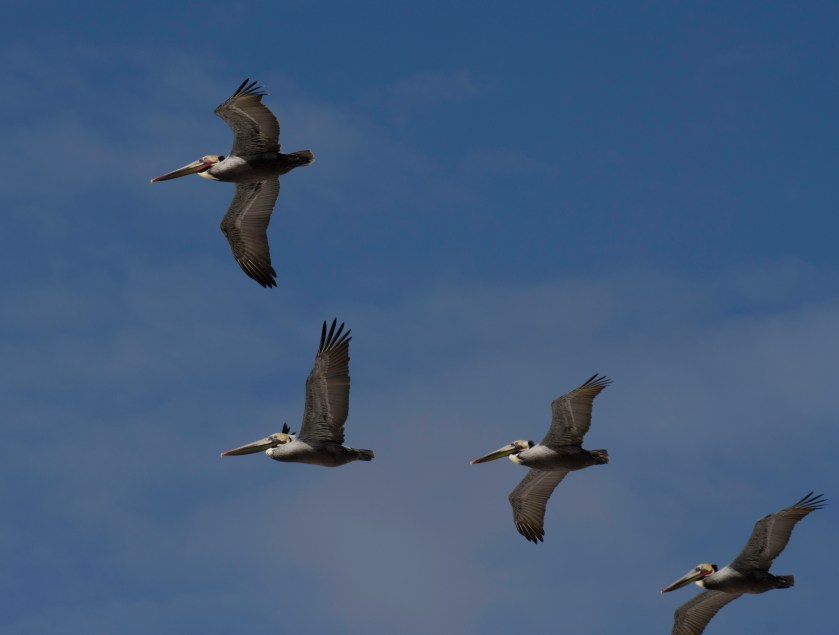
This really was my first attempt to catch birds in flight. I used my Tamron SP 70-300 f/4-5.6 Di VC lens – yes, long name – but it is a great lens! The VC stands for “vibration control.” This element, combined with autofocus and a short, short exposure time gave me the opportunity to catch the pelicans in flight, still and unblurred. The Nikon also can shoot up to 6 frames / second (I think); this also helped to catch them in flight, swooping in and out of the waves. Even with my camera mounted on the tripod, I was pretty pleased by being able to pan and shoot at the same time.
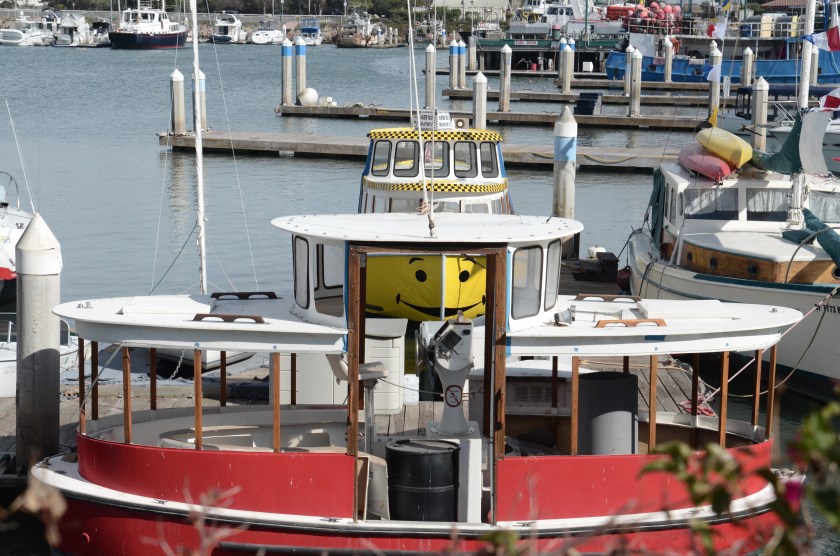

When we got back to the car, we tucked all the photo gear back into the car, and went to eat lunch. 3 hours on a chilly, windy beach, trudging through the sand, makes you work up an appetite. Some of the best fish and chips is to be had at Andria’s Seafood, so off we went a pile of fish. Then, back to the car to change lenses – I put on a 17-50mm lens – a wander around the marina itself, into the boat yard where numerous fishing boats are up on blocks for repair and repainting. Other areas explored were the commercial fishing area, tourist boat rentals, and down to the local museum for the Channel Islands National Park. Fishing boats are big, some very ugly, but always fascinating as far as I am concerned. I don’t like sailing unless doped up on scopolamine patches, or out in a brisk and wild wind on a sail boat – I get v-e-r-y seasick otherwise.

The little museum has a wonderful section of books, as well as a saltwater open aquarium which replicates tidepools, and there are windows on the floor you can peer into, meeting lobsters and flounders face-to-face, as well as looking in from above at starfish and urchins and barnacles. Behind the museum is a small garden of plants found on the Channel Islands. My favorite one is the coreopsis, which is odd as it has a thick trunk from which many bright yellow flowers erupt – it really looks like something Dr. Seuss might draw!

Finally, a decsion: head to a local beach park, or out to the pier. The pier won, hands down. Here, just a prime 100mm macro lens for me. I wanted the challenge a prime gives, as well as the macro element in case I saw something I really found interesting to look at close up. (I did . . . ewww! . . . someone’s used condom.) Once up on the pier, though, I had wished otherwise as the surfers and parasailing surfers were out in numbers. Despite that, there was a lot to see, above the pier and below.
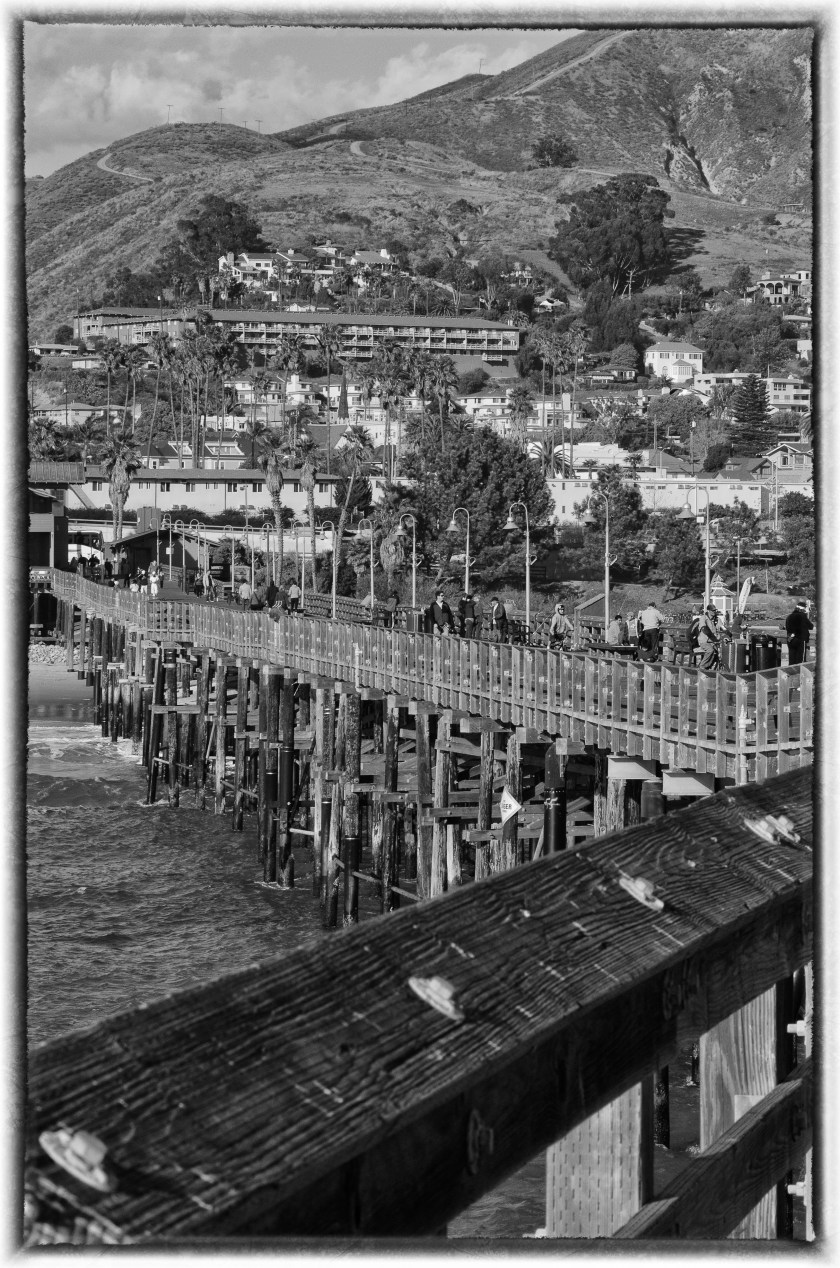
Gosh, I love digital! I took about 300 pictures, just because I could! Some had to be shot fast, such as gulls and pelicans in flight, as well as sailboats flying before the wind. Overall, I was really pleased with the lenses and their responsiveness. The Tamron 70-300 was fantastic in its response to distance and time and focusing. It was the first time I really put it through some jumps, and I am really glad I got it. The 17-50mm is also a Tamron, while the 100mm macro is a Tokina. I have some manual focus lenses, but I doubt I could have gotten some of what I did of the birds without automation.
Brrrrr!
My hands were so cold this morning! I wandered out of the house around 6:15 into a chilly morning (for us, for me in a long time!) of 35 F – just a few degrees above freezing! The goal: take pictures of the sunrise.
Did it work? Well, I got a few I like, a few that are hmmmms, and a lot that I think that the delete key is their raison d’etre.
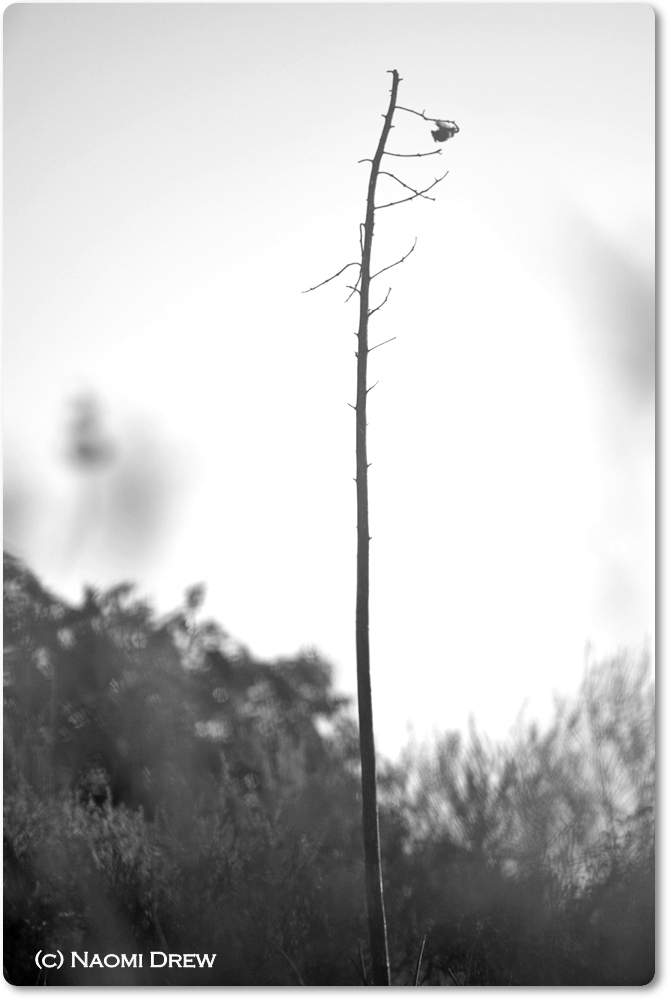
Nonetheless, I did have a blast. I had forgotten what it is like to be chilly or even cold – where I live, it is very temperate. I cannot recall the last time I was actually in snow, other than when I was living in Colorado in the 80s. I ran in and out of the house a few times before setting off – nope, a vest is not enough. Got a jacket, got a hat. Wished I’d had some gloves!
I headed up to Wildwood Park, climbed a slight hill, and parked myself amongst the sage and (I think) toyon and last year’s yucca. I metered in aperture priority, and shot a few shots. It was pretty dull stuff. Dropped the shutter speed to underexpose a bit. My fingers were getting very numb. The light was nothing exciting . . . until the sun began to climb over the mountains in the east. Suddenly, there was magic. The light began to change, the shadows moved, Mount Clef caught the sunrise and glowed.

I had two Nikon lenses with me. The one I began with was the 35mm f/1.8 G. The other was an old classic, the 105mm f2.5 AIS. The former autofocuses, the latter does not. Both are really good lenses, for different reasons, and I brought them for different purposes. I wanted landscape and a broader vista – hence the 35mm – but I found myself wanting an even wider lens. The 105mm was fine, and I brought it to work on manually focusing, checking if the little dot in the viewfinder really works. It does, but not if you are skittering about handholding the lens! Still, I got a few nice shots.
I did not go passionately hiking up hill and down to get my photos . . . nope, I rolled around in the dirt, in the stickers, scared some birds and cottontails. My clothes were covered in burrs and other debris. Out for a couple of hours with a few interesting shots, and a wonderful morning. It’s been awhile since I’ve watched the sun rise, and while there were no dramatic skies to shoot, the cold and activity, followed by a hot cup of coffee and breakfast, made a great way to begin a Sunday.
The other day I picked up a book on black and white photography, specifically John Batdorff’s Black and White: From Snapshot to Great Shot. He mentions using available light. With this in mind, and rather restless as I wait for the afternoon to pass before heading out to a swank party, I wandered around and came across my husband’s shoes on the table. He just polished them.
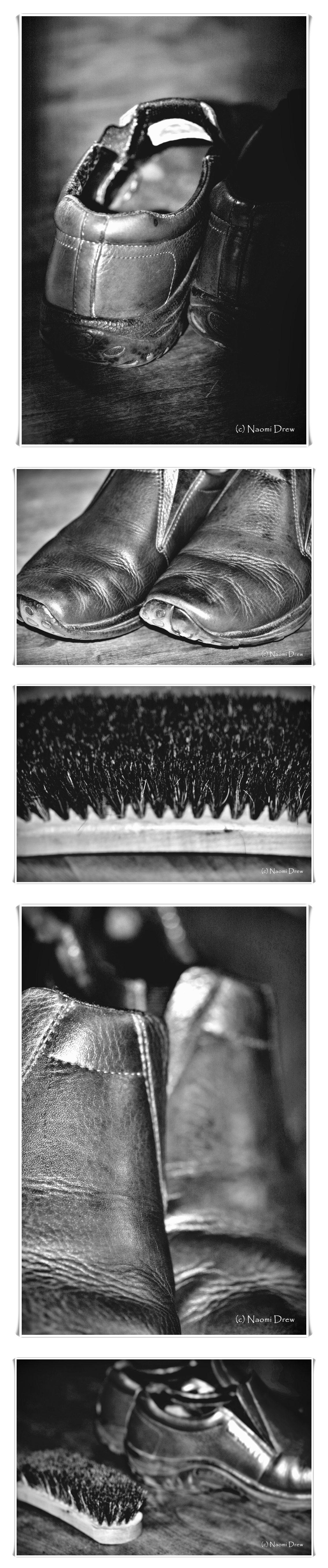
I used available light, and augmented a bit with some post-processing and on-camera pop-up flash for a few pictures.
As they say, work with what you got.
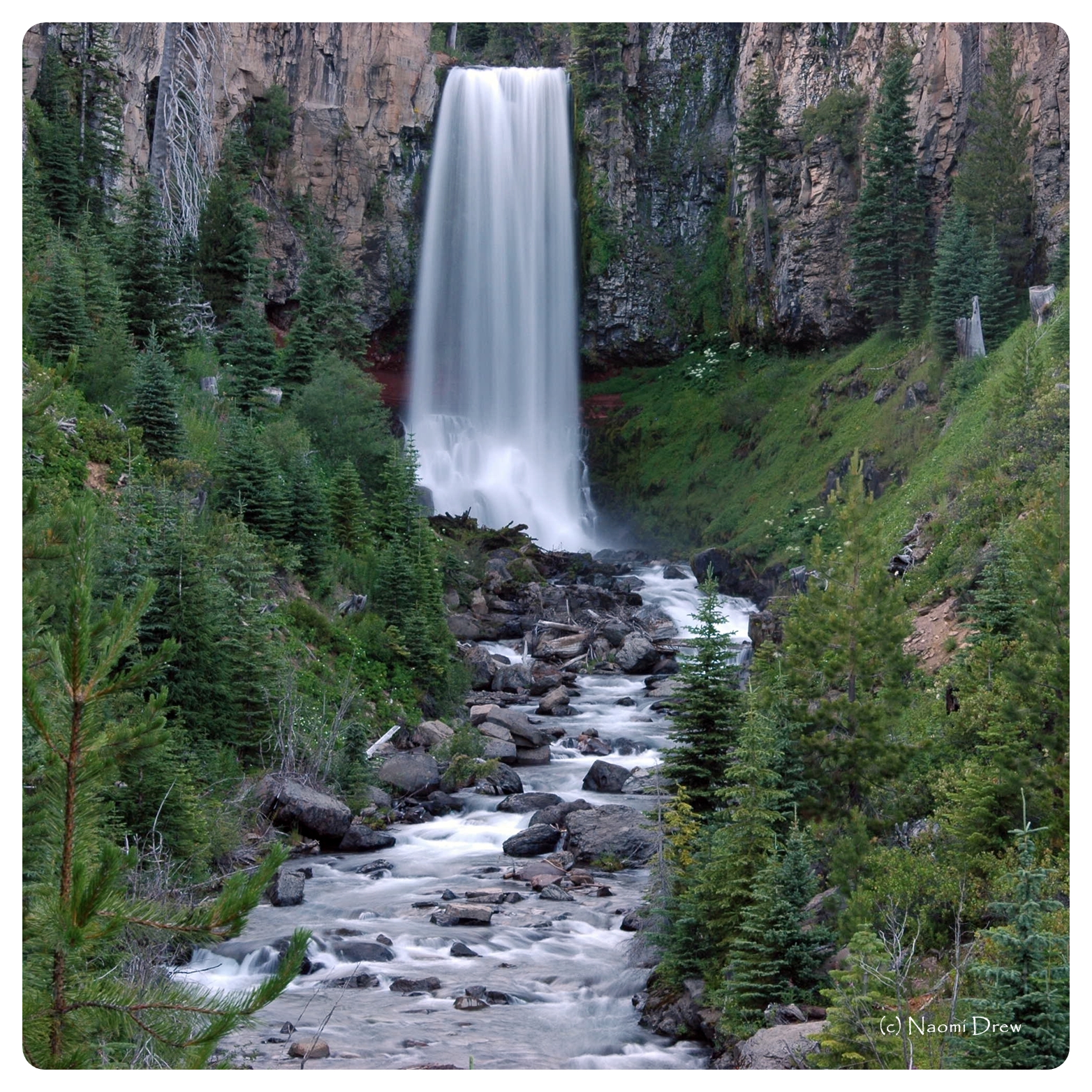 Outside of Bend, Oregon, is Tumalo Creek and Falls. We went there on our last night in Oregon, before heading home. It was a spontaneous trip, so I just threw the camera bag in the car, not taking a tripod. I should have as the light was fading quite rapidly. Everything I did was handheld, or precariously propped up on a railing.
There is always something about blurred water in photography that attracts me. I can hear the water by looking at it. This blur, in contrast to sharp silhouettes of trees or plants against the water, is always an eye-catcher.
None of these pictures particularly pleased me. I was using the Tokina 11-16, which is a very wide-angled lens. These are far harder to use well than what you might think. Composition is really difficult. At the falls, it was particularly difficult because of the perspective and falling light. There were a couple of other photographers there – with tripods! – who probably did a much better job than I did.
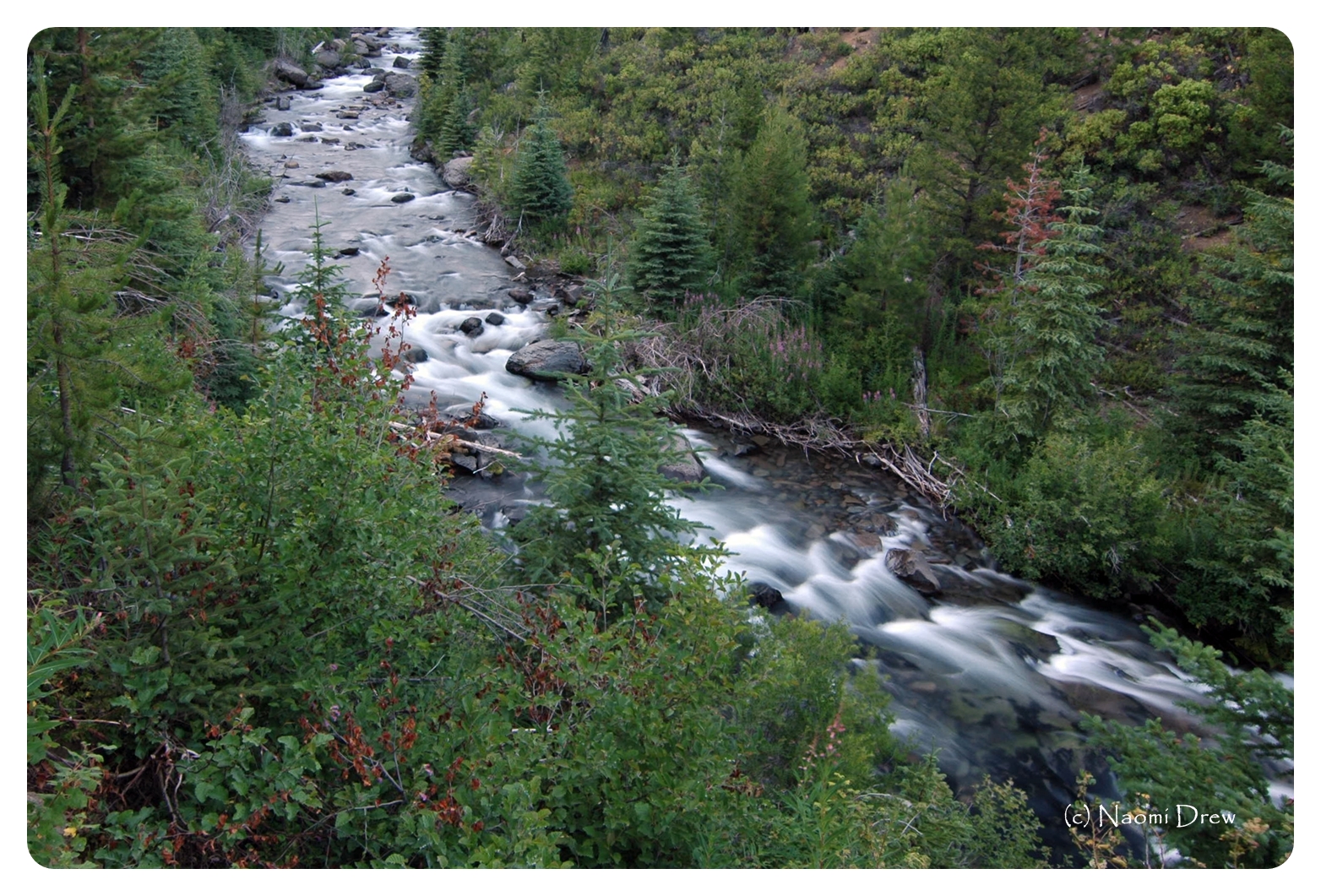
Pulling these out, a couple of months after our trip, I did a bit of cropping and other post-processing, but mostly I was considering the composition, and how a poorly composed picture may be improved by judicious cropping. Not so sure if it worked, but what I did learn was a little more about composition! Cropping something into a square is far more challenging than a rectangle . . .


