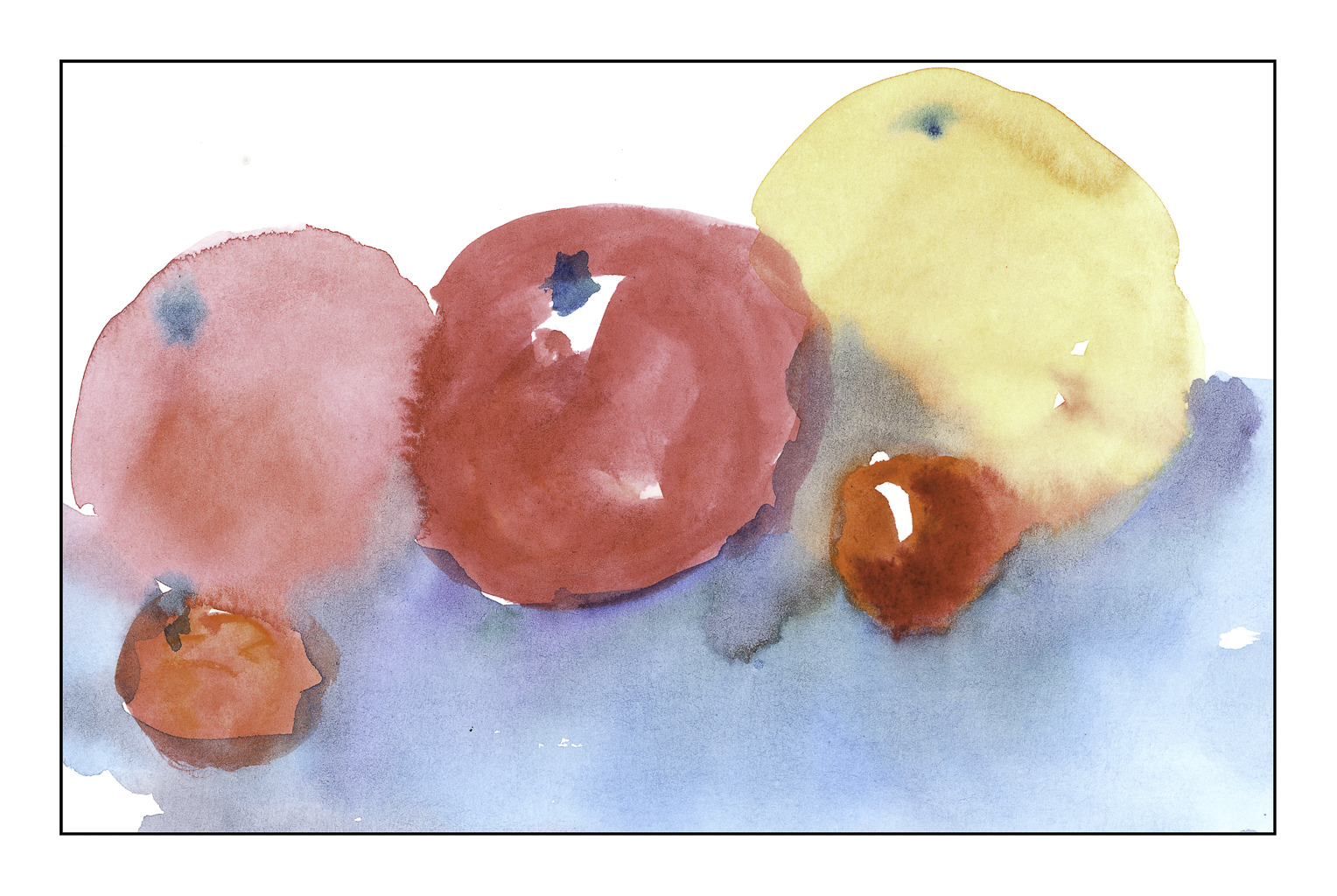
The very first entry of #WorldWatercolorMonth! The prompt is “primary palette” and so I chose a painting that predominates with the primary colors of red, yellow, and blue. From there, secondary colors were mixed, such as oranges and greens. With gouache, water may be used to thin the paints, but white and black are often used to lighten or darken colors as needed. Given the fact I haven’t done much painting over the past 2 or 3 weeks, this one worked out rather well. Let’s see what happens tomorrow!
This year I am going to try to do a painting every day in July for World Watercolor Month. In the past few weeks I’ve fallen off as I have veered into ink making and indigo dyeing. Now, time to return to a good daily habit. I think daily artwork is like brushing your teeth every day – it makes for a more pleasant start to the day!
I did Inktober for most of the month of October 2018, and it was a wonderful process, and in doing it I learned so much. Pen and ink is black and white and World Watercolor is with colors, in the form of gouache or watercolor – or probably any other water-based medium. I expect I will learn a lot by being focused on this as well. Because I am attempting to learn gouache and improve my poor watercolor skills, maybe I will alternate medium daily – like odds for gouache and evens for watercolor. What do you think?
Use the hashtag #WorldWatercolorMonth to draw people to your work if you participate.
This afternoon was fun! A meetup up group met at a local brewhouse, art supplies and toys in hand, to do some art journaling. I’ve never done any. When I think of art journaling, Frieda Kahlo comes to mind – her journals are filled with words and pictures that swirl around and create a lively chaos of their own. Not reading Spanish, I have no idea what they say – but words are not always necessary.
What does one use in art journaling? It seems anything you want. It’s a self-expressive medium. So, I took a piece of tape and put it across the bottom of the page – you can see where it is. Houses, baloons, a Ferris wheel. From there, I added my own. Is there any meaning? Mayhap – no idea! I can tell you that the tiny buildings made me want to create some disproportionately large things . . . and for some reason, the serpent showed up with his apple, alongside a few hands, a dead chicken, a mouse, and who knows what else.
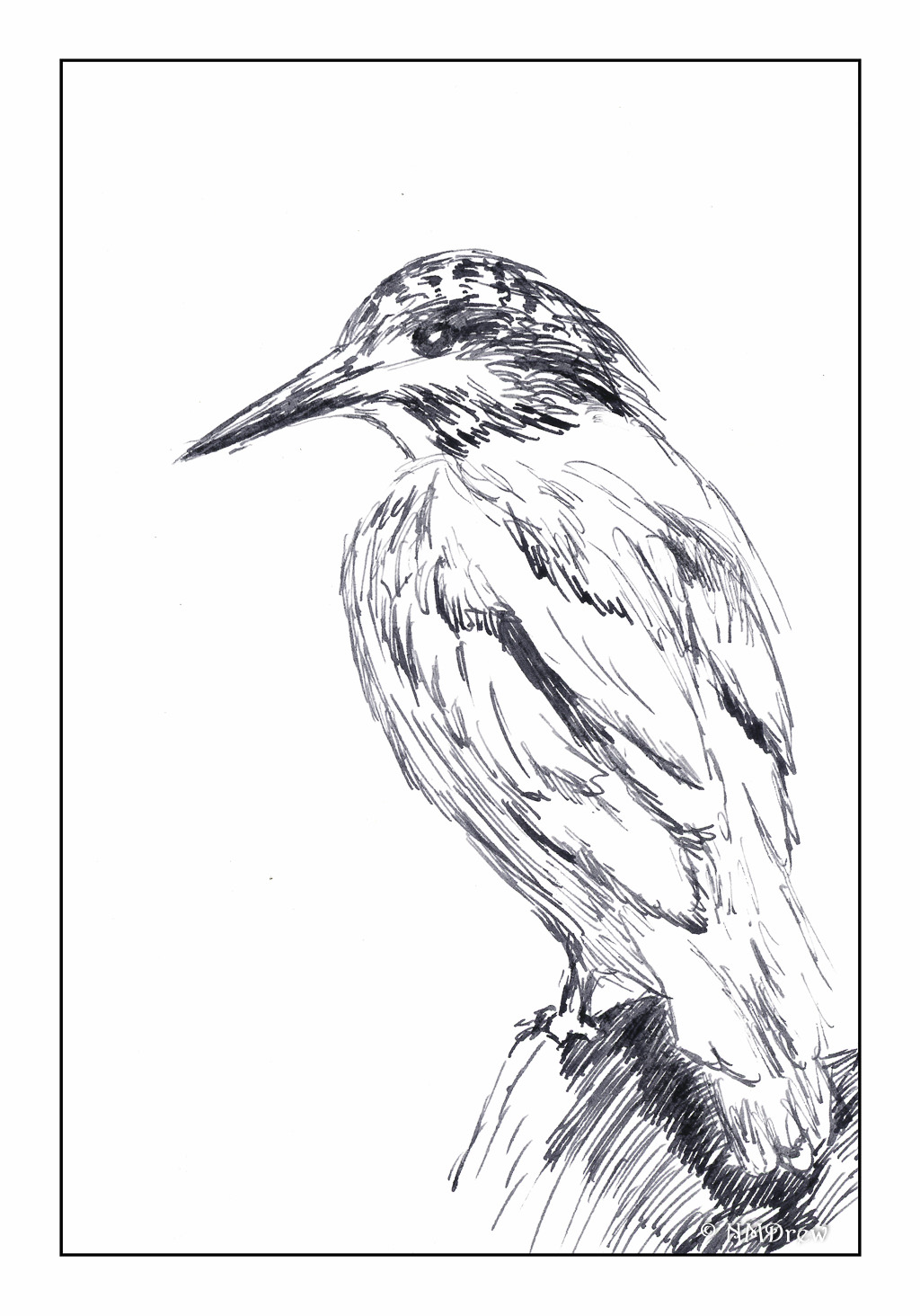
This morning I did a quick sketch of a kingfisher using iron gall ink using a dip pen. As you can see, there is a bit better variability in lines than when drawing is done with a quill pen (see yesterday’s post). Both have qualities I really like – expressiveness, boldness, delicacy. As I am used to using fountain pens, a dip pen is no problem once I learned how to control the amount of ink on nib. What must be remembered is how to load the nib, and as nibs are all different, a bit of testing on scratch paper helps.
At present, I am deciding if I want to colorize this drawing – which is why for now, it is not! If I do, I want to use very dilute but vibrant colors. It is my hope that the ink will shine through the paint without my having to re-ink parts of it.
Long before we had metal dip pens, artists drew with reed pens and with quills cut from the pinion feathers of a swan, turkey, or goose. If you look at the ink sketches of artists such as Rembrandt or DaVinci, you will see some very common characteristics. The ink lines vary in width – narrow, wide. Often the ink is brown, and so those not in the know think that brown ink was a thing way back when. In reality, it is the degradation of iron gall ink (aka oak gall ink) through time. When initially laid down, it was black. With time, it turns brown, and with a lot of time and depending on its degree of acidity, the iron gall ink can destroy the paper and drawing.
Over the past week, I have been playing with iron gall ink and a quill pen I cut from a turkey feather. I have some homemade iron gall ink nearly done – come Thursday, it will be ostensibly ready to use. Today, because I am finally at a point where I have time to play, I drew with iron gall ink and my quill, and then applied watercolors. The ink took its sweet time drying, and I didn’t blow dry it, but let it air dry or blotted it to see what would happen. As it is a damp day, it took awhile. Anyway, the following three pictures were first done with the ink, dried, and then painted in with watercolor. If you look at the pen strokes, you will see variations. I’ve never drawn with a quill before, so it was a new experience, one quite different than with a dip pen or fountain pen.
Kumquats – InkKumquats – Ink and Watercolor
The kumquats were the very first drawings I did with the quill and ink. I had to really think about textures. You see, when you use iron gall ink, it begins as a light grey, but as it is exposed to the air, it becomes darker and darker until it is black. This made values a challenge!
Bamboo Forest – InkBamboo Forest – Ink and Watercolor
Here, the ink in the picture was not quite dry, and some bled into the watercolors as I lay them down.
Market Melons – InkMarket Melons – Ink and Watercolor
For the melons, the ink was taking forever to dry! I decided to see what would happen if I blotted the ink. The result was smudges, which you can see throughout the picture.
Fruit – WatercolorFruit – Watercolor and Ink
This final set was done with a sketchy watercolor. No thought was really given to composition or to color as I wanted to use the ink to express outlines, shapes, and shadows.
Altogether, this was a lot of fun, and for me there is a potential I hadn’t really thought about in getting a sense of history by using historical tools – quills, iron gall ink – that were once the best technology had to offer. I wonder what Rembrandt and DaVinci would think about paints in a tube, rather than the task of purchasing, grinding, and creating their own paints . . . perhaps they made their own quills and inks, too.



 .
.