Clouds Above the Fields

I don’t know about most people who paint, but I expect every painting to be a masterpiece.  Of course, this is silly.  I don’t think about practicing things, such as painting clouds.  However, I watched a few YouTube videos on cloud painting and decided to give it a go.  I found a picture on Pixabay I liked, filled with clouds, and a plowed field stretching to the horizon.  To me, it just seems a bit ridiculous not to try to paint a masterpiece each time – really, practice – so a finished picture it is.

Clouds really are variable, but there is a tendency to overwork them.  Here, I simply tried to get a sense of white-white-white and ways in which clouds have contrast, shadow, distance, and how they look in the sky.  These are rather poofy ones, without any defining characteristics other than that.

Since this was practice, I put in some black ink lines just to see how they “feel” in a painting.  Don’t know if I like them . . .

The Muddy Palette

Before I knew that gouache works best fresh out of the tube, I filled a palette up just as I do with watercolors.  Let’s face it, paint ain’t cheap, so I wet these paints over and over.  Finally, most of the colors are used up and it is into the sink to soak for now!  In the future, fresh paint.  That will be a really new event for me because I don’t tend to paint like that.  I made swatch cards of all my gouache colors (more than 20, less than 1000), so I plan to use those as I consider paints in future paintings.

Fog Monster #2

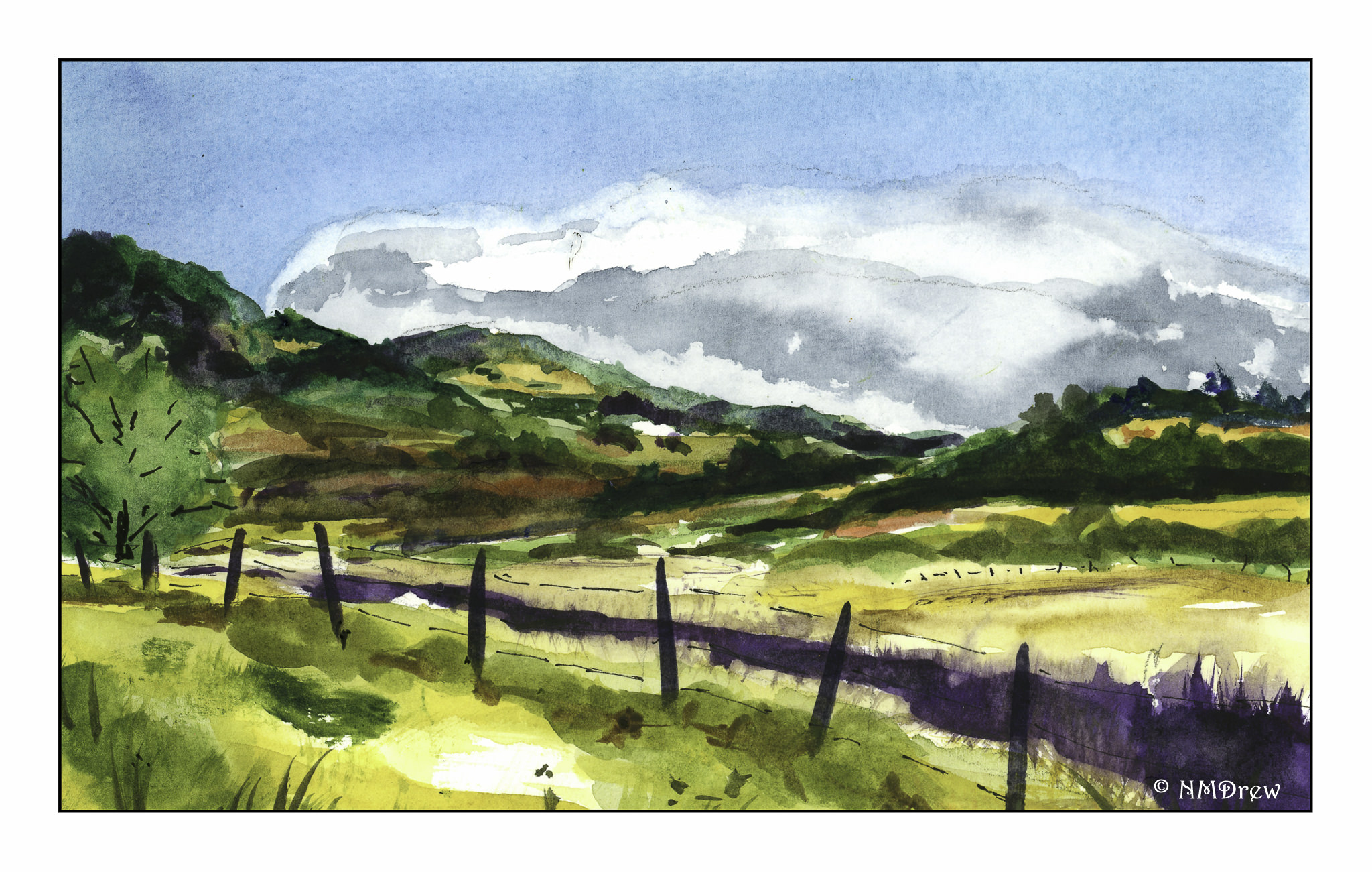
For some time I have considered the possibility of doing two studies for each painting, one in watercolor and the other in gouache.  Today’s painting is exactly that.  I took the same study in gouache (yesterday) and painted it in watercolor.  It was a really interesting experience!

First, I am doing all these studies in a 7×10 sketchbook.  The paper is not really good for really wet watercolors, but is very nice for gouache.  Knowing this, I kept my paper as unsaturated as possible, but also worked to use wet-in-wet where I thought necessary, such as in the sky and fog bank, but being very careful about the amount of water I used.  In other areas I did small, quick forays into wet work, but kept it to a minimum while allowing for bleeds, or coming back to work a bit more, such as on the right side where the grasses are in contrast to the road (lower right side).

Problems continue with depth.  The middle ground hills and the ones against the fog are muddled into each other.  While I made things simpler in the distance, the colors remain the same in intensity.  Atmospheric perspective needs a bit of boost in this one.

Look forward to more of these studies.

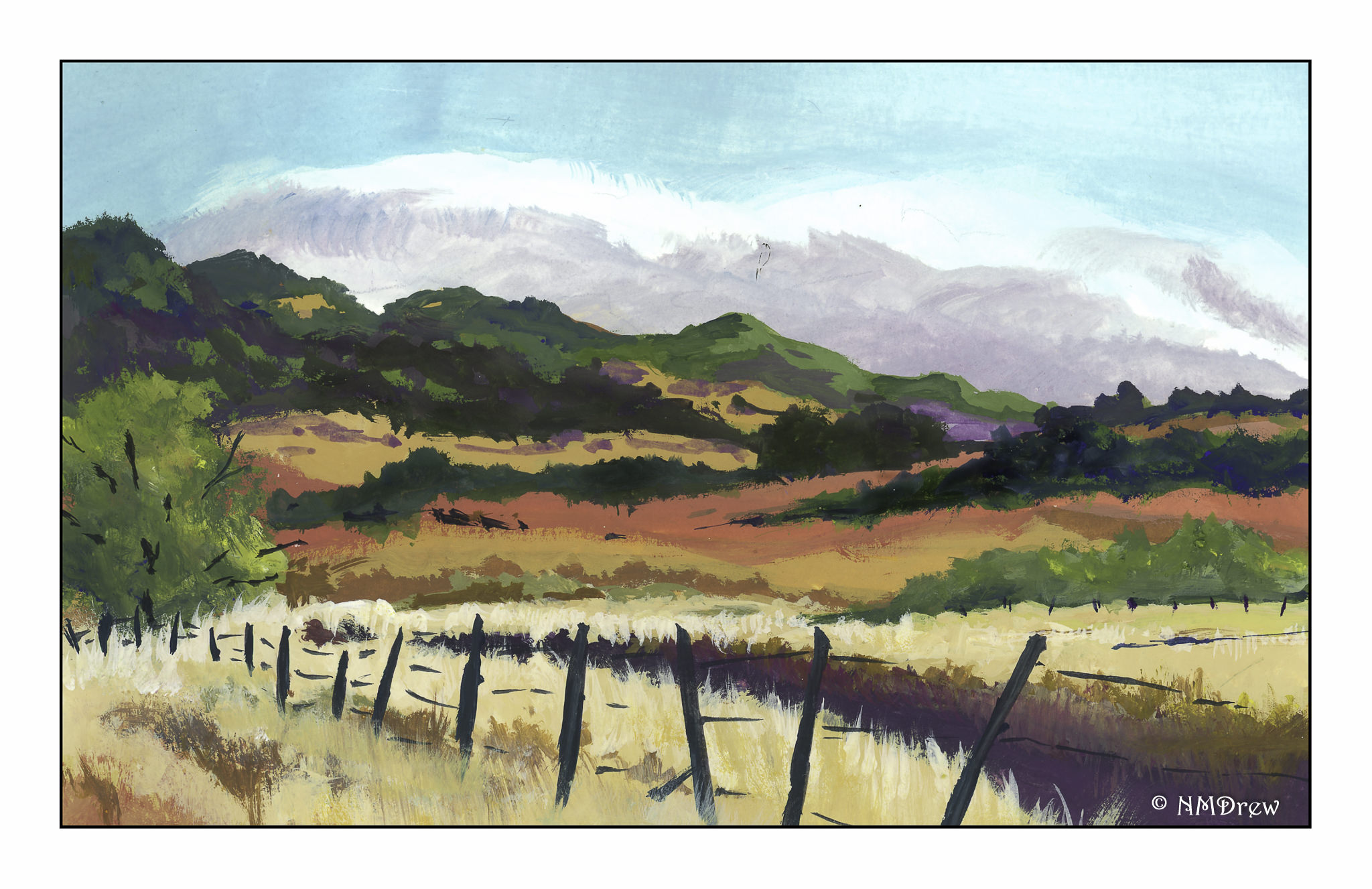
Fog Monster #1

The California coast depends on the fog that rolls in from the Pacific during the late spring and summer – and other times of the year, probably – for its ecology.  Plants collect the damp of the fog as a primary water source, and at times it makes the coastal areas, and inland valleys, rather damp and dreary.

Here, we call it “May Grey” and “June Gloom” and “The Fog Monster” – and believe me, when you live in a coastal city in July, and the sky is cold and damp, you cannot help but agree with Mark Twain when he said, “The coldest winter I ever spent was a summer in San Francisco.”

You see the coastal fog rolling over the foothills toward the inland valleys.  I tried to simplify my palette and fields of color to suggest distance.  The sun is coming from the viewer’s right, so I also worked to make it evident on the distant hills.  I used a lot of dry brush in the foreground, and basically worked from top to bottom so that the distant layers would be overlaid by the middle and foreground.  The only thing that wasn’t quite in that sequence were the fence posts.  Once they were established, dry brush to represent grasses was employed.

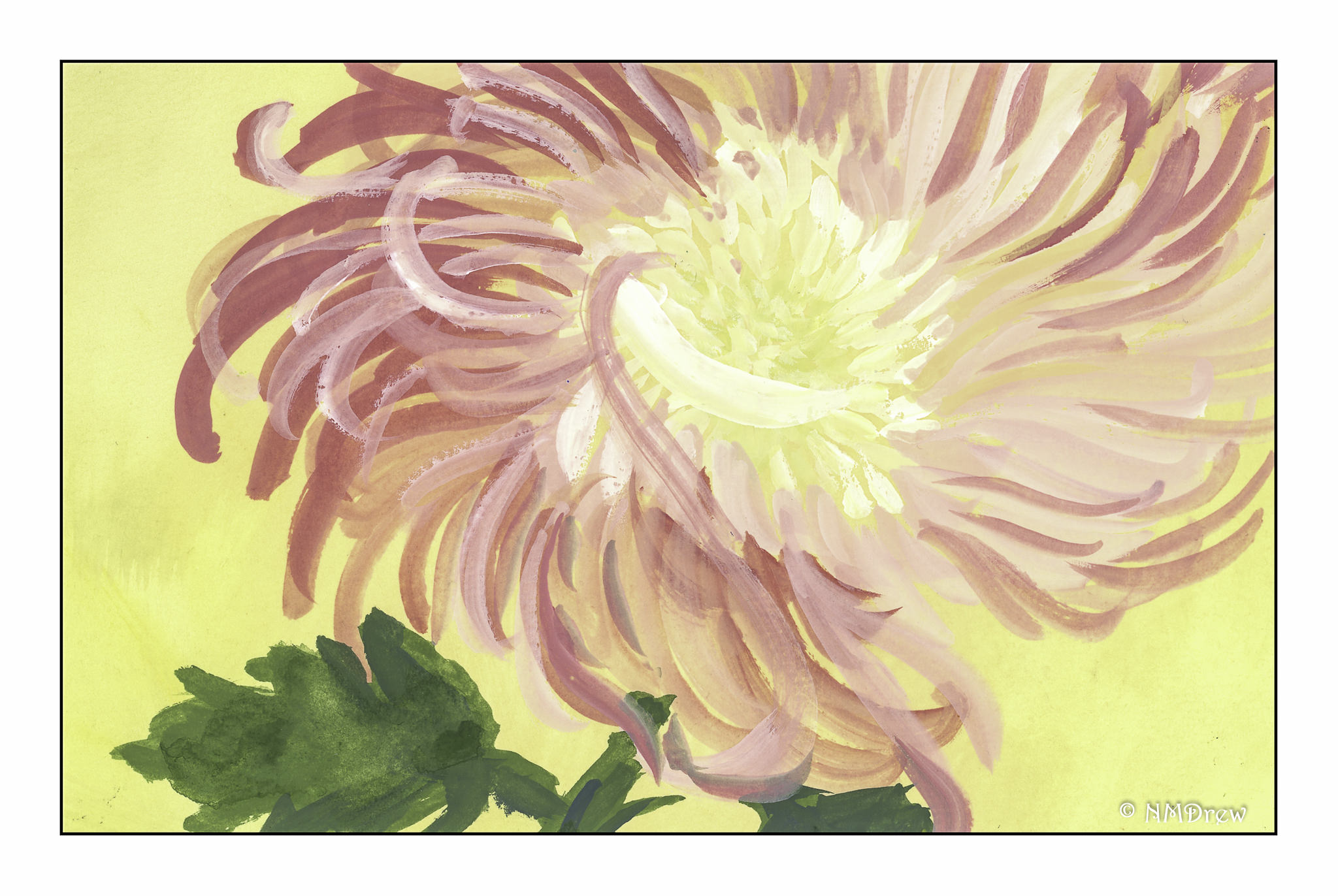
Chrysanthemums

Years ago I did Japanese ink painting, along with Chinese painting.  Chrysanthemums are a traditional study.  Here, I tried to work with the gouache in the same fashion – following the same formula – as in Oriental painting.  Because the paper and pigment are different, it doesn’t work out the same, although the brushwork is applied similarly.

Using what I learned from the first painting, while I held to the constructs I had learned in Asian painting, I applied the principles of gouache here.  I built on layers and worked over areas I wasn’t too thrilled with.

Being familiar with how different painting techniques are applied is very handy.  This knowledge can be applied to another area (here, painting) and modified to fit the needs of the medium.  Painting is like opening up a brand new world!  It is quite an adventure.