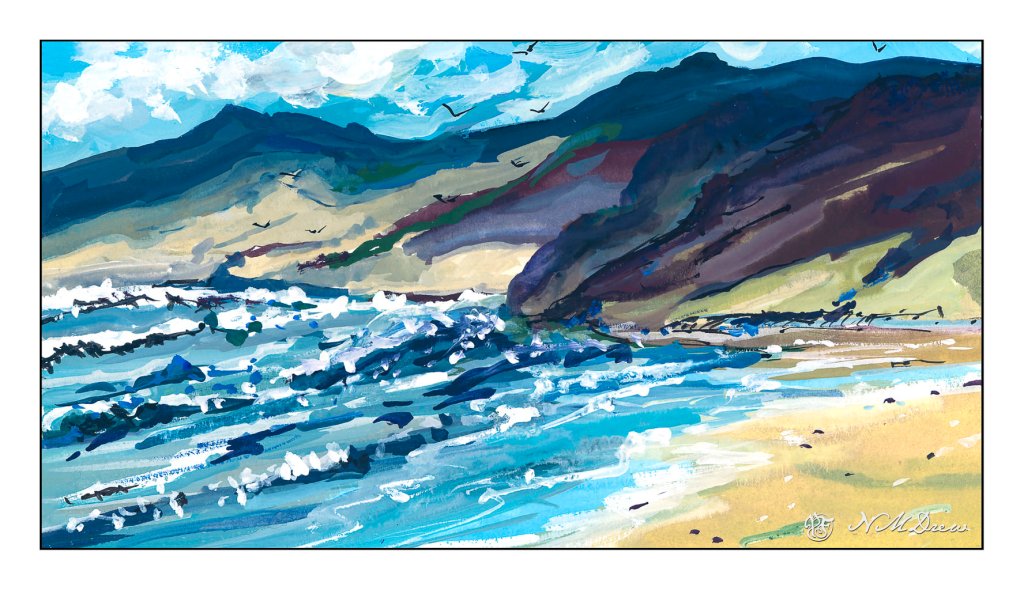
Where have I been these last several weeks? Busy with online classes in drawing as a prelim to painting and hand sewing 18th century stays. So, I have been doing things, but have had so many other distractions that I have not been too active online here. So, today, a gouache, just because paint needs to be used to feel like a normal person.
Jalama Beach is in San Luis Obispo County along the central coast of California. It is a strange, remote beach. Winds blow the sea foam onto the sand, and it can look like very dirty snow. The first time I came here was in my teens – a long, long time ago. Then you could get abalones just by picking them up, and the beach was littered with their shells, big ones easily 8-10 inches in diameter. (Tasty critters, I will say.)
Winter time brings erratic tides, scudding clouds, and wind that can blow fierce and cold. Sandpipers and gulls wheel overhead as the wind beats you back. The wildness of the place is something that anyone who has been to a lonely beach can understand. I think I caught it (for myself at least) here.
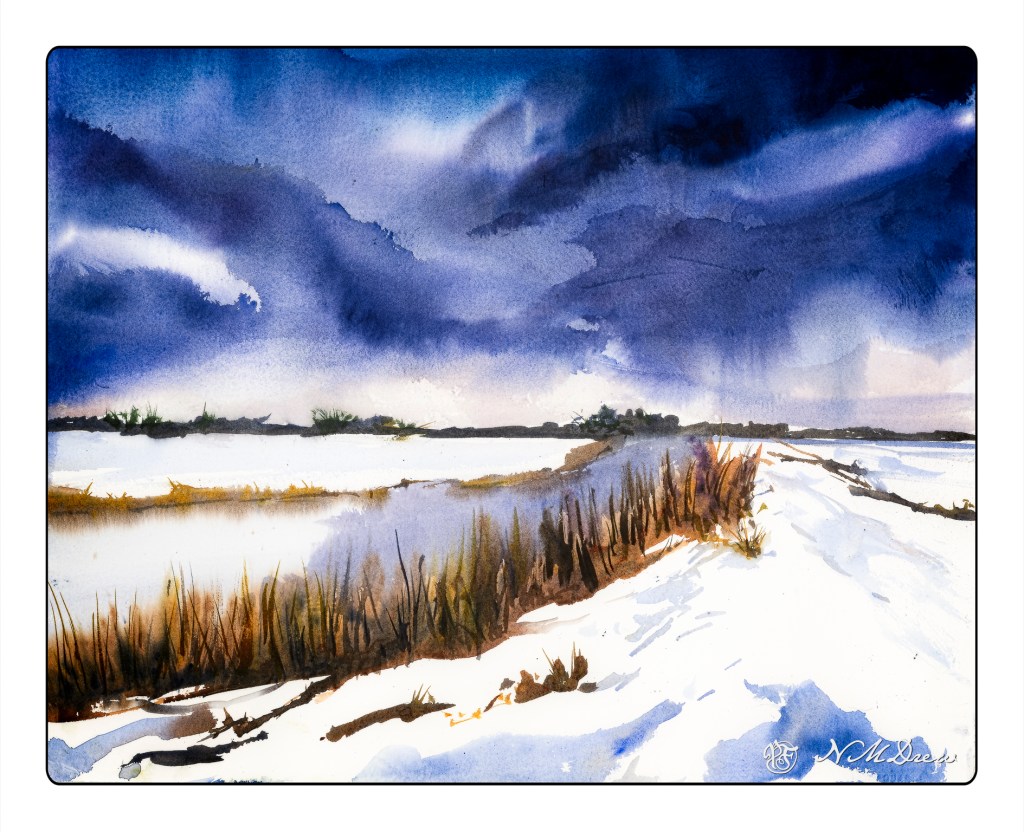
It is always worthwhile looking at the works of various painters, regardless as the medium in which they are creating. The works of Edward Seago have a charm to them which is old world, peaceful, and hearkens to a quieter and simpler time. This painting is based loosely off one of his oil painting of the eastern English coastline. What attracted me was – and is – his vast skies. The low lying shoreline beneath such a magnificent sky is worth trying out. The same may be said of the watercolors of Edo Hannema – he, too, finds the work of Seago, and Edward Wesson, as sources for inspiration.
In Southern California, the sky, where I live, is almost always blue. No clouds, little haze. Humidity sits at zero. (I won’t discuss the vast amount of lotion I use!) However, the big skies of the midwest with towering clouds, or the piles of clouds over New Mexico, are in my memory, and so the clouds and moist skies of a wetter clime draw me.
Here, I used the 1.5 inch flat brush for 90% of the painting, resorting to a small flat brush – 1/4 inch – for some detail. Large washes, wet into wet, some glazing. Paper is Arches 140# CP, 16×20. The large brush is becoming a favorite for sure!
The large brush helps me keep my colors clean and think about masses rather than details. Big to small. I am also refreshing my water as I move along – this took about 2 or 3 refreshes – and cleaning off my palette, too. With a large brush, large washes, a lot of color is used. Clean palette, clean water, and, of course, a clean brush. The results are beginning to be seen.
When I first started to paint in watercolor – like when I was a teenager! – the advice was to use a brush bigger than what you think you need. Yeah, right. Over the years, I have resisted this, but lately I have been doing the majority of my painting with a 1.5 inch flat brush. From there, different brushes with different ideas in mind.
Here, 16×20 CP 140# Arches. I sponged the entire paper with water and then set in the sky. From there, the water and grasses along the shore, working to get blurring of colors into the wet paint. Then, the horizon with the same 1.5 inch brush. I let it dry.
From that point, it was a matter of thought. Initially, the sky dried to a pale color, so I laid in more dark paint for the sky, using a spray bottle to move the paint around, and holding the painting by hand, tilted the paper this way and that to run the paint in various directions.
Looking at it upside down always gives a new perspective, sometimes good, sometimes not. I added some dry brush for the weeds, and used a wet mixture of blues for the snow shadows. I also painted a darker version of the same snow blue into the distant water, moving it into the weeds / reeds. Then, more dry brush once the water had dried to overlap the paint I applied.
This is a stronger painting than some of my more more recent ones, and I will credit the large, flat brush forcing me to work simply. It’s actually much more fun, and easier, in many ways, because I am not getting finicky to the point of crazy.
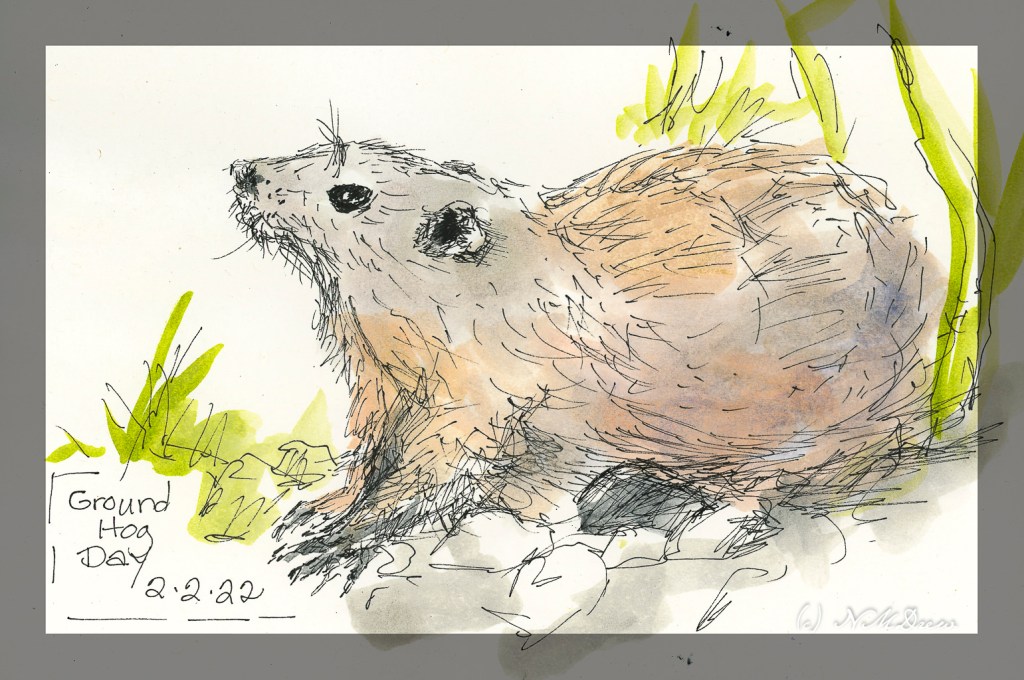
One of the beauties of drawing is you can create anything you want. This is a ground hog, but one I invented. I invented him when I realized his ear is all cockamamy. So, new subspecies: the Lopso-Eared Ground Hog.
Ground Hog Day has always been a favorite of mine. First, I like ground hogs. They are cute. Second, the entire idea of a day devoted to such a cute animal is rather delightful. According to the website history.com:
On February 2, 1887, Groundhog Day, featuring a rodent meteorologist, is celebrated for the first time at Gobbler’s Knob in Punxsutawney, Pennsylvania. According to tradition, if a groundhog comes out of its hole on this day and sees its shadow, it gets scared and runs back into its burrow, predicting six more weeks of winter weather; no shadow means an early spring.
Groundhog Day has its roots in the ancient Christian tradition of Candlemas, when clergy would bless and distribute candles needed for winter. The candles represented how long and cold the winter would be. Germans expanded on this concept by selecting an animal—the hedgehog—as a means of predicting weather. Once they came to America, German settlers in Pennsylvania continued the tradition, although they switched from hedgehogs to groundhogs, which were plentiful in the Keystone State.
Groundhogs, also called woodchucks and whose scientific name is Marmota monax, typically weigh 12 to 15 pounds and live six to eight years. They eat vegetables and fruits, whistle when they’re frightened or looking for a mate (they’re sometimes called whistle pigs) and can climb trees and swim.
They go into hibernation in the late fall; during this time, their body temperatures drop significantly, their heartbeats slow from 80 to five beats per minute and they can lose 30 percent of their body fat. In February, male groundhogs emerge from their burrows to look for a mate (not to predict the weather) before going underground again. They come out of hibernation for good in March.
In 1887, a newspaper editor belonging to a group of groundhog hunters from Punxsutawney called the Punxsutawney Groundhog Club declared that Phil, the Punxsutawney groundhog, was America’s only true weather-forecasting groundhog. The line of groundhogs that have since been known as Phil might be America’s most famous groundhogs, but other towns across North America now have their own weather-predicting rodents, from Birmingham Bill to Staten Island Chuck to Shubenacadie Sam in Canada.
In 1993, the movie Groundhog Day starring Bill Murray popularized the usage of “groundhog day” to mean something that is repeated over and over. Today, tens of thousands of people converge on Gobbler’s Knob in Punxsutawney each February 2 to witness Phil’s prediction. The Punxsutawney Groundhog Club hosts a three-day celebration featuring entertainment and activities.
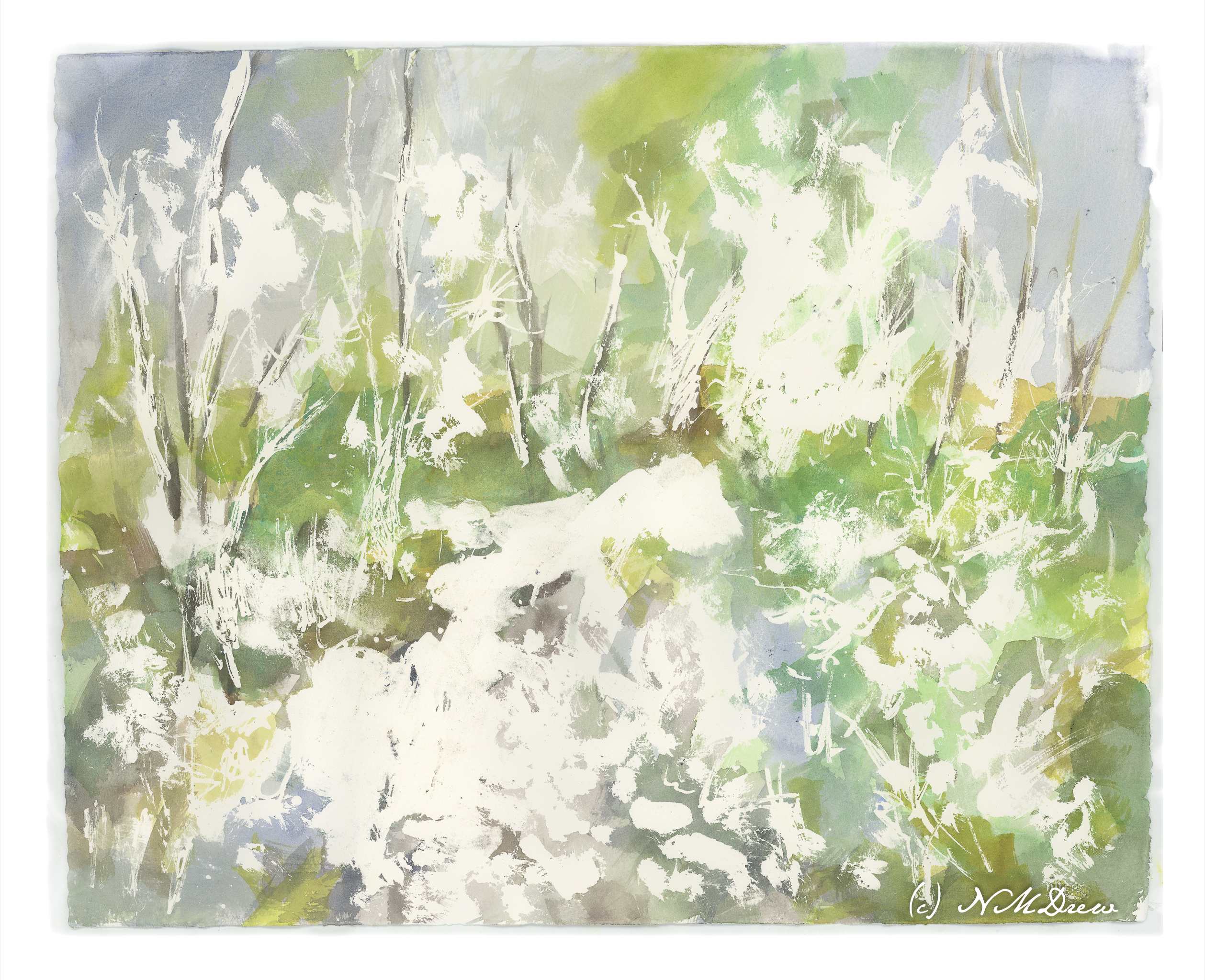
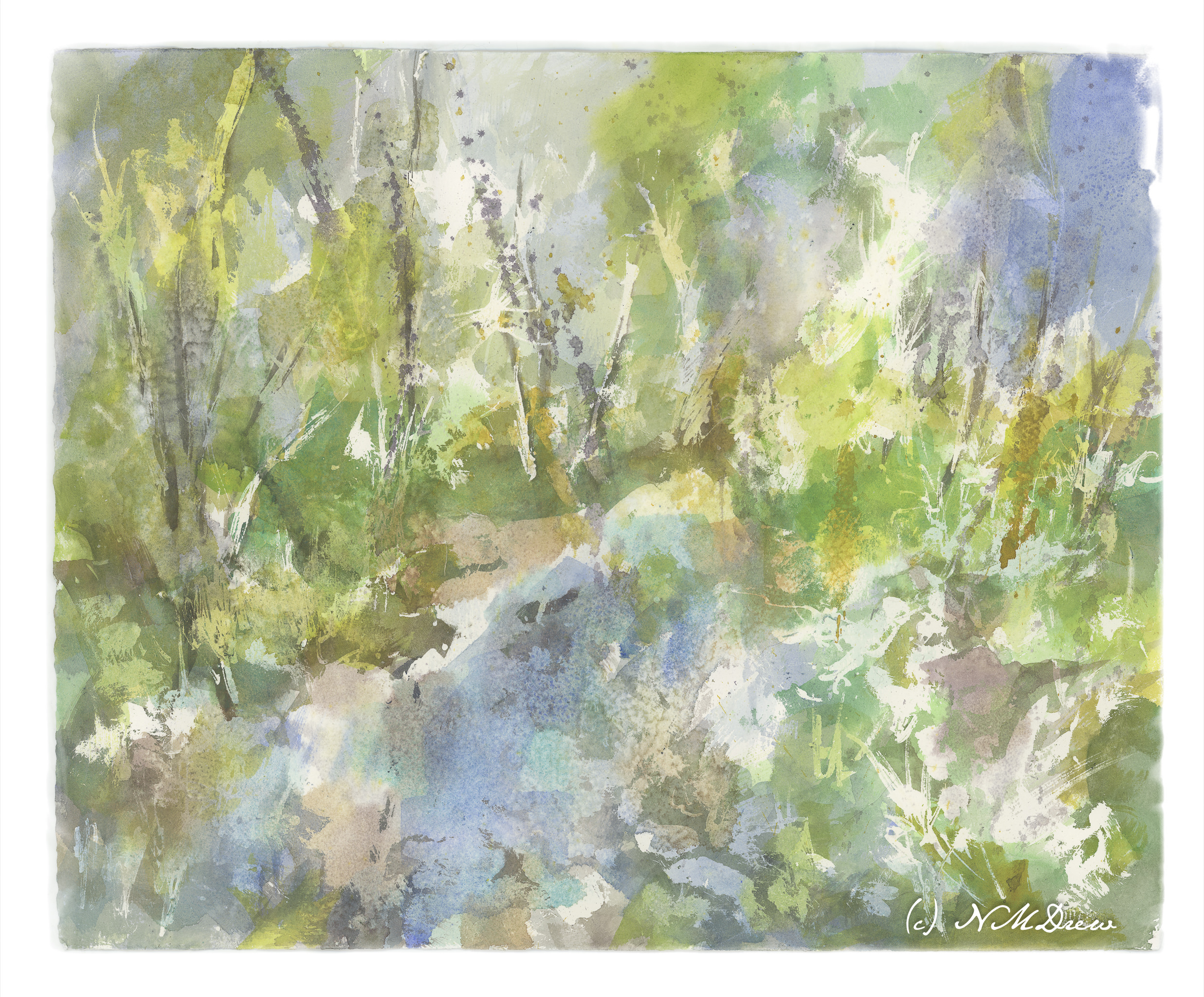
Anyway, as I mentioned yesterday, more blue in the lower front, some other touches, and then let it sit overnight.
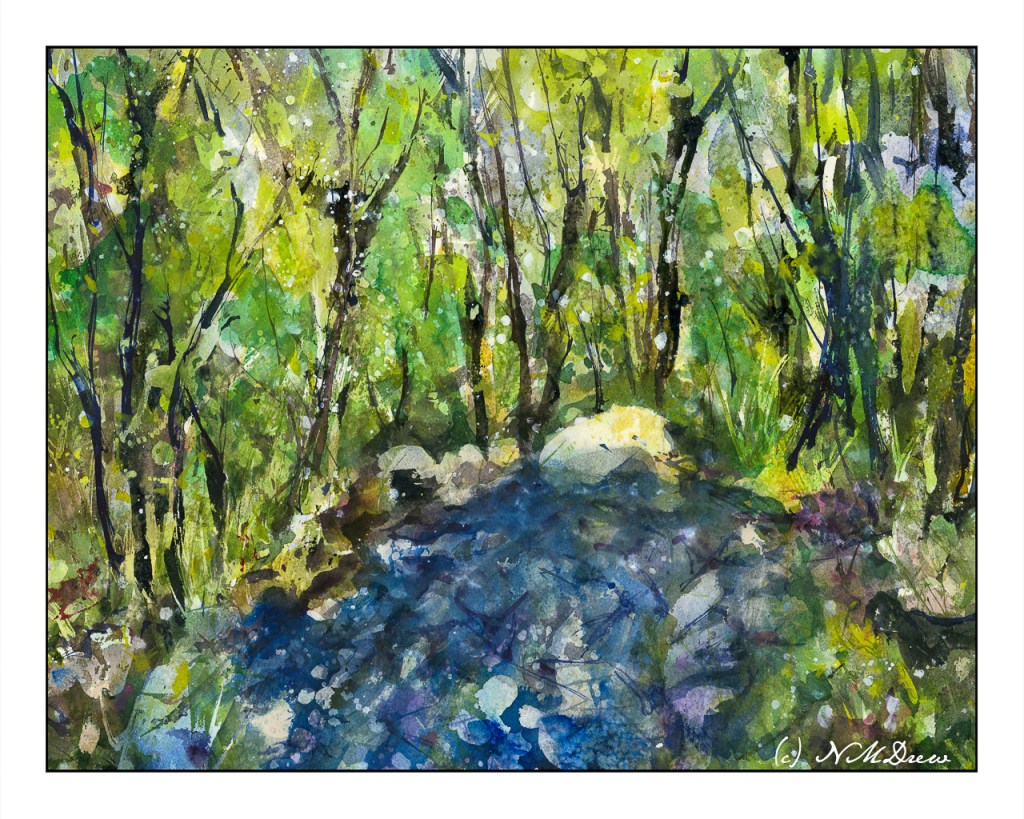
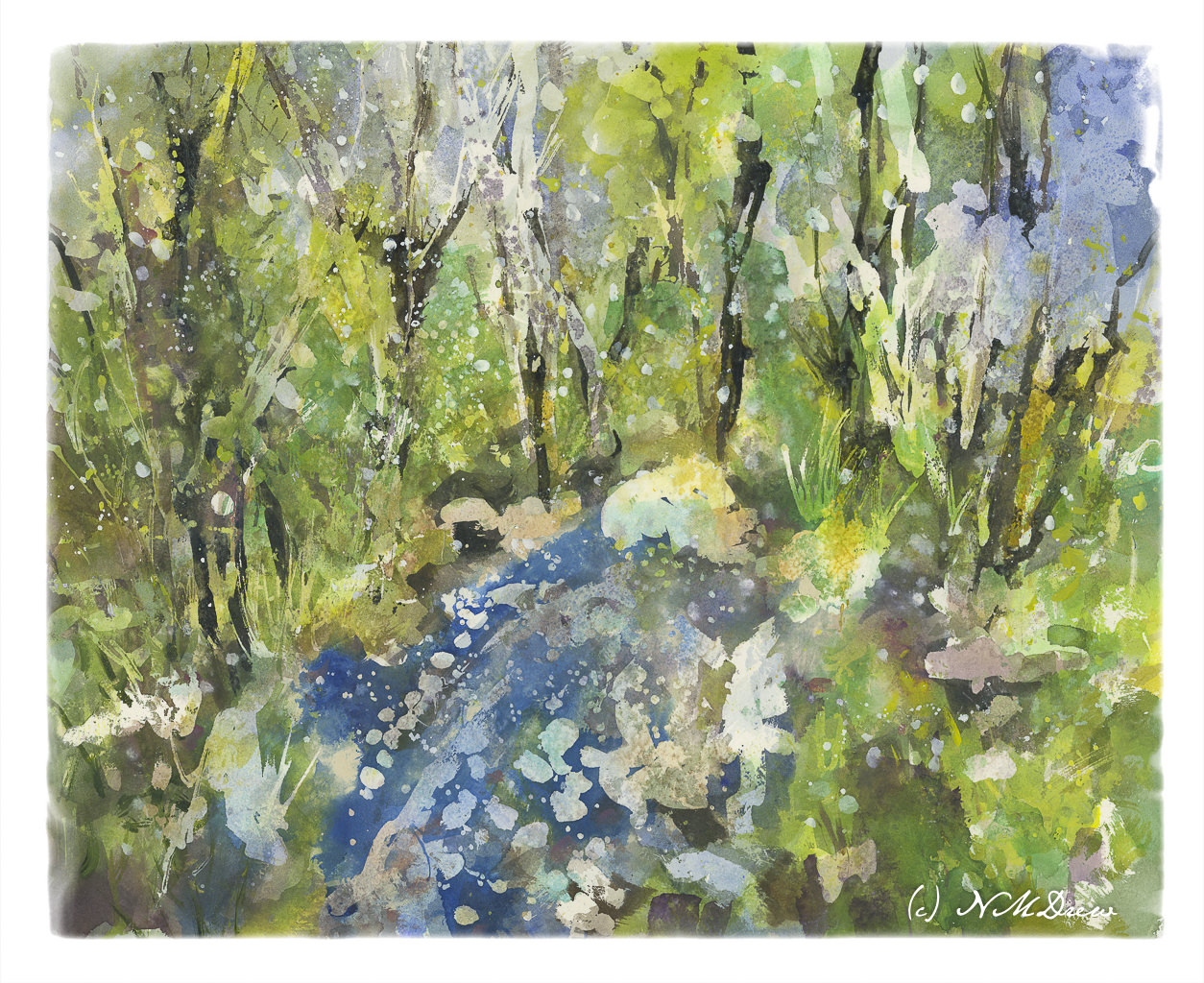
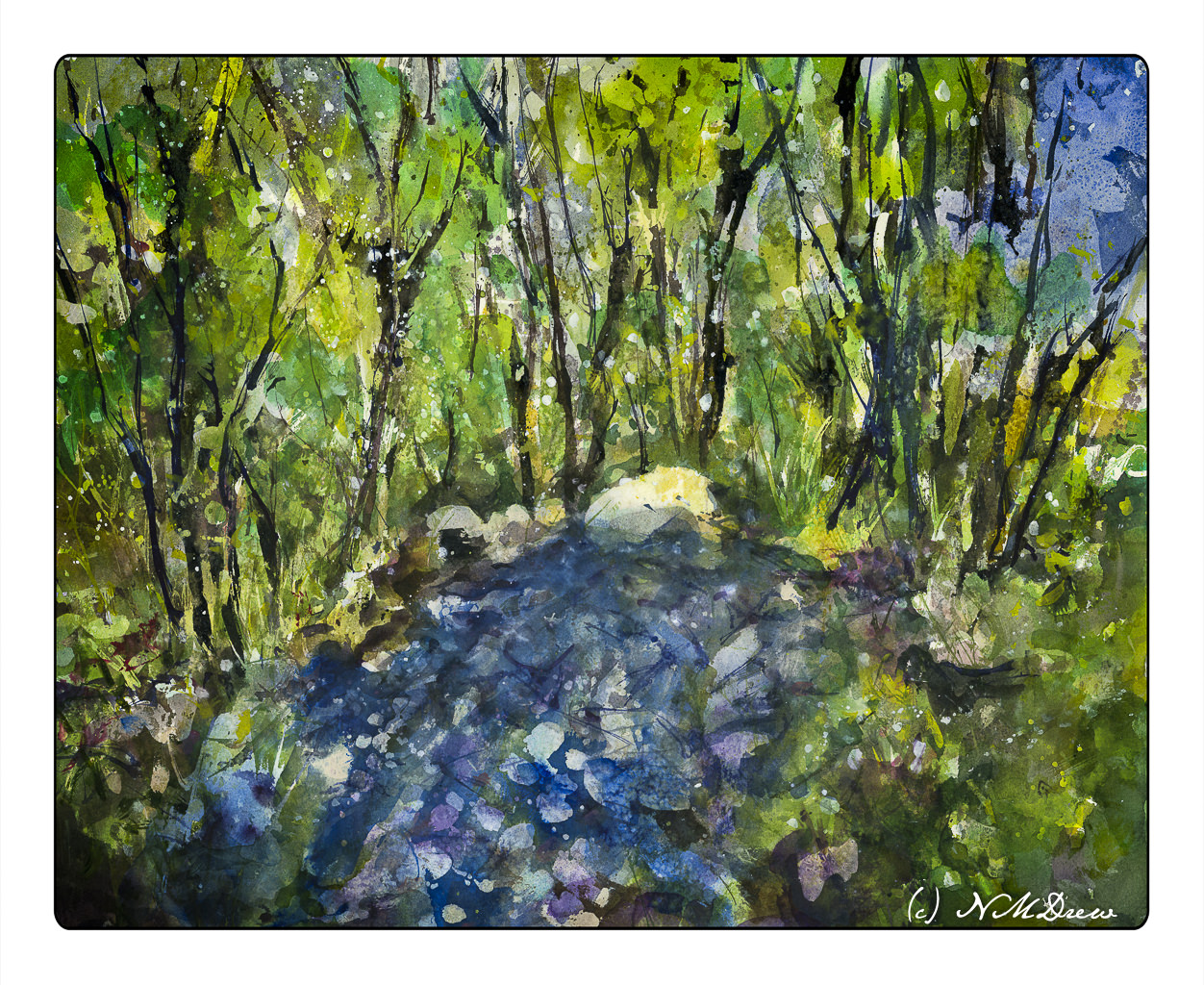
This morning I took another look at it, and the only way I can describe what I did was to refine it. I increased contrast in some areas to create harder edges. Other things were designed to lead the eye toward the center of the painting, toward the whitish rock at the top of the water. I also looked for areas that just didn’t look right, somehow too symmetrical or distracting. In the end, little bits here and there made it better to my eye. But – that was during morning coffee when I was trying to wake up!
I have never worked on a painting – a watercolor – for this long a time period. Total time is probably 8-10 hours. Time was spent laying down frisket, colors, letting things dry. Then frisket was rubbed off. Water was sprayed at different times and salt sprinkled. Rubbing alcohol was also sprayed on. I think the last round of frisket took about 30 minutes to rub off, along with salt. The result, though, are transparent layers of color which I could not have accomplished otherwise.
While the perspective seems a bit off – or maybe we are looking down into the water from above? – I like this painting. It’s a new adventure for me in watercolor, and while bright, I don’t think it is overly so. I deliberately did not use any orange!! New ideas are coming to mind for painting in a transparent medium. Mood and impression work here for me – not realism, but suggestion. So, spring thaw, melting ice, new leaves.
In this final version, I cropped it and changed the perspective a bit in Lightroom. Post-processing artwork is much like post-processing a photo, an din the printing industry it is done all the time. You can see the uncropped version in the gallery below.


 Ink, Yarn & Beer