The “beer” side of this blog is building a car – and the progress is slow, but steady. He also has some 3D printers and has made a number of cool things and useful things. But, his heart of hearts (at the moment) has been craving a CNC machine. A CNC machine is a machine that allows complex machines to be tooled using a computer. To learn more, click here!
CNC machines cost money. Personal ones are easily a few thousand dollars, and good ones probably even more. So what is a boy to do?
Enter the 3D printed CNC machine, built from scrap and extruded plastic filament.
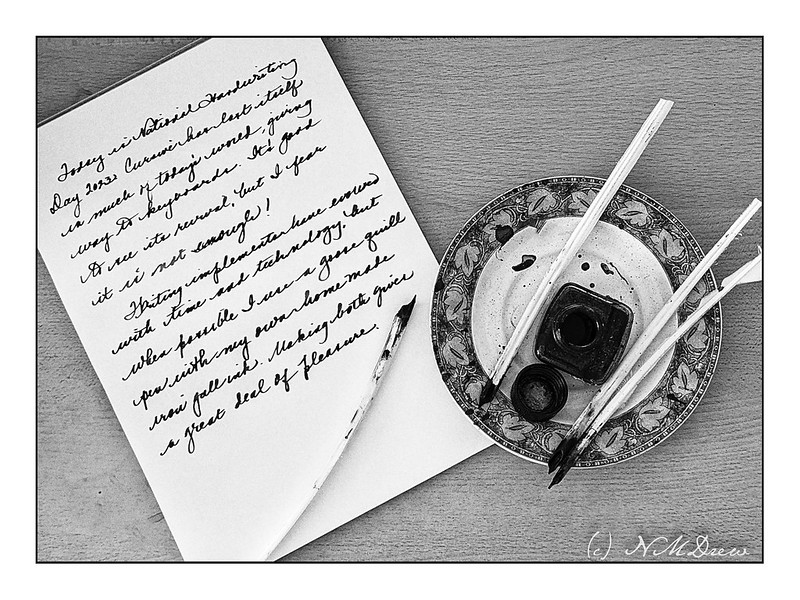
Handwriting has gone the way of the dodo, and cursive even more so. When I was teaching, it really surprised me to find students who were barely able to hold a pen or pencil, much less form readable printing or cursive. Apparently kids are forbidden to use cursive in hand-written work these days because they just can’t do it neatly. And while I disliked practicing handwriting, today I will say that I am so appreciative of the fact that it was part of my public school curriculum on a daily basis for grades 1-8. Today? Well, keyboarding is taught, and learning to touch type in high school has really paid off, but I still turn to pen and ink and paper, and on a daily basis I prefer quills I have cut myself, and iron gall ink I make as well.
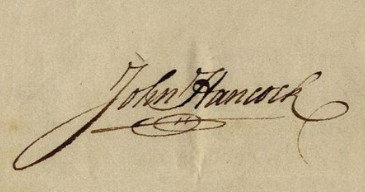
Here in the US, National Handwriting Day has apparently been a thing since 1977. Choosing January 23 is because the first person to sign the Declaration of Independence was John Hancock, whose signature is famous for its beauty. The expression of “put your John Hancock here” or anything similar is a way of saying “sign on the dotted line.”
Times change and we need to adapt, but there are times when I think modern technology and the wonders of the computer age mean we lose what we use to have. In a way, the book Fahrenheit 451 makes a point for preserving older technologies, and having people memorize whole novels is much like the oral traditions of countries where not everyone could write. Working together, old and new can preserve our history – and what we consider to be a daily thing (i.e. writing a letter on paper!) can vanish. Digital archives preserve such knowledge, but to acquire this knowledge again means actual, physical experience.
If you look at my little blurb in the photo, you can see my handwriting is okay, but I don’t always make my letters correctly and have to backtrack over them. When I was in school, if I had to turn in a handwritten essay, such mistakes would bring down my grade. And if I made them – well, I just started over.
So, cheers to National Handwriting Day. Reading cursive and handwriting is important and the best way to learn is to be taught at an early age. Apparently students not taught handwriting and cursive lose out on far more than just an ability to pick up a pen or pencil and communicate on paper.
Come to think of it, do kids even pass notes in class? Or do they text and hope they don’t get busted for using a phone in class?
Like most people, I look back over the past year, I look ahead to the new year. New years are like morning – something to anticipate. Yesterday is the past, and so is a past year. There is a bit of melancholy in looking back as awareness of passing time grows more acute each year but, it is always offset by the anticipation of the future. I don’t know if other people feel like that, but to me there is always an element of joyful anticipation even in times of gloom and sadness. I’ve lived long enough to know nothing lasts forever, but the patterns repeat, and therein lives hope. There is enough change and enough consistency. And I prefer to dwell on hope rather than despair – but to avoid it is foolish.
So, what has happened in this past year? For me, the most difficult thing has been the loss of my closest friend on November 30th. I am not lost because of his death, but just feeling a loneliness. On the other hand, I have rekindled a friendship from years ago that could prove to be a pleasant addition to my life. A door closes. A door opens.
I have also learned and realized a lot about my family – my parents in particular. I found two letters, one from my mother, one from my father. The first was a letter written by my mother 6 months before she married my father. The second letter was one written by my father 12 years later. While the contents are personal and private, what was most important was seeing my parents as people in a very different perspective – such different personalities and approaches to life! I think of the grasshopper and the ant in Aesop’s fables – my mother had the gaiety of the grasshopper but lacked foresight, went along for the moment, and my father was the ant, always planning and working toward the future, but often failing to value the moment he was in. (I’m sort of both!)
In some ways – perhaps in many ways – 2022 was about re-evaluating life and people. As I move more into retirement and into free time, I am less concerned with the connections -the ongoing desire for connections – with people, but more appreciative of them when they occur. It is so easy to want more from others than is realistic with copious free time, and it takes a bit of effort to rein it in. Once done, though, a bit of disappointment – but again, another door opens, and there are things to look forward to doing and experiencing.
For me, life is always a balancing act. There is sorrow and sadness, there is joy and hope. Reality is a harsh teacher, but if you pay attention, there is much to be learned and the subtle pleasures of little things – like the yellow volunteer flower on my doorstep – remind you that the small individual person, event, critter, plant, in the big, vast world has a whole universe within to be explored.
There is a channel on YouTube called “Life in the 1800s” that brings to life the proverbial days of yore. This video, from a voice recording made by Julius Franklin Howell, gives a view of the Confederate side of the Civil War, in which he fought as a young man. As today is Thanksgiving in the US, I think about our history, real and fabricated. What we think today is not necessarily what was thought when history was being made. This was a fascinating video, an oral history, of someone who was there.
“I am afraid you do not like your pen. Let me mend it for you. I mend pens remarkably well.”
“Thank you – but I always mend my own.”
Austen is discussing the quill pen in particular – a pen made from the feather of a bird, usually a goose, and cut with a pen knife. The ink is most likely iron gall ink, made at home or sold in penny jars. Pre-cut quill pens could also be bought, perhaps well made or not, but certainly could be customized to one’s own liking. It is from this particular section of Pride & Prejudice that I decided I could “mend my pen” to my liking as it got worn with use.
First, let us consider what writing with a quill pen entails. It means getting a feather, preferably a long feather from a goose’s wing, a first or second pinion about 14-16 inches long. From there, the feather is aged before cutting – reportedly a year – or cured with heat, or “clarified” after soaking overnight in water that might have alum added to it. Then it is trimmed with all feathery parts are removed. The end of the feather that attached to the bird is the part which becomes the nib. It’s a complex process to learn, but easy enough once you get your mind around the steps and shape you need. As always, practice makes perfect – but even an imperfectly cut quill pen can write quite well. I speak from experience.
To cut a quill, you need to soak it in water and then heat treat it to “clarify” it – making it hard enough to handle the cutting process. This video shows you this step:
YouTube, of course, has a number of videos about it. Some are good and some are absolutely ridiculous. Here is a good one – he has already clarified his feather:
And this is basically what you do all over again when you “mend your pen”!
Why mend? Why re-trim and shape a feather quill pen? For one thing, quill pens are like anything – some you really like! I have one that fits perfectly in my hand and is a daily writer. Others are not as comfortable, some quills are narrower in diameter and less comfortable; wider in diameter and uncomfortable for lack of familiarity. All can write beautifully and I, the user, simply adapt to each one. However, quills do become a bit messy if used regularly and a good mending can refresh them. As well, quill pens require rotation – the nib becomes soggy from the ink, and need to dry out. My inkwell from the early 1800s has 4 holes in it, to hold 4 pens, so I can cycle through them (not that I do!).
When I choose to mend a pen, I follow a protocol that seems to work for me. Here are the steps.
Test the pen by using it. What is the problem?
Soggy pen? Too wide? I usually begin by re-cutting the very end of the pen off to create a new writing surface. Test the pen. Problem solved? Go no further.
If the pen is still not writing with a clarity of your liking, sometimes you just need to shave off a bit of the top and bottom of the nib as done in the video. This can help sharpen a nib. Test again.
After the above trimming, you may want to make your nib a bit more narrow, so shape the sides of the pen. I do this a little at a time, carefully, and test the pen until it is to my liking.
Does the pen fail to carry ink beyond a few words? It could be the slit in the pen nib needs to be re-cut. When this occurs, I usually have trimmed the nib using the above steps before re-cutting the slit. The slit is important for ink flow; without it your ink can blob out all at once and that is not a nice thing to have on your paper!
Is your pen, after trimming, writing rough? If so, I find that 3M 2000 grit wet sand paper helps. Write on the sand paper, practicing the marks you make when using cursive.
The tools I use for making and mending my pens are a few. They include
Toenail trimmer
Quill knife – a pen knife as seen in the 2nd video
Xacto knife
Self-healing mat
3M 2000 grit sand paper
Small tool to clean out inside of quill
Here is a good video about tools used to cut a quill, as well as cutting the quill itself:
You don’t need all these things – the differences of quill cutting varies, as you can see, from the above videos.
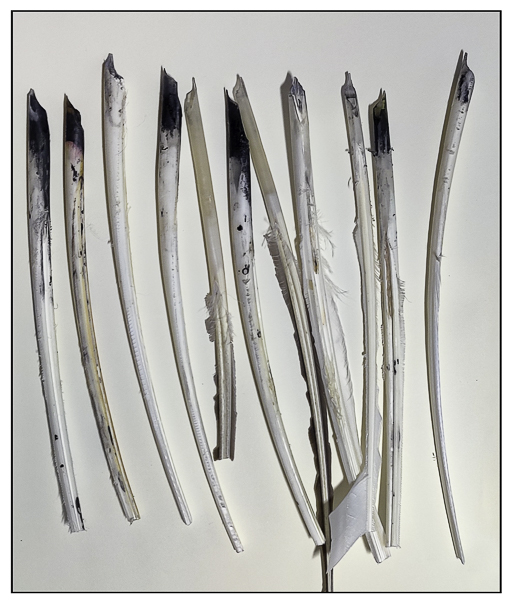
So, today I mended about 7 pens and cut 5 more, two of which were failures. I threw an old quill pen out as it was done in, and my mending attempts only made it worse. I saved my favorite pen and fixed a bunch and made some new ones. Not a bad few hours spent in the sunny patio! I now have 11 usable quills for my daily jottings.
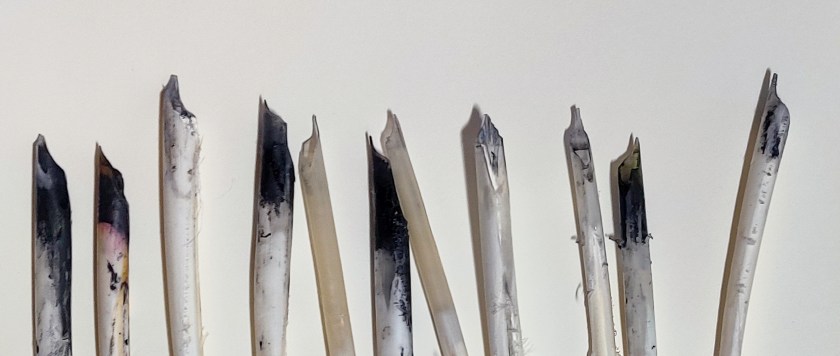
And a close up of the nibs – some are quite inky!
Hope this helps you realize that your old feather quill pen can still be used with a bit of TLC! If they did it in the Regency period, you can still do it in the 21st century.