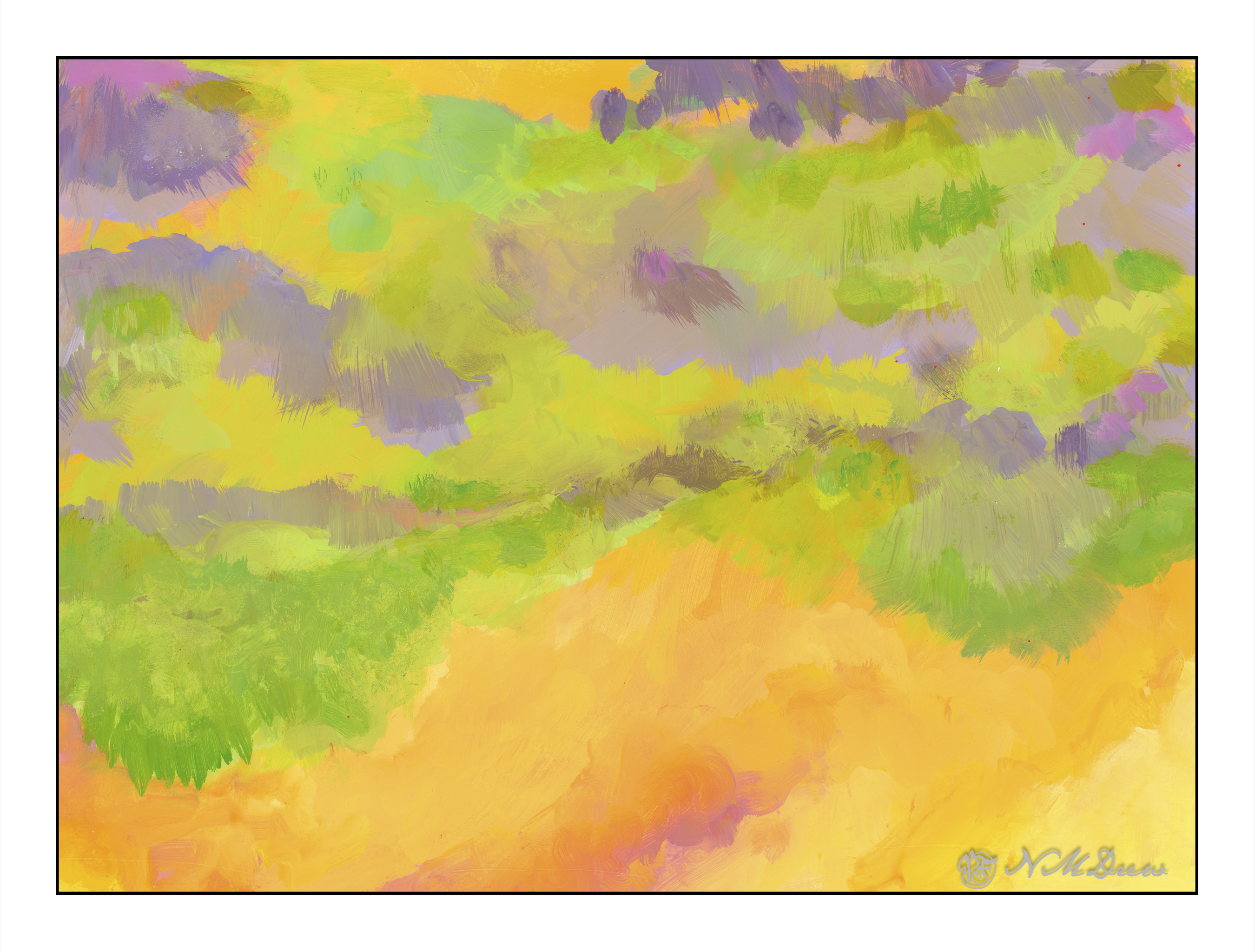
Colorfield #1

Lately I have been playing a lot with color and trying to use it not realistically, abstractly, and so on. There are a lot of people out there known for their color usage. Andre Derain, Georges Braque, Mark Rothko, Wolf Kahn are a few of them. The name for their color usage varies, from Fauve, Abstract Expressionist, Colorist / Colorism, Colorfield. I rather like the word Colorfield as it seems more all encompassing and broader in content / context than many of the others.

There is a lot more to using colors abstractly than I have realized, probably because I am a bit of a realistic if not realistically realistic person when it comes to artwork. Harmonious colors are important to me, and playing with these as I have has been a very difficult situation. While I like stormy weather, gloomy paintings are not my cup of tea. I don’t like them a lot as they tend to be depressing – but that is dependent, too, on subject matter. Picasso’s Guernica is a good example of a depressing painting – as are many of his portraits during his “Blue Period”.
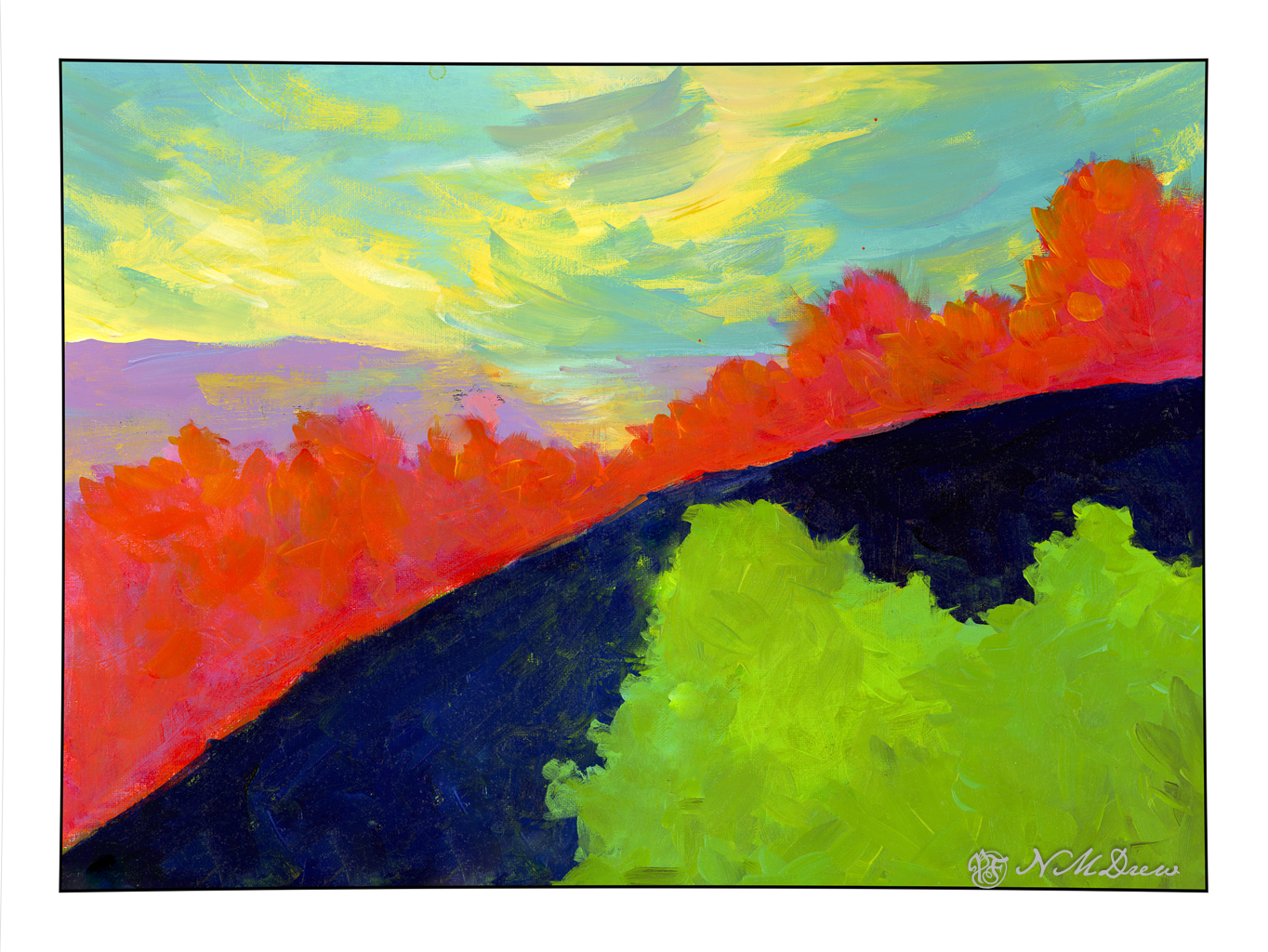
This painting, to my eye, is really depressing. There are parts of it I like, such as the sky and lavender land below it. Independently I like the red / lavender bushes. Below them, the navy and green just don’t do anything for me. Get rid of the bottom or change the colors may be something for the future, but I am pretty tired of this whole thing!

Colorfield – what do I want to do with it? When I did Into the Blazing Hills, I was much happier with the colors and certainly not depressed by them.
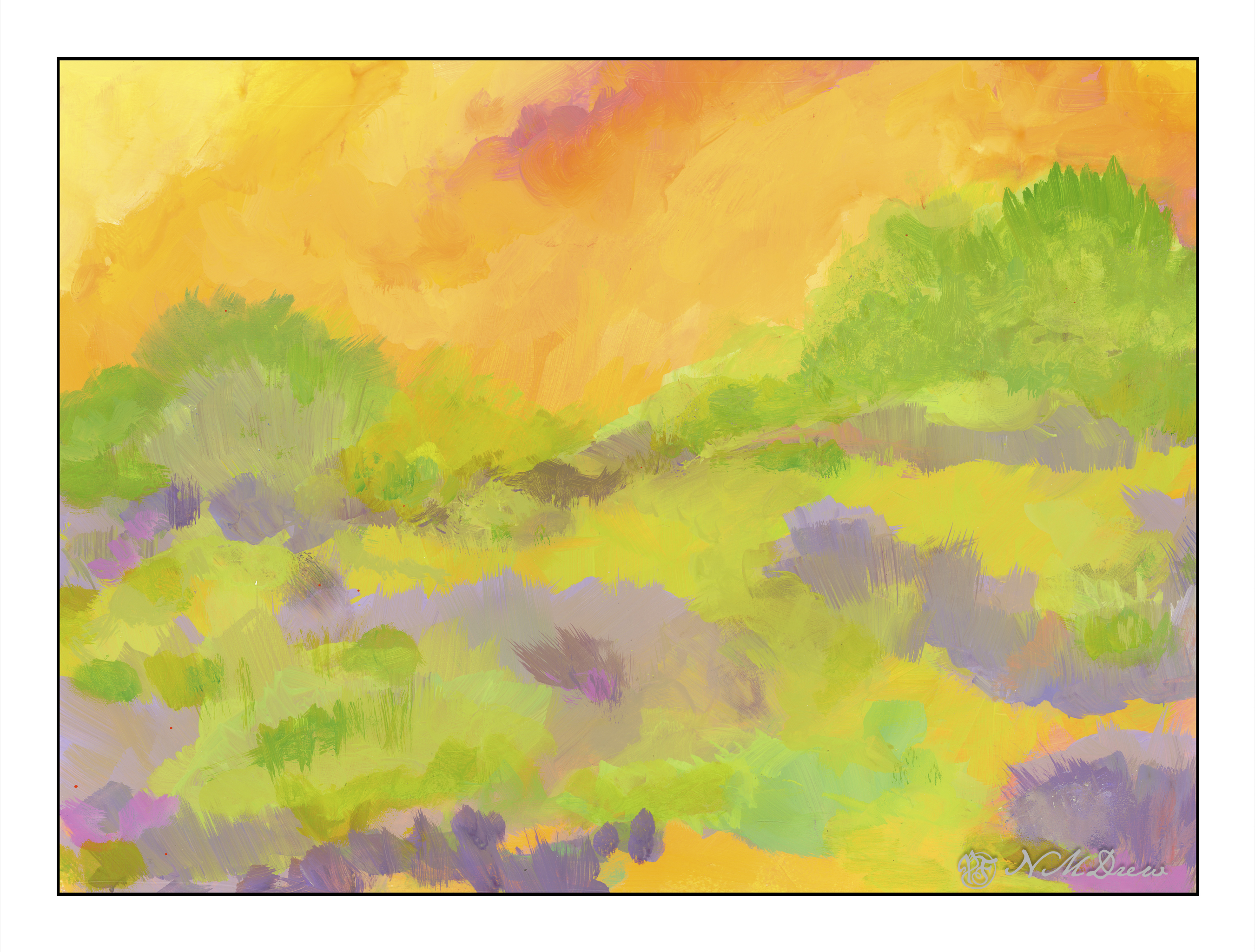
Looking at the above painting, I realize I like the lightness and warmth of the colors. The blob of blue and green in the top painting are cold and too contrasting in comparison with the rest of the painting. The orange bushes / trees create a hard barrier and keeps the whole painting from working well together.
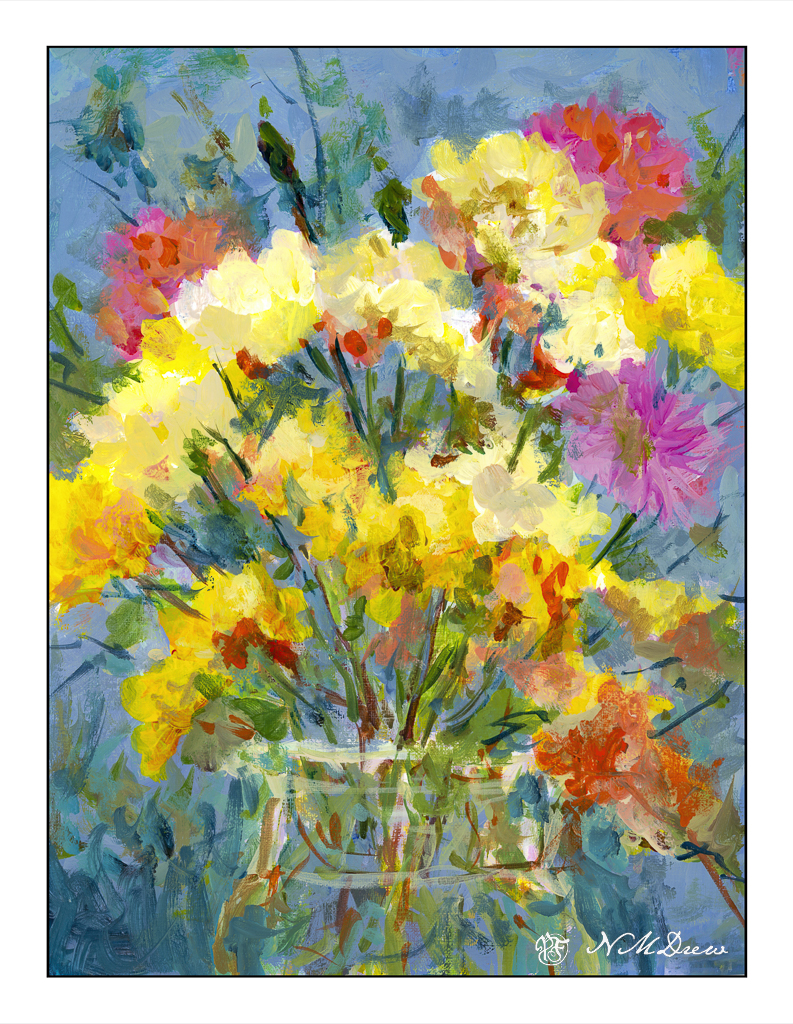
These flowers are also more harmonious and pleasing to me. A busier painting than the top one, and less abstract than the second one, but it doesn’t give me a sense of depression.
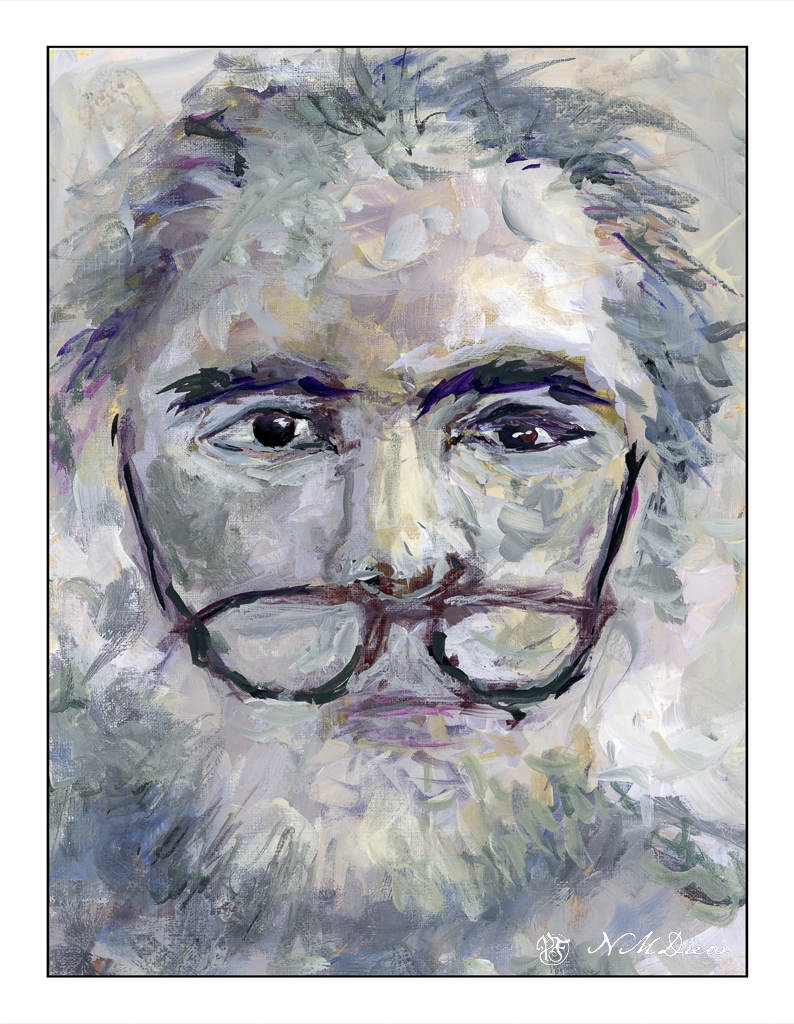
This portrait, too, is not depressing even though it is a low-key color palette.
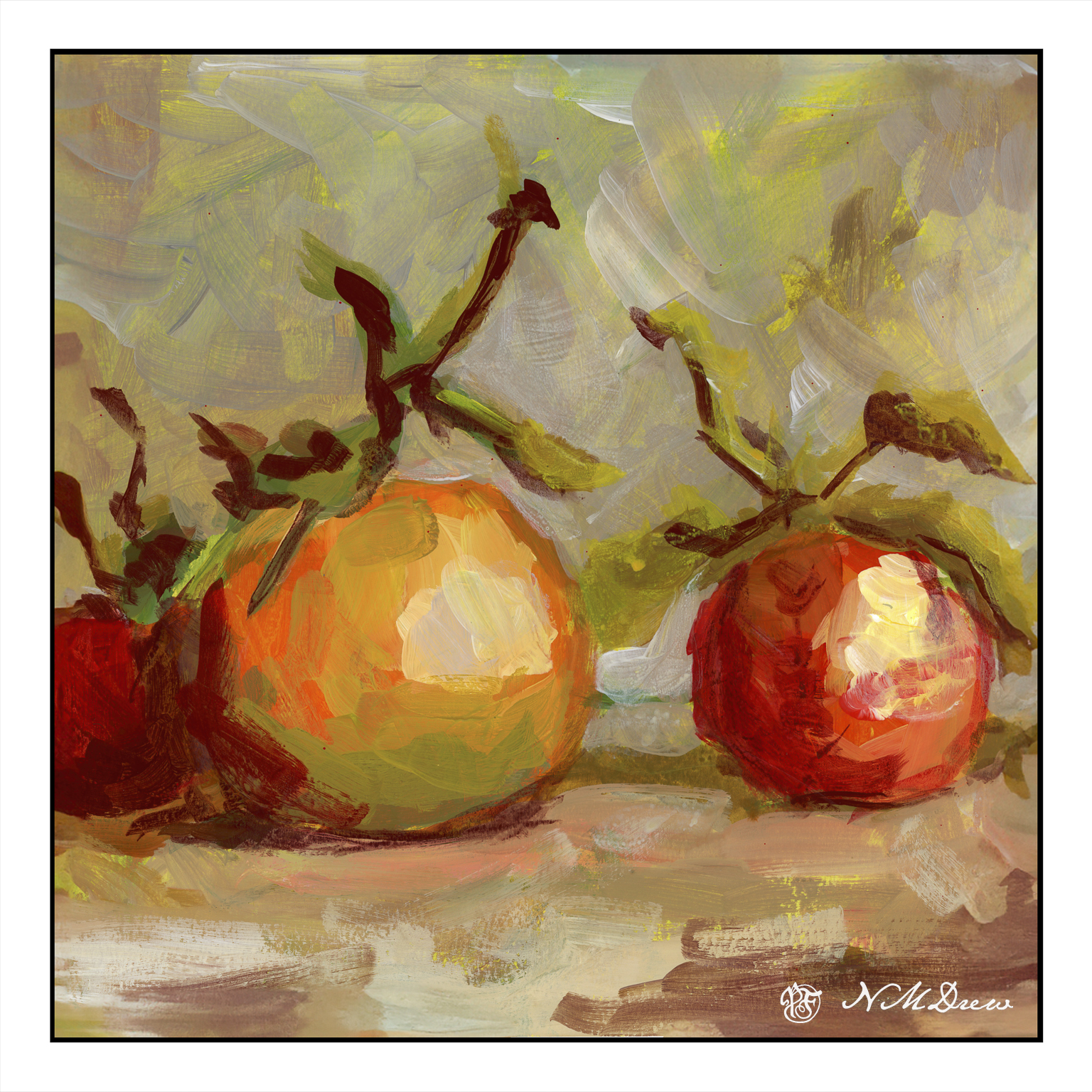
Colors here are also warm and friendly.

So, what does all this mean for me? It means that using colors – in say a “colorfield” style painting – that I like, that please me, are very important. While I like bright colors and contrast, how far should it go? That is really what this painting was all about – finding what works, what doesn’t work.

Play is a way to learn. I learned I need to pay attention to colors especially if I am using large areas, such as with this study. The teal / yellow sky is okay; the lavender land beneath the sky is also okay. The lavender / orange trees are fine too. But, that green and blue do nothing for me except repulse me. It is “not me” if I were to say anything about it. It is ugly and not harmonious. There is not a sense of balance in any part of the painting – rather it is a bunch of stuff stuck together to see what happens.

Not a happy camper with the results, but pleased with my analysis.

The Not Taken Vacation: Ronda, Spain

Located in the province of Malaga in southern Spain, Ronda is about 65 miles northwest of Malaga, Spain. It is a “white village” located in Andalusia – a vast region along the Mediterranean and inland – but it is more than just a “white village” as it is home to what I think is one of the most fascinating bits of architecture, the Puente Nuevo. We will explore that famous bridge later on, but for now, let us just enjoy the magnificent scenery of this lovely place.

Ronda has been settled since neolithic times, but the 6th century seems to be when itself became a more settled area. It is marked by cliffs and canyons, as you can see below, but it is also built up on either side of the Guadalevin river. As the countryside is steep, getting from one side of the river to the other is a bit problematic.

These buildings are on one side of the Puente Nuevo. They stand on steep cliffs. As someone without a head for heights, I am not so sure I would want to stand on a balcony and look down – but I think looking across would show some marvelous scenery. Also, coming from earthquake country with unstable soil, my thoughts are, oops! – why did they build there? However, I expect things are far more stable than they are in my neck of the woods as this is an area where a bridge spanning a canyon 400 feet deep and completed in 1793 still stands.

So much to see in the south of Spain! To be continued!

The Not Taken Vacation: Tram Ride in Lisbon

Lisbon is a very hilly city! Can you imagine huffing and puffing your way home, to the market, to the sea, to the museum, to the doctor, to the park, to your mother’s Sunday dinner, to anywhere?

No?

Me neither. (My days of training for the Olympics are long gone.)

Enter the tram. To learn about the history of the tram in Lisbon, Portugal, Wikipedia has an interesting and fascinating article. Some of them are two-way, meaning one on the left and right of a main street, and others, such as this one, go one way up and down narrow, winding roads.

I am sure that there are many things which typify Lisbon, but for me, a tram ride would be my first thought. This way you can see the streets of the city, look at houses and architecture, see people away from tourist spots. A single track – such as here – chugging through they neighborhood – with very narrow sidewalks on either side makes, in my imagination, for a rather scary experience. And cars in front of such a tram? A child chasing a ball? How fast do these trams go?

My mother recalled the electric buses which ran throughout Chicago and its environs as a kid. It was often the only way to get anywhere for most people. Horse-drawn ice wagons, too, are part of her childhood memories, as were the Cossacks on horseback in Poland those of her parents. I have driven since 16, and have used public transportation very little. Cars are my way of scooting around. However, the cable cars in San Francisco are world-famous and first class fun – I would take those any day. But, for now, I must suffice myself with an imaginary ride on a tram up and down the hills of Lisbon.

Upward to the Beyond

What is the “right” way to hang an abstract? Is it the artist’s choice – the viewer’s choice – the hanger’s choice? The painting “Into the Blazing Hills” is one thing – the title telling you what I see. Inverted, I see “Upward to the Beyond” – moving toward the other side. What is the other side?

Putting my digital signature on this one gives it a different sort of reality – the signature grounds the painting and says “this is the bottom so upward is the top.” What is the top? What is the bottom?

Sideways, the painting does nothing for me, with the yellows on the left or right, but yellows on the top or bottom create a totally different feeling, but somehow the feeling is right. I will say, the yellows on the bottoms are more disconcerting and unsettling to me than when it is on the top. So, upset or comfort?

If I were to critique this at all, I would find this painting bottom-heavy in yellow, and moving upward it seems as if there are trees silhouetted against the sky. However, there is all this stuff in between, and it lacks the harmony, I think, that “Into the Blazing Hills” has. Perhaps it is the ability for me to recognize my surroundings – the hills of California – with either a sky and brilliant, blazing sunset – or a wildfire encroaching a bit of paradise, destruction being moments away.

This is going to take time – maybe both are “right” – and perhaps the middle chaos in this painting is okay but needs a path of some kind to lead the eye upward.

Into the Blazing Hills

One thing I enjoy about a retrospective show of an artist’s work is to have a sequential progression of his / her development. As an erstwhile “artist” I find myself is bopping around. It is my erratic personality – my magpie personality – drawn to this and that. That is probably why I like Hawaiian print shirts – colorful and rather crazy. When I look at my own paintings over time, color is always the primary theme. Sometimes my color usage is quite bad – nay, awful! – and sometimes very much to my liking.

In this vein, I decided to just paint with the Golden fluid acrylics, spreading around colors and creating shapes. I figured it would make itself known to be whatever it is to be. As someone who likes landscapes, I figured it would become one. My thoughts were, as I progressed, a flower meadow, hills of flowers, trees, and then just putz. Using acrylics means putting paint down in a way which works with their quick drying qualities, but I did use matte medium. A lot of times I just dumped color on the palette paper, mixed, added white, and then mooshed it around on the paper. The matte medium creates a bit of transparency, and it makes a sort of glaze over underlying colors.

Painting was done with wide, flat brushes – 3″ and 1″ flats – later a large round – and my fingers encased in nitrile gloves. It took about 3 days and 6 hours to paint this on 15×20 watercolor paper. Golden Fluid acrylics, matte medium.

Colorism is something that truly appeals to me. Not Fauvism, which I find a bit too loud for my taste, but colors to create an emotion or feeling more than reality, with a bit of a suggestion of reality.