Learning Curve

I have some nice software for photography.  Some is intuitive and easy to use.  Some is free.  Some I have paid for, and have been able to navigate with a fair amount of comfort.  However, Photoshop CS5 has proved to be none of the above because it is such a complicated and sophisticated program.

Not having time nor interest in classes, that leaves me with mucking around or doing internet classes or reading.  I’ve got one book which is fantastic by Martin Evening, complete with DVD and lessons.  However, what I have been wanting is one simply focused on layers.  Layers are an essential part of CS5, but rather confusing because of the many things that can be done in a layer, to a layer, with a layer, and in the layers panel itself.  Last weekend, down at the local bookstore, I found a couple of books which caught my interest, one on flower photography, and another specific to layers in CS5, by Matt Kloskowski.

Layers, to me, means using acetate and transparencies, because I am from the pre-computer days and am used to rubylith and light tables and wax and the darkroom.  I am not illiterate, either, in the computer world, but I am lazy in the learning world!  As a result, this book is probably going to be able to open a lot of doors into this software I have not explored.

Another software I really like is from Nik. It is Silver Efex 2, specifically designed for black and white photography. I have tried a few of their other products, which are also good, so I ordered their Complete Collection, and it includes Silver Efex, Viveza, HDR, Color Efex, and Sharpener.

The Complete Collection should arrive today.  I have enough to keep me out of trouble for awhile.

Sumi-e Studies

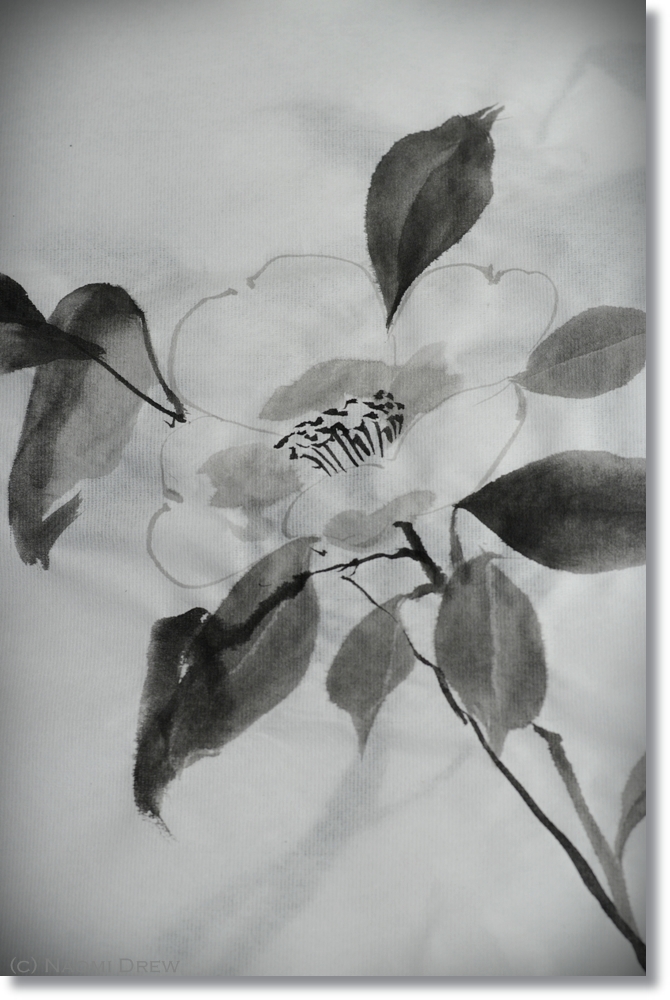
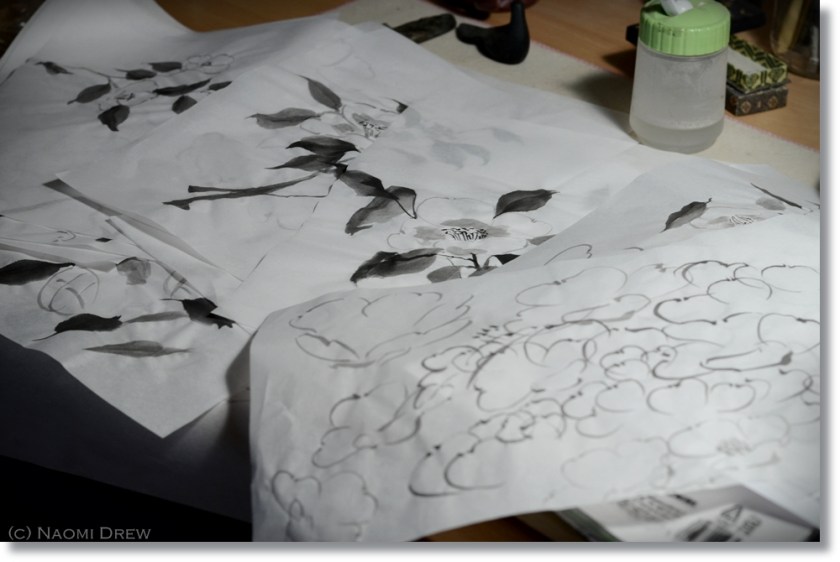
After the trip to the Descanso Gardens, and the Gardens of the World, I finally got out some ink, paper, and brushes.  The camellias in bloom everywhere in the Descanso Gardens, and the rows of magnolias in the Gardens of the world, pushed it.  Seeing something that I have practiced painting before, in abundance, was an amazing inspiration.  So much beauty!  It is much different to paint something, practice something, and become familiar with it in one form – and then to re-experience it in another form.

I chose to focus on the camellia, or tsubaki.  There is a lovely painting demonstration by Kazu Shimura, as well as other images in sumi-e throughout the web if you google.  Photographs help, too, ones you might take or you might find.

The petals have a light ruffled edge, the center stamens and pistils point outward. Blossoms vary from a few petals – as seen in Shimura’s paintings – to multiple layers.  The leaves vary in shape, but in general are long and round and end in a point.  The edges of the flowers are hard to do gracefully, for me at least.  The leaves are easier.  I spent several hours just practicing the outline of the petals.

Yesterday at a local garden supply store, there were camellia bushes for sale.  I may just buy one for more up close studies as this is the season of bud and flower and leaf.

Skep – A New Hat!

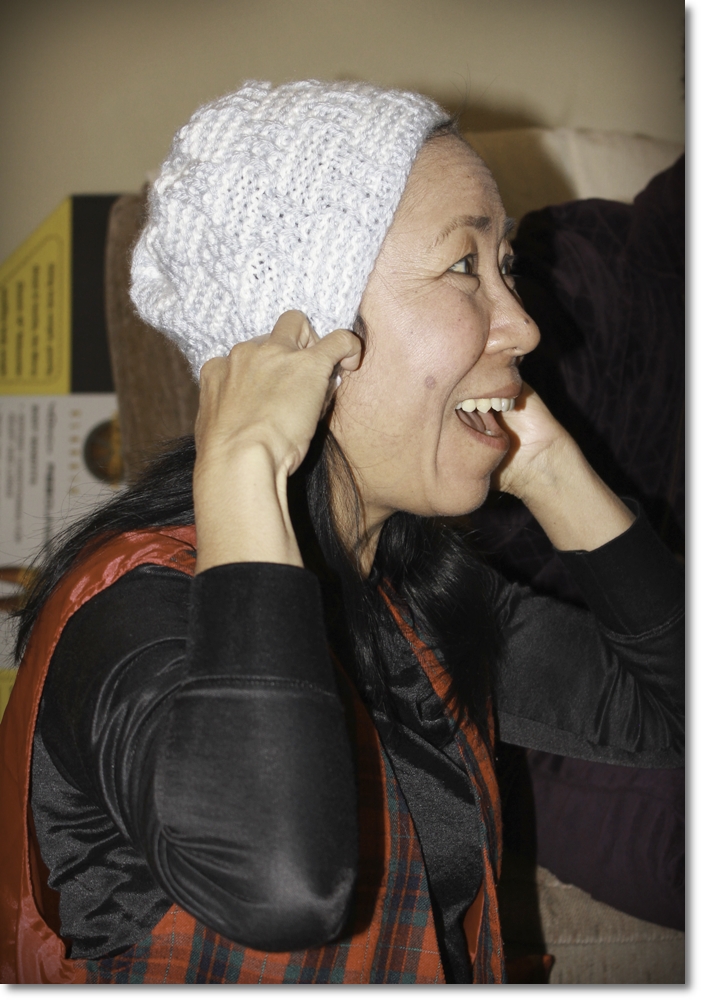
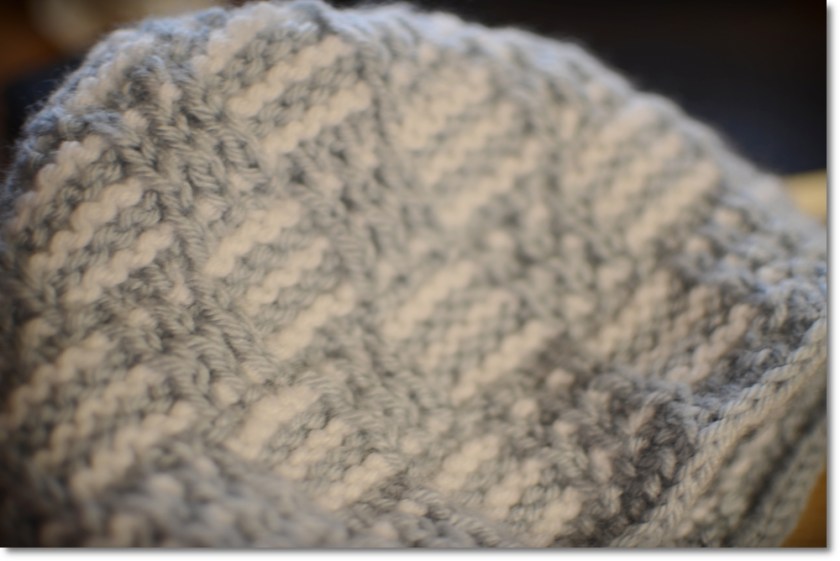
This hat is a simple mosaic stitch pattern, with texture created using purl stitches along with knit and slipped stitches.  Although mosaic knitting looks complicated, it really is not.  The fact is, each knitted round (or round with purl stitches) is done in only one color.  The slipped stitches pull the contrasting color up from the row below.  The biggest challenge in writing up this pattern was actually in translating the written pattern into a charted design.

Besides the mosaic pattern, the foundation round of the hat is done in i-cord, invented or unvented by Elizabeth Zimmermann.  This creates an edge that is tidy, but a bit stretchy.  The result is a hat with a snug edge which helps the hat hold its shape.  From the initial i-cord cast on, the first round increases the stitch count, and thence the pattern commences.  You can purchase pattern on Ravelry – follow the link here, or else click on the pattern listing under my “page” column.

Although I did not make the pattern available in different sizes, it would be easy to modify the pattern for a very large head or a child, simply by adding or subtracting repeats.

What is a “Skep”?

A skep is an old word for a beehive, made of coiled straw or grass, and shaped into a conical formation.  In the New World, there were no honey bees, and so when the Europeans settled, they brought their bees with them.  The shape and texture of this hat made me think of a skep – thus its name!

Unfortunately, our honey bee population is being challenged by viruses or some other horrible illness, and their number is dwindling.  Add to this, they are mating with African bees, which are known to be very aggressive.  Neither is a good thing.

A Bee Artist

I would like to refer you to a site I really enjoy, Pencil and Leaf, which is the blog of an artist who does wonderful drawings and painting of bees and flowers.  Buzz over to see her fine work.