Why a Master Copy?

Copying the work of a master painter, as I have been doing with Edward Seago (and others) of late in watercolor, is a time-honored tradition in learning how to do things. There is a lot to be learned while doing a master copy, and doing a master copy imprints itself on the copy-ist in many ways. Search “why make a master copy” on the internet, and you will find a million bazillion results.

Here are some reasons from Cecile Yadro’s website:

  • Beat the art block
  • Develop your skills
  • Get creative inspiration
  • Learn to self-critique
  • Improve your observation skills
  • Develop patience and focus
  • Develop muscle memory
  • Build confidence

These are all great reasons, and some you may not even expect, such as muscle memory! For me, these are salient reasons, and even more importantly, open my mind up to a way of doing things and seeing things that I probably never have otherwise considered. By nature, I am not analytical but reactive – patience is not one of my virtues and frustration is not something I like reacting to. As a kid, well, let’s just say my inability to handle frustration made me the “bad” child!

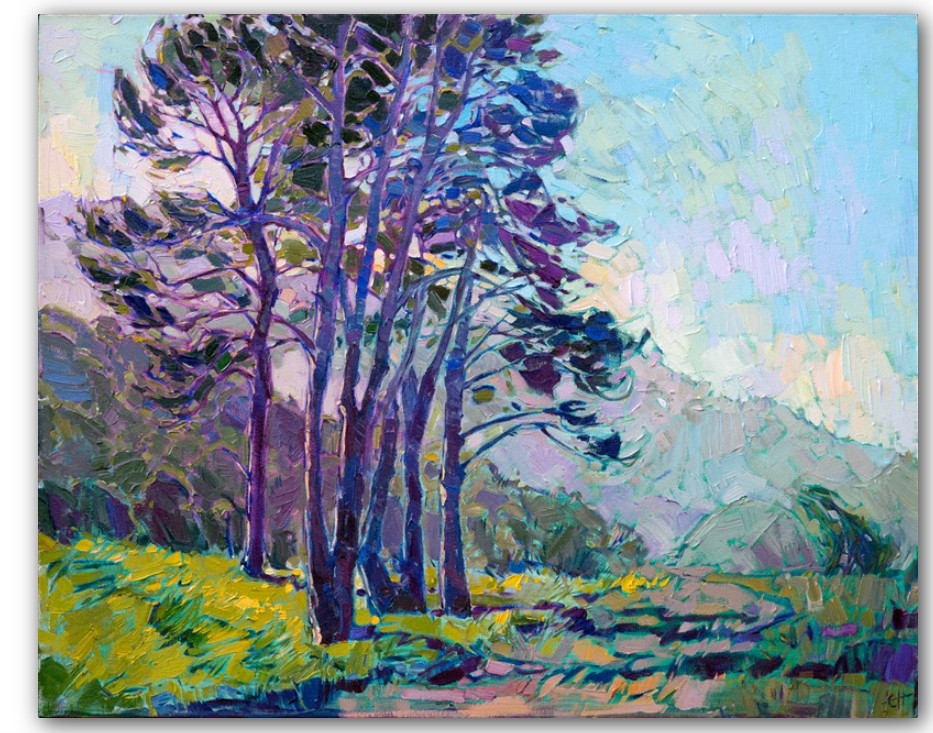
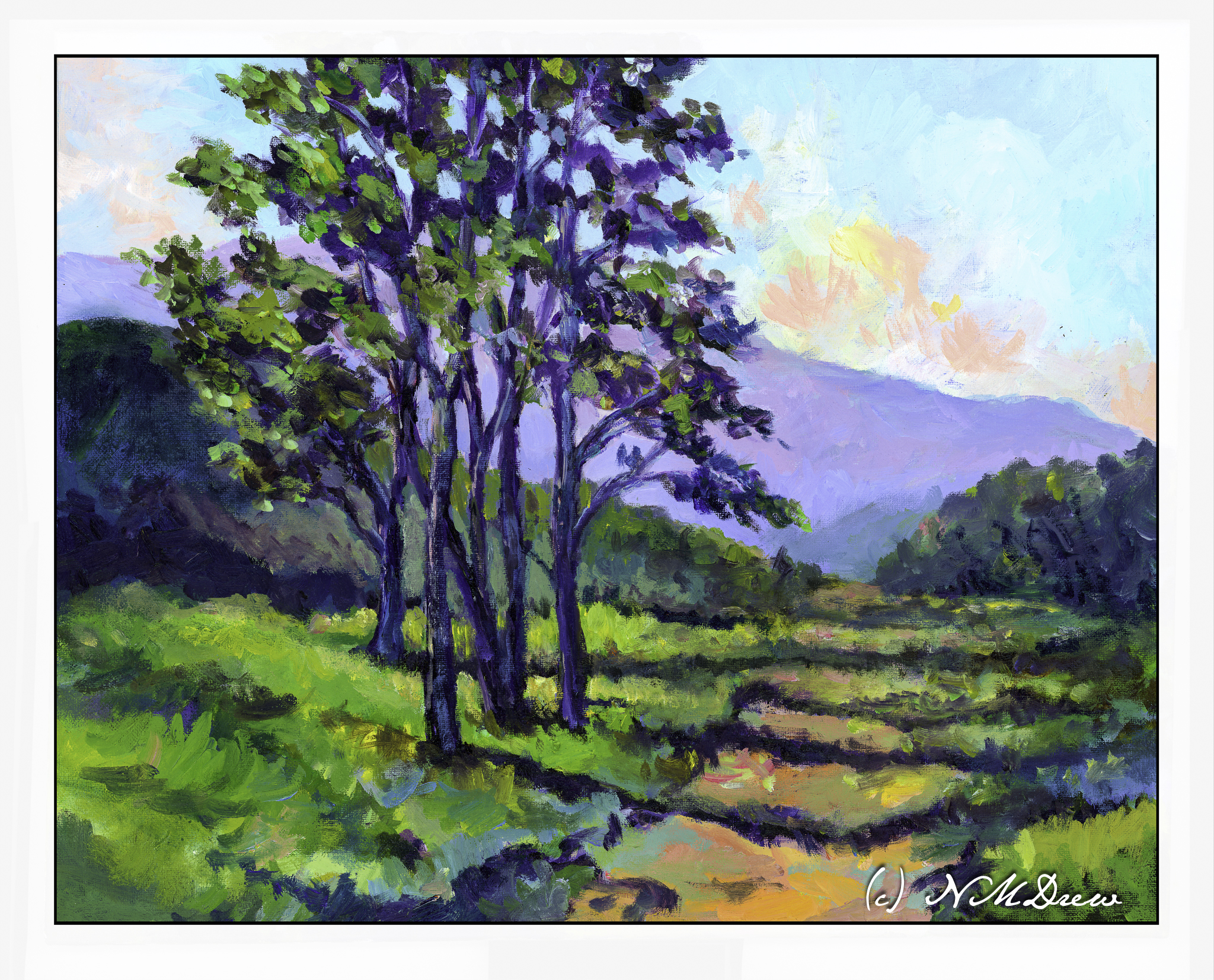
Watercolor master copies are easy enough to do, as is with any water-based medium which dries quickly. I say “easy” because once done, I can scan them and look at them, and critique them more objectively. I see things I miss when looking at a non-digitized painting. (Need to work on that!) Oil painting, though, is a different story. Oils you can paint over, you can use quick-drying mediums, you can take forever to decide something is finally “done”. I have been working on three oil paintings, master copies of three different artists: Erin Hanson, Michael Chamberlain, and Maggie Siner.

Today let’s learn a bit about Erin Hanson.

I first came across the work of Erin Hanson about 3 years ago. Cruising through who knows what, I found her site and learned that she created a painting style called “Open Impressionism” which, as her website states, “continues the work of impressionists and post-impressionists.” It does insofar of the radical use of color to capture light and movement. There is a freshness here that I rather like, and the bright colors appeal to me. Her ability to create good composition is evident, too, and these make for attractive paintings. Below is a lengthy YouTube video which will acquaint you with her work:

YouTube has a number of videos by and about Hanson. Explore at your will. As well, check out her portfolio of paintings on her website – you can see her evolution over time as well as decide for yourself if you like her style. As with any artist, some paintings will appeal to you more than others.

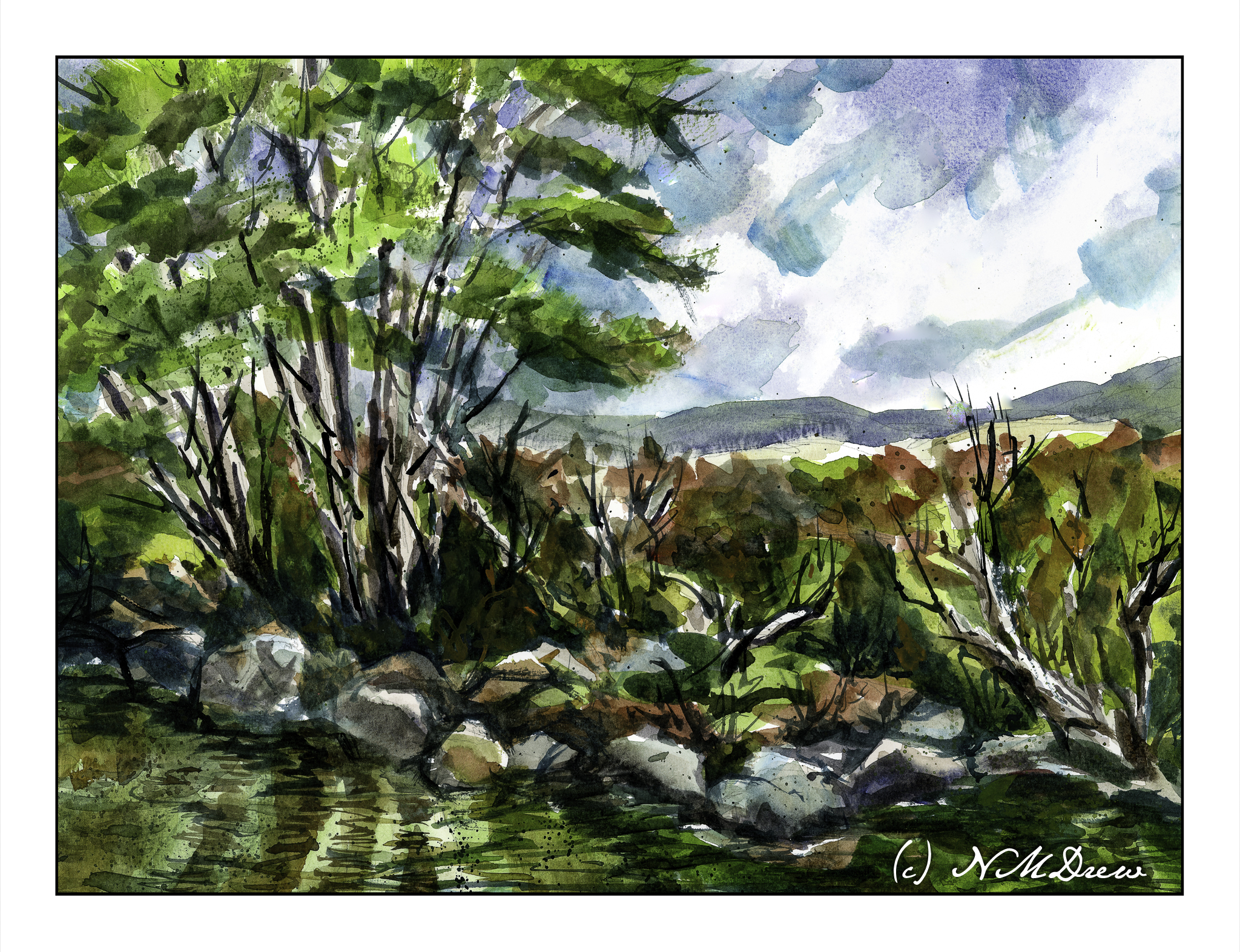
Along the Riverbank

When we lived alongside the Rancocas Creek in New Jersey, the shores of the creek were slick and muddy and the underbrush along the edges of the creek were thick and tangled and nearly impossible to get through. Of course, kids worked their way in – as did I – and paths led to some wonderful places. We had a tree house in a huge willow tree and a rope swing over the creek. If you were brave enough, or foolish enough, you could jump into the creek from the rope. I never did that! Instead, I traipsed around in the mud, pushing my way through stink weed and elephant ears (our names), losing my shoes in the mud (and getting spanked for that!), and getting bitten by mosquitos.

Such memories are the inspiration for this watercolor. I wanted to show the crowded growth along the banks, the greenish water, et cetera, et cetera. I also wanted to make it a simpler painting, trying to do masses of color without all these details. I don’t know if that would have been possible but I think I will try this painting again, but I need to think about it and play a bit to get it. As well, the whitish bark of the trees, living and dead, were hard to paint – decisions to paint around, then tint, or tint and then paint around them drove me a bit to the frantic side of my personality, which already tends towards hysteria.

Anyway!

I also used a new-to-me watercolor paper, made by St. Cuthbert’s Mill in England. I am not sure as to its fiber content, but it is archival. The texture is nice, size is good at 11×15 inches, and worked really well with the paints and water. Color could be lifted, as in the reflections of the trees on the left in the creek. So far I am pleased with this paper and definitely plan more paintings using it.

Colors were, again, of a more limited and older tradition: Hookers, ultramarine and cobalt blues, yellow ochre, siennas. A bit of alizarin and both cad red and yellows were thrown in for mixing.

While this painting is busy, it works okay for me. I think the challenge to simplify it will be worth the time and energy I spend to do it.

Carolina Sea Shore

Beaches differ so much, but one thing they have in common – the ocean! The shore between land and ocean can vary, from rough and rocky, to wide and sandy and flat, and everything and anything else.

Once more, the simplicity of Seago’s watercolors was in mind, but my own rather picky or detail-oriented tendencies made simplification really hard to achieve. Along this shoreline is seaweed and other detritus, differing levels of shoreline, dunes and grasses. In the distance is an opposite shore – island or land arm of a bay? I had to force myself to stop!

And there is a giant bird shape in the middle of the sky . . . funny how you don’t see these things – at least I don’t – until I scan the painting and look at it days later. Maybe I’ll fix it, maybe I’ll leave it.

Again, a limited palette of ultramarine, Hooker’s, ochre and sienna. I also used a bit of phthalo blue, an as a touch-up, white gouache. Hahnemuhle 9×12 140# CP paper.

A Little Church in Norfolk

Given my recent subject matter – Edward Seago and his paintings of Norfolk, a county in East Anglia, England – I was rather delighted to see this video! Living in California where the comment “some of these buildings are more than 25 years old” is so true and always makes me laugh, historical buildings, and historical paintings from the Saxon era, are wonderful. So, with no further ado: