Trying to Turn the Tides of Time

Change!

I am not getting younger, have some labile blood pressure problems, and have been out of shape for a long time.  Where I live, there is not a decent health club within a reasonable distance (for me, that is about 3 miles!  I hate driving places!).  I’ve been here 7 years, and have become increasingly more blobbish in my life style.  And I have become fatter and fatter.  Typical of most people my age!  And, perhaps, being American.  Add to this, I injured a knee several years ago when running because my running partner was a ditz, didn’t stay on her half of the path, saw something, and ran right into me to go see it.  That stopped my running altogether.  I tried doing things like running in place, but that really was bad, on both knees.

About a month ago, I decided I was just tired of it all, and with a new running partner, set off.  We were both in awful shape, and huffed and puffed and managed to run a teensy fraction of .6 miles.  Still, we did it.  And we continued to do it every other day, and one day on the weekend, in the morning.  Last Saturday we ran our usual route, through an oak grove on a dirt trail, with an elevation shift of about 100 feet, most of it in one spot, up a steepish hill, and did it twice.  1.2 miles!  We stopped in between, but the fact is, we did it.  And, this morning, in a different area of town, still under the oaks on a dirt trail, we did 1.7 miles nonstop.  Very slow pace – 3.17 mph for me – but it was nonstop.  And, when I took my pulse after about a 5 minute rest, it was 60-64.  That is good!

In addition to getting exercise, I am also really looking at what I eat.  Overall, my diet is healthy, except if I get a cookie in my hand.  Sugar gets me every time.  I eat vegetables, fruit, nuts, grains, but I also eat a fair amount of red meat, although I seldom grab anything to eat I have not made myself.  Checking labels is something I do religiously, especially for salt.

The fact is, I eat a lot of carbs, and a lot of fat.  Carbs add to the weight, and fat clogs the arteries.  I am trying to shift my diet to one which is more plant-based, meaning adding beans, such as tofu or, today, cooking up a mess-of-beans in the pot.  Things which do have fat are focused on the healthy fats, such as in fish, nuts, and olive oil.  I am keeping red meat to once a week.  Eggs vary in amount during the week because most mornings I dislike the smell too early in the day.  Snacks are dark chocolate or nuts or seeds or fruit.  I am shifting, I hope, from half-and-half in my coffee to a soy creamer, but that will have to be one that tastes good, and may be hard to find.  At least I am not using the pure cream I used so long!

So, a few recipes have been found that I like.  One is a simple smoothie, which is great for an easy afternoon snack:  one banana, 1 c. of almond milk (the 60 calorie variety) and a splash of vanilla extract.  Today, I am cooking up some dried beans, and after soaking them overnight, I am cooking them with onion, pepper, jalapeno, and multiple herbs and spices.

The final thing, I weigh myself daily, and log my foods.  I use FitDay, which I have used for years, and it continues to offer a lot, is easy to use, and more than anything, I am comfortable with it.  I also am recording my blood pressure, which does not thrill me, but it has to be done because it bounces all over the place, both systolic and diastolic.  In general, though, the diastolic (lower number) doing pretty good, and the same with the systolic, but I have had some extremes in the past few days – 150/80, and 128/96.  One day I had 119/78.

Yes, I want to lose weight, but I also want that blood pressure to become more consistent, and better blood work.  It is taking time, but after just a month, I can see some pretty good changes.  I ain’t no spring chicken, but don’t want my clockwork sprung and not working!

3 + 6

Three colors used to create six spheres. I think they are oranges or lemons or something.

Colors are Daniel Smith New Gamboge, Winsor Newton Alizarin Crimson, and Graham Phthalo Blue.

Everything was done with glazes.

_DSC1337

Some glazes were pure color, others were mixed colors.

_DSC1338

Some were more successfully done than others. Some shadows are pretty nice. Some of the fruits are nice. Some are pretty bad.

_DSC1339

I used three primaries, and got greens and oranges and purples. I created some mud. I had to be patient.

_DSC1340

At times, I let the paper sit, and watched granulation occur. Other times I rolled the paper around to get colors to blend more evenly. On a few occasions, I lifted out pigment with a slightly damp brush in an attempt to make a smooth transition of colors in different areas.

_DSC1341

And when I ate up all the white highlights I had left, a few even got a touch of Chinese white. A no-no, but had to be tried.

Practice, Practice, Practice!

I am continuing the varied steps from Birgit O’Connor’s excellent video.  Upon her recommendations for brushes, I ordered the DaVinci Cosmotop Mix B in size 30, and the Cosmotop Spin Mix F in 20 and 14.  The brushes I have been using have been either pure synthetics or pure Kolinsky sable, neither of which seems especially suited for the painting methods she demonstrates.  I also bought the Pebeo drawing gum, which is thinner and more manipulable than the Winsor Newton masking fluid.

Shapes, Pebeo, and Color Splatters

Above is the very first step in the current practice piece.  I laid out my masks, then used Winsor Newton’s masking fluid and a toothbrush and splattered resist all over.  This fluid is thick and drops in blobs, big and small.  Some will become pebbles and ocean glass by the end of the painting.  Then, using the toothbrush, splatters of color, to make the sand, were used.  My colors were combos of burnt sienna, ultramarine, umber, and yellow ochre.

Splattered Shapes

After letting everything dry, I removed the masks, splatters and all, and set them aside on a piece of typing paper.  (Maybe I will use them again!)  You can see what a mess there is!

No Shadows

The next step was quite long.  The shells, stones, pebbles, glass, and what is supposed to be seaweed, were painted.  O’Connor demonstrates some really cool techniques in her video, and the new brushes made all the difference in the world.  I am also getting some control, at last, in the shadings of the shells and stones.  In particular, I like the stone in the upper left corner, and the seaweed.

Shadows #1

As you can see, adding shadows to the painting give the illusion of depth.  If you look closely, though, you can see that the shadow in the upper left hand corner is very over worked, and the shadows vary in lightness and darkness.  This is because of a number of things.  I did not mix up enough watercolor wash for all the shadows.  This is very important to create a consistent hue.  Another thing is that these shadows are far more challenging that you might think – a single stroke is best.  The one in the upper left I revisited two or three times.  I think it might have been best done with a layer of water laid down first, as it is so large, and then working the shadow is as a wash, being careful to tilt and shift the paper so the shadow color is evenly distributed.

Shadows & Sand Ripples

The final step was adding the ripples in the sand.  These are fun to do, and remarkably easy.  And, they can really add to the overall composition of the picture, helping to move the eye in and out of the shapes.  Part of me thinks that I need one or two small ones moving from upper left to lower right between the upper left rock and the tip of the mussel shell, but I am not sure.  Below is the final painting, cropped to remove all the distractions of the in-progress pictures.

Final Impression

To sum it up, this has been a wonderful learning experience, and has renewed my confidence.  Yes, I am doing exercises, but exercises are necessary for mastery.  I will do a lot more because there is a lot to learn in these seemingly simple studies.  Again, O’Connor’s video is definitely a worthwhile purchase.

Rocks & Shells

Rocks

As with sumi-e painting, in watercolor painting, much is to be learned from observation.  Recently, I purchased a video by Birgit O’Connor.  As an artist, she excels in vivid, colorful, large and intimate perspectives of flowers, but in looking on YouTube, she also can do a lot more than flowers.

The video I bought is Rocks, Sand & Sea Glass.  What makes it excellent for me is that she is very clear in her demonstrations, and more importantly, clear in her verbal explanations.  Her voice is nicely modulated, and proceeds at an even pace.  I really like the fact she identifies the brush she uses so explicitly, such as “my number 30 natural hair brush.”  Detailed as it seems, it allows the viewer to hear while watching.  I don’t have to sit and stare at her brush to think about what one she is using because she tells me.

In addition to watching, practice is paramount.  Seriously, you have to sit down and do it.  And do it again and again.  I know this about painting, because brushes vary, papers vary, my mood varies, and colors vary.  Self-control is necessary.  So is practice.  Having something interesting to paint makes it more fun.

Mussel Shells

Brushwork is so critical – knowing how to use a brush, how to load color, how to move the brush, maneuver it for shape, and how much pressure to apply.  How the paper responds is also important, simply because different papers have different characteristics, as well as come in different grades.

These are what I’ve produced.  More will come, as my supplies show up, too!  Thank goodness for Dick Blick and Amazon!

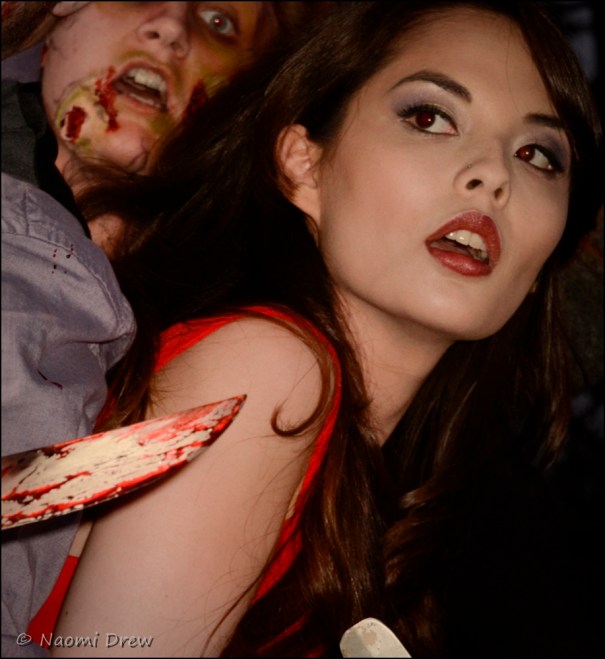
A Day in Zombie Wood

ZA 4

There is a meet-up group in my area for photography.  They have had a number of photo shoots, complete with models, make up, and outfits.  A friend of mine has been to nearly all of them, and says each time he goes, he learns something new.  I’ve been meaning to go, and finally made the commitment for the Zombie Apocalypse shoot.  And, it was worth it, not just because of the phenomenal make up jobs, but because of the people there – all so very nice!

ZA 12

An interesting thing occurred while I was shooting – suddenly, behind the camera, I was envisioning the picture I wanted before I shot it.  That has never happened before, and I cannot help but wonder if this means that I “know” enough now to have an artistic vision.  Shooting was a very fast process – those zombies can really scamper around – and that is when all of this visionary stuff began.  Compositional elements, seeing everything as it occurred, and anticipating what might occur.

ZA 21

Before I got to the zombies, I was photographing the young lovers, and while that was not quite as much fun, it was certainly a worthwhile endeavor.  It proceeded at a slower pace, because they were sitting at the picnic table.  At first, they were a bit stiff, but soon enough got into their roles as they became more used to everyone sticking cameras in their faces and telling them what to do.  That direction-giving probably helped to move them into their roles.

ZA 9