Round Brush – Doing Lines

Before I get into the morning’s routine, I feel like writing up what I did yesterday afternoon on my first “me only” day in a long time.  After my nap and afternoon coffee, I pulled out a novel, watercolors, paper, iPad, and a few other things, and moved out to the back patio.  The goal was to work on using a round brush and practicing how to use it.

I did – and still do occasionally – sumi-e – which is really focused on brushwork on absorbent paper.  Watercolor is not ink only, but colors, and the colors are alluring and distracting.  So distracting are they that I forget the value of brushwork and am completely seduced by colors!  As a result, I did some web searching and found a nice article on different brushstrokes to do with a round brush, as well as with a flat brush.  I chose the round to begin with as that is my go-to brush type.  Below are the exercises.

I made notes as I moved along.  I used pale colors, too, just to see how my scanner would pick them up (BTW, it did a pretty good job – the ink is a bit pale, though).

From this point – which was about an hour’s practice – I moved on to deciding what to do next.  Read my novel?  Have more coffee?  Paint a picture and focus on brushwork using a round brush!  I alternated between a larger squirrel mop and a synthetic sable round.

The first step was to choose the paper.  In the end, I chose a Handbook across two pages.  I had read somewhere about using a light color to create the outlines one might make with a pencil, so I used Quinacridone Gold and laid down the foundational lines.


At this point I worked out the building structure, horizon, and vanishing point, more by eye than using anything scientific like a ruler.

The next step was to add vast washes of color for the sky and field debris between the flowers.  The brushwork was done wet-on-wet for the sky.  A clear wash was followed by a sky of cerulean.  The same was done with the purple flower field on the right, which was then overlaid with a wet-into-kinda-wet mix of Alizarin Crimson and Carbazole Violet.  The gold between the long white was also wet-into-wet using Quinacridone Gold in varying strengths.  Then I let it all dry.
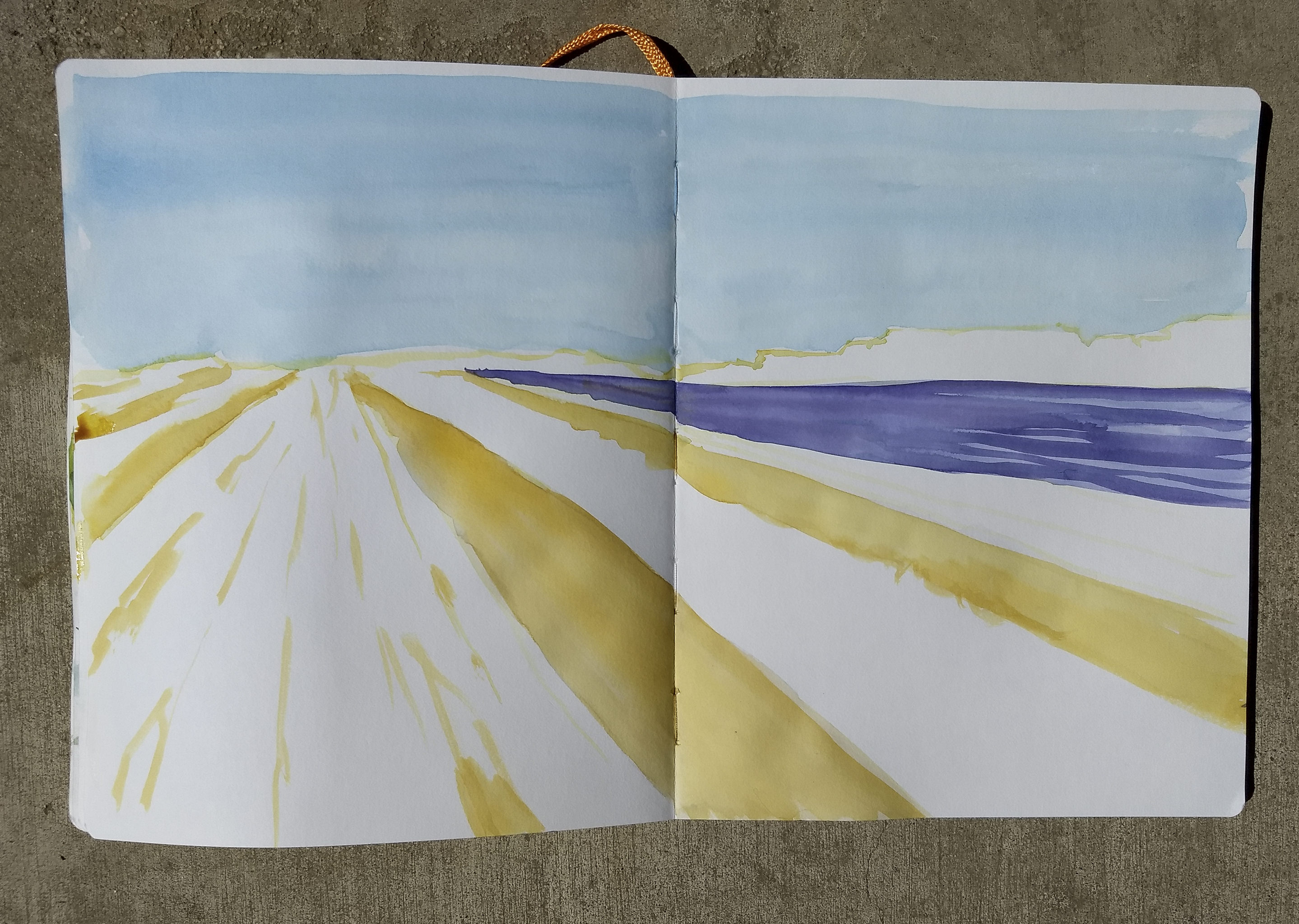
The next step was to create the pink flowerbeds. I used a mixture of Quinacridone Gold, Quinacridone Rose, and Alizarin Crimson. I really pushed the colors here, laying down values far darker than I would if I was working toward what I wanted – I really need to remember than watercolors dry about 30% lighter than the wet paint!

As you can see, I worked to create white space in the pink flower beds, and tried to add depth as they move toward the horizon.  From this point, the painting continued, and I didn’t stop to take pictures.  I read my novel as different layers dried.

As each step of proceeded – from initial lines of the sketch to the flower field – I thought about brush strokes.  The lines of the initial sketch were simple lines with the tip of the brush.  The washes for the sky used the side of the brush.  The fields of gold and violet were done as washes and as brush tip lines.  The pink flowers were a combination of lines and curves and dots.

Below is the final image.  The sky is vastly different than the flat wash, which I initially had planned on retaining, but as the outlines on the building were not strong, and the whites too pale and lacking in contrast, I turned the painting upside down and used a mix of Cerulean and Ultramarine to make edges pop.  This led to just doing the sky all over.  Imagine my surprise when I saw not only lines in my brushwork, but the lines in the composition!  The way the fields of flowers create a diagonal motion matches the opposite movement of the sky and clouds.

Altogether, I am really pleased with this study.  It took about 2 hours, with layers drying and my thinking and reading my novel.  Certainly an afternoon well spent, I think.

Sunday Morning

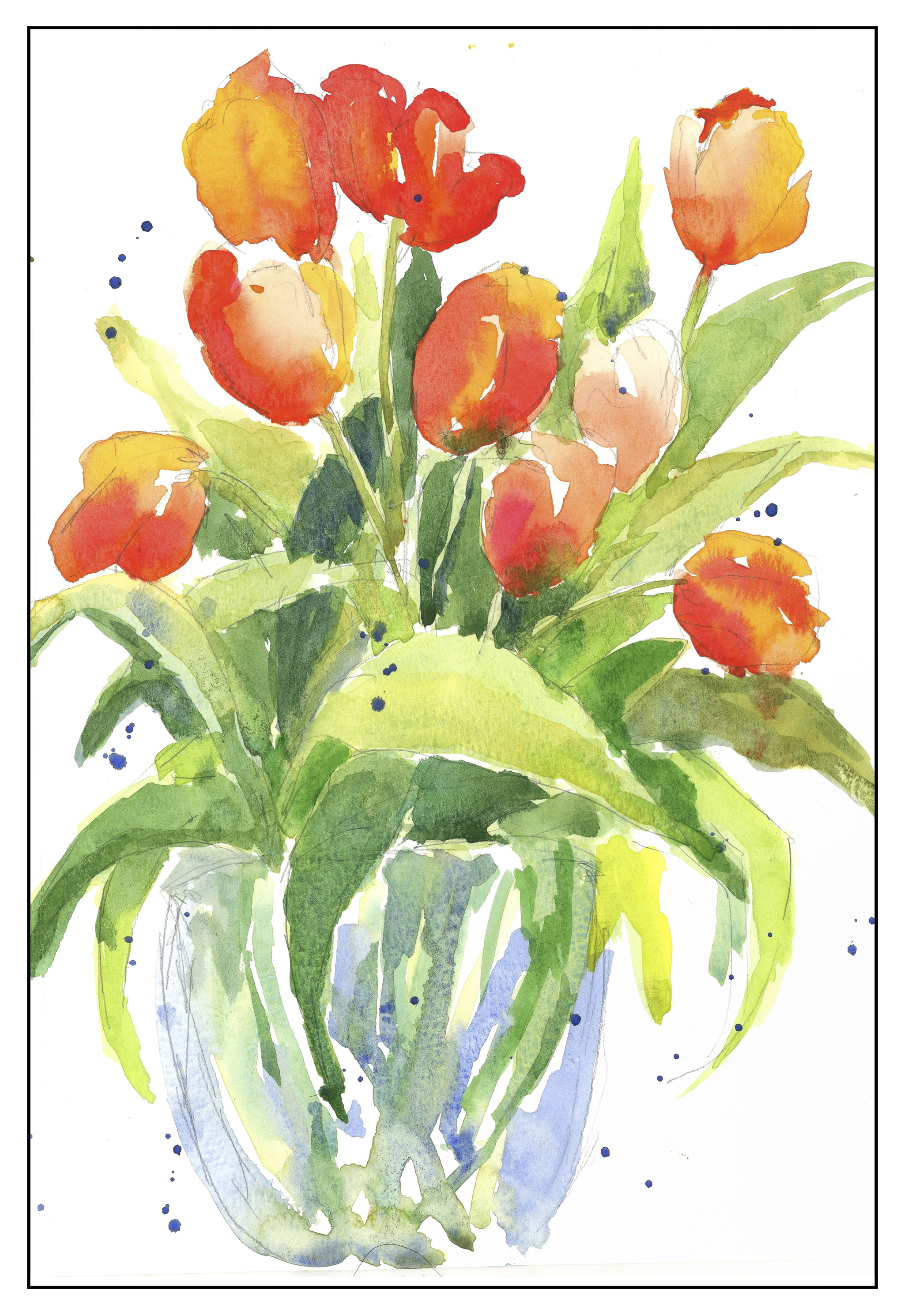
This morning I had one goal in mind:  paint.  With a gloomy sky here on the California coast, the damp and cold penetrate you to the bone.  Once it leaves, it’s a great big sunny day ahead!  So, while waiting for the fog to dissipate, I took a few pictures of a bouquet I put together of chamomile flowers and small, red carnations in a rectangular glass base.  I didn’t do a value study because I wanted to look at the colors – light, dark, and so on – to see what I could produce.

I penciled in the basic drawing, took some notes of the colors and mixed this and that, testing them on a scrap of paper.  Looking at the vase, I saw the different shades of color through the glass with water and without water, as well as the water line and edges of the vase.  Chamomile leaves are multi-lobed and floppy; carnation leaves are rather spiky.  Chamomile flowers are happy, daisy-like flowers, and quite small.  Carnations are upright.  Both are really lovely!

Process was like my last two flower paintings – start with the large areas of color and move into details.  Overall, it worked here, until I started getting into the hodge-podge of leaves.  I think I should have simplified their masses of color, but I didn’t.  I like the negative painting I accomplished for the chamomile flowers, as well as the edges along the bouquet where the white flowers have to merge into something.  The carnations were far more difficult than I thought, and once more, I made something more complicated and tight than I would like to see as “my” style.

Nonetheless, I feel that this painting is a moderate success.  I was patient and let the washes dry, working from lighter to more dark, thinking about white space and negative painting.  And I still have a bouquet of flowers to enjoy!

Time Rolling By

I don’t know if you experience this, but it seems to be a common theme.  Once you know that you have vacation ahead, you realize just how tired you are!  Tired of work, tired of the people you work with, and just plain tired!  With retirement coming up, I am even more frustrated by my job and its hours, some of the silly things that occur.  I am also tired of some of the people and looking forward to not being around them.  That’s life, and change is good, as are the constants in daily life.  Look for your blessings every day – I really believe this, and try to do it, without losing perspective, either.

Last weekend 11 trees were trimmed and pruned; 5 were completely removed.  For the first time in years, the back half of the house has daylight, not artificial, as a main light source.  I bought a plant to see how it will do, between the dogs and the poor soil.  (Poor plant!)  It’s a penstemon, which is drought-tolerant.  It’s a lovely, cheerful flower.  I put it under the dogs’ noses to let them smell it, and then told them “bad”.  Let’s see how it survives!

In addition to dealing with tree removal and pruning, I have been in a real funk about my painting.  After a disastrous series of watercolors, I just put everything aside for about a week.  Still, I did other things, like go for walks and continue to recover from the house renovation by moving things here and there and unpacking more boxes.  All this upheaval!  It’s a slow process, but it’s getting done.  Of course, there are still a million other things I could delude myself into doing as “necessary” – which really are, but not vital to my existence!

So, after a week of blithering and dithering and feeling like a lost soul, I sat down, once more, in the studio.  I took out a large palette of colors (the key to which is still missing), and decided to do some flowers in vases.  I like flowers, so it seemed a perfect subject.  I worked in the main color areas first – after doing a line drawing, but no value study (a habit I need to establish) – top to bottom.  After that, I looked some more.  And some more.  Then I began to add details, all the while working very hard to think ahead and in the present at the same time.  I produced two paintings I liked.

And finally, I had a Friday afternoon.  Watercolor class or just do what I wanted?  I chose the latter.  Doing what I wanted was more interesting and more challenging and more needed than anything else.  Into the car, down to an art store, down to the nursery, and finally the bookstore.  I bought 4 paint brushes, 1 penstemon, 2 watercolor magazines and 3 books.  I drank a cup of coffee.  Finally, some time of my own, some time to think, and some time to recover from this sense of ennui that has been my companion for many days.  Yay!

Making, Doing, Being

We take our everyday lives for granted, which is pretty much what we are used to on a daily basis.

Some people are always worried about where the next meal is going to come from – people who live in poverty or war-torn areas probably experience this far more than I can imagine.  If I skip a meal, no biggie – lots of stuff in the fridge or down at the market.  When a student tells you that in his former country, as a child, what he remembers most is always being hungry, it makes you think.  To live like this is beyond my imagination.

And what about people who go from being very active, to suddenly being limited on a physical level?  From walking to not walking?  To using both hands to using one?  The physicality of everyday life is not something most of us remark upon, unless it is suddenly gone!  A stroke?  A fall?  Some crazy American with a gun?  A nerve-wasting disease?  How do we handle this?

If you think about, everyday life is normal as long as it doesn’t change.  When it changes, how do we handle it?  What do we do?  Do we fall down and pity ourselves?  Do we get up and move forward with whatever is in front of us?  Certainly a level of self-pity and horror exist when something bad happens which changes our daily lives, but it also can lead to creativity and a philosophical or spiritual awakening.  How we choose to adapt – and the key word is adapt – often determines our outcome.  It may be minimal in the eyes of others, but it can be major within the person affected.

I really believe we need to look at our lives on a daily basis, to appreciate and be grateful for what we have, not focusing on what we don’t have.  If our lives can be better, how?  If we want to change things, what do we want to change?  This is not an ever-moving forward process.  Like the frog in the well, three feet forward, two feet back.  The road is bumpy and challenging.  At times the goal is obscured or lost, but movement continues.  We choose in many ways how to adapt to our lives, however horrific we may find them.

Those who adapt, survive, even if the survival is not to their liking.  Those who give up are also adapting, but probably not successfully.  What we want, too, changes.  We need to adapt to those changes.  We need to think about them, to consider them on multiple levels.

When we stop making, stop doing, we stop being.

Freedom!

Sounds grand, doesn’t it?  It’s a heady feeling.  Instead of ending my work day at 6:30, it now ends at 4:30 for the next 2 days, then next week at 3:30, and then after that, 5 weeks off (maybe 4, I haven’t really counted) until I return to work for 2 mornings a week to do a short summer school session of ESL (English as a Second Language) before another 2 off  and then begin my last year of work.  Retirement looms closer and closer, and what is a girl to do?

Practice!

Yeah, I mean that.  Practicing for retirement means finding a meaning and a purpose and a general “raison d’etre” so that life is not a series of TV and aimlessness.  It doesn’t mean finding a second job or a new vocation, it means simply doing things which have value and meaning to me.  Volunteer work?  Maybe.  What kind?  Where?  Why?

I have all sorts of ideas about what I want to do, and this summer, with my free time, I really want to explore things.  LIke a lot of old folks free from the traces of work, travel sounds really good.  Of course, photography and painting and reading.  Exercise – going to the gym – long walks – hiking – socializing – thinking – making – sewing – painting – egads!  My head is exploding!