Sunday Morning

This morning I awoke to the sounds of birds and the rustle of leaves in the breeze.  The sunlight was dim through the windows, with hints of blue, presaging an incredible day.  Now the sun is up, and all that seemed promised is true.  New leaves are appearing on the tulip tree and the redbud; the birds are still singing.  Robert Browning wrote, “all’s right with the world.”  On mornings such as this, it is best to believe it, and so I shall.

So, what to do?  We are having family over for Sunday dinner, so there are things to be done around the house, a bit of shopping, a bit of cooking.  It is a simple thing to do – marinated lamb roast, salad, bread or rice or potatoes, tzatziki.  The company is to be enjoyed, and hopefully all invited will be able to join.

Life – and time to finally live it – is grand.  No more “return to work” dates; I choose what to do and when.  The Puritan side of me espouses “pain before pleasure,” meaning, get the unpleasant stuff out of the way ASAP!  That means chores, like cleaning.  I like clean things, but the cleaning process is not exciting – I’d rather be outside digging in the dirt or drawing or reading.  The satisfaction of a chore, to me, is when it is done.  Putting it off dulls the joy in other activities, but as I like an orderly and relatively clean house and studio, it makes sense.  Doing the unpleasant first makes the rest of the day move into infinity.

Yesterday I bought some plants -peppers, alyssum, dianthus.  Bulbs were on sale half price since it is past their season.  Potting soil, too.  Before I start the dinner shopping, but after housework, I shall begin work on my little front yard flower bed.  My gardener worked in some soil for me, and now I have some ideas as to what I am going to do with it.  Its a sunny – shady area as it faces west, with the house to the east.  Afternoons find it quite shady, and as summer comes along, I think it gets shady earlier.  Alyssum and dianthus will be along the outer borders of the plot – see below – bulbs sporadically distributed depending on their sun requirements – and the peppers will be placed in their own pots out on the sunny southern patio (aka “the dog-free zone” or the “DFZ”!)

Along with gardening, planning for my next painting is on the way.  I have been following various YouTube painters – as you have seen in earlier posts – but I have also been working my way through a book on perspective and contemplating spartan photography.  (Huh?  Wuzzat?)

And, Josh and I spent 3 days in San Diego, which was something wonderful to do – get away from it all to enjoy coming back to it all!


Atmospheric Perspective, i

Day 5 into retirement found me with finally enough time to sit down and start my “class” on perspective.  No, not a classroom setting, but rather following the exercises in a book.

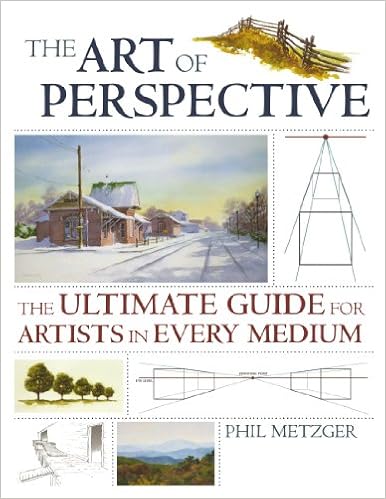
The book is The Art of Perspective:  The Ultimate Guide for Artists in Every Medium, by Phil Metzger.  As an individual, I found no web pages authored by him, but I did find numerous books which get good reviews.  I picked this book up because it dealt with not only the traditional perspective found in drawing and architecture, but the perspective produced by color.  As someone working in watercolor – or anyone working in any medium – color and how to use it is so important.

Atomsopheric Perspective has a few rather obvious points.  Metzger says “paint what you see”.  This is sound advice.  The reason it is sound because the natural world is out there.  You actually see atmospheric perspective.  What this means is:

  • colors become more blue the further they are from the viewer.  Mountains are cooler.
  • Bright foliage can create brilliant swaths of color, even at a distance, so this belies the idea of “things become cooler with distance.”  They do have less detail with distance.
  • Things are simpler the further away they are – this makes sense of course!
  • Air pollution of cities makes for browner (perhaps) distances rather than bluer.  What is important here is to note that edges become more soft and colors, while still colorful, begin to fade.  White buildings become greyer unless a brilliant flash of sun is on the building.
  • At times, hills will appear darker than the ones in front or behind them – this could be caused by a cloud passing overhead.
  • Fog softens the landscape or the cityscape.

Exercises

I decided to do a number of paintings.  Actually, I figured I would just do the first exercise, on trees, called “Receding Woods” on pages 18-19.  This is it below.  I followed Metzger’s steps – pale wash, distant trees, mid-ground trees, stream, shadows, details.  This is the result.

I found this to be a frustrating and useful exercise.  I used the palette he suggested:  Alizarin Crimson, Cobalt Blue, Burnt Sienna, Pale Cadmium Yellow.  Drop the colors onto wet paper, and move on.  Next step were the pale trees in the background – light blues and browns.  From there, darker blue trees to suggest shapes.  Mid-ground trees brought in some detail.  Finally, the frozen creek and shadows.  As a wonderful piece of art, I am not impressed with what I did – but I am impressed with the clarity of Metzger’s writing and example.

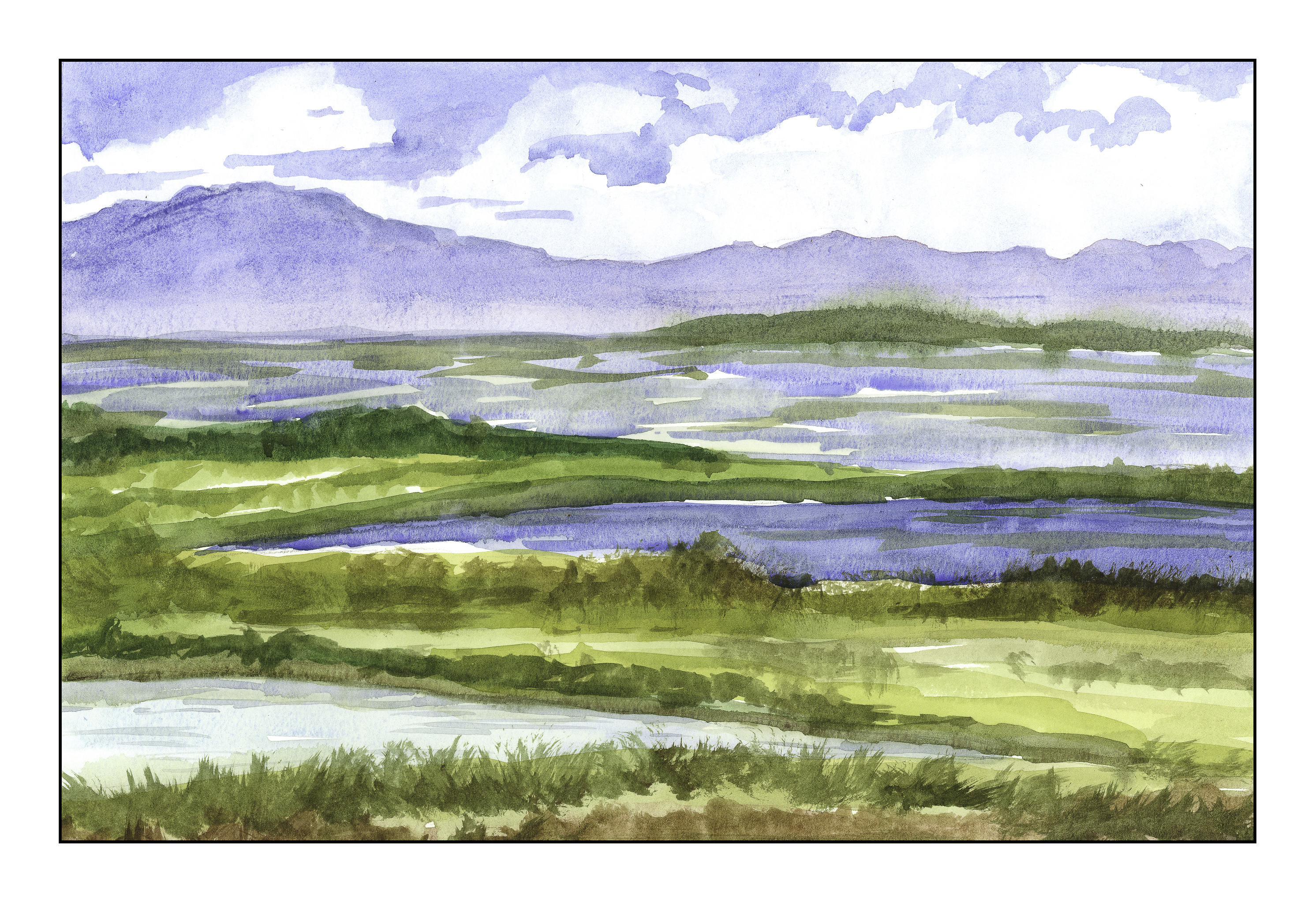
From this, I decided to go to Pixabay and search for things like fog, barns, marsh, swamp.   The next study is a marshland.  I figured it would be good for water, reflections, and distant mountains.

What I liked especially about the picture was the haze at the base of the mountains and the blurred quality of the green hill.  In the photo, it was less distinct.  From there, I tried to paint the values I saw, so the distant water was a midtone, the middle water dark, and the closest the most pale.  I also made the mountains more blue and violet and tried to use warmer colors the closer to the bottom of the page I got.  It worked to a degree in varied areas, and not in others.  Still, having 3 different values of water was rather interesting.
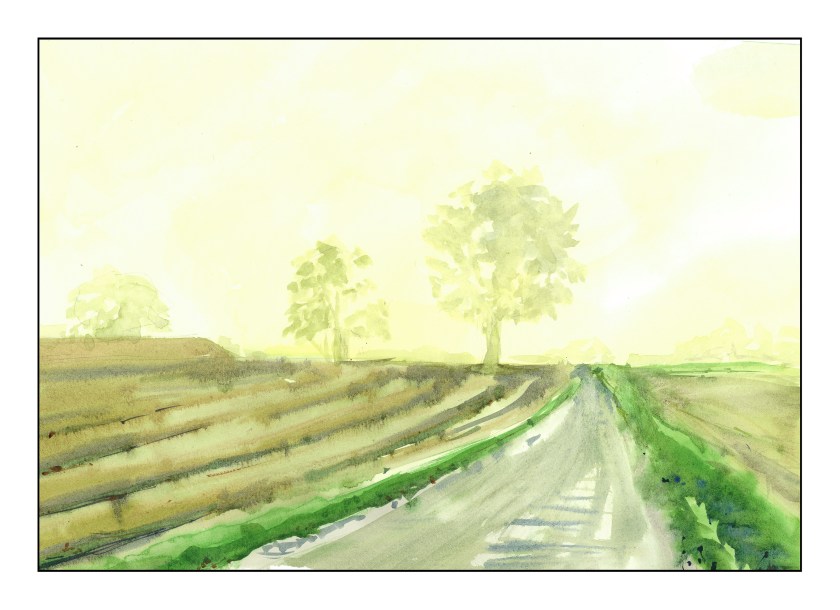
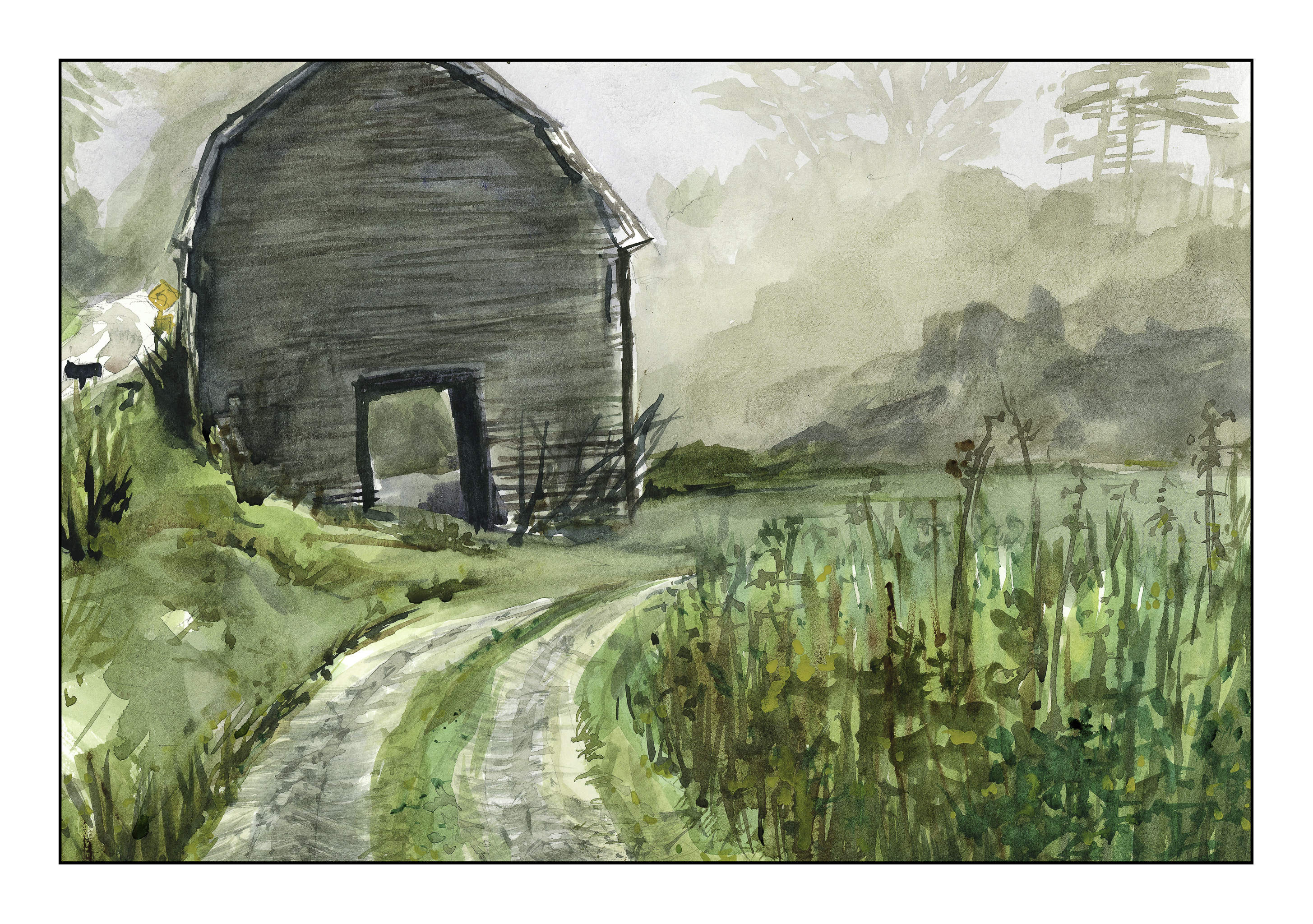
Her is a study on distance and fog.  The image was mostly green and yellow in cast,  The sun is peeking between the two center trees.  The tree shapes show lighter in the painting, as the do in the photo, but I think I could have done a better job with the sky to emphasize this point.  To show distance, I tried to make the further objects more simple and cooler, while working at a bit of detail and warmer values for those closer to the viewer.  Perspective was indicated by the road narrowing and the curve of the furrowed field.

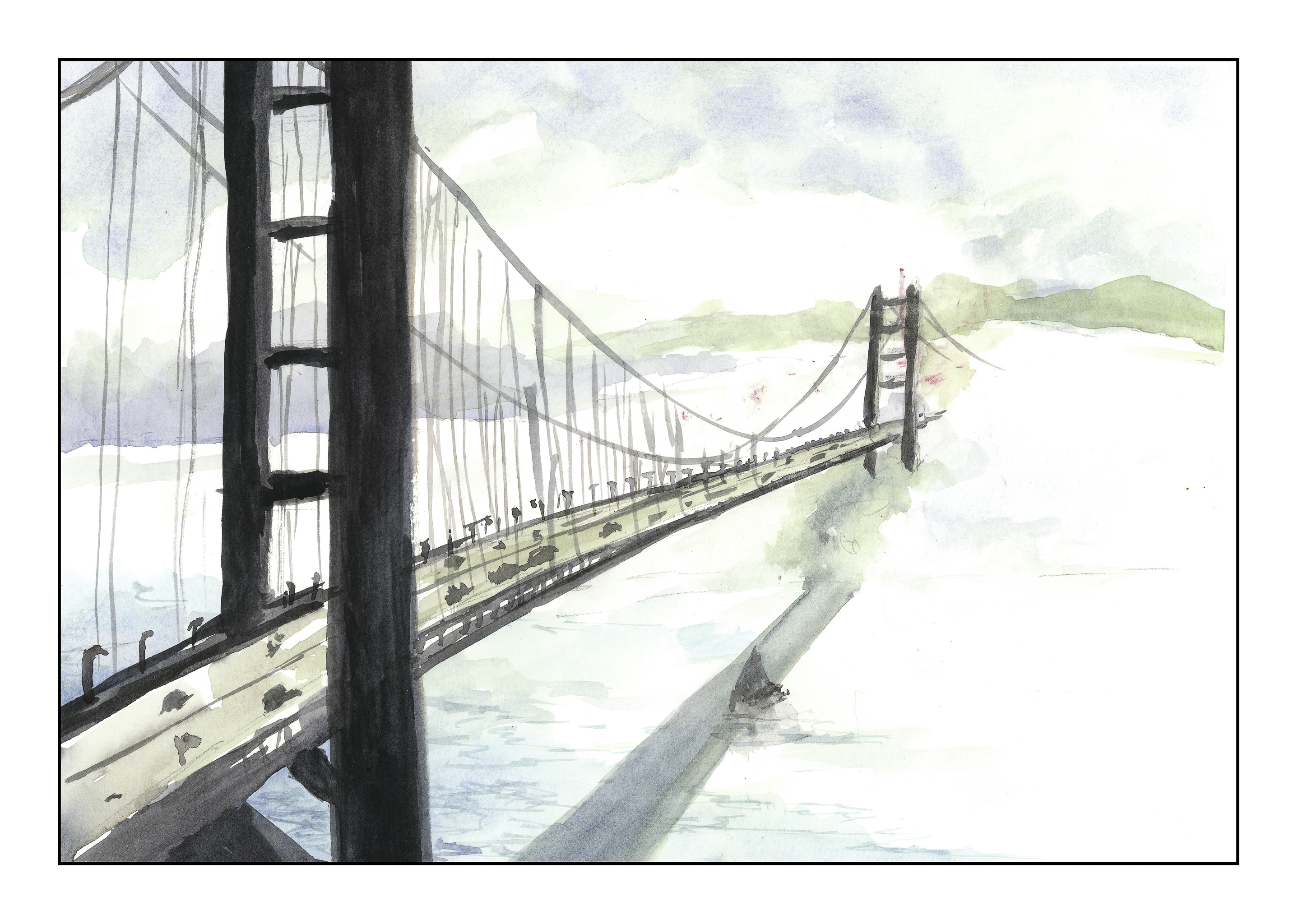
This picture was a challenge!  Me, paint a bridge??!!

Anyway, a bridge is disappearing into a fog bank; a sail boat sails through the shadow cast by the bridge.  The distant bridge vanishes into a thick, white cloud.  Detail softens and vanishes.  On top of it all, this is a bridge!  (I don’t think I would want to drive across it if it were really were in the condition represented by my painting!)  Once more, cooler colors and less detail the further from the viewer; more detail closer to the viewer.  I liked mixing the blues for the water and found out that a rigger brush and a flat brush were my best friends for the bridge.  I like this painting a lot more now that I finished it – not a work of art, but a good practice study.
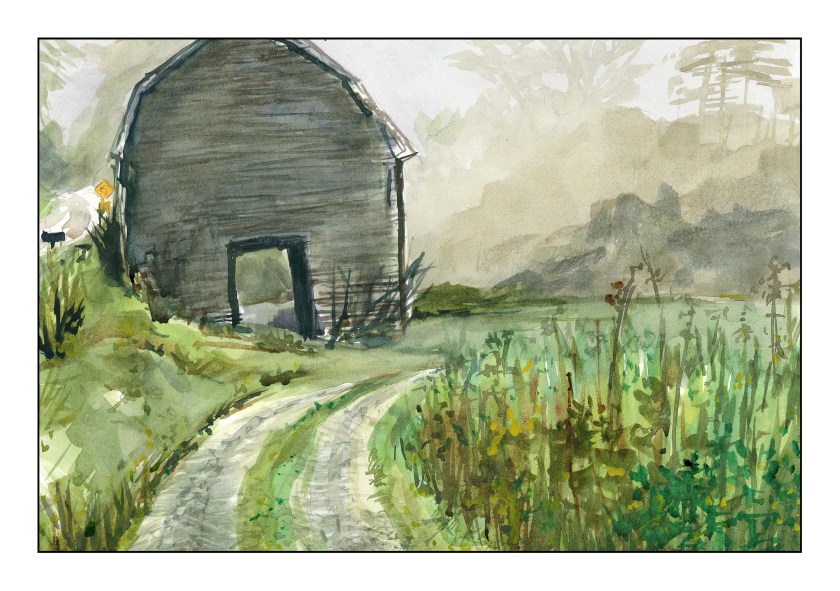
This final painting was a serious challenge.  The paper I was using for all of these is student grade, so washes are tricky and often become hard edged or have blooms.  I solved a lot of those problems by scumbling along the edges; this was good for softening, blending, and blurring the edges.  I also used a 1-inch flat brush for the majority of the painting, forming the blurry vegetation, to the barn, to the road.  Only when I added detail did I use a small brush, specifically a rigger.  While I don’t think this painting has great perspective, the goal of atmospheric perspective was met.  I used to the left and right of the barn, as well as with the weed patch on the lower right.

Some Thoughts

As a first exercise for my “class” I really enjoyed myself!  I started painting at 9:30 in the morning and only finished around 5:00 pm – time to make dinner.  I focused on the atmospheric perspective idea and learned a lot simply by doing.  Sure, I know this basic information, but to put it into practice and think about it is a lot different.  Experience in the real world is, in my opinion, one of the best teachers, and such studies are invaluable.

 

The First Day of Retirement

Well, what better day to retire than April Fool’s Day?  I thought it was a great idea, so at the end of January I submitted my paperwork, and today I get paid to do nothing related to work.  Social security, my pension, and Medicare are all lined up.  And now, my new life begins!

Today, I was taken out to lunch to celebrate!  I also have been deciding a “class” I want to take.  I’ve decided to study the exercises in a book on perspective for painters, so it covers not just the vanishing point varieties (one, two, and three dot), but also perspective based on colors.  Tomorrow, I begin!

Besides studying perspective, I have also been painting and drawing and sewing and making pictures with both digital and film cameras.  I finished my little quilt.  I’ve scanned photos and edited them.  I have been out to the local botanical garden and begun a sketchbook about the garden in spring.  Visiting family and friends and doing fun things is also part of the program . . . I don’t think I will be bored too often, but I might over extend myself.

Here are some things I’ve been doing . . . but no pictures of the quilt – that is a later post.

Daffodils

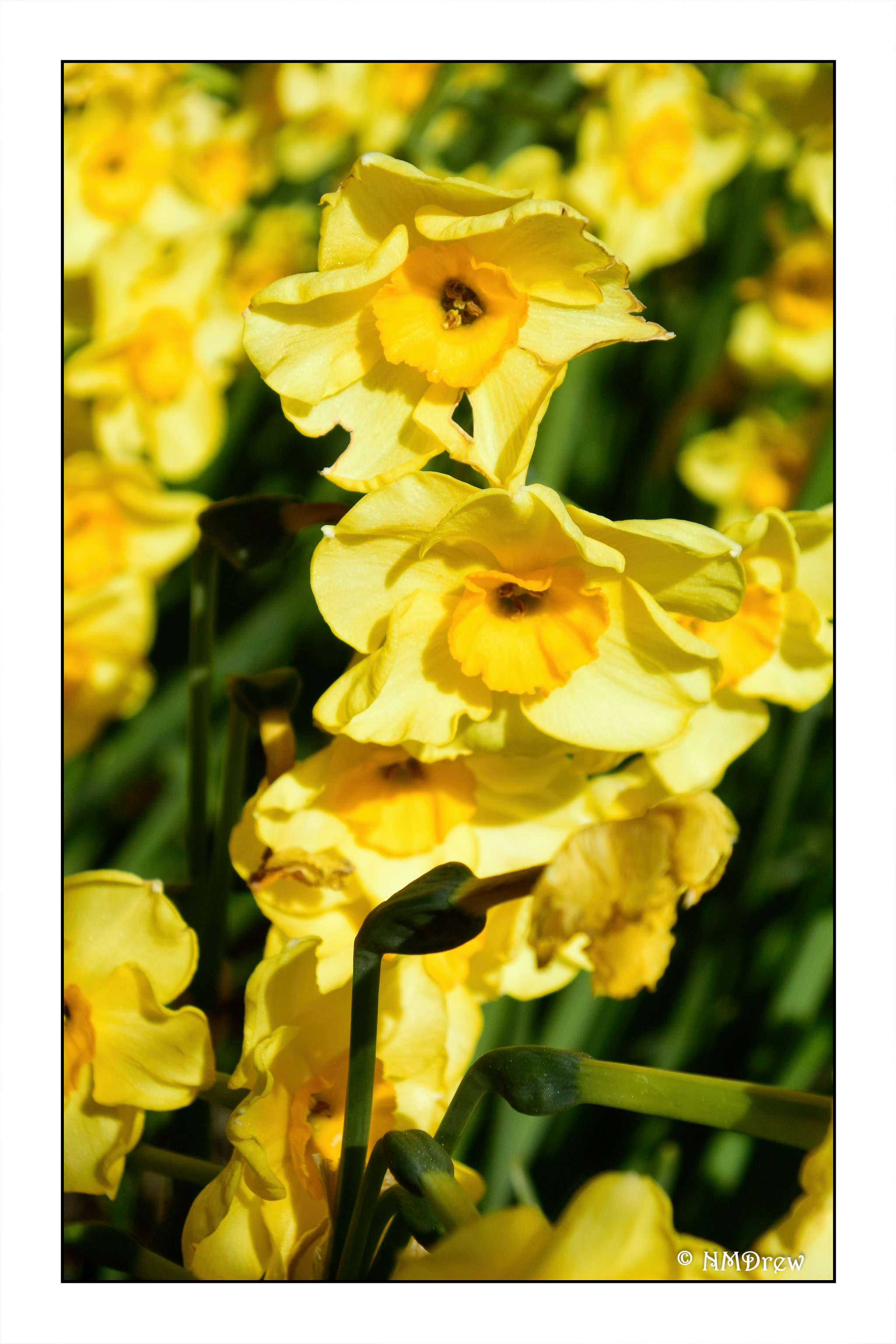
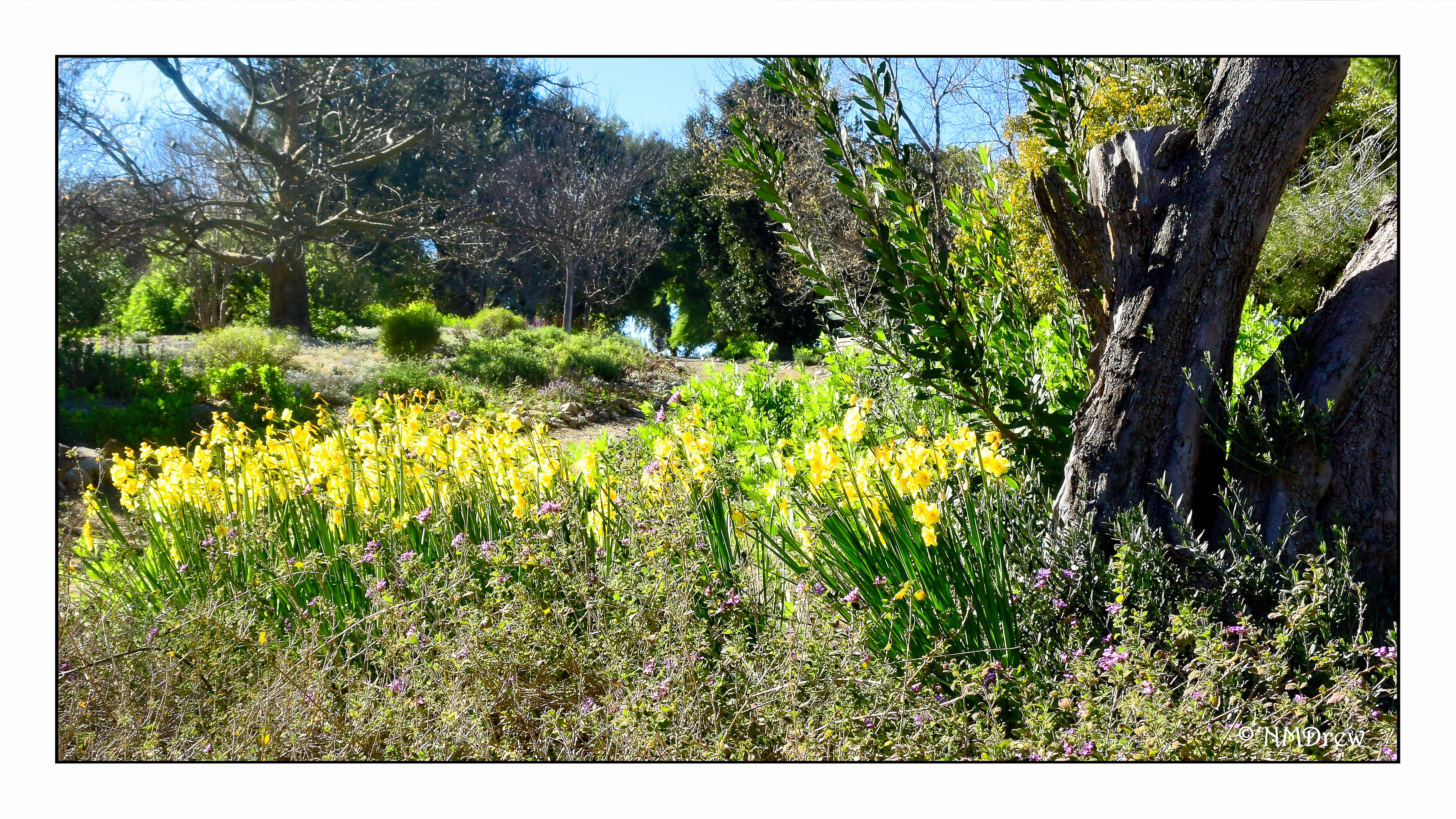
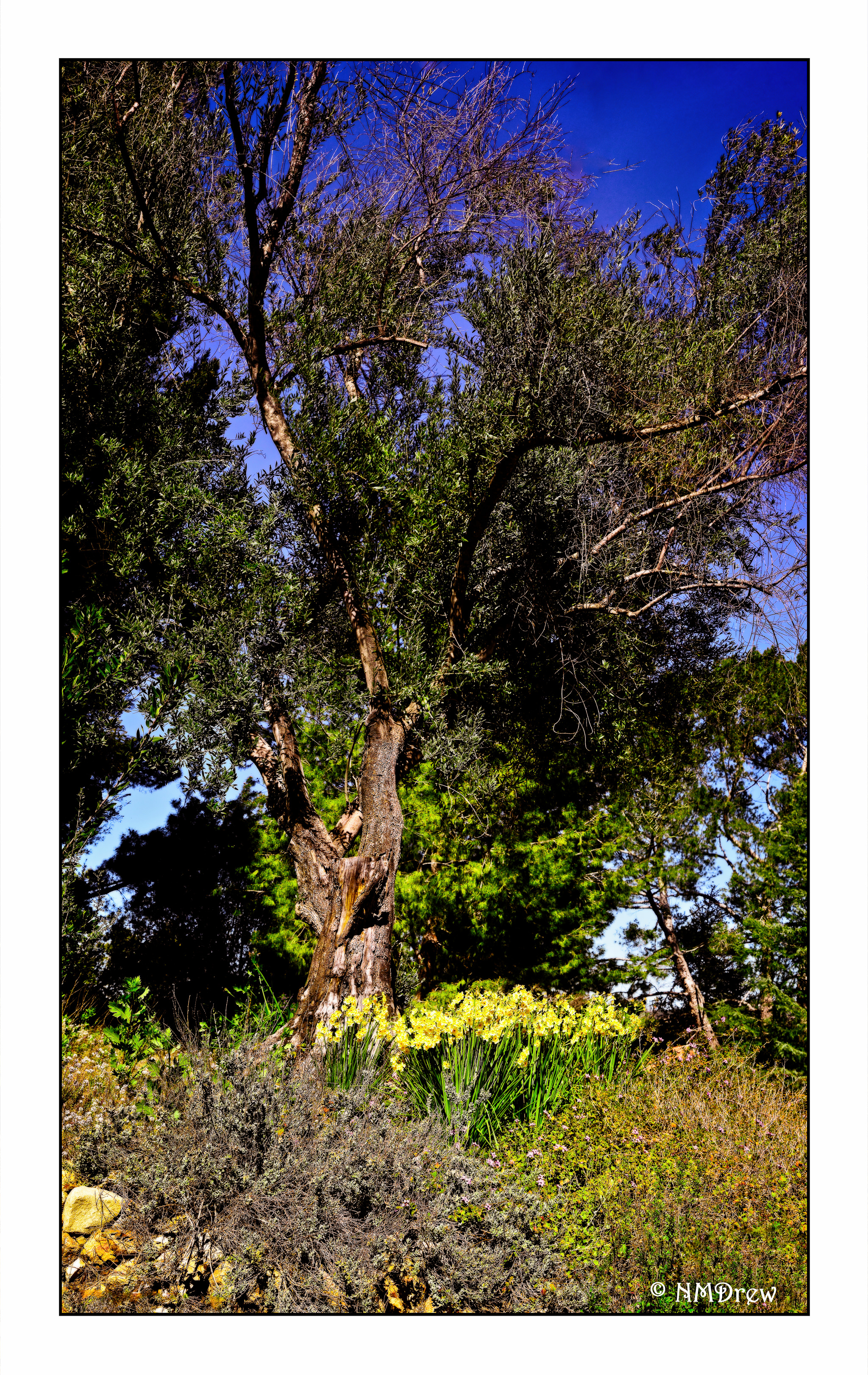
Every now and then, a day becomes more than a day.  I went out to the local botanical garden to do some sketching, and came across a small mass of daffodils all in bloom under the olive tree.  After all our rains, the world is bright with new growth and color – butterflies in multitudes, fresh breezes, the scent of flowers – everything is as if the world was just created.  How easy it is to forget nature’s beauty in our crazy world . . . 

I Wandered Lonely as a Cloud

     –by William Wordsworth

I wandered lonely as a cloud
That floats on high o’er vales and hills,
When all at once I saw a crowd,
A host, of golden daffodils;
Beside the lake, beneath the trees,
Fluttering and dancing in the breeze.
Continuous as the stars that shine
And twinkle on the milky way,
They stretched in never-ending line
Along the margin of a bay:
Ten thousand saw I at a glance,
Tossing their heads in sprightly dance.
The waves beside them danced; but they
Out-did the sparkling waves in glee:
A poet could not but be gay,
In such a jocund company:
I gazed—and gazed—but little thought
What wealth the show to me had brought:
For oft, when on my couch I lie
In vacant or in pensive mood,
They flash upon that inward eye
Which is the bliss of solitude;
And then my heart with pleasure fills,
And dances with the daffodils.

New Challenges

One thing I find interesting is my need to “drop bombs” on my daily life.  What this means is simply that getting into a rut is not a good thing, and shaking up the patterns and routines are necessary to keep life interesting.  For example, I have settled into this pattern:  coffee, breakfast, clean up myself and the house, figure out evening meals, and then paint and draw.  Much as I like the last, I find myself getting stuck in a rut.  The other things I like doing don’t get done.  And, I get really bored; worse, I feel like I am not “accomplishing” anything!  That’s the problem with having a lot of interests and an impatient, restless personality.  I irritate myself as well as others.

The other day, I finally got around to buying a new laptop computer.  My old ones were worthless except as boat anchors.  Poor graphics and connectivity.  Slow.  I have one, a Windows XP machine dedicated to my film scanner.  Another was not forward compatible with Windows – can you believe that???  Anyway, as a result, I had to clean up the bloat ware on the new laptop and install software I use.  With everything internet-based, it’s interesting to now own a laptop with only a few external connections and no DVD drive.  The result was I finally broke down and decided to enroll in Lightroom CC for photography.

I really like LR as a jump-off point for other software to edit photographs.  The catalog system is great.  However, the Creative Cloud version has some things I need to learn!  I have never been a cloud-based person, preferring to keep stuff on my own hardware rather than rely on others to take care of me.  As times change, though, so must we, even if I am not sure this is always for the best.  What I know I will like is being able to access my photos from either my laptop or my home computer without having to use sneaker net anymore.  That is also what I like about Google and being able to sync across computers.

The challenge here is making sure I do what I like.  It’s actually very hard to find time to do all the things I want to do.  Poor weather has kept me in the house a lot – who wants to go out in pouring rain? – but that is like house arrest after a bit.  The LR is going to be a challenge, and fun.  The bigger challenge is to find the time to do so many other things!

I have made one promise to myself, though:  I will draw or paint every day, no matter what else is on the agenda.