Having photography as a hobby sometimes yields pictures that can be used to create more pictures. I decided to give up the no-lines approach for now (though it is a great exercise to learn how to make shapes – I was just really frustrated by what I was doing), do some pencil roughing, and then work one color area at a time. First the tulips in shades of red, orange, and yellow, mixing some oranges as I went. Next, the greens of leaves and stems, consciously determining the areas to negative paint later on, as for the flower petals. Finally, the bowl. Before the whole was done, I went back to each area and tried to create a sense of depth by deepening other areas and being careful not to touch the areas I had left deliberately white.
Author: -N-
Through A Window
Mission
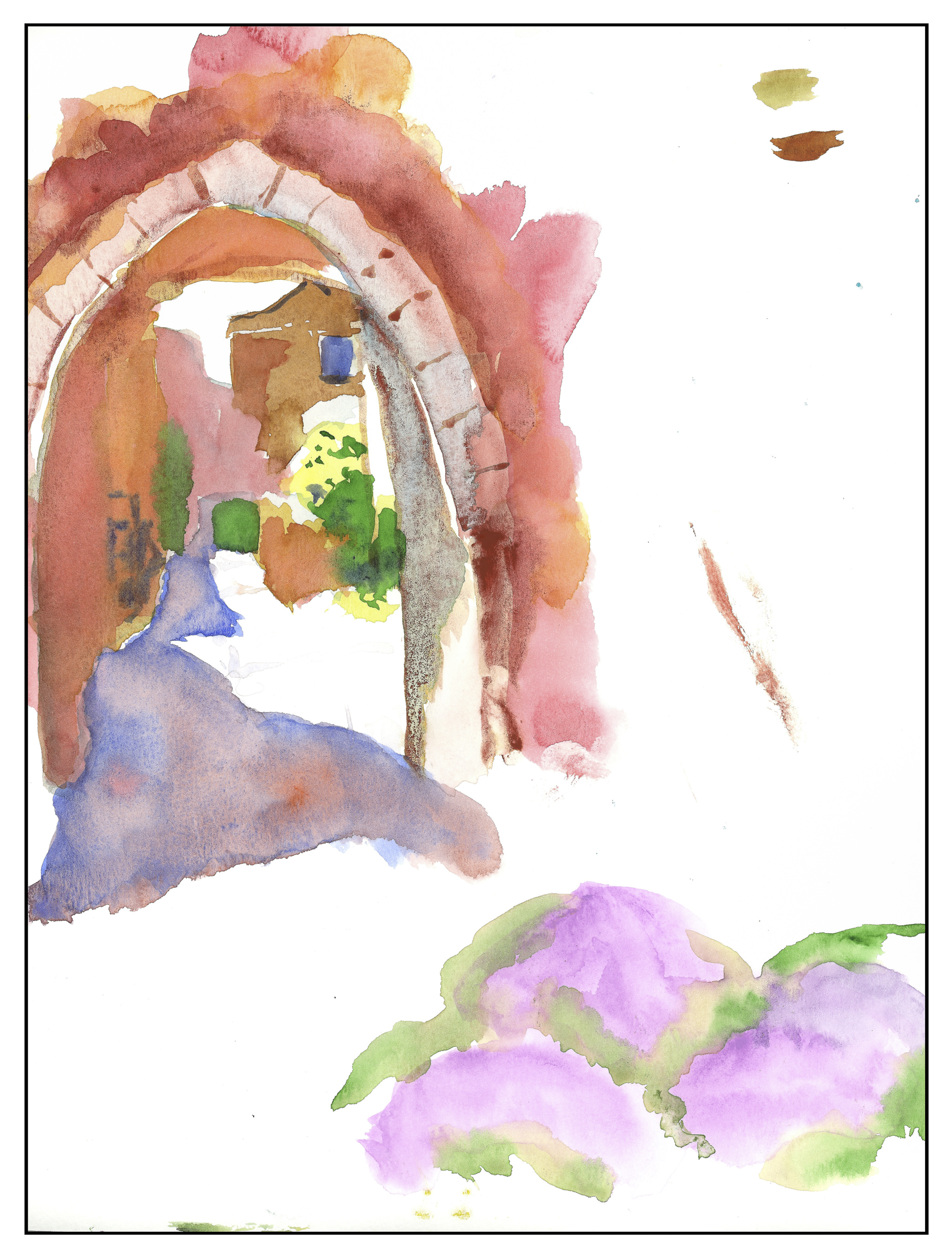
We went to visit the La Purisima Mission nearby in Lompoc, California. It’s a state park which is a rebuild of the mission itself, which was destroyed in the 1812 earthquake. The mission rebuild was part of the Civilian Conservation Corps of the 1930s during the Depression. This is from a photo of the roof. The perspective is off, and it’s a bit muddy, but it was a lot of fun trying to figure out how to make the color for the curved tiles.
Lines & Shades
Once more, the house is in total disarray – the trees in the back yard have been removed or severely trimmed back. 5 trees out, 11 pruned. The guy who did it all is an artist – you can actually see the branches on the trees, and the neighbors. So what does it have to do with a post called “Lines & Shades”? All this disruption messes everything up! With such disruption – and being unable to leave the house – it was a strange sort of prison. I read murder mysteries for the most part until yesterday. It was quiet and no one was home except me and the dogs.
Back to basics. Pen and ink, contour drawing. The first one was kind of stiff, but as things moved on, it got easier and more fun. I wanted to make “lost and found edges” as well, to make things suggested, not spelled out.
I also decided to scan in a value study I did from a photo I took years ago of the Santa Monica River in the mountains nearby, on a hot, dry day. This is to remind me to follow a more traditional route in painting as my own sense of contrast – light – dark – is not the best. As you can see, I did it some weeks ago, but I hope to make it into a watercolor in the not too distant future. The hard part is finding the right color for the sandy river bottom, but I have an idea . . .
Making, Doing, Being
We take our everyday lives for granted, which is pretty much what we are used to on a daily basis.
Some people are always worried about where the next meal is going to come from – people who live in poverty or war-torn areas probably experience this far more than I can imagine. If I skip a meal, no biggie – lots of stuff in the fridge or down at the market. When a student tells you that in his former country, as a child, what he remembers most is always being hungry, it makes you think. To live like this is beyond my imagination.
And what about people who go from being very active, to suddenly being limited on a physical level? From walking to not walking? To using both hands to using one? The physicality of everyday life is not something most of us remark upon, unless it is suddenly gone! A stroke? A fall? Some crazy American with a gun? A nerve-wasting disease? How do we handle this?
If you think about, everyday life is normal as long as it doesn’t change. When it changes, how do we handle it? What do we do? Do we fall down and pity ourselves? Do we get up and move forward with whatever is in front of us? Certainly a level of self-pity and horror exist when something bad happens which changes our daily lives, but it also can lead to creativity and a philosophical or spiritual awakening. How we choose to adapt – and the key word is adapt – often determines our outcome. It may be minimal in the eyes of others, but it can be major within the person affected.
I really believe we need to look at our lives on a daily basis, to appreciate and be grateful for what we have, not focusing on what we don’t have. If our lives can be better, how? If we want to change things, what do we want to change? This is not an ever-moving forward process. Like the frog in the well, three feet forward, two feet back. The road is bumpy and challenging. At times the goal is obscured or lost, but movement continues. We choose in many ways how to adapt to our lives, however horrific we may find them.
Those who adapt, survive, even if the survival is not to their liking. Those who give up are also adapting, but probably not successfully. What we want, too, changes. We need to adapt to those changes. We need to think about them, to consider them on multiple levels.
When we stop making, stop doing, we stop being.