No April Fool’s. Three rainstorms this winter, and this is what we can expect – fires. Ten minutes down the road from me.
The state of California has hired 1400 more firefighters in anticipation of a long and horrible fire season. With the massive we burns we have had locally and in the mountains, there is some speculation that the fire season will not be as bad as the damage is already done, but it will occur nonetheless. And be fierce.
I keep thinking I need to move someplace else before all I see are cacti and dirt. California is not the only place suffering – drought is affecting our crops. In the midwest, the bread basket of the country, is losing top soil, is no longer the same environment it was 50 years ago. Everywhere, we need to learn to farm more strategically for dryer climes.
After spending 7 hours yesterday sorting through books I hope to sell or donate, I was bushed. Dusty and dirty, too. It’s amazing how much of a mess your life can become when you aren’t paying attention! Painting definitely has its attraction as opposed to drudgery, but lately I feel like pushing myself into areas I don’t ordinarily venture. Cleaning and discarding shakes things up, and it seems to be carrying over into artwork.
Charles Reid, besides being great at landscapes, is also fascinating for me as his watercolor portraits are so loose and wonderful. I read a bit in one of his books about how he does skin tones. Colors for pale skin can be yellow ochre, alizarin, and cerulean – these are the ones I used to paint the figure on the left. For the one on the right I threw in some ultramarine and Hooker’s green at Reid’s suggestion. I worked to make the highlights warm and the shadows cool – more yellow in the light areas, more blue in the shadow areas.
Here are some gardeners laboring away. The color palette was pretty simple – ultramarine, orange, and a bit of ochre and green. I tried to create a sense of dimension in each pose, working with complementary colors to create shadows.
I then thought that after doing people, I should do an animal. I found a wonderful picture on Pixabay of an elephant striding along. I was rather teary when I thought about how we are losing so many wonderful creatures, large and small, because human beings are not the best. Of course, I’m not starving, so my perspective is very different. I was caught by the beauty of this elephant and think I will probably draw and paint creatures more. I have never painted or drawn an elephant before and enjoyed this one a lot.
Finally, a building, specifically Dunguaire Castle. It’s from the 16th century and has been restored. I think it would be a wonderful place to visit as it is right on Galway Bay in western Ireland.
Altogether, this afternoon’s romp in the paint was satisfying and challenging. Figures, animals, buildings – all of these really pulled me out of my comfort zone. I kept my palette simple and worked to create a 3D element with shading as well as contrasts of warm and cool. Initially I used rather cheap paper, but in reality, it sucked, so I pulled out my Arches 140# CP and was much happier with the results.
I’ve long been a fan of Charles Reid and his wonderful, loose watercolor style. In particular, I enjoy his paintings of the Bahamas and other Caribbean scenes. The light, the sky, the land all work together to create something most of us dream about.
A Watercolor by Charles Reid
The above painting is by Charles Reid, but when you look at it, you can also see he is influenced by the watercolors by Winslow Homer a century earlier.
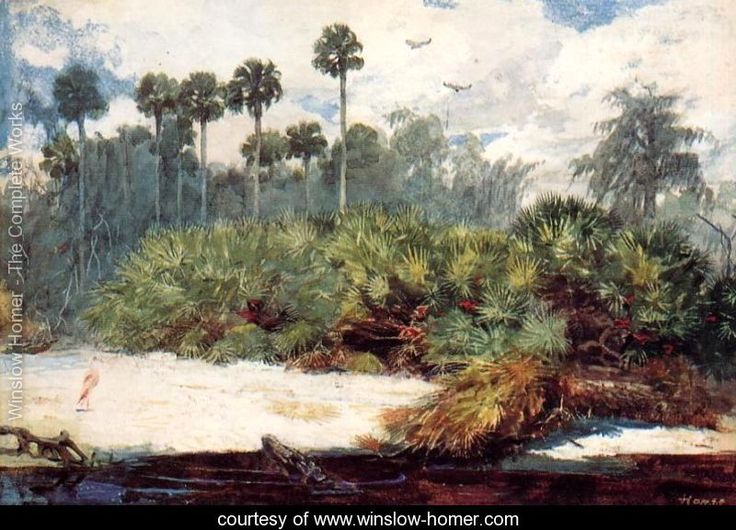
Florida by Winslow Homer
Winslow Homer painted not only the Bahamas in the Caribbean, but other tropical areas, such as Florida. Palm trees and ocean and sky and wind show us another world.
Palms by Winslow Homer
Several years ago I spent a week crewing in the British Virgin Islands, and the colors I saw were are so seductive. Around every corner, I thought of Winslow Homer. Charles Reid, while I knew of his work, I did not know he had painted the same areas as Homer, nor where I had been hanging out. It was a real delight to discover he painted the Bahamas and similar areas.
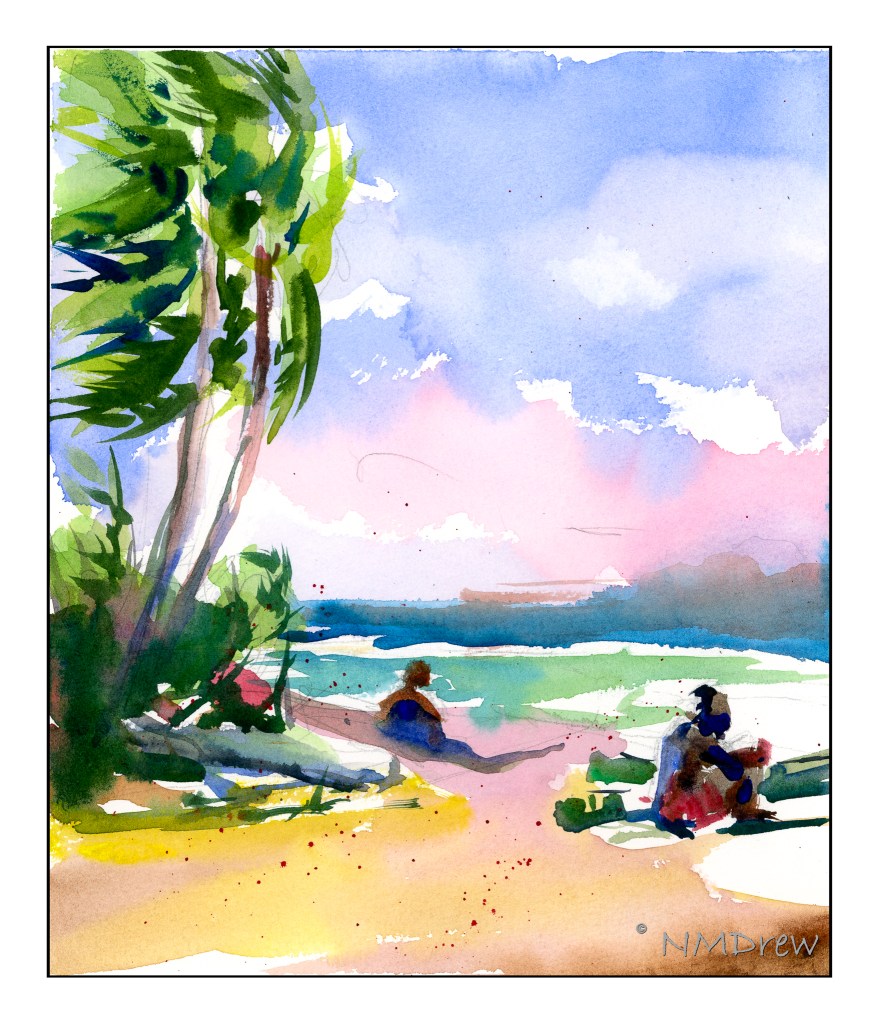
A study based on a watercolor by Charles Reid (see above).
Here, a quick study – about 15 minutes – of the watercolor above by Mr. Reid. It’s rough. The goal was to capture a purity of color and gesture to express movement, the shape of people on the beach, the colors of the sky.
Island, Island View
Sky, beach, water, clouds – the Caribbean has it all. The British Virgin Islands are just a few of the many islands in the area, many of which have tourist-driven economies. Despite this, the islands have their flavors, based on who originally colonized them – English, French, Dutch and American.
I don’t know if I could live on a small island because I am so spoiled by the ease with which I can buy a book (hard to do on an island, especially before e-books!) and a wide variety of food. What you cannot buy, though, is the atmosphere and the beauty. That you take home with photographs, paintings, and memories.
I have been so busy these past few weeks with cleaning and rearranging my house, discarding this, donating that, setting up a sewing cabinet, having personal documents shredded, etc., etc., etc., that the idea of sitting down to paint is like craving that first cup of coffee in the morning – I need it!
Whew. When I opened my gouache box, the smell of mold was there. Gouache needs to be kept damp, and if not opened up and used on a regular (i.e. daily) basis, moldy it can become. It’s not my idea of a good time.
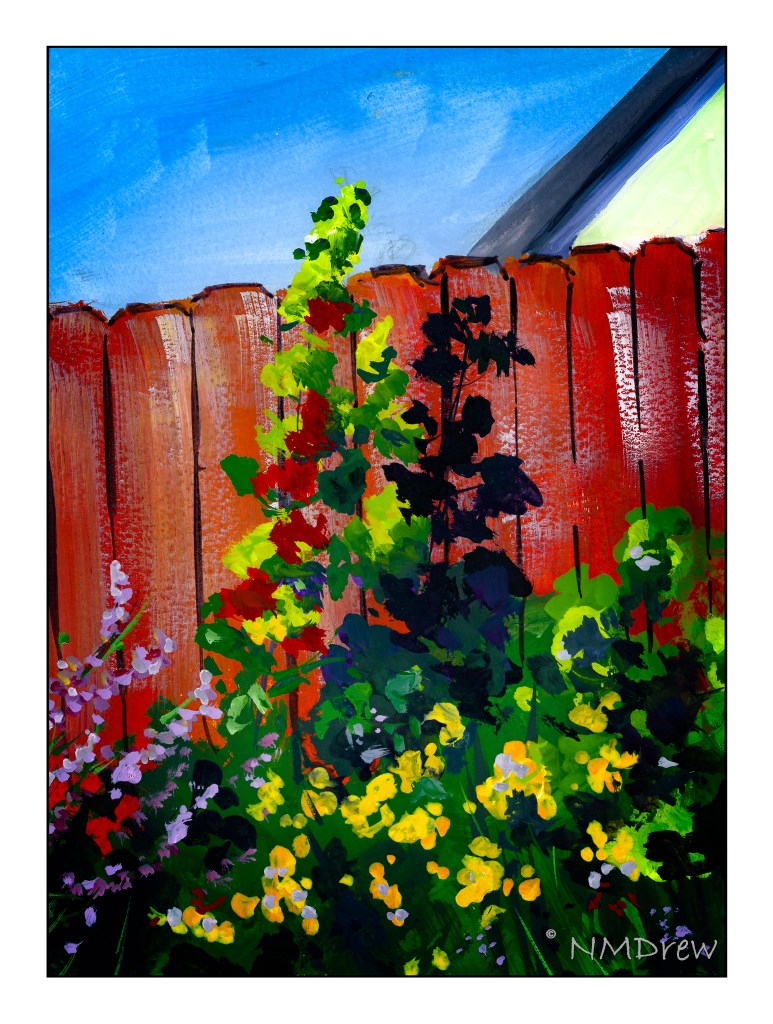
I just decided to paint, not caring what it smelled like – and an open window and a good breeze helps! I mixed up colors, mashed up this and that, and when I was done, took everything to the sink and ran the water as hot as I could. Now, all is soaking, and here is a painting based upon a photo I took awhile ago.
Josh got home and helped me with a few things. First, we installed the pegs that allow the left hand tray / fabric support to rest securely on the left-hand doors. Next, we installed the longer footers on the foot rest.
This is how we plan to store the cabinet overnight. Will we be running into in the dark? I also have my drafting table chair pushed in because that is an important element. I need to measure how high it is, seat to ground, in case we decide (I decide!) if having to move a chair room to room is a major inconvenience. If so, I will need to know how far up or down a chair can go when and if I buy another one.
If you look into the foot space of the cabinet, you can see that my machine is lowered and the plug / machine cover is in place.
This is a view from the other side of the table which gives a better view of the plug on the top of the machine.
The Next Day . . .
Okay, overnight I stored it like this, both shelves on, folded in, and chair in place. No one got nailed in the middle of the night!
Now, in use . . .
I have set up the cabinet as I want to use it today. The extension table is out to support the rotary cutting mat. The left side has had its tray removed and stowed in a storage area in the footwell of the cabinet. The left side drawers are folded back so that the cabinet can be rolled in closer to the wall. My old typing table from the last century (I think even 1970s) is supporting a portable tabletop ironing board. The iron itself rests on a silicon mat so it won’t burn the ironing board cover. Time to iron and then sew another quilt square – and there are 4 in this pattern, so off I go!






 Ink, Yarn & Beer