
Lately I have been looking at pictures of Scotland. Bright white houses with few windows seem to be a norm here, and in watercolor they provide a brilliant spot that lets the watercolorist leave the paper untouched. This skill is actually important in watercolors as bright white paper needs to be worked around. There are tricks to retaining white paper, such as using a resist of some kind, but to master the skill of retaining white paper without anything but practice is both frustrating and rewarding.
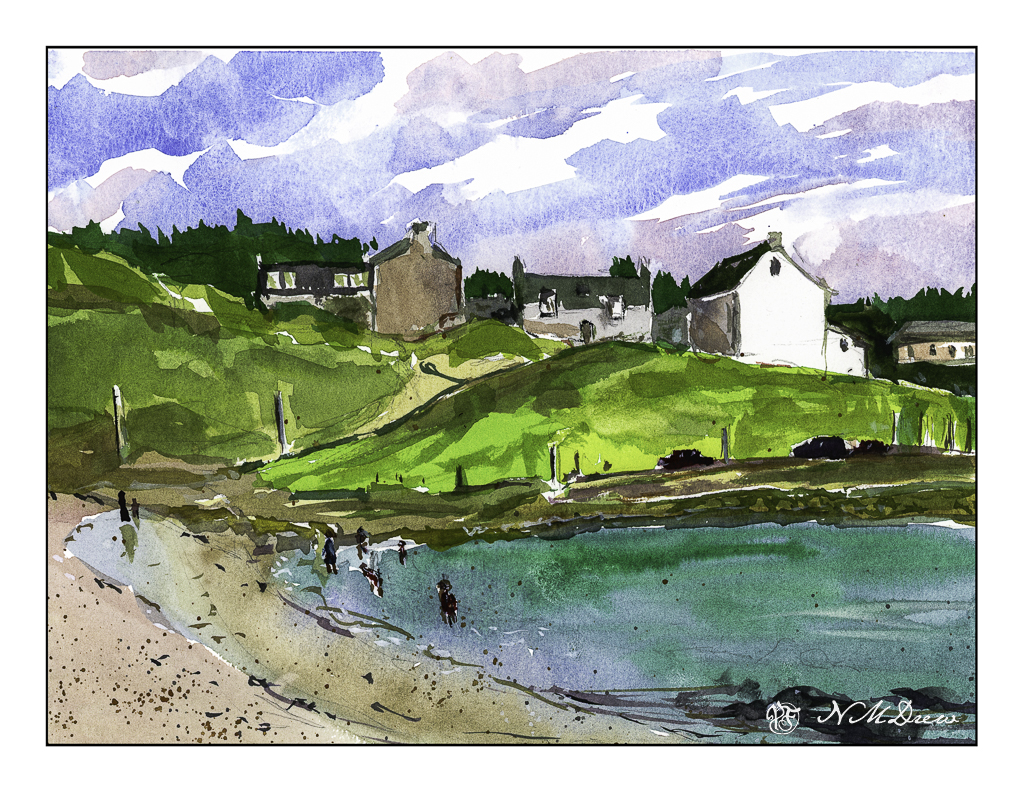
I would say it is pretty obvious which house is white paper, but if you look carefully, you will see the building on the right has some white paper remaining untouched as do some of the windows to the left of the white building. The sky, too, has untouched areas of white for clouds. The large masses of colors also have bits of white here and there. This breaks up things and makes it more interesting to look at. I left white around the bathers, too, but some of them ended up getting soaked – not by the sea but by me and my watercolor brush!
After I did this painting I started thinking about English watercolors. In the 20th century, two famous painters, Edward Wesson and Edward Seago, are well known for their broad areas of color that create detail by shape and form more than a painstaking approach. This works especially well, I think, for landscape, but for urban scenes, it is more difficult. Nonetheless, the lone bright house in the landscape makes for a lovely study. I plan more of these in the not-too-distant future.
Hahnemuhle CP 140# / 300 gsm paper; 9×12.
 Ink, Yarn & Beer
I’d never really considered that you’d need to leave gaps in the paint to allow whites in watercolours, although giving it a moment’s thought, it’s clearly obvious that’s the case.
The effect has really captured the sunlit clouds and white rendered buildings well though.
The paper house certainly draws the viewer’s attention. Since there are many shades of white, there’s no white paint in watercolors? The house behind it looks sort of gray. I think there’s a lot I need to learn. This is helping me in my photography.
Anne, there is white paint in watercolor – Chinese white, but also one can use gouache or acrylic. All are waterbased paints. There is a school of thought in watercolors – a purist viewpoint based on lack of good white watercolors perhaps – that there is to be neither white or black paints used in watercolor paintings. Oftentimes judged competitions have included these parameter. More than anything, not using white paint is a technical skill, as is not using a resist. Contrast and value are hard to learn, with values being the most difficult. I often turn my watercolors into black and white, as I have photos, to see the scale of contrast as well as observe the subtleties of value.
Thanks, FishyFish! Every art has its techniques. Doing black and white photography made contrast more apparent to me and certainly helps with painting. Just doing things, for me, is the best teacher. Doing and then reading puts the doing into context and words so vague ideas solidify.