
Over the next several weeks I am enrolled in a couple of oil painting classes. Acrylic paints really do frustrate me in a lot of ways, and please me in others, but it is time to work with oil paints on a more serious level. Let’s see where it goes.
To get ready for these classes, I pulled out some of my supplies. Of course, the oil paints come out – I have a smaller selection of colors than any other medium! I also have canvases in panel and mounted format. However, I did need to stock up on linseed oil, solvent, and other such stuff. And then paint.
Canvas mounted on panels is actually, I think, the easiest way to go. Canvas pads flop around and easily bend. Mounted canvas on stretcher bars takes up a lot of space but can provide a gratifying surface to paint on if properly and tightly mounted and prepared. For now I am using canvas panels which, while not super high quality, are relatively inexpensive and easy enough to prepare, if at all, prior to painting.
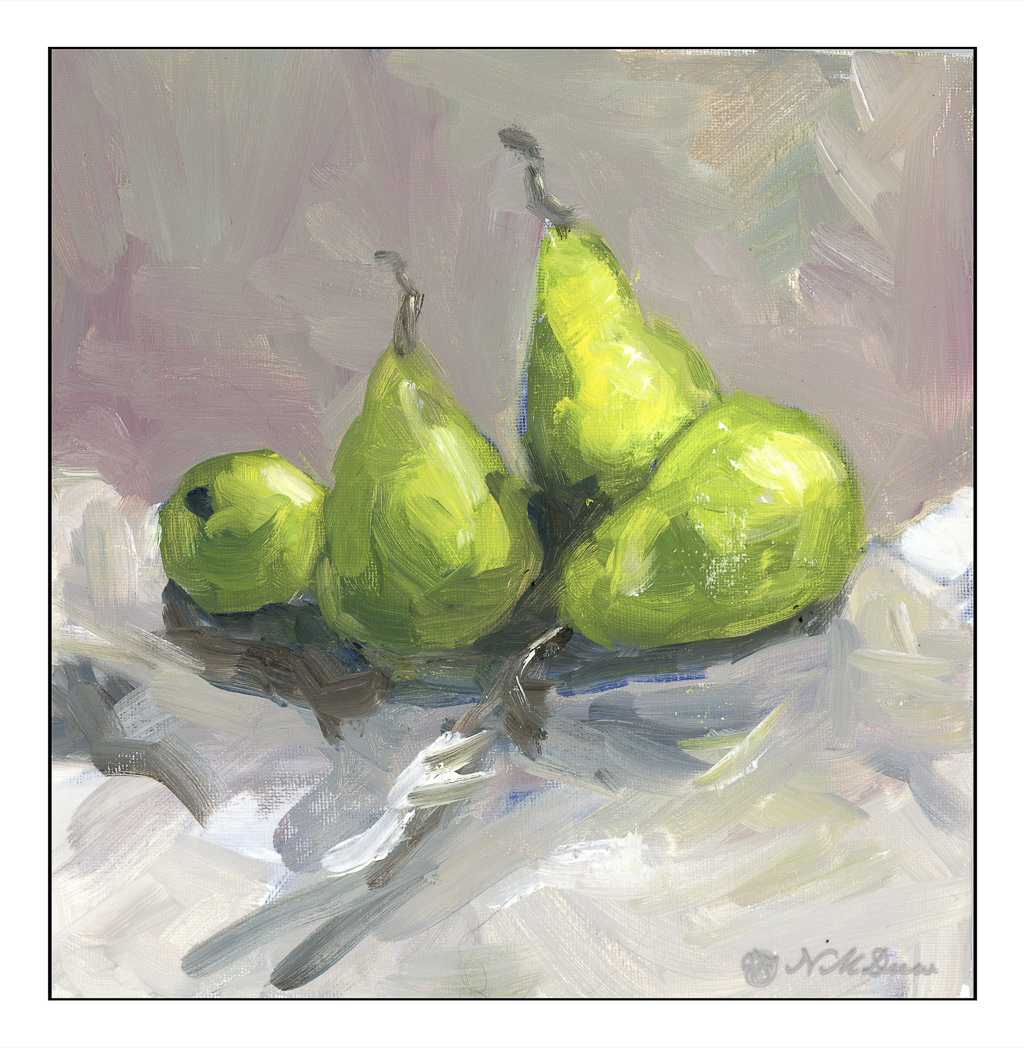
I love pears! Painting them is far less tasty than eating them, but they are by far one of my favorite winter fruits. Here, some d’Anjous, all cuddled together. My focus here was brushwork and getting a sense of the unctuous quality of oil paints. Some people use the paints straight out of the tube, but I like mine to slide around a bit. It really makes for fun blending. The colors, too, were rather limited here for the purpose of seeing how they can interact.
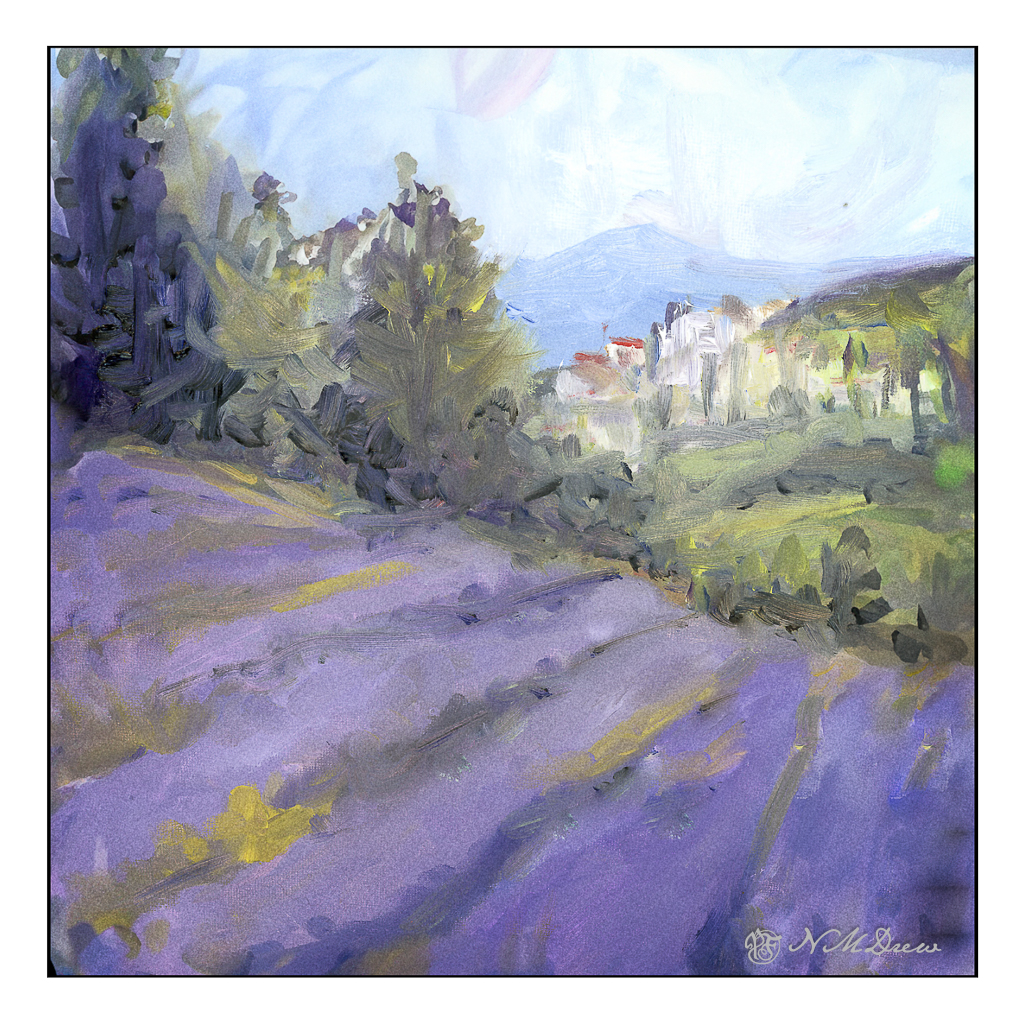
Here, more lavender fields. Why so many? It is because lavender and purple are honestly rather nasty colors to create from the standard mixes. I find that I like to have “convenience colors” on hand – namely, a good violet such as carbazole or dioxazine. Mixed with other colors and / or white, I get lavenders and such that appeal to me. I initially tried to just use variants of red, blue, and white for the lavenders, but gave up with frustration. Not worth the sweat! Maybe later I will master a good orchid lavender, but for now . . .
As with the pears, playing with the things you can add to the oil paints to thin them out. I used Gamsol and Soy-Thin, both low odor solvents. I didn’t use any linseed oil in either painting – that will come later – as will other things, such as drying agents like alkyds.
The pears and the lavender field were painting on pre-gessoed 10×10 cotton canvas panels measuring 10×10 inches square.
 Ink, Yarn & Beer
Boy -N- you are giving me an education! I like your explanations of your processes, and seeing the results adds to the understanding.
Good practice pieces.
Looks like you’re already doing great with oils! I share your frustration with acrylics….too difficult to avoid hard edges for me.
I agree – hard edges are a problem with acrylics and blending is a lot of work. Using medium helps but it’s not the same as with oils. Looking forward to my classes! Do you use oils?
Thanks, Fraggy!
Thanks, Anne! Not too long ago someone told me they thought it was stupid to write about stuff publicly, and while I didn’t snarl at them, I was sort of surprised. For me, writing something out is my method of analyzing it. I have to think to find words to explain something. Sometimes it works, sometimes not. I’m glad you find some value for my blitherings!
I dabbled a bit in oils, but never got back to it.I am trying to figure out if I should set up for oils in one of the kids bedrooms. Perhaps if I clear out more of the stuff they left behind.