
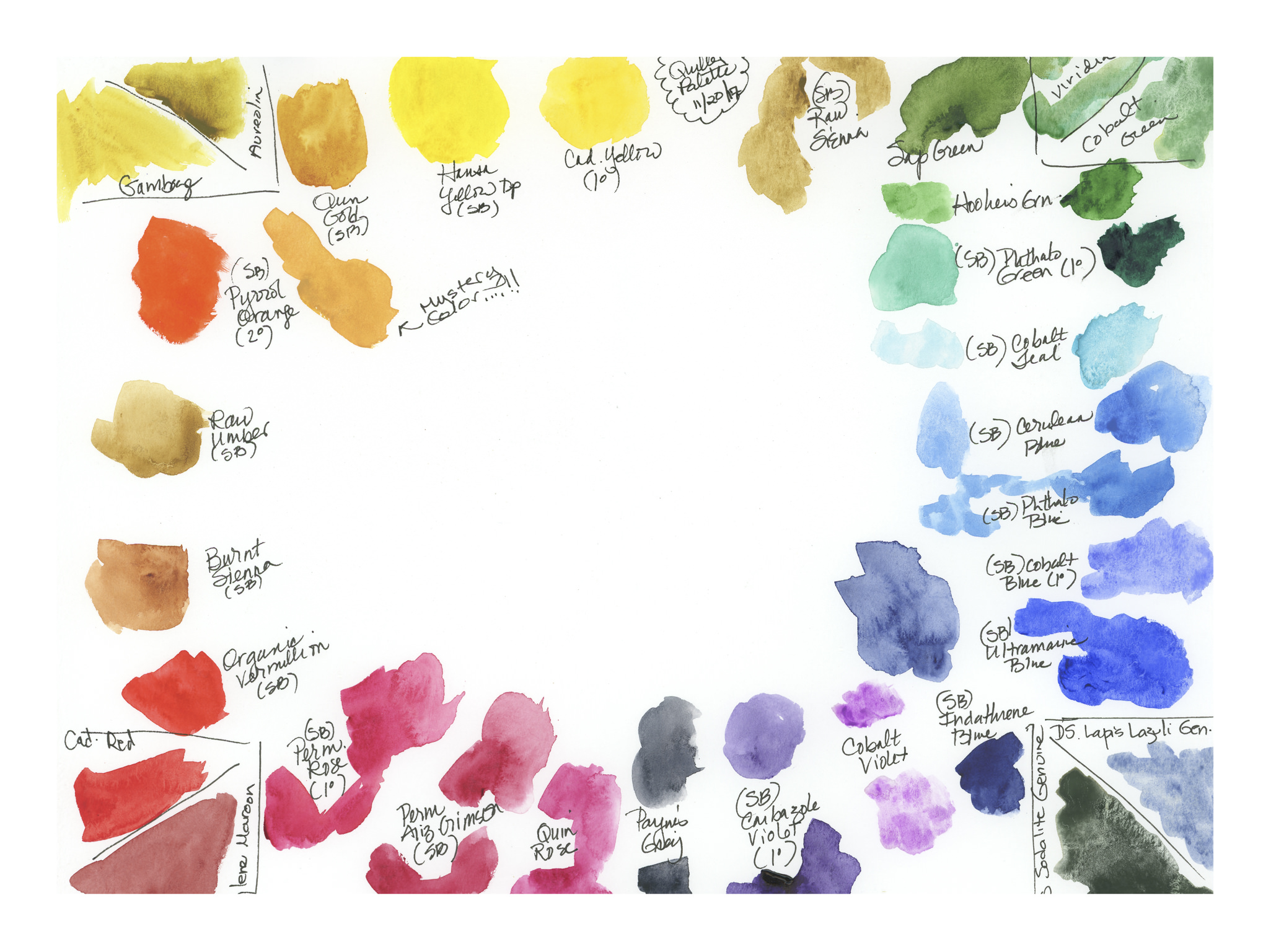
I have a Quiller palette from years ago that was a complete mess. Cleaning it up took a bit of time and effort, especially as it had not been used for years, and the paints were ancient. Most likely, the colors could have been retrieved, but as I wanted to start fresh, I cleaned it up – not an easy task! I soaked the palette to loosen old colors, and for about 2 weeks kept adding water to a particularly stubborn well, until finally the colors all came loose.
I filled it up this afternoon after considering the colors I have on hand, and the ones which I am currently using in a travel palette. I decided to use the 18 colors I have in one travel palette, and then add others. Some colors are totally new to me, such as the quinacridone colors (gold, rose), some cobalts (violet, teal, green), and newer variants of old standbys. When putting in the colors, I found one that I had not labeled! A mystery color – but it might be a yellow ochre, though it does not quite seem right. Kind of funny since I was so meticulous (ha!).
Other new colors include indanthrene blue, which is a rather interesting and intense dark blue, rather an indigo, along with a couple of Daniel Smith real stone pigments – lapis lazuli genuine and sodalite genuine. Old favorites are also present, such as the cadmiums, Hooker’s green, and Payne’s grey, along with the umbers and siennas.
It was time to put together a larger palette for the studio. Travel palettes are small, and not really conducive to studio work, which for me means a lack of freedom and a more stingy approach to color and water. Travel palettes have limited space, but room to play is always welcome! The Quiller palette is generously sized and has plenty of wells, which makes it a particularly attractive one for me. Additionally, the wells are set up to indicate primary and secondary colors, with room for other colors in between, as you can see below.


 Ink, Yarn & Beer