
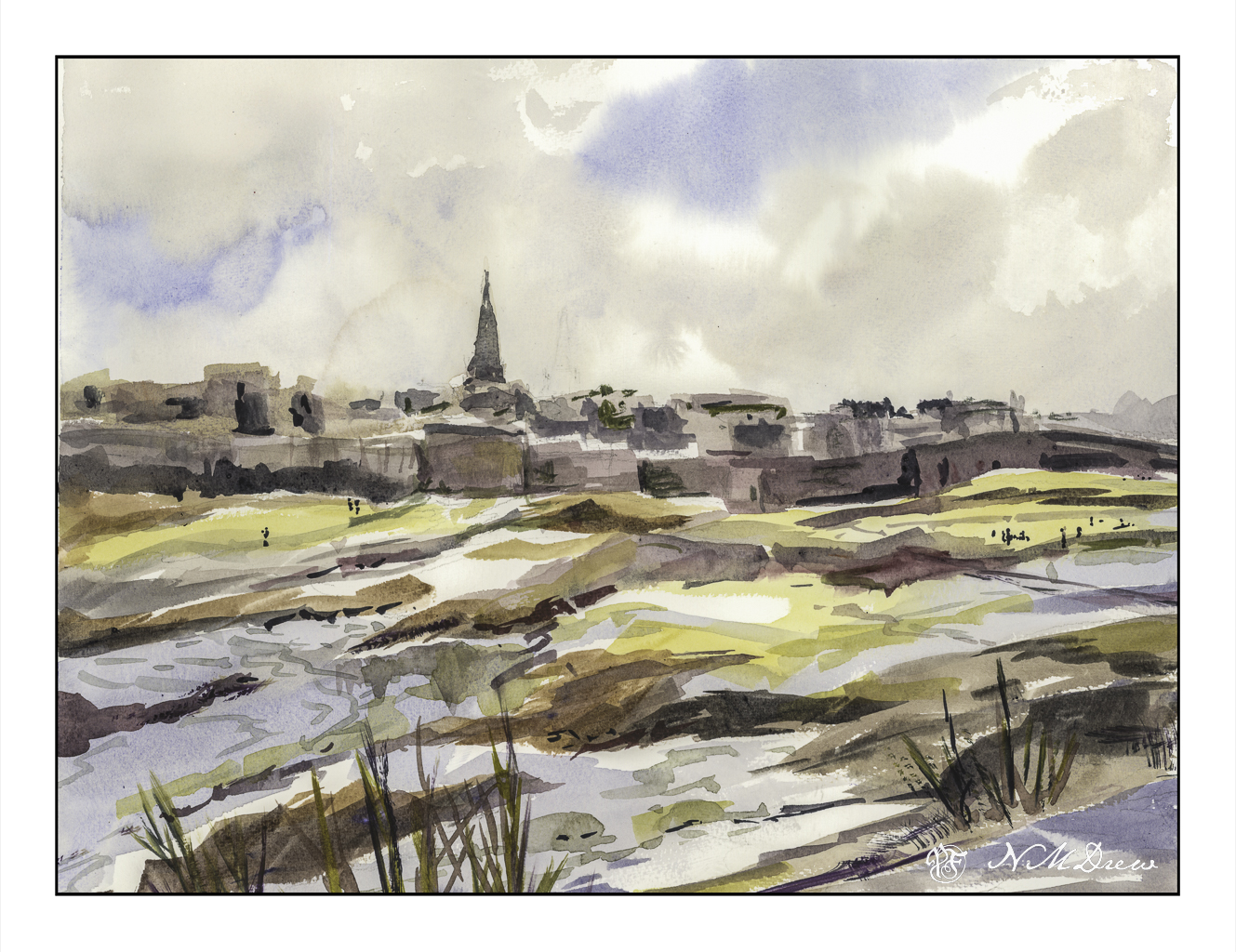
Beach at Saint-Malo

Remember the story All the Light We Cannot See? Ever since, the city has intrigued me. The story is worth reading, and if I remember, the movie was decent as well.

This painting was a quick one, and it turned out pretty good in my opinion. The point was to just paint, as well as to try out a new-to-me watercolor paper. This paper is St. Cuthberts Mill’s Bockingford paper. It seems to be a fairly soft paper as the tape around the edges of the painting pulled up some of the paper even though the tape was on the paper itself for only a short time. Using the heat of a hair dryer solved this problem, like it usually does. I liked this paper, though it does buckle a bit more than I expected when wet, but in the end it has proven to be well behaved.

Initially I scanned this painting on my Epson V600 scanner using the Epson software. Contrast was harsh and the sky barely showed up. I have had issues with watercolors and the software before – not at all pleasant to see – and then I suddenly remembered I have VueScan by Hamrick. I closed out the Epson software and fired up VueScan – and, oh, what a beautiful difference! This software is something I bought years ago, and I never really thought about using it for watercolors – I use it for photos I plan to run through Negative Lab Pro. Well, I guess I will have another use for it as well! Sheesh.

Watercolor, St. Cuthberts Mill Bockingford, 12 x 16, CP 140#.

Modular Medium Format: Mamiya 645 Pro TL, Part II

I am gonna keep the beast! 

The image above has the waist level viewfinder, which I would like to have.  I have the eye-level viewer complete with automatic exposure and a hand grip with film advance.

There is a really good review of this critter over at Emulsive, which is a great website for reviews on older cameras.

Everything worked out really well, auto-exposures and ones from reading of the Sekonic light meter, as well as my own guestimates!  Totally happy!  And what I like even better is the distinctive look of the 80mm f2.8 C lens that came with the beast.  Add to that, the Negative Lab Pro has been a real worthwhile investment for post-processing.

In order to check out the camera, I loaded a roll of Fuji Pro 400H, a film which has great color and latitude.  Its color is not as intense as Ektar, but it comes close with the brilliance of the colors.  I just shot around the house and neighborhood.  There is absolutely nothing outstanding about these images except to prove the camera works, and works well.  The whole point was to learn about the various aspects of the camera, both automatic and manual.

I handheld the camera for all these images. Friday I am expecting some of the proprietary Mamiya lugs to attach to a camera strap so that I won’t be as likely to drop it. The hand grip is a great handle, but I have read of people almost losing the camera from depending on the hand grip – somehow, the grip got disconnected from the body. At some point, I will get the waist level finder as I enjoy using so much on my Yashica D that I know it will be a good accessory. Because it is such a large camera, if I do get any other lenses, I am likely to limit myself to a macro lens. Other than that, at this point I don’t plan to accessorize it too much. I like the way it currently is, but if I want to go hiking, a lighter set-up would be good.

Altogether, I am happy with my decision to go with a modular medium format camera.  However!  G.A.S. is setting in . . . 6×7?  4×5?  Oh, dear me!