A whole day spent outdoors taking pictures! A first in the photo safari department for me.
I went with a friend, another novice in photography, and for both of us, it proved enjoyable and challenging. There is nothing worse than going out to shoot pictures with someone not doing the same – you know who I mean . . . the person who “patiently” waits for you to do whatever, “sneaking” glances at the wrist watch, sighing, texting.
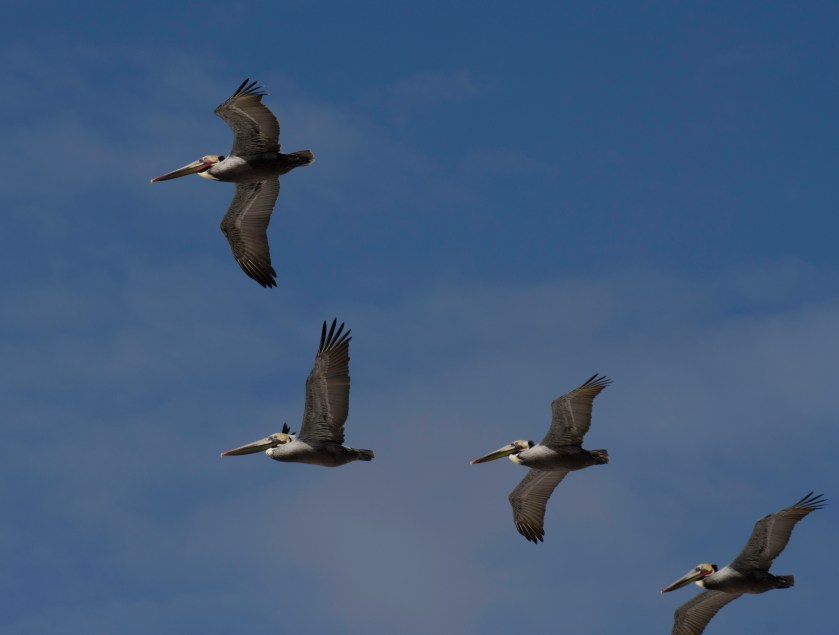
The first stop was the Ventura Marina, and a walk south toward McGrath State Beach and the estuary of the Santa Clara river. The tide was out, halfway between high and low; the beach was broad and long, mostly deserted except for a few strollers and fishermen. The estuary is home to many birds, and provides breeding and feeding grounds. Gulls, terns, pelicans all roost here, and others I cannot identify. We set up our cameras on tripods, used long and short lenses, and played a bit. In particular, we enjoyed the pelicans, out on patrol, flying in groups or in pairs, toward Ventura itself. Often, they head out in the morning, after the first cup of coffee (some sleep in), and then return later in the day.
This really was my first attempt to catch birds in flight. I used my Tamron SP 70-300 f/4-5.6 Di VC lens – yes, long name – but it is a great lens! The VC stands for “vibration control.” This element, combined with autofocus and a short, short exposure time gave me the opportunity to catch the pelicans in flight, still and unblurred. The Nikon also can shoot up to 6 frames / second (I think); this also helped to catch them in flight, swooping in and out of the waves. Even with my camera mounted on the tripod, I was pretty pleased by being able to pan and shoot at the same time.
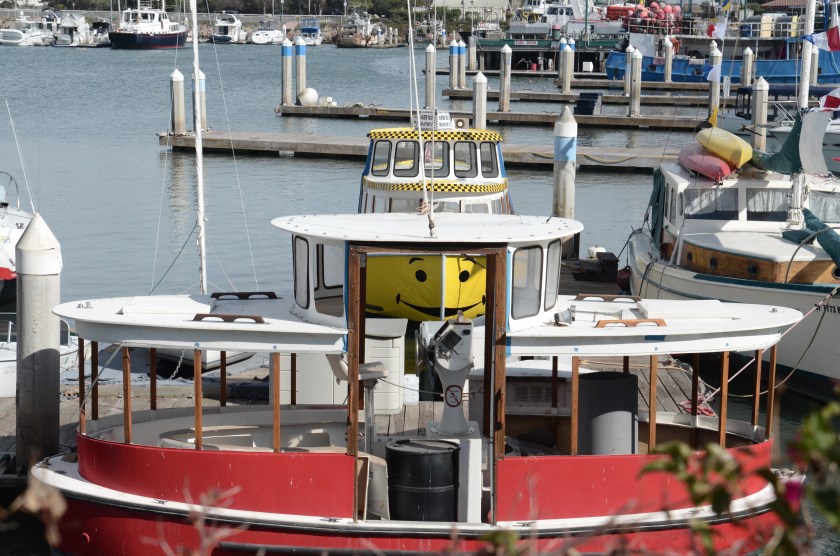
When we got back to the car, we tucked all the photo gear back into the car, and went to eat lunch. 3 hours on a chilly, windy beach, trudging through the sand, makes you work up an appetite. Some of the best fish and chips is to be had at Andria’s Seafood, so off we went a pile of fish. Then, back to the car to change lenses – I put on a 17-50mm lens – a wander around the marina itself, into the boat yard where numerous fishing boats are up on blocks for repair and repainting. Other areas explored were the commercial fishing area, tourist boat rentals, and down to the local museum for the Channel Islands National Park. Fishing boats are big, some very ugly, but always fascinating as far as I am concerned. I don’t like sailing unless doped up on scopolamine patches, or out in a brisk and wild wind on a sail boat – I get v-e-r-y seasick otherwise.
The little museum has a wonderful section of books, as well as a saltwater open aquarium which replicates tidepools, and there are windows on the floor you can peer into, meeting lobsters and flounders face-to-face, as well as looking in from above at starfish and urchins and barnacles. Behind the museum is a small garden of plants found on the Channel Islands. My favorite one is the coreopsis, which is odd as it has a thick trunk from which many bright yellow flowers erupt – it really looks like something Dr. Seuss might draw!
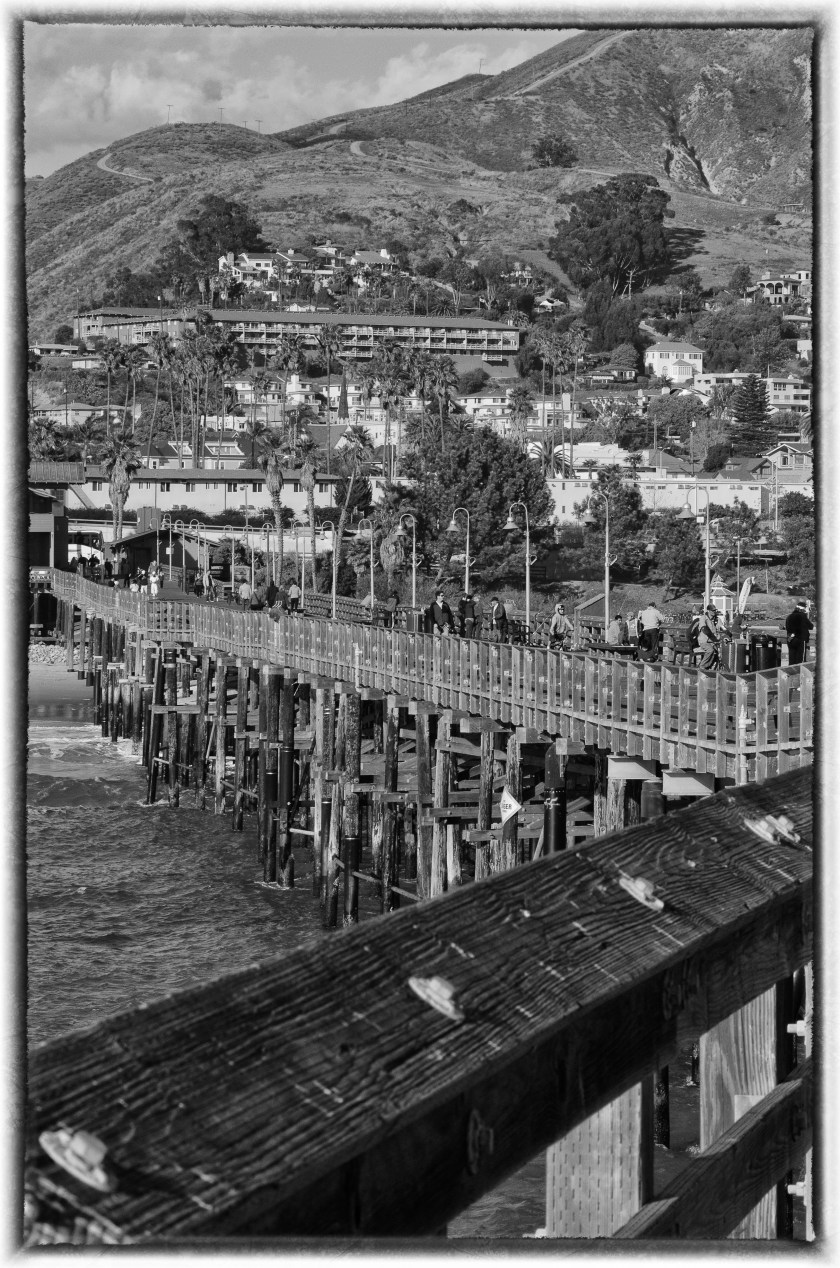
Finally, a decsion: head to a local beach park, or out to the pier. The pier won, hands down. Here, just a prime 100mm macro lens for me. I wanted the challenge a prime gives, as well as the macro element in case I saw something I really found interesting to look at close up. (I did . . . ewww! . . . someone’s used condom.) Once up on the pier, though, I had wished otherwise as the surfers and parasailing surfers were out in numbers. Despite that, there was a lot to see, above the pier and below.
Gosh, I love digital! I took about 300 pictures, just because I could! Some had to be shot fast, such as gulls and pelicans in flight, as well as sailboats flying before the wind. Overall, I was really pleased with the lenses and their responsiveness. The Tamron 70-300 was fantastic in its response to distance and time and focusing. It was the first time I really put it through some jumps, and I am really glad I got it. The 17-50mm is also a Tamron, while the 100mm macro is a Tokina. I have some manual focus lenses, but I doubt I could have gotten some of what I did of the birds without automation.
These past weeks here in Ventura and Santa Barbara counties have seen odd weather – not seasonally odd – but overall odd. Thunder and lightning seldom occur here – but they did, in abundance. Cold weather, and a week of rain. Now, up into the 70s and 80s, the east winds are blowing dust and pollen everywhere. Everyone is congested and feeling as if hayfever has descended like a plague. The winds are drying up people and plants. Tomorrow, we can expect more rain.
Despite my whining, it has been really lovely to get a week or so of rain. The problem is the sudden shift from high humidity to low, and the winds just add to the mix by drying everything up more so than just higher temperatures might. The skies have been beautifully clear and blue, and the clouds are more than usual – the usual is no clouds around here!
After work, a friend and I took our cameras and headed out to a local park in Thousand Oaks, Wildwood Park, which is part of the land dedicated to open space around the city. This park has meadows and scrub, rocky paths, vistas. In the early evening, with a week of rain behind us, the winter vegetation is beginning to green up. Underfoot, the earth gives a little, which feels strange when one is used to a dry, dusty crunch.
The cacti are rather fat and full of water. The prickly pear have ripening fruit.
Sagebrush flowers are dried, hollow shells, but the leaves erupt in an acrid spiciness when crushed. While the hills still look burnt from the dryness of the summer, a hint of green may be seen.
The sunset was bright and clear, with a majestic descent of the sun into the western mountains, turning clouds pink and the valley gold, orange, purple, and gone.
Here, ink usually means sumi ink. Ink sticks. Painting in ink. Surprise! Ink also comes in bottles, for dip pens and fountain pens, and anything else you may wish to do with it. I’ve a small collection of vintage fountain pens, dip pens and nibs, and ink in cartridges and bottles. A lot of pleasure may be had in using fine writing tools.
Cave Painting from Lascaux
Colors
For thousands of years, we have sought colors for painting, drawing, and writing. People painted the rock walls at Lascaux, using earth pigments such as red and yellow ochre, umber, and carbon blacks from wood smoke or burnt bones. White came from grinding up chalks. Cave and rock paintings can be found throughout the world, such as those at the Painted Cave in Santa Barbara. These pigments were applied with the hand, with some form of brush, and by filling the mouth with the colors and then blowing them onto the rock – people left their handprints behind using this method.
Painted Cave in Santa Barbara - by the Chumash Indians
Frescoes are attributed to the Minoans on Crete. The art of the fresco has been used for centuries, and continues to be done today. Pigments are mixed with water, and applied to wet, fresh plaster. As the plaster dries, the painting becomes a permanent part of the structure. Egyptian and Indian antiquities are filled with frescoes. European churches have frescoes which span the millenia. Mexican artists, such as Diego Rivera, created murals using the fresco. Locally, Gordon Grant painted the murals in the downtown Ventura post office in 1936-1937.
En El Arsenal by Diego Rivera, 1928Mural in Downtown Ventura Post Office by Gordon Grant, 1936-1937
Today if we want color, it is readily available in clothing, paper, ink, paint. With technology and the advent of chemically-derived colors, we do not give much thought to the labor involved in earlier times to get colors. Just dyeing in cochineal and indigo is a time-intensive project; if thought is given to collecting the bugs or growing the plants and the transport and processing of these materials, a sense of the work needed to get colors can be gained. Earlier times meant searching out pigments, carting them home (like carrying rocks on your back!), grinding them up, purifying, whatever. And then, what about all the creative ways explored to move that color to walls or cloth? These techniques became closely guarded secrets to ensure a livelihood to those in the know.
Writing
Writing was also done on many of these frescoes, but writing itself began earlier and throughout the world. Early Chinese wrote with pictograms; cuneiform developed in the Middle East; hieroglyphics were used by the Egyptians. Alphabets developed and simplified the writing process as letters represented sounds – thousands of images did not need to be learned. Different alphabets may be found throughout the world – Arabic, Hebrew, Greek, Russian, hiragana, Roman. These may be modified to meet a local need.
Codex Zographensis in the Glagolitic Alphabet from Medieval Bulgaria
Along with writing came a desire to communicate. Lugging clay tablets around was rather cumbersome – postage could be prohibitive – and so more portable, yet permanent, means of writing were sought. Parchment and vellum were developed and used for books and manuscripts. Papyrus was pounded into sheets and scrolls, and used by the Egyptians. The Chinese developed paper. Pigments and inks were developed – some good, some not so good – that could be easily applied to these surfaces. Plants, minerals, and a myriad of chemicals were used to create ink and color. Iron gall ink was used for centuries. Carbon ink, derived from soot and combined with bone glue, was and is used to form the sumi stick. Recipes for homemade ink can be found throughout the internet, and in old books for the handy housewife.
Writing Implements
All sorts of things were used to write with, but some of the noteworthy ones are the pen and the brush. Reed pens were used by the ancient Romans. Hollow reeds had a nib cut onto one end. Ink was poured into the hollow, and the reed was squeezed to move the ink to the nib. Brushes have been used extensively in the East and the West, but in the East they were used for both painting and writing, while in the West, brushes are primarily for painting. Quills cut from bird feathers were common throughout Europe, with those of swans, geese, and turkeys. An amusing, informative article about quills and pens may be found on the Jane Austen Society of Australia site.
A Good Recipe for Black Ink
Feather quills are not especially sturdy implements, so with time and technology, metal nibs were developed. Dip pens became commonplace in the 19th century as manufacturing technology improved. The fountain pen developed in the late 1800s, and was common until the ball point pen began to replace it in the mid-1950s. Cartridge pens came in at the same time, and are still very popular. Today we see rollerballs and gel pens and magic markers (that term dates me!) of all sorts.
Despite all these changes, writing with a nib and ink continues. Fountain pen bladders of silicon and rubber are still manufactured and used in the repair of vintage fountain pens. The delightful Fred Krinke of The Fountain Pen Shop in Monrovia, California, is still going strong, with a family store in existence since the 1920s. David Nishimura sells vintage pens, as does Gary Lehrer. John Mottishaw is renown for his customization of nibs. Nibs for dip pens are available and for sale in many places – some are new, some are new old stock from over 60 years ago. Calligraphers still make their own quills, grind their own ink and pigments, and practice the art of fine writing. Carrie Imai offers private lessons as well as group instruction.
Fred Krinke of The Fountain Pen Shop in Monrovia, CA
The Art of Writing
Before the printing press, and even after its invention – but before the computer! – fine handwriting has been universally admired. In many cultures, the measure of a person is often determined by the quality of the penmanship or brushwork. Graphology, or handwriting analysis, purports to be able to reveal all sorts of things about the individual, from personality traits to health. (Given the decline of emphasis on handwriting, it could be amusing to see what might be determined.) A clear hand was necessary when records were written rather than entered into a computer, but certainly a fine hand was important as well. Many of the world’s historical documents were handwritten by scribes, and flourishes added to their visual richness. Marriage contracts and other legal documents were ornate, formal, and artistic.
A Jewish Marriage Contract
Because writing became such an important form of communication, the tools and instruments of writing became works of art by themselves. Sure, anyone can write with a twig, but human nature seeks to embellish and beautify: Gold and mother-of-pearl dip pens, cut glass ink bottles, fancy writing slopes and lap desks, ornately decorated ink sticks, elaborately carved suzuri, colorful fountain pens.
The Art of Slowing Down
Today, with our throw-away culture, the beauty of these functional items may seem foolish, but personally, I totally enjoy them. And, like many people, I use them as well. Email is faster than snail mail, but the thrill of a personal letter still remains. Sitting at a keyboard, indoors, at a desk, is tiresome and boring (though it is getting easier). I’d would rather be outside with paper and ink any day!
Burr Oak Writing Slope, ca 1840, by Parkins and Gotto
If you don’t have any interest in writing or painting, then all this blither means very little. However, the history of how we got here is fascinating and easily forgotten. Thankfully, I don’t have to go out and collect my oak galls or raise some geese – I like having such conveniences as stores – but I will say that there is much to be gained in re-creation of past arts. Writing with a goose quill pen is a unique experience; cutting the pen is too. Dyeing wool, writing with a dip pen, using a lap desk over 170 years old places history into the present existence. Using colors and inks from long ago, with centuries of tradition and craft, provide an insight to life when it was slower (and more difficult and deadly in many ways). Today, too many of us live in haste, moving from one task to another, and forget that leisure and creativity are as important as productivity and speed. Paper and ink and color are one way to leave it all behind.
This weekend Anacapa Fine Yarns celebrates its 5th birthday. And what a party it is! On Saturday, Judy (my MIL) and I wandered over, planning on some damage occurring to the budgets. We got in a bit later than the 10:00 a.m. opening – not much later, just 30 minutes – and the place was packed!
Lois started this store after working in a large accounting firm for years, and the years of “taking care of the books” certainly showed in her foresight. Anacapa has been able to grow with the business. Lois is a cheerful, friendly person – sunny and funny – and greets many of her customers by name.
The store has a lot of floor space, natural light, good artificial light, and cosy feel. In the front is most of the yarn, with plenty of room for new shipments, books, buttons, needles and notions. There are knitting bags, bits of fluffy wool for spinners, and yarns for all budgets and tastes. In the far corner are the books, with a small, circular table where you can sit, knit, chat, and look at patterns. In the back is an even larger room, for classes, and more yarn (what else?). Lois has had trunk shows, authors, teachers, as well as monthly and on-going classes.
As the years have gone by, more yarn has come in, wonderful employees, and a group of friendly fans make this a great place for knitters to congregate. Customer service is always available, and I have never had a bad moment here – until I look at all the woolly seduction! Then – well – you know how that is! Choices! And some – just some – self-control!!
And the sale? Well, you can see how crowded it was. The line was verrrry long! Judy and I each got sock yarn. Judy got some grey-green-blue Koigu, and I got some ocean-blue-green. Judy also got a lovely sock yarn that was creamy with other colors dispersed through it. I also picked up a nice ball of manly Tofutsies for the esposo, and some – finally! – Mini Mochi in greens.
Anacapa is a gem of a yarn store, and if you are up in Ventura, California, don’t forget to visit. They are open 6 days a week – closed on Monday. The newsletter is published regularly – take a look and see what’s happening and who is showing up.
I’ve been shopping here for years. This is an old-fashioned, family-run store, located in the middle of Main Street of Ventura, CA. There are fabrics, sewing and knitting supplies, upholstery materials, patterns and buttons. Everything is beautifully displayed – the plain exterior belies the inside, trust me – and the service is superb. Many people who work at Fabric Town have been there a long time, and the service provided is some of the best by staff who know what they are talking about. Change is counted back to you, too, so no one is dumping a bunch of bills and coins in your hand. There is a courteousness here which dates back to earlier days.
Fabric Town carries high quality fabrics, if you sew. Silk, cottons, wools. Patterns include Vogue, Butterick, McCalls, and Simplicity, and some of the newer firms as well. Notions for sewing are all over, with a good button selection, zippers, pins, and whatever you might need. All is very reasonably priced. If you quilt, you won’t be disappointed, either.
Yarns and knitting supplies include acrylics made by Red Heart and Paton’s, as well as the good wools, cottons, silk blends, merinos, bamboo and such by Cascade, Berocco, Trendsetter, Crystal Palace, Knit One Crochet Two, and others. There are sock yarns, DK, sport, aran weight. The yarns are divided into categories, such as sock, and then nicely displayed on glass or wooden shelves. The book selection is not large, but the ones they have are nicely chosen. They also carry Clover knitting notions and my favorite aluminum needles, Susan somebody! They do not have an extensive class schedule, but have some knitting classes posted here and there.
Here is where they are located: 2686 E Main St
Ventura, CA 93003
(805) 643-3434
Although the address is on Main Street, you have to go around to the back, next to the BofA teller area. Check them out! They are open 7 days a week, too.






 Ink, Yarn & Beer