In the Kitchen, On the Counter

The wind is whipping through Ventura and Los Angeles counties. Fear of fire is there. Today I have to drive about 30 miles into the east winds.

This morning I went out to check on my patio to see what has blown over, as well as to see the sunrise as there are clouds scudding along the windy river.

And then back indoors – the wind is a bit chilly at 6:30 a.m. But, since I had my camera in hand, I decided to look around and take some snaps of my basil and the little squash I grew this summer.

In the Kitchen, On the Counter (1 of 2)

Kitchen herbs are always welcome! When I come back from my jaunt into the wind, I vowed to water the ones still outdoors – these winds dry everything up and I have lost more than one plant to my laziness and dislike of 40 mph winds .

In the Kitchen, On the Counter (2 of 2)

In a rather E. Weston style, my little squash. I have eaten the others and have decided to see how well it will age. By this I mean I read how people would store pumpkins and squash through the winter months, so this is my experiment to see what it is like – will it be dry and tasteless, dry and tasty, or what? Hard squash is one of my favorite things to eat, but before eating my prey I plan to photograph it some more.

And now, on to breakfast and more coffee. I decided to get this up and out before the electric company shuts off the power in the hopes of preventing fires. These winds whip them up once started, and I sure hope we don’t get any. No rain for months makes us the perfect tinder box.
Winter Farm on Christmas Eve

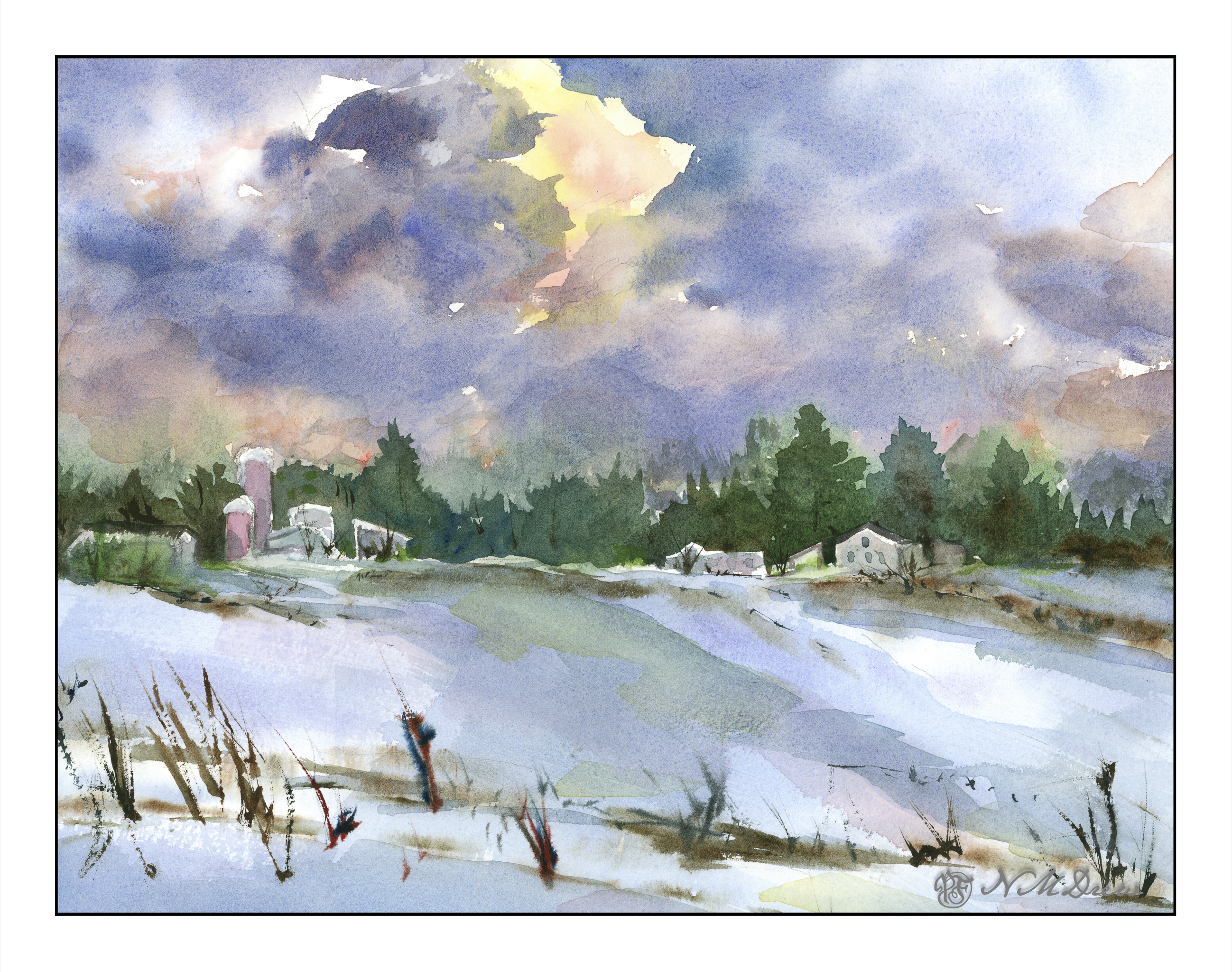
Now to the northern part of the continent . . . somewhere in North America for winter on the a prairie farm, snow covering field stubble, early evening or morning. Cold, desolate, and heartbreakingly beautiful.

I spent the morning painting this on rough 300# natural white Kilimanjaro. I did it in stages. The sketch was light, with suggestions of shapes. Then the sky was wet and yellow, quin gold, and permanent alizarin crimson used to create the rosy golds. Once down, cobalt blue and ultramarine were placed to simulate sky being careful not to merge into the rose gold of the central cloud. As the sky dried, purple and alizarin were mixed with ultramarine to create the darker clouds. 

After the clouds were laid in, I did the dark trees, blurring some green into the still damp sky, as well as waiting for the sky and soft trees to dry. This was done to create the hard edges needed for the buildings against the tree line. The buildings themselves were left white as the trees dried.

From there, the snowy field was laid in with cobalt and ultramarine in a very light wash and using a 2″ soft brush. Again, drying. At one point, the 2″ brush was dried and dipped into lightly damp burnt umber and applied to make the streaks of brown for field stubble near and far. Then the buildings were done, and once the snow dried, more thin washes as glazes applied to the foreground snow, culminating in a streak of quin gold and then permanent alizarin to the middle of the painting, hoping to show a sense of light reflected in the still dark snow from the breaking clouds above.

After that, details such as dried grasses, windows, tree trunks and whatever were added as deemed necessary.

I am pleased with this painting quite a bit! It achieves what I set out to do – a winter scene, snow, clouds, and patience to wait and think about a painting before just diving in with brush and color. The 300# rough Kilimanjaro is 11×14 and a wonderful paper to paint on. More is needed in the future for sure.

Winter’s Trees

For the past several weeks I have been immersed in painting classes – 2 or 3 a week, and too many hours to count. I finally decided I was doing more than was good for the rest of my life, and decided to cap it to a few hours a day. That balanced things out as I was getting rather nutso.

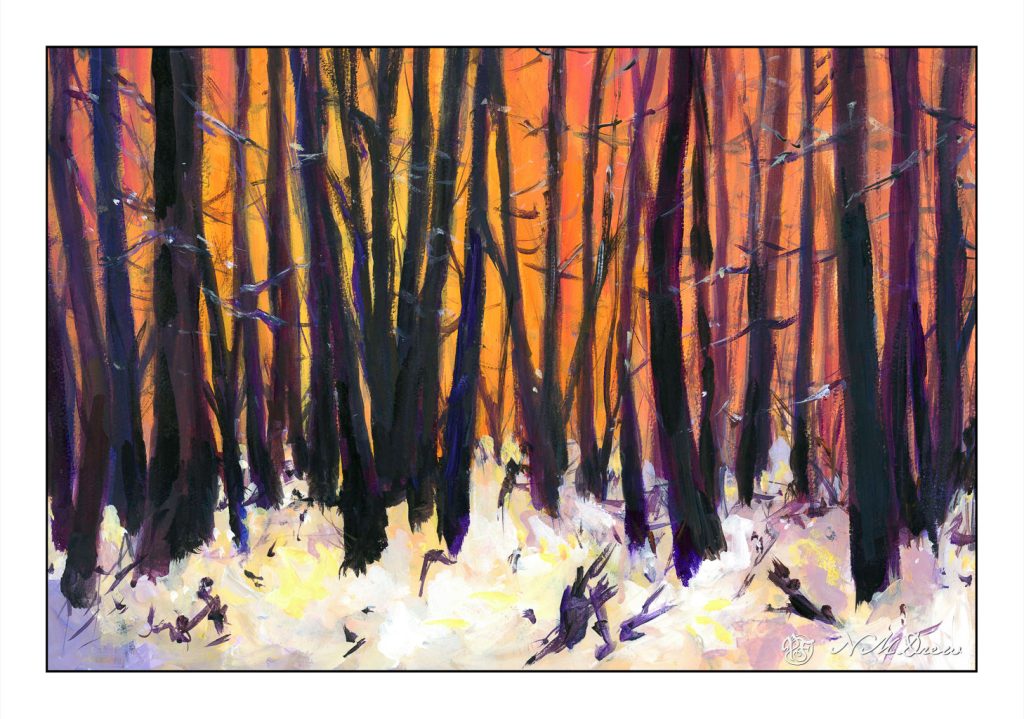
This is based off a Pixabay photo of trees and snow, at sunset or dawn. I am not sure if this one is “finished” yet, but think it is done enough to scan and put online. It is acrylic paint on a piece of 11×15 watercolor paper. I decided to use it as the paper is 100% cotton but the sizing is not good. As I bought the paper a long time ago, I cannot return it.

One thing about painting in acrylic, you can paint on a lot of different surfaces. I like the feel of paper beneath my brush more than a canvas panel that I have gessoed. Maybe it is because I am used to its surface texture, but there is more of a connection there with its surface – smoother than a cotton canvas panel, but with some tooth. I do plan to learn more about oils later this summer but need to play with it a lot more and figure out where to paint as oil solvents, while now often odorless, are still volatile and not exactly something to be breathing in a closed space.

As I work on learning how to paint I also explore different artists. Right now I have been looking at a lot of the Russian artists of the Impressionist variety along with ones from the 1930s, such as Nikolai Timkov and his fellow painters. Impressionists and more modern painters appeal to me because their sense of color and brushwork, as well as subject matter, are more to my liking than any other era. I like abstraction, too, so a bit of all of these appeal to me. Strong graphics, elegant composition, good colors get my eye. Art is really a personal thing anyway. What I want to hang on my walls may be nothing you would even consider . . .

All this painting is also making me think about brushwork. It expresses so much. Smoothly blended or broken? I think the next exploration will be broken brush strokes and trying to choose a color and put it down – paint it and leave it, as Ian Roberts is telling us!

On the Edge of Field and Forest

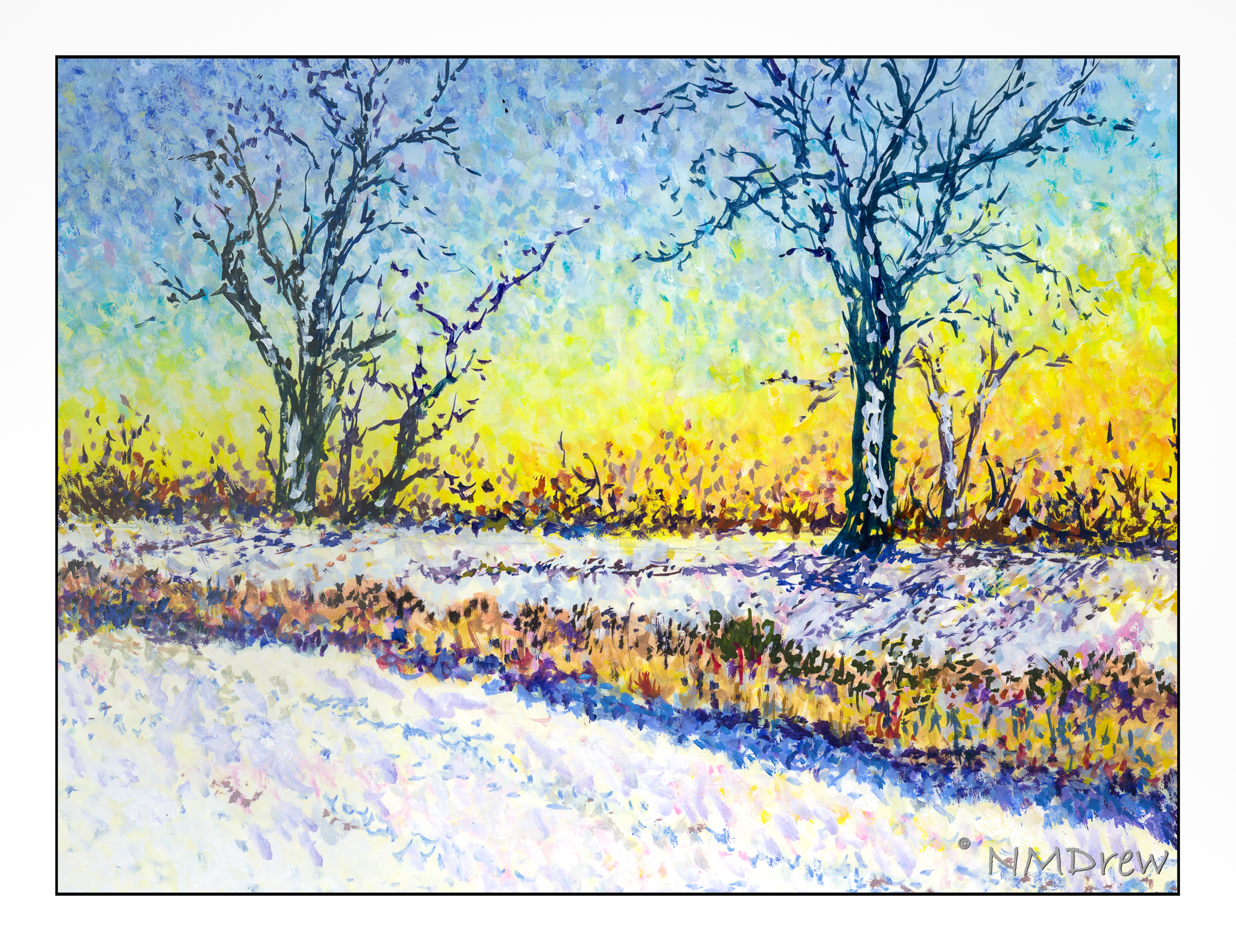
Another winter day . . . snow, sunrise, warm and cold. Pointillism once more.

This time I laid in the background color, such as the blue of the sky merging into the gold of the horizon, blending them together with white. the same with the diagonal hedgerow and foreground snow. After that, I used a tiny, tiny brush, soft to the touch, and filled it with gouache paint I thinned down a lot.

The time to complete this painting was easily 2-3 hours (with time out for lunch and a nap, of course!). I think the color gradation, especially in the sky, has worked well with the usage of small points of color. I also tried to make the middle ground snow cooler and greyer than the foreground snow.

Ahhhh! It feels so good to paint!

A Winter Morning

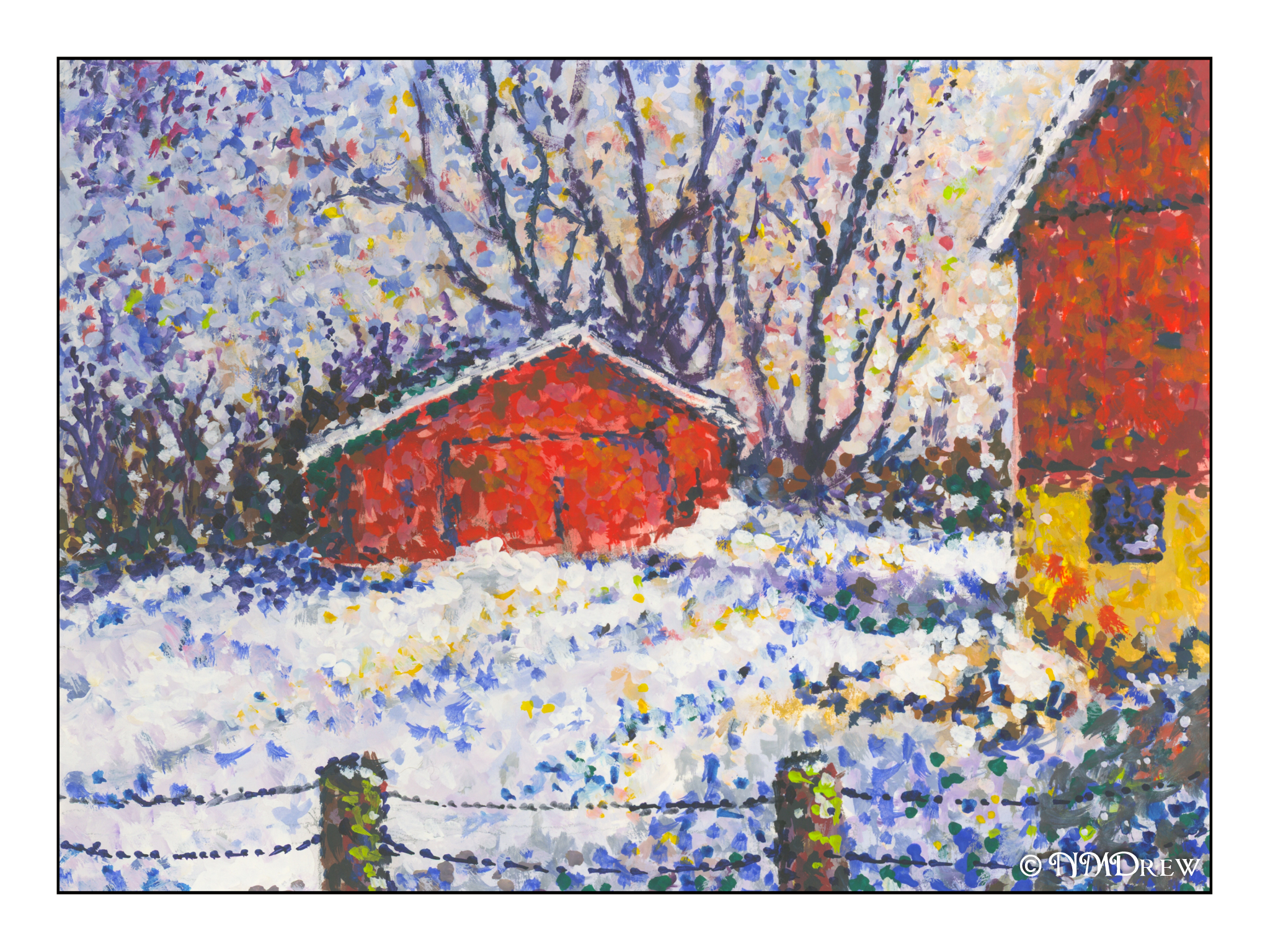
Still dreaming of snow and winter, but honestly glad not to be in the northeast! More snow dumped in 24 hours than was dumped all of last year. That is a lot of snow! Nothing like snow up to the roof, no electricity, and wondering how you are going to stay warm. When I was a kid, we burned oil for fuel, so heating the house wasn’t an issue as far as I can remember, but I do remember a few times when my youngest brother was in diapers, and there was no electricity to heat water. Frozen pipes, too, but that is usually easily solved by letting the water run gently through open taps.

I am continuing using gouache and Pointillism. Something in me just loves this, and I have started looking beyond Paul Signac and into contemporary artists. The graphic quality of Pointillism and the colors keep drawing my eye. Also, I am getting more “aware” (for want of a better word) of color interplay by using dots and mushing colors together.

Meanwhile, today in California it was a chilly 68F and I had to wear socks in the house.