Sketching with Shari, i

I think I have purchased every single course that Shari Blaukopf has online! She is such a good teacher, puts together short and affordable courses, and I always learn a few things – or oodles of things – from her! Her latest one is “Sketching Techniques with Pens and Inks” which you can check out here. I do a lot of pen and ink, but figured I would dip into this one just to see what I could learn. And, I did – such as a more clear way to view things from eye level. Ellipses become more round below and above eye level (duh!), and she explained it in a way that made me review my own way of drawing a bit, and perhaps will help me solve some perspective problems.
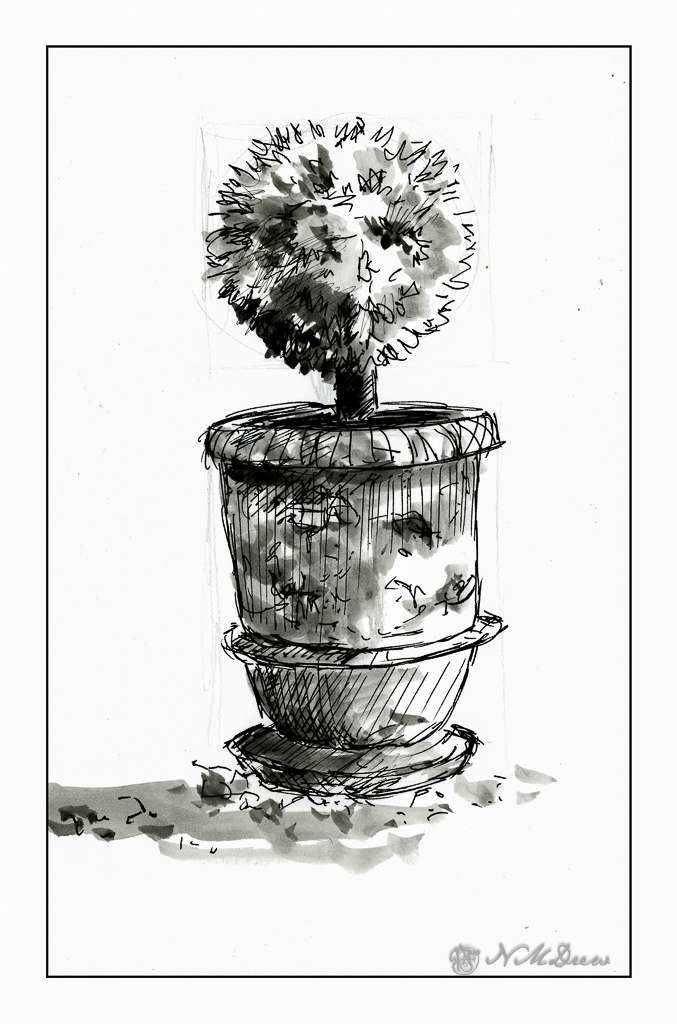
So, this first one is a potted plant in a planter somewhere in France. It’s a cool planter, too. Shari pointed out that it is good to begin with the big shapes and determine ratios. Top is a circle for the pruned tree or bush. Make a square, insert your circle. Below is the trunk, and beneath that is a large rectangular shape which you can divide into upper pot and lower pot, as well as the stand. Texture a bit for the gravel and stones upon which this planter stands. Shari put in light pencil lines, which she later erased in her video, but I left these in. You can see them very lightly in the painting. Contrast and shape coupled with expressive lines and here we are.
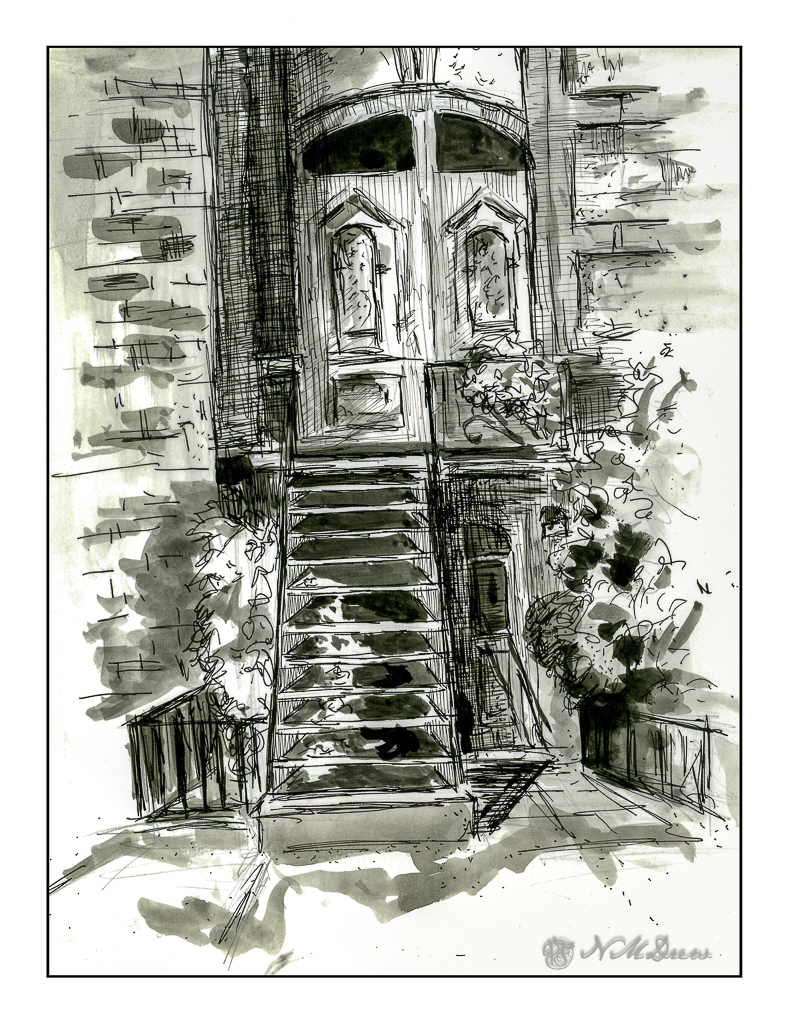
The Victorian door is considerably more complex than the planter, but once more Shari’s clear instructions helped me set up the proportions to make things work. Both the planter and this door came with reference photos, which is very helpful because things can become a bit confusing. This subject was definitely a challenge.

The detail in this subject matter makes for a desire to put it in – one of the good things about pen and ink – but I also needed to make sure I did not lose a sense of light and dark. I used waterproof ink, but to get the greys I put a bit on a plate and used it straight or diluted it as needed. I check the values to the side of the drawing before inking. Lines and dots also add to the texture and contrast of the drawing.

I like my potted plant as it works well with contrast, value, and textures. The Victorian door is more complex. Under the stairs is a second door, and I may go back in and fictionalize it a bit or darken it a bit to the right of the stairs. Something to look at and rethink.

Sailor black ink; fountain pen with Sailor ink; water and brush. Strathmore Bristol paper.
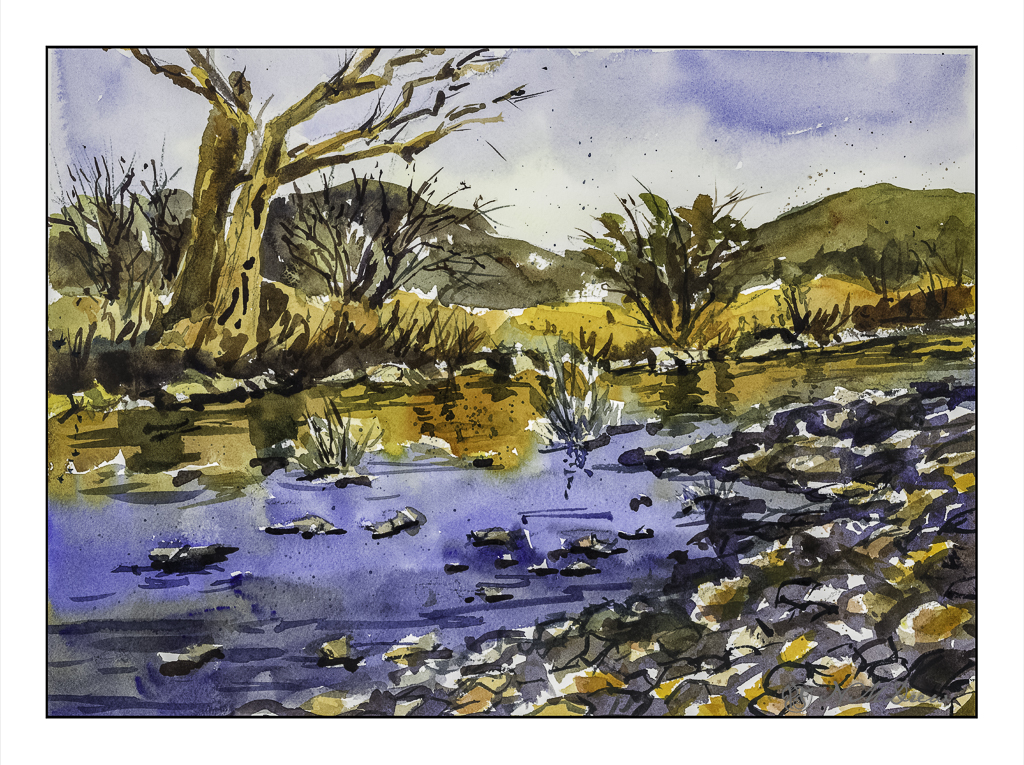
Watercolor Triad – Desert Wash Scene

Well, the electricity is off again. I feel like I am living on a little island because only a few people in my neighborhood are affected. Fortunately, we have our generator! So, light, electricity, internet, and the opportunity to continue with my course on color triads by Shari Blaukopf.

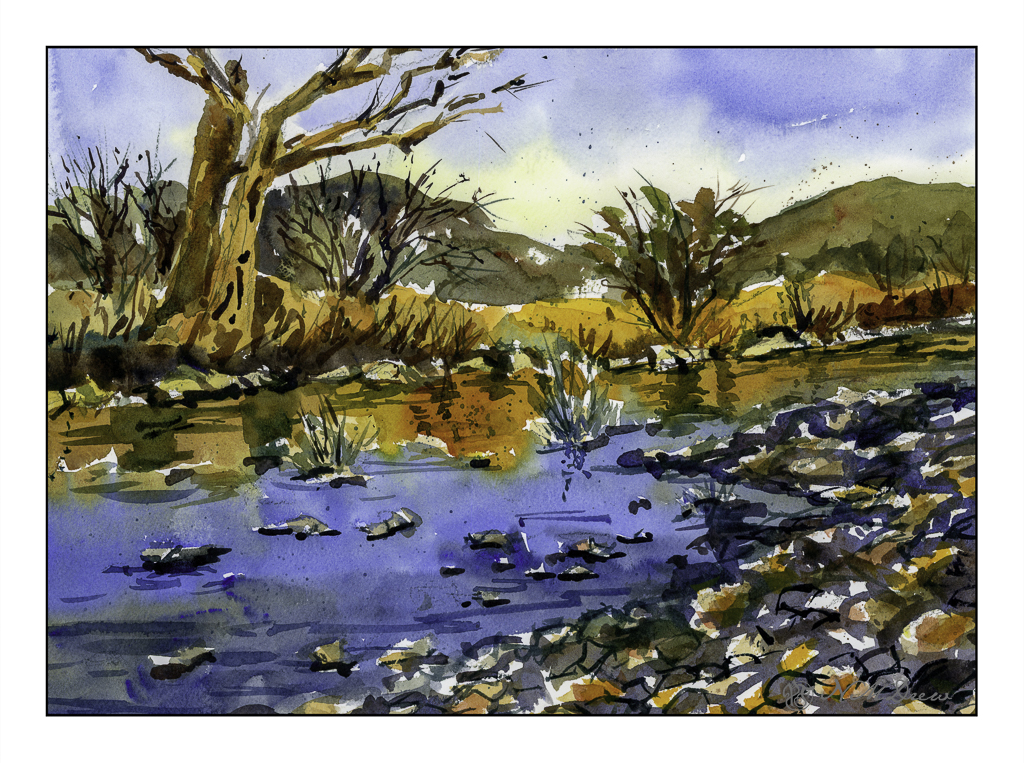
I did the first one, a tropical scene in Florida, and this is the third, the Arizona desert. The second one is winter and since it is cold and rainy outside, the desert appealed to me a bit more. The color triad used here – and easily, too – consisted of New Gamboge (yellow), Ultramarine Blue, and Burnt Sienna. I did not have the New Gamboge, so I mixed Cad Yellow Medium with a bit of Pyrrole Orange to get the color she suggested. These colors are perfect for a late evening in the Arizona desert.

The above scan is with VueScan. It is a bit more subdued than the one below, scanned with Epson Scan. I like both of them, but think the richer colors of the Epson Scan are a bit more to my liking. The warmth of the scene is well done here, and matches my own colors perhaps more closely.

All of Blaukopf’s courses have been a real pleasure to follow. If you like watercolor, I suggest her more than any other online teacher. I never fail to learn something new. For instance, in this class, the golden middle ground, just above the opposite shoreline, included painting the colors up into the trees on the left. From there, at a later point, more detail was added.

The other thing I learned was a really interesting and unique way to do reflections in water. The two colors – golden yellow and then blue – were mixed up in big puddles. First the golden yellow was laid in, with a bead of color at the bottom. Then, with the blue, with space between it and the gold, the blue was brushed in with only a touch onto the golden yellow here and there. This allowed the colors to merge, but not become murky or form blooms. Finally, the darker water of pure ultramarine was mixed with a bit of the golden yellow mixed with burnt sienna.

This triad study was so much fun to do! Time to try some of my own from my own photos.

Watercolors, Arches 140# CP, 9×12. Cad Yellow Med, Pyrrole Orange, Ultramarine Blue, Burnt Sienna.

Color Triad, i

With the threat of fires and losing our house, I feel a bit crazy. We ordered a generator, but it would be ironic that it gets burnt up and our house. No, our house is not in danger, but it is so scary to be contemplating its loss, as well as realize people have died and lost everything. So, it is as if I have to grab onto life and what I love, from people and pets to things I love to do. Watercolor painting is one of them, and the artist whose work I enjoy the most is that of Canadian watercolor artist Shari Blaukopf. Her colors are fresh and cheerful, her personality soothing and calm, and her mini online workshops are always a pleasure.

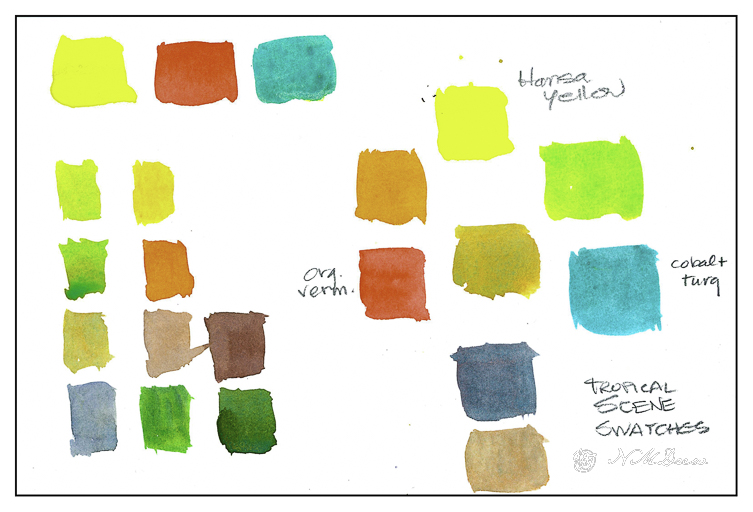
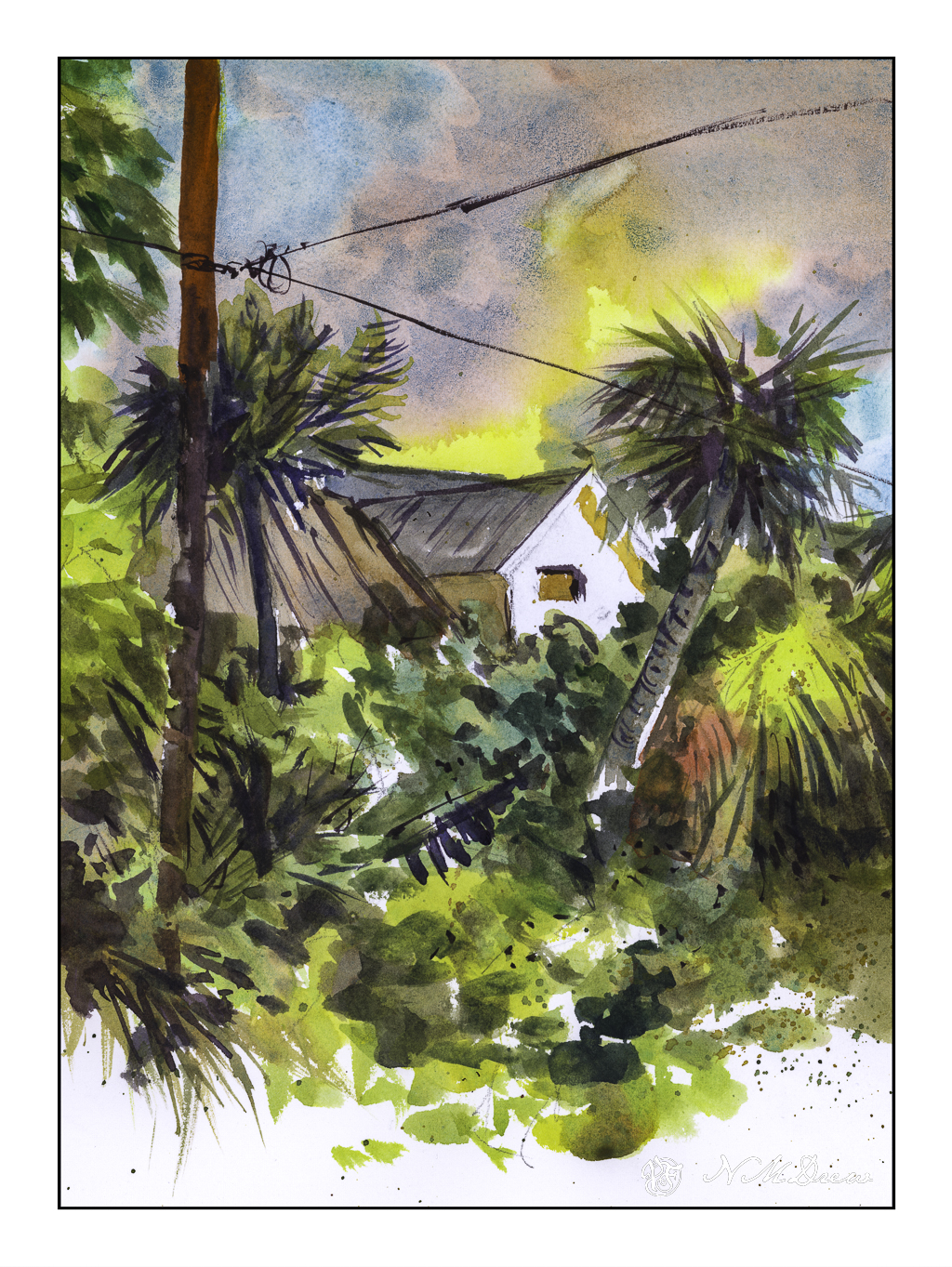
So, today, her most recent one: Expressive Triads. In painting, a triad is three colors, all primary, but within that the colors vary. This first one, for her tropical scene, consists of Cobalt Teal, Hansa Yellow, and Organic Vermilion. We begin with mixing color swatches.

She also adds ultramarine blue at times, toward the end, to mix really dark values which can vary depending on how much yellow or vermilion you add to the mix. I normally don’t swatch but today it just seems so important to attention to details and savor them.

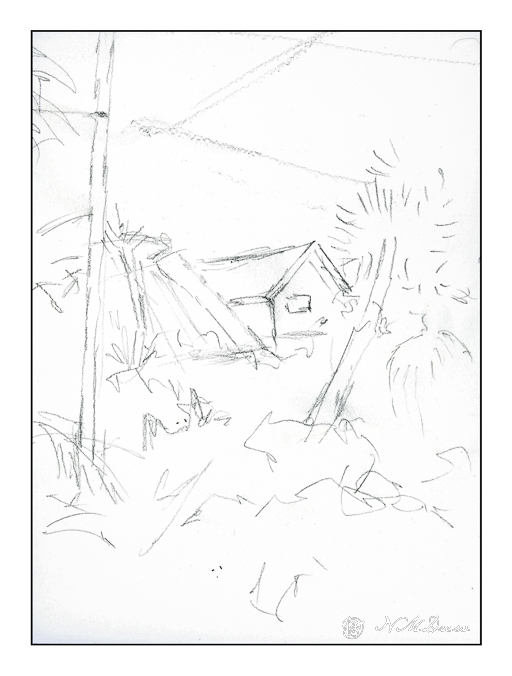
From there, a piece of 10×12 paper and a pencil sketch for the general shapes of the scene. This is from a trip Shari took to Florida. She points out the warmth and colors of the scene – yellow clouds, teal sky, grey sky / clouds. As she paints, she explains what she does, colors used, brushes, talking as she paints. She suggested that you watch her video and then paint along after watching it. It is a good idea!

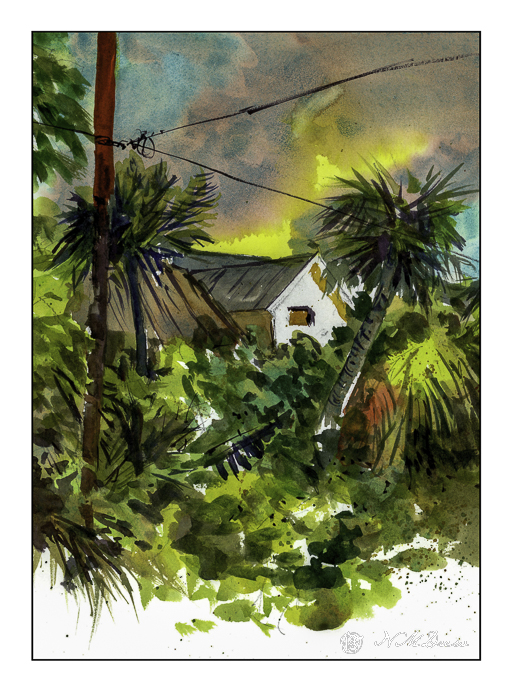
Her first scene – one of three – is this one. Her videos explain each section as she does it. So this scene itself has three sections – the sky, the foliage, and finally details. I don’t want to give away her course details, but suffice it to say she is clear. I learn a lot from watching and then doing. The beauty of her video courses is their clarity and brevity and extremely reasonable pricing. I spent about 2 hours with this first painting – watching and then painting.

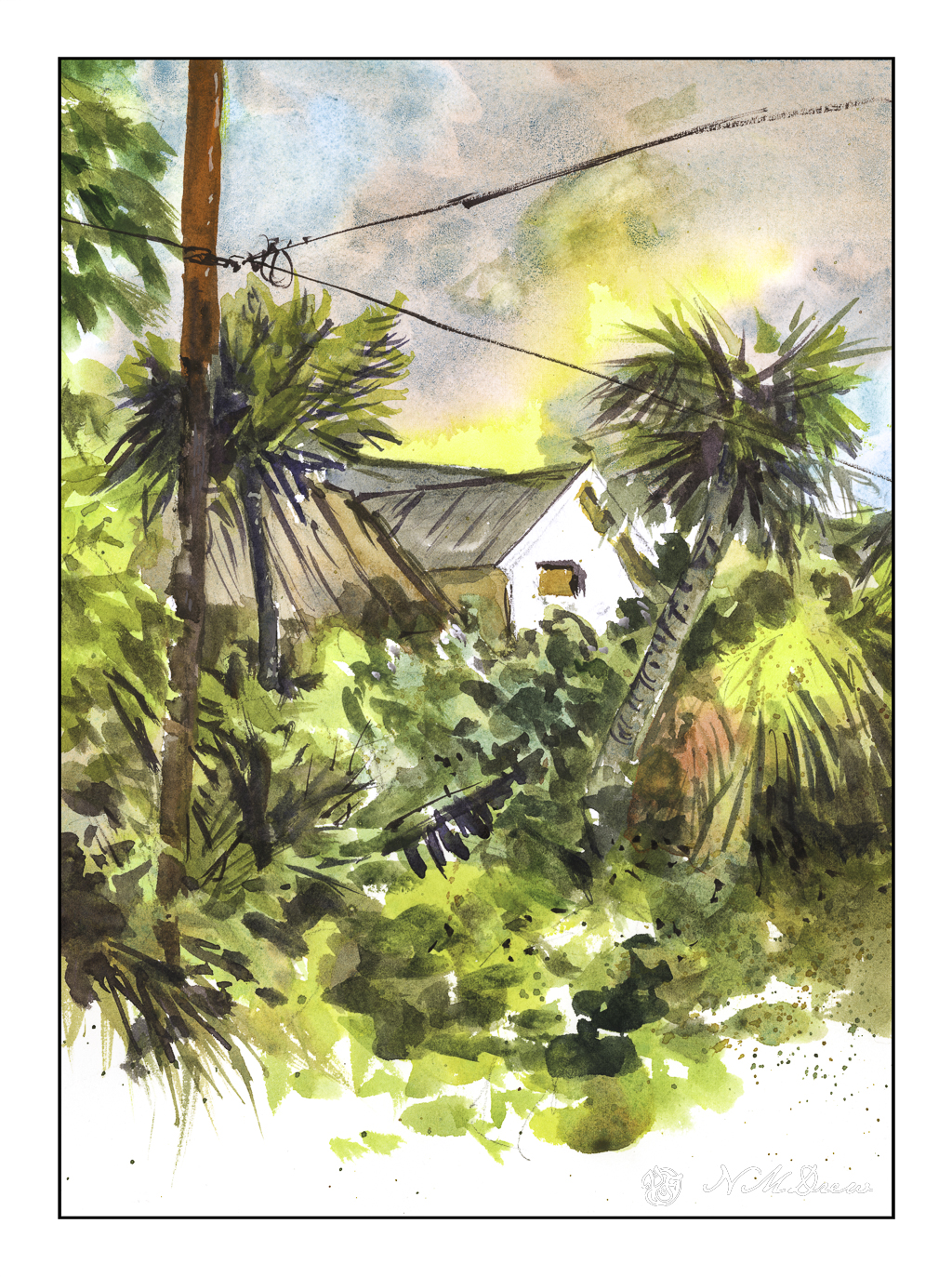
While her sky is representation of the tropical skies in Florida, here, in the midst of the fires in LA, this sky makes me think of the conflagrations flooding the news. Palm trees and semi-tropical vegetation is common here, so the yellow clouds and sky mixed with grey make me think of smoke and fire on the horizon. Our sky is clear, and let us hope it stays that way. The above picture is scanned unedited with Epson Scan software.

The above scan is with VueScan and is less intense – especially in the yellows. I wonder if I need to permanently switch the software to VueScan as it seems more accurate, at least with this painting.

Final Touches

Below, some final touch-ups to the painting. I blurred out the bloom in the sky below the upper telephone wire, added shadows to the eaves of the house, and painted in some lines to the trunk of the left side palm tree. Once more, scanned with VueScan.

Watercolor, Arches 140# CP paper, short course by Shari Blaukopf.

Another Day in Late Spring

As I mentioned yesterday, I finished up Shari Blaukopf’s short course on painting spring flowers in watercolor. From crocus, we moved onto hyacinths, and today we have a field – or certainly a large patch – of tulips.

Shari’s tulips are more rounded at the tops, as are your standard tulip. Me, in my messiness and lack of attention to shapes, created ones which have more ragged tops, more open in bloom, and any other excuse you can think of for not adhering to recognizably-shaped tulips!

With that out of the way, this painting was a conclusion to all three studies. Out of all of them, for me the crocus was the biggest challenge simply as I am not familiar with them in reality – only pictures. The hyacinth was difficult because the flowers are small, 6-pointed, and blur into one another. Working with them as color masses, light to dark, with an occasional recognizable flower made for success in painting a complex subject. These tulips, while not especially tulippy, were my favorite to paint.

If you enjoy watercolor, I recommend Shari’s short courses – as I have before. They are reasonably priced, some are better than others, but in each one there is a clear subject and a clear goal. She has put together some “series” of online classes, too, which cover related topics. Many classes have a section for the student to upload their studies, and Shari is very good about getting back, even if it may be a few weeks later because she is away teaching in-person workshops.

Watercolor, 10×12, CP paper.

Yes, It Is Still Spring . . . .

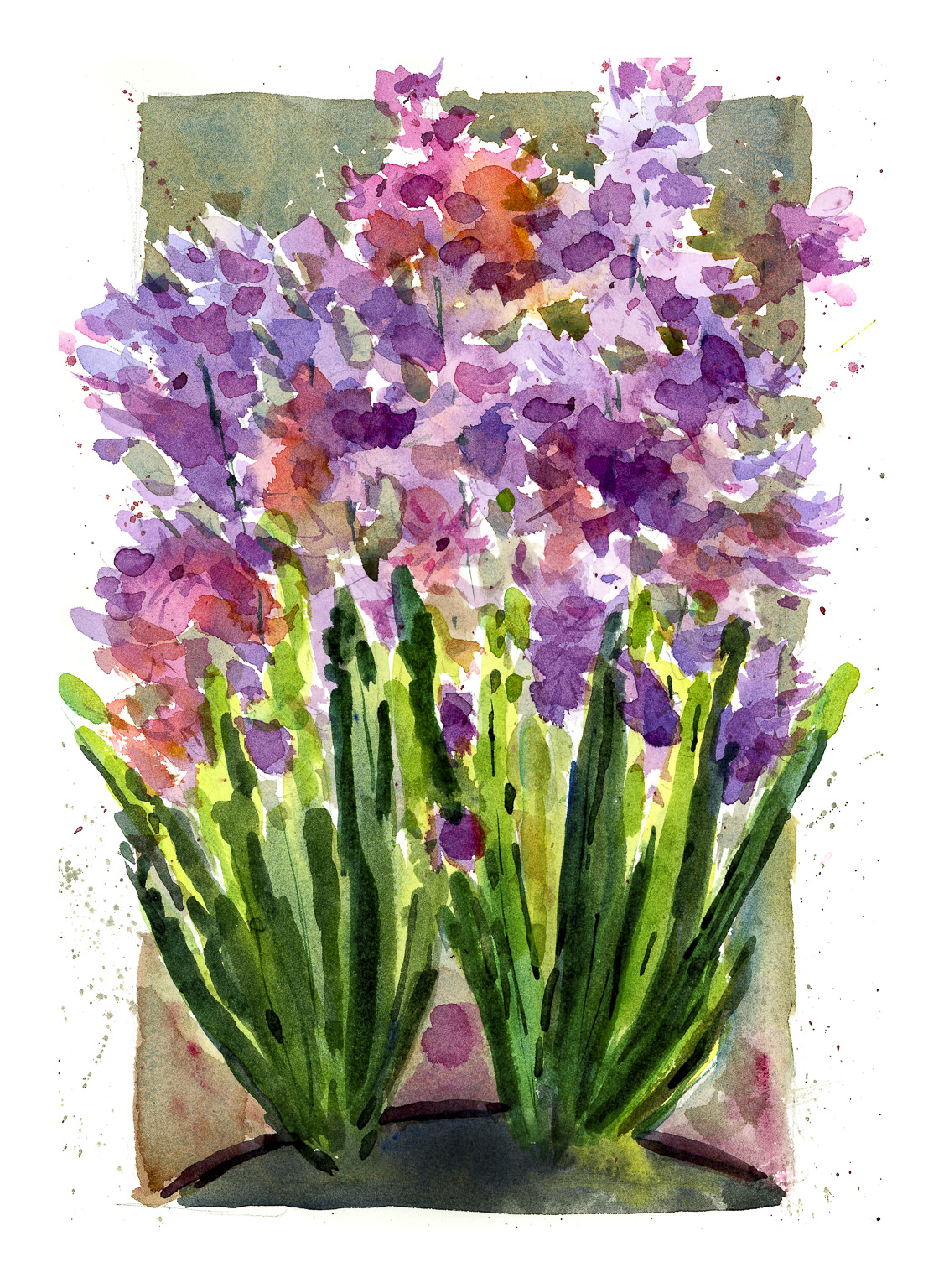
The solstice is not yet here, so it is still technically Spring! I thought this was an important fact since I am showing off the hyacinth study from Shari Blaukopf’s online course of flowers in the spring. I already did the crocus – the flower I have never seen – and today I present you with the second study, hyacinths.

Whether or not these really look like hyacinths may be up to you. Shari is not a botanical watercolorist, and neither am I. I really like the intensity of her colors and the way she handles paint and subject matter. Add to that, she is a really good teacher and I have enjoyed all her online courses.

Overall, I am pleased with this study, but I will say the bottom, in the pot and the dirt, I need to fix that, but will later. Time to have a snack and kick back after this. I was focused and now I need to unfocus.

Watercolor, about 9×12.