Karelian Pies

Karelian Pie

Years ago I met a young Finnish woman named Sirkku, and she made what she called Karelian Pies.  I’ve never forgotten them, but never really knew how to make them.  What I do recall is that the filling was a buttery, creamy rice – unlike anything I had ever tasted before – in a rye dough square that had finger prints on the edges, and was turned over, corner to corner, to contain the rice.  I thought they were absolutely delicious.
Mixing Flours and Water

Move ahead to the days of the internet and instant gratification.  I decided to look them up, and came across this recipe for the pies at Tofu for Tea:

Karelian pies (makes 12-14 small pies)
120 g rye flour
30 g plain flour
1/8 tsp salt
120 ml water
190 g white rice (she used sushi rice, I used Arborio)
500 ml milk
1/2 tsp freshly grated nutmeg (optional)

If you don’t have a scale, try to keep the portions similar for wet / dry ingredients.  Luckily, I do have a scale, and it worked out nicely.  Use Google to get equivalent non-metric measurements.
Choose a good dark rye flour.  Bob’s Red Mill is one I use for all sorts of baking, and it is always really tasty.  Other brands exist – see what is out there.

Rye Flour
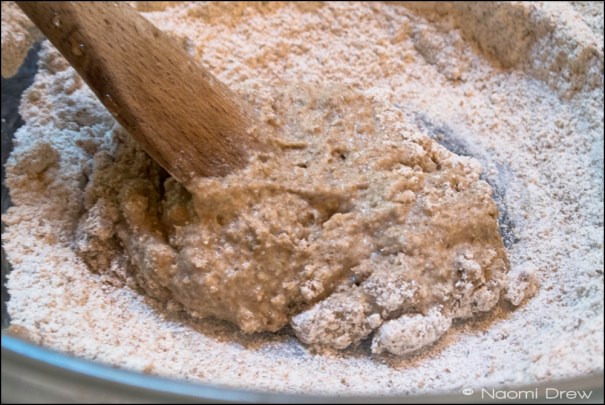
Sift together the rye flour, plain flour and salt in a bowl, or use a whisk to blend the flours and salt.  Add the water to the flour by making a small well in the middle, and stir with a spoon as you pour the water into the well.  Dough will be soft and moist (and I think would be great for crackers!).
Mixing Flours and Water
When all is combined, mush the dough together into a ball and transfer to a board dusted with flour.  Roll the dough into a tube, cut in half, and roll out until long and thin.  My final dough looked like two long tubes, each about 14 inches in length, and about an inch in diameter.  Divide into 12-14 pieces.
Tubular!
Sliced and Ready to Roll Out
Making sure you have plenty of flour on your hands and the board, roll the sliced tubes into balls.  As with pie dough, it is really important to work with a lot of flour, and dry hands.  Flatten each ball slightly, and with a floured rolling pin, very gently flatten the balls into oval shapes.  Flip the dough over after 3 or 4 rolls with the pin, and never put more pressure on the edge of the dough with the pin – you want a light touch.  Spread the dough out from the center to the edges until it is about 1/8 inch thick.  Transfer to cookie sheet lined with parchment paper.  If the dough gets smooshed into the board, or sticks to the rolling pin, scrape it off, and roll it into a ball.  Before reworking it into a flattened shape, remove the sticky dough left on the board or the pin, and redust everything with flour.
Rye Dough Balls
Rolled Out Dough
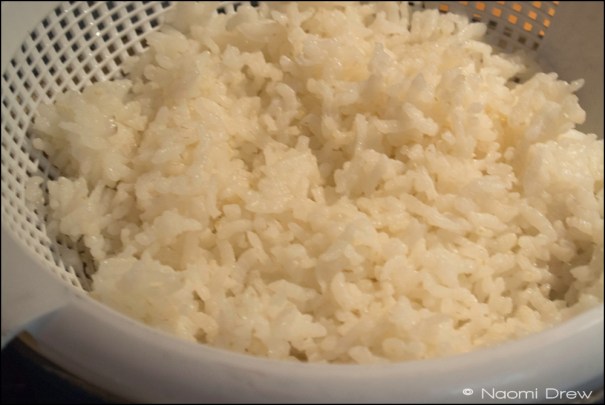
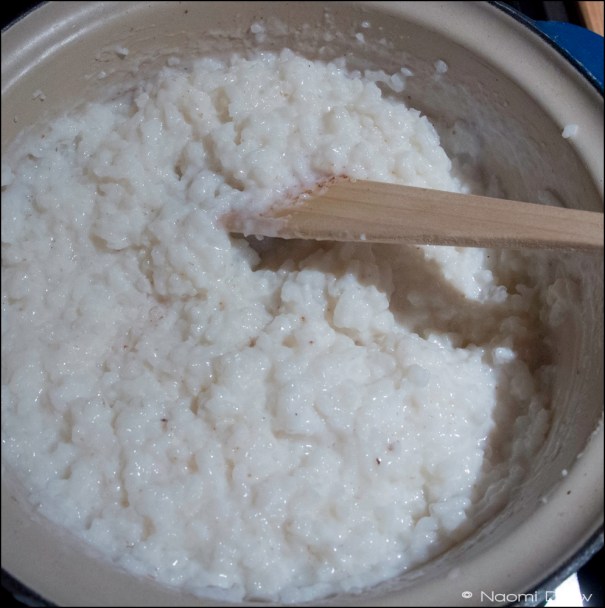
The rice totals about 2 c. dry.  Put into a pan, rinse until clear, and then drain.  Add 1 qt. water (or 1 liter), bring to boil, then drop to low, cover, and cook about 15 minutes.  You will now have a rather watery mix of rice and liquid.  Drain rice and water in a sieve for about 20 minutes.  Return to pan, add milk (about 2 c.) and bring to light boil, drop temperature, cover, and maintain a simmer.
Cooked Rice - First Cooking
Draining Rice
Creamy Rice - Second Cooking with Milk
Check your pot and stove top as milk boils over very easily!  As an aside, this is also an excellent base for stove-top rice pudding, but the crock pot works better because it doesn’t boil over.
Boiled Over!
Boiled-Over Milk
The flattened rye dough doesn’t need to be covered with a damp cloth while the rice cooks.  You might consider cooking the rice and making the rye dough while the rice cooks
Pies Ready to Bake
Once the rice is cooked, stir it up with the grated nutmeg.  You might consider a little butter as well, if you like that richness.  The nutmeg adds a really nice touch to the pies – no idea if it is traditional – and I imagine that, instead of nutmeg, some good, fresh herbs would be nice, such as fresh chervil or savory.  Fill the pies with a nice mound of rice.  You can fill each flattened rye ball, and then do curl the edges of the dough up and around the rice, or do it individually.  Keep your hands dry, so I suggest just dusting them with white flour.  Pinch the dough together around the rice.  When you have made all the pies, left over rice can be added carefully to the pies.

Melt a couple of tablespoons of butter in a dish and stir in a bit of milk.  Brush this over the rice and on the rye dough.

Preheat the oven to 210 C / 400 F.  Bake for about 20 minutes.  I had two racks, so I switched the racks half way between, at the 10 minute mark.  Cool on the pans, or move to wire racks.  When completely cooled, store in a container in the refrigerator.
Cooling Pies on Rack
Notes
It took about 1.5 to 2 hours to make these.  They are rather tasty, and certainly not something most of us eat every day.  I imagine they would be very nice as a side dish, say with fish or a good green salad.  By themselves, they can be a bit bland, but with a good pairing with other foods, would work out very nicely.  Personally, I really like them, and when I want something to do, they could be just the perfect thing to keep my hands out of the devil’s work.

Danish RUGBRØD – Rye Bread

Pretty – But a Potential Disaster! Read On!

Before I continue, I do want to state that I don’t think the author of the recipe is to blame for my crust problem. I think that there are times when a recipe is not complete, or instructions are not followed correctly. Because this bread is not kneaded, there is less flour in the final product, and it is the first time I have ever made a bread like this. Working with pure rye is tricky, but a kneaded rye is actually workable. My inexperience is to blame as far as I am concerned . . . but continue reading, and let’s see if I can fix my problem.

Cooling

Well . . . I have been reading about software, but reading and looking at a computer are fine for a short while.  I would rather be outdoors, or baking, or something that requires physical activity.  For some reason, Danish open-face sandwiches came to mind, and with that, came a search for the bread that lies beneath everything.  Recipes abound, and it was a bit of a challenge to find one I liked.  By far, the simplest was found on the blog Fahrenbite, and which I followed fairly closely.  I even dug out my scales, which will do both pounds and ounces, kilos and grams, and switched it to metric.

The most interesting thing about this bread is that there is no sourdough starter added to the dough.  The entire dough ferments for two days, and the smell is mild and pleasant.  No white flour is added, and the bread is not kneaded on a board or cloth to incorporate more flour.  Instead, it is glopped into bread pans.

The video below is quite charming, and I used it as a basis for my choice not to knead in extra flour.

This video, as well, demonstrates the process.  I love the bread cutter, and I expect you can buy one online, but a good, sharp knife and some skill with it should do the trick.  The music is quite fun!

Okay, let’s begin.  Plan on a 3-day process.  The first day you mix up the rye dough, and set it aside, covered with a towel or plastic wrap.  The second day seeds and / or rye kernels are set in water to soak overnight.  On the third day, it is all mushed together and set aside to rise, and bake, and be eaten!

Day One

2.5 c. water
1 pkg. dry yeast
1.7 lb / 800 g / 3.5 – 4 c. rye flour (I use Bob’s Red Mill and Arrowhead Mills rye flours mixed together – both are great!)

Mix all of these together. Dough will be sticky and thick. If you are using measuring cups, it is a guessing game. I used the scale Josh uses when he weighs grain for beer . . . so 800 g. it was. Set this aside, and cover with a dry or damp towel, or plastic wrap. Ignore it for 2 days. I didn’t dampen my towel, so some of the top layers of dough was a bit dry, but ten minutes in the KitchenAid incorporated it into the rest of the dough quite nicely.

Day Two

Seeds of any variety. I used whole rye berries and hulled sunflower seeds. Other recipes suggest pumpkin seeds, and so on. You choose. I bought the rye berries at Whole Foods – about a cup or two – and had sunflower seeds on hand. Put your chosen seeds into a bowl, and cover with water. Since I didn’t know if they would swell up as much as dried beans, I was on the generous side with the water. Let sit overnight.  Pre-soak amount of seeds and rye berries came to about 3 cups.

Day Three

Drain the seed mixture. Together, combine the rye dough and the seeds, and mix for about 10 minutes. I used the regular paddle on the KitchenAid (as seen in the second video) and let it run for about 10 minutes. While it was mixing, I added 1 tsp. salt, and with the mixer stopped, scraped the sides down at regular intervals. Even with the electric mixer, I beat the dough for about 10 minutes before turning it into pans.

Rugbrod Rising

The pans I used are called “pullman pans” and have lids to create square loaves. I did not use the lids, but needed a narrower loaf pan than my usual bread requires. They are about 4 inches wide, and rather more deep. With a big spoon, divide the dough between two pans, flattening the dough once you are done. The second video used sesame seeds across the top, but I just sprinkled some rolled oats randomly across the top. Once done, cover with plastic wrap and set aside to rise for 2 or 3 hours.

Rye flour has little if any gluten, so do not expect it to rise much. You will not have an abundance of bread from the flattened amount, but there will be some change.

Baking

Preheat the oven to 350 F / 180 C. Place the rack in the middle. Bake for about 1 1/4 hours, turn out onto wire rack, and cool.  Do not slice the bread while it is warm – bread as dense as this will crumble and fall apart.  Have patience!

Notes

Here in our beer-making household, we are out of dark malt! As a result, I did not have any coloring to add to the bread, so it is rather pale. The malt would add a flavor to the bread – next trip to the brew shop will result in a purchase of the darkest malt available.  Some recipes had user comments – one added “brown coloring” to  it, but I have no idea what that is, unless it is the equivalent of caramel coloring.

Open-face sandwiches vary, and you can find a lot of different ones online.  Fahrenbite has some suggestions, and what also looks like a yummy recipe for Danish meatballs, known as frikadeller.  Another blog with lovely photos, as well as a list of sandwich recipes, is Danish Open Sandwiches, known as smørrebrød.  

Afterword . . . 

These look lovely, and taste delicious.  The problem is the crust – it is thick and crunchy, and the inside of the bread is very soft.  Cutting through the crust is a disaster – a professional slicing machine may solve the problem, or letting the bread sit a day or two in a plastic bag to soften the crust.  Other thoughts include baking the bread at a lower temperature – maybe 300 – and for longer, as well as possibly use unglazed ceramic pans.

As I write this, I have sprayed the remaining whole loaf – and the half loaf that did not get destroyed in trying to find a way to successfully slice it with different knives – thin filet knife, butcher knife, serrated knife.  None were successful.  Anyway, I have sprayed the loaves all over with water and placed them in the warming oven.

I got this idea from another recipe for this bread, which said to bake the bread for 2 hours, spray inside the oven every 30 minutes while baking.   Then, when finished baking, leave the bread inside the oven for the next few hours as it cools, and now spray the crusts with water.  Seems like they saw this problem . . . let’s see if spraying will help, or keeping in plastic for a few days.  I expect mold could be a problem here, if not properly watched . . .

Wah!

Stay posted for updates on the crust!

Fisheye of Loaf

Rye Bread


This is a delicious rye bread, made in the French tradition from a recipe found in The Breads of France by Bernard Clayton. It takes time to make this bread, but is time well spent. It begins with a sponge, which ferments and imparts a wonderful flavor to the final loaf. If you want to make this a lighter loaf, use more white flour, and if you like the taste of dill seed or caraway, do not hesitate to add them to the final product.  I would do it after the sponge has risen, before the first rise.  This recipe is based on Mr. Clayton’s Pain Seigle recipe, with some modifications of my own.

Starter
1 c. dark rye flour (I used Arrowhead Mills Organic Rye Flour)
1 packet active dry yeast (Fleischman’s)
1 c. warm water

Mix all ingredients together in a bowl. Cover with plastic wrap. Let ferment at least 1 day before bread baking day at room temperature. I set mine outside one day in the sun, and it developed a lovely sour smell. I then let it ferment two more days, so on Day 3 I made my bread.

Sponge
1 1/2 c. warm water
1 c. rye flour
1 c. unbleached white flour (I used King Arthur’s Bread Flour)

Add all the above to the starter, stirring all into starter thoroughly. Add any seeds you might like – caraway, dill, or mustard. Let sit for at least 8 hours before making dough.

Dough
1/2 c. warm water
1 tsp. salt
2 c. rye flour (I used the rest of the small bag of rye flour I had boughten)
2 or more c. unbleached white flour, and more for the bread board when kneading

Pour sponge into large bowl. Add 1 c. of each flour, stir in. Add rest of rye flour. Dough is slimey and wet, but mix in the best you can. Dump out onto a floured bread board – be generous with your flour! Get out a spatula or dough scraper to help slap this wet mess into shape, incorporating more flour as needed. Begin to knead dough, adding more flour until dough is firm, no longer slimey, and does not break into wet spots. Do not over-add flour, as you want a firm but soft dough. Too little flour and your final bread will be rather flat.

First Rising
Shape into ball, then place into greased bowl, coating dough with oil in bowl. Cover with plastic or damp towel and let rise 40-60 minutes.

Shaping and Second Rising
Plop dough out of bowl and back onto a lightly floured bread board. Flatten a bit to remove air bubbles, then shape into another ball. Divide ball into 2 or 3 sections (see picture – I cut mine into thirds for small loaves). Shape into balls, pulling dough into smooth surface on top. Place onto baking sheets sprinkled with corn meal or lined with parchment paper. Cover loaves with waxed paper and let rise another 30 minutes.

Getting Ready to Bake
About ten minutes before the end of the second rise, preheat your oven to 400 F, making sure that the rack is in the middle of the oven.

Mix together a glaze of 1 egg yolk and 1 T. or more of milk.

Take a very sharp knife and slash the tops of the loaves, or make slashes on the outside of the bread. This will create nice visual texture and allow the bread to rise during baking without cracking too much.

Make a mop out of a paper towel, or use a pastry brush, and use the egg-milk glaze to cover the tops of the loaves.

Baking
Set timer for 22 minutes. Place bread in oven. When timer goes off, turn the baking sheet around 180 degrees, and reset timer for another 22 minutes. When timer goes off a second time, pull out bread. With a hot pad, pick up loaf and tap the bottom of the bread. If it sounds hollow, it is done; if not, put in for a few more minutes, and then tap again.

When bread is done, place on wire racks to cool, uncovered.

Notes
This bread freezes well. I made 3 small loaves just in case we got tired of the bread. So far, only one is left! This is great for small sandwiches, with sweet butter, or cheese.

For a first loaf, this is a bit of a challenge as rye bread dough is slimey and wet, and really does not develop gluten like whole wheat flour does. The addition of the bread flour increases the overall gluten content of the loaf, letting it rise a bit higher, but if you were to make a loaf of bread with 100% rye flour, it would be heavy and dense, but incredibly delicious!