Hot weather means a desire for cool food. What can be better than cold, homemade potato salad made from scratch with flavorful produce from your own garden – or the neighbor’s? Potato salad is actually quite good for you, especially if the mayo is homemade with virgin olive oil, or store-bought with canola or olive oil. The key, though, is a potato salad that is icy cold, and has bits of heat throughout. Radishes are excellent for this, as are homemade pickled onion, and a bit of hot pepper powder. If you have fresh hot peppers around, you might give them a try as well.
Recipe
4 Yukon Gold potatoes, about 3 lbs.
7 red radishes, diced
Pickled onions (homemade) – about 1/4 c. diced
5 celery ribs, finely chopped
10 green onions, white and green parts, finely chopped
3 hard-boiled eggs
1/2 c. mayonnaise
2 T. apple cider vinegar
Ground pepper, hot pepper powder, Mrs. Dash, Dijon mustard
Chop potatoes into 1/2 inch dice; bring to boil in water. Cook till firm. Drain, and rinse with cold water. Shake out excess water. Refrigerate.
Bring eggs to boil in salted water. Boil 3 minutes, then leave in hot water (not boiling) for another 10 minutes. Cool in running cold water. Refrigerate until ready to use, then peel and chop. Add to potatoes.
Chop all vegetables into fine dice. Stir into potatoes and eggs.
Dress with seasonings, mayonnaise and vinegar. Stir all together. Refrigerate for several hours.
Before I continue, I do want to state that I don’t think the author of the recipe is to blame for my crust problem. I think that there are times when a recipe is not complete, or instructions are not followed correctly. Because this bread is not kneaded, there is less flour in the final product, and it is the first time I have ever made a bread like this. Working with pure rye is tricky, but a kneaded rye is actually workable. My inexperience is to blame as far as I am concerned . . . but continue reading, and let’s see if I can fix my problem.
Well . . . I have been reading about software, but reading and looking at a computer are fine for a short while. I would rather be outdoors, or baking, or something that requires physical activity. For some reason, Danish open-face sandwiches came to mind, and with that, came a search for the bread that lies beneath everything. Recipes abound, and it was a bit of a challenge to find one I liked. By far, the simplest was found on the blog Fahrenbite, and which I followed fairly closely. I even dug out my scales, which will do both pounds and ounces, kilos and grams, and switched it to metric.
The most interesting thing about this bread is that there is no sourdough starter added to the dough. The entire dough ferments for two days, and the smell is mild and pleasant. No white flour is added, and the bread is not kneaded on a board or cloth to incorporate more flour. Instead, it is glopped into bread pans.
The video below is quite charming, and I used it as a basis for my choice not to knead in extra flour.
This video, as well, demonstrates the process. I love the bread cutter, and I expect you can buy one online, but a good, sharp knife and some skill with it should do the trick. The music is quite fun!
Okay, let’s begin. Plan on a 3-day process. The first day you mix up the rye dough, and set it aside, covered with a towel or plastic wrap. The second day seeds and / or rye kernels are set in water to soak overnight. On the third day, it is all mushed together and set aside to rise, and bake, and be eaten!
Day One
2.5 c. water
1 pkg. dry yeast
1.7 lb / 800 g / 3.5 – 4 c. rye flour (I use Bob’s Red Mill and Arrowhead Mills rye flours mixed together – both are great!)
Mix all of these together. Dough will be sticky and thick. If you are using measuring cups, it is a guessing game. I used the scale Josh uses when he weighs grain for beer . . . so 800 g. it was. Set this aside, and cover with a dry or damp towel, or plastic wrap. Ignore it for 2 days. I didn’t dampen my towel, so some of the top layers of dough was a bit dry, but ten minutes in the KitchenAid incorporated it into the rest of the dough quite nicely.
Day Two
Seeds of any variety. I used whole rye berries and hulled sunflower seeds. Other recipes suggest pumpkin seeds, and so on. You choose. I bought the rye berries at Whole Foods – about a cup or two – and had sunflower seeds on hand. Put your chosen seeds into a bowl, and cover with water. Since I didn’t know if they would swell up as much as dried beans, I was on the generous side with the water. Let sit overnight. Pre-soak amount of seeds and rye berries came to about 3 cups.
Day Three
Drain the seed mixture. Together, combine the rye dough and the seeds, and mix for about 10 minutes. I used the regular paddle on the KitchenAid (as seen in the second video) and let it run for about 10 minutes. While it was mixing, I added 1 tsp. salt, and with the mixer stopped, scraped the sides down at regular intervals. Even with the electric mixer, I beat the dough for about 10 minutes before turning it into pans.
The pans I used are called “pullman pans” and have lids to create square loaves. I did not use the lids, but needed a narrower loaf pan than my usual bread requires. They are about 4 inches wide, and rather more deep. With a big spoon, divide the dough between two pans, flattening the dough once you are done. The second video used sesame seeds across the top, but I just sprinkled some rolled oats randomly across the top. Once done, cover with plastic wrap and set aside to rise for 2 or 3 hours.
Rye flour has little if any gluten, so do not expect it to rise much. You will not have an abundance of bread from the flattened amount, but there will be some change.
Baking
Preheat the oven to 350 F / 180 C. Place the rack in the middle. Bake for about 1 1/4 hours, turn out onto wire rack, and cool. Do not slice the bread while it is warm – bread as dense as this will crumble and fall apart. Have patience!
Notes
Here in our beer-making household, we are out of dark malt! As a result, I did not have any coloring to add to the bread, so it is rather pale. The malt would add a flavor to the bread – next trip to the brew shop will result in a purchase of the darkest malt available. Some recipes had user comments – one added “brown coloring” to it, but I have no idea what that is, unless it is the equivalent of caramel coloring.
Open-face sandwiches vary, and you can find a lot of different ones online. Fahrenbite has some suggestions, and what also looks like a yummy recipe for Danish meatballs, known as frikadeller. Another blog with lovely photos, as well as a list of sandwich recipes, is Danish Open Sandwiches, known as smørrebrød.
Afterword . . .
These look lovely, and taste delicious. The problem is the crust – it is thick and crunchy, and the inside of the bread is very soft. Cutting through the crust is a disaster – a professional slicing machine may solve the problem, or letting the bread sit a day or two in a plastic bag to soften the crust. Other thoughts include baking the bread at a lower temperature – maybe 300 – and for longer, as well as possibly use unglazed ceramic pans.
As I write this, I have sprayed the remaining whole loaf – and the half loaf that did not get destroyed in trying to find a way to successfully slice it with different knives – thin filet knife, butcher knife, serrated knife. None were successful. Anyway, I have sprayed the loaves all over with water and placed them in the warming oven.
I got this idea from another recipe for this bread, which said to bake the bread for 2 hours, spray inside the oven every 30 minutes while baking. Then, when finished baking, leave the bread inside the oven for the next few hours as it cools, and now spray the crusts with water. Seems like they saw this problem . . . let’s see if spraying will help, or keeping in plastic for a few days. I expect mold could be a problem here, if not properly watched . . .
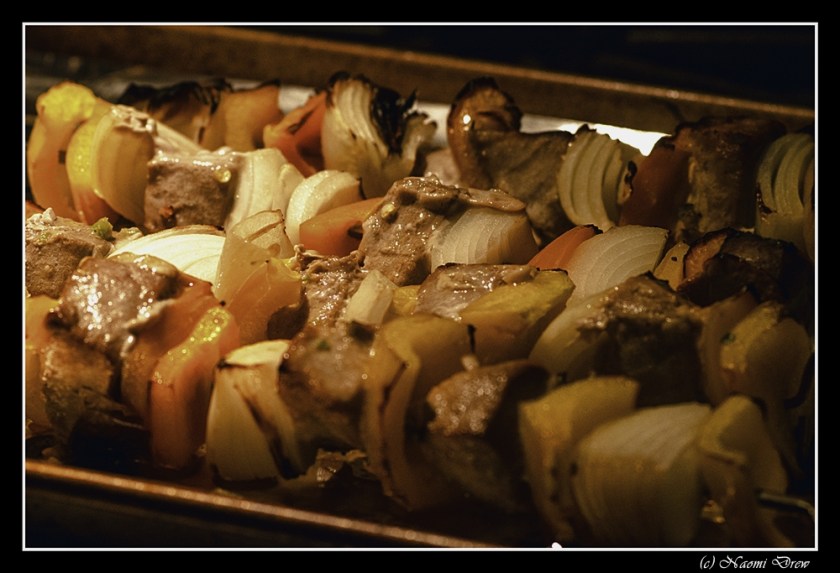
Epicurious.com is one of my favorite websites for food, but often their recipes are a bit bland for my tastes. I had some Ahi tuna at hand, searched for a recipe, and found this Ahi Tuna Kebab recipe which features a ginger-chile pepper marinade. Using this as a jumping off point, as well as reading some of the reviews, I came up with my own variant. This is absolutely delicious, and very easy to make!
1/4 c. seasoned rice vinegar (I used Trader Joe’s)
1/4 c. finely grated fresh ginger (I buy a lot, then freeze it – easy to grate, and it lasts!)
3 T. cooking oil
2 T. sesame oil
2 T. soy sauce
2 T. brown sugar
1/4 c. chopped fresh cilantro, with extra leaves for garnish
2-3 fresh serrano or jalapeno peppers, finely minced
1 lb. Ahi tuna, cubed into large cubes
2 bell peppers in different colors
2 Spanish onions
Create marinade using the vinegar, ginger, oils, soy, sugar, cilantro, and hot peppers. Whisk together in bowl, setting aside about 1/2 c. of the marinade. Pour the rest into a baggy, and add the cubed Ahi tuna. Marinate an hour or so.
Chop bell peppers and onions about the same size as the cubed tuna.
Preheat broiler. Prepare 3-4 metal skewers with alternating peppers, onion, and tuna. Spray with oil. Broil about 5 inches from broiler, turning about every 3-4 minutes until cooked as desired.
To serve, remove fish, onion, and peppers from skewers, and garnish with extra cilantro leaves. Spoon set-aside marinade over individual servings.
Suggested sides are edamame in the pods, white rice, and other fresh vegetables.
Josh’s birthday was Monday. He took it off. I am off today, the 4th, and he is working. So, while he works, I am making his mother’s peach pie – only with nectarines – and a first time try at pulled pork in the crock pot. Let’s begin!
Pulled Pork a la Moi
I’ve looked at numerous web sites for crock pot recipes for pulled pork. Most call for premade items, such a smoke flavoring and barbecue sauce, and lots of it. I decided, instead, to put together a fairly dry recipe, and create a rub.
3 lbs boneless butt roast
2 small brown onions
Wash and pat dry roast. Slice into it in thin layers. Set aside. Slice onions fine, and place on bottom of crock pot.
2 tsp. powdered mustard
2 T. brown sugar
1 tsp. chipotle powder
Salt to taste
1/2 t. fresh ground black pepper
Mix together mustard, sugar, chipotle, salt and pepper. Pat into sliced areas of roast and then pat remainder onto outside of roast. (If you want to make more, or use a larger roast, make more of this.)
1/2 c. apple cider vinegar
1 t. powdered chili flakes
1 T. brown sugar
2 t. dried mustard
1 t. garlic powder
In bowl, mix together all of the above ingredients, and then pour into crock pot.
Set crockpot on high for 8 hours, or lower heat to low after 3-4 hours. Continue to cook another 6-10 hours. Baste as necessary with liquids in the pot. Rotate roast, too, to settle on onions and in sauce.
When done, remove pork and onions from crockpot. Chop or shred meat and onions. Serve plain, on rolls, with slaw and with vinegar sauce below.
Vinegar Sauce
2 c. cider vinegar
2 T. brown sugar
1 T. ketchup
1 T. Huy Fong Rooster Sauce (Sriracha)
Chiles, pepper, salt to taste
Combine all ingredients in sauce pan, bring to simmer. Simmer 3-5 minutes. Remove from flame; set aside in dish with lid and refrigerator. Shake off and on. Serve cool over pulled pork.
* * * * *
Now that we have the main meal out of the way, time to move onto the pie. This is the pie that Josh’s mother and grandmother have both made, and he considers it to be the epitome of peach / nectarine pies. My own pies tend to be more spicy, and any crumb crust I do has nuts in it as well. But, it is his birthday, so he has final say!
Birthday Nectarine Pie
Preheat oven to 400 F. Make sure temperature is accurate.
Crust
2 c. flour
pinch salt
2/3 c. sweet butter, chopped fine and chilled
Blend all above together with pastry cutter or in food processor to make coarse crumbs. Set aside 1/2 of mixture for crumb topping – about 1 1/3 c. – in another bowl. Into remaining mix, stir in 4-7 T. ice water, using smaller amount first and then more as needed. Roll out to fit 9-inch pie plate, form edge, trim, and put trimmings in with crumbs set aside. Chill pie crust wile preparing filling and crumb crust.
Fruit
4 c. sliced peaches or nectarines. (Remove skin if using peaches.)
1/2 c. white sugar
2 T. tapioca
Mix all together in stainless bowl. Let juice up as you make the crumb crust.
Crumb Crust
To crumbs and trimmings add:
2 T. chopped cold butter
1/2 c. sugar
1/2 t. freshly grated nutmeg
Work all ingredients together to make crumbs. Do not overwork or you begin to make dough!
Assembling Pie
Pour fruit into prepared crust. Sprinkle crumbs on top of fruit, distributing evenly.
Bake pie in oven for 40 minutes at 400 F. Check pie every 20 minutes; rotate if necessary, and cover edges of crust with foil to keep from burning. When bubbling and crumbs are brown, remove from oven. Cool at least 2 hours before serving.
I bake my pies on a foil-covered cookie sheet. If anything spills, or bubbles over, it is easy enough to clean up.
I love simple food in the summertime. Fresh vegetables, fruits, breads, grains, yogurt. There is a richness in flavor that is best at this time of the year because the world is full and abundant. Self-indulgence in these areas is not a bad thing. And when one is recovering from a cold, and the mere thought of handling food or eating is not at all interesting, it is a good time to go out and buy unusual and wonderful things. So I did . . . and ended up with:
yogurt from St. Benoit from Sonoma County, CA
Wensleydale cheese with blueberries
organic rolled oats for granola
a custom-made sandwich with, among the ingredients, red onion marmalade and arugula
Firestone Wookey Jack Black Rye IPA
I’ve never heard of St. Benoit, but did a bit of research on them, and think they are really onto something. You can learn about St. Benoit and see what you think. Dinner tonight was a bit of their yogurt, a nectarine, and chopped almonds. Very satisfying.
I used to make my own yogurt. I’m rather tempted to again. Yogurt is especially good with granola, too.
And, at the moment, I am baking a batch of granola in the oven, as I love the crunch of granola and the sweetness of fruit for breakfast. The biggest problem with most granolas is they are horribly sweet if boughten. I prefer to make my own. Formerly, for sweetness I chose real maple syrup, but my husband doesn’t much care for maple. I don’t like sugar in granola. One day I ended up with some agave syrup and a craving for granola, and used the syrup. The result was a bit of sweetness without a maple flavor (I like maple, personally . . . ) nor the intense flavor brown sugar can give foods.
Granola Recipe
6 c. organic rolled oats
2 c. walnuts
1/2 c. dried cranberries
1 1/2 c. raisins
1/2 c. agave syrup
1/4 c. canola oil
Preheat oven to 350 F. Mix together all ingredients in a dutch oven, and bake, stirring every 15 minutes, for about an hour, until toasted to your liking. Let cool to room temperature.
You can substitute or add whatever you want. This is what I had available.
Looking for Organic & Local
All this self-indulgence started making me look for what is around here in Ventura County. Agriculture is a big industry in our county – the history of the county is tightly bound to raising crops, such as avocados, berries, citrus. We have a couple of excellent producers of organic produce – McGrath Family Farms and Underwood Family Farms are two with whom I am familiar. I looked up local honey after reading about the potential that a lot of honey may be tainted and illegally imported. Not a good thing. Locally, it looks like we have a good source nearby at Bennett’s. Meat is another issue. We have free range beef from Watkins Cattle Company.
At heart, I’m a backyard farmer. I would love to have the time to produce more of what we eat, but I have to work, and our backyard is too dark and shady at present for any real crops. Instead, I try to support the local farmers rather than the large chain stores. We also try to cook most of what we eat from scratch, but of course, not everything can be done this way. When we go shopping, we never cease to be amazed at all the packaged foods people buy as the mainstay for their meals. Our baskets are filled with very few boxes or frozen foods.
Kind of snobby, huh? I guess I literally put my money where my mouth is.






 Ink, Yarn & Beer