I am not quite sure what hit me the other day, but I wandered off to the local library to look at kids’ books.
Where I live, we are fortunate to have a well-run, financially sound (so it seems) library system. There are about 130 K people here, and only two libraries to serve the population, but both libraries are well-designed, light, airy, and busy. Busy meaning there are kids and teenagers and adults, as well as scheduled activities, such as lectures and movies.
The children’s section of the library is separate from the adult. There are sections for young adult, for research, for youngish readers (8-12?), and for non-readers and beginners. The shelves are the right height for kids, and topped with books and displays to catch the eye.
Okay, so what does this have to do with drawing? A lot! Good illustrations add so much to a story, for both children and adults. Textbooks without illustrations are unattractive. Color adds more. And children’s books need pictures – just like Alice said, “What is the use of a book if there are no pictures?”
Yeah, there is a lot of use for pictureless books – but they are even more useful with illustrations.
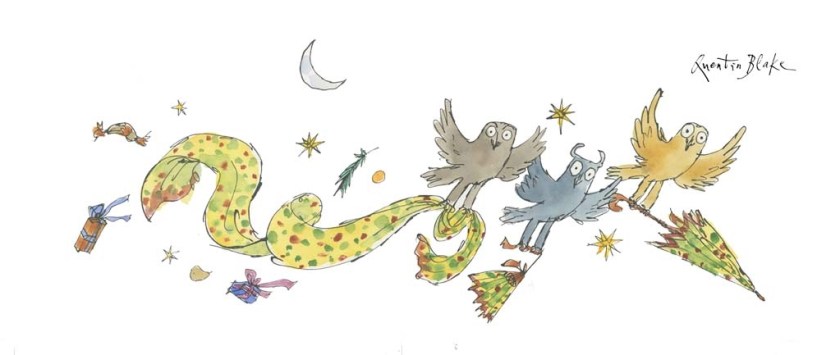
So, here I am, wandering through the children’s section, looking at this book and that. Most books had written words with pictures to illustrate them. And then I came across Clown by Quentin Blake. Blake is the illustrator for many of Roald Dahl’s books (you know, Charlie and the Chocolate Factory). Clown is a story without words, only pictures. I had a few good laughs as I “read” the book, and totally enjoyed the illustrations.
Blake is the master of light mood, caught with pen and watercolor. A loose style that, nonetheless, is filled with details. When the clown wriggles out of the garbage can, you have to look to see it happening – but you do! When I looked again and again, so many things showed up.
Then I looked at more of his books. Cockatoos had me laughing out loud. Illustrations and story worked so well together – I loved to see all the cockatoos hiding, and I loved the last line in the story.
I blither about art, and drawing, and writing, a lot. The mental arguments are strange and annoying. I put up barriers and fill time with meaningless twaddle when I could be out doing something. I have fought with myself over and over again about my “style” in the painted, colored, drawn world. It was never technically accurate or realistic enough. I am confident about my writing style – academically, I can crank out papers at an appalling rate – but with drawing, I drag my feet, tormenting myself with my perceived failures and inabilities.
The light bulb went on with Clown. I love that loose, fun style. Is it “art”? Probably not – but why should that matter? If it brings pleasure and communicates, I guess that is definition enough.
Yesterday, I took out my own pen and ink and began to doodle. I didn’t care what I drew. My imagine was allowed to play without rules.
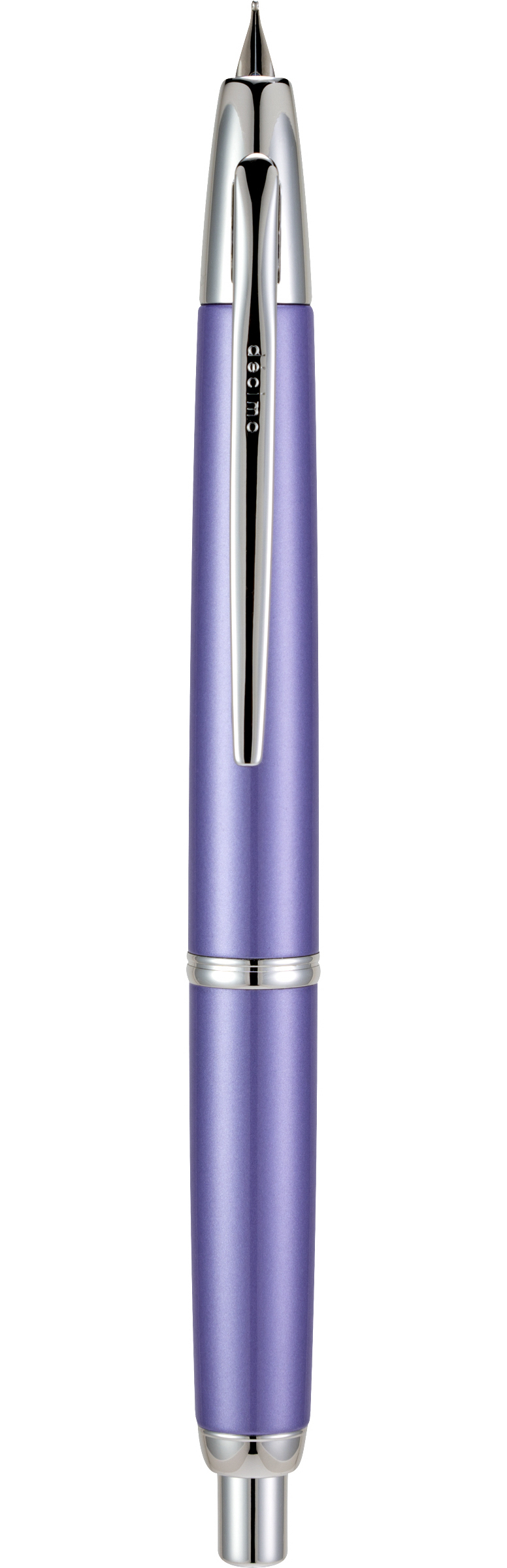
I love pens, particularly fountain pens, especially vintage ones. My collection is largish, but not like some people’s. Modern fountain pens seem just be made for making money, but every now and again a new pen hits the market that is worth considering. For me, I often turn to the Japanese companies of Namiki, Pilot, Sailor, and so on. I love the beauty of lacquer or abalone, the hand-ground gold nibs, but they cost so much! When the Vanishing Point came out, I liked it immediately, but it was too large to be comfortable. And then I came across the Decimo, a slimmer version of the VP, and bought one. In lavender or purple, whatever you want to call it, with a broad nib.
I’ve had the pen for one day. I’ve used it a lot! I have used it to copy quotes from my current read – Wuthering Heights – to doodle with, to practice cursive. My checkbook has new entries in it, with a fountain pen. Next week’s check-paid bills will be with a fountain pen. Click! Write. Click! Nib contained.
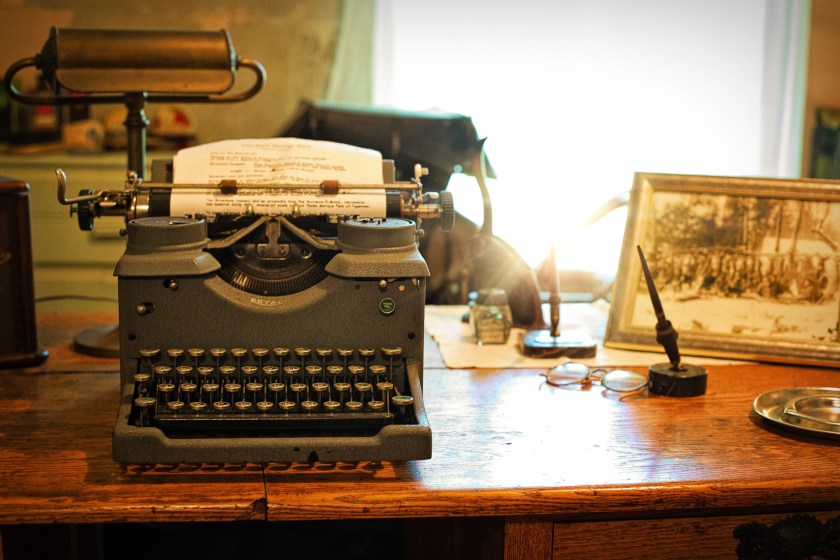
The physical act of writing is my form of meditation these days. I write on paper with a pen. I consider a word, then write. Yes, I do have Scrivener, I have a Chrome book, and I have scrumptious paper that lets a nib glide across its surface. I practice my roundhand, my Spencerian, my Palmer cursive. Ascenders and descenders are considered for slope, looping, length.
Ink is also important. I have bottles; some vintage, some just more than a few years old. Colors range from trusty black to iron gall for dip pens to ones with exotic names like Poussiere de Lune. New inks and extra converters are arriving on Monday. More paper, too. I can practice my penmanship and write a story or two. Maybe I’ll write a friend a letter and seal it with wax, or write secret love letters to my husband and hide them, so he can find them years hence to open when I am gone. Pen and ink dreams in a mechanized world.
Paper is wonderful! Recently, it has been replaced by the computer, which makes a lot of things easier and convenient, but it is not quite, quite the same.
For the last several days, off and on, I have been working on a story I started last January, using Scrivener as the editor. My Chrome book is also seeing use. And finally, paper and pen when I just don’t want to look at another monitor, or just want to go outdoors and enjoy myself.
While I am not going to go into what I am writing, I do want to explore the process of writing. As the title of this entry suggests, words are very important. One of the things I find so irritating in an author is a failure to provide a variety of terms. For instance, I recall a very popular recent author whose use of the same word within a few sentences has driven me to distraction! What is wrong with finding a synonym? In prose, variety is important, but in poetry, the repetition of sound creates a very different pattern, and so the usage of a word numerous times may be very appropriate and artistic.
This is where paper and pen can come to the aid of the computer-produced manuscript. I like to take what I have written and give it double- or triple-spacing. Then, stapled together, I take it someplace outside or at a coffee bar and sit with a pen to edit. I circle, I cross out, I re-write. In short, I edit with a different perspective because I am seeing the writing on paper.
While I love the convenience of computers and such, I also love the feel of a good pen on a piece of paper. The experience is physical and sensual and intellectual all at once. And it is a very real experience – just like we are trying to create for our readers.
Here, ink usually means sumi ink. Ink sticks. Painting in ink. Surprise! Ink also comes in bottles, for dip pens and fountain pens, and anything else you may wish to do with it. I’ve a small collection of vintage fountain pens, dip pens and nibs, and ink in cartridges and bottles. A lot of pleasure may be had in using fine writing tools.
Cave Painting from Lascaux
Colors
For thousands of years, we have sought colors for painting, drawing, and writing. People painted the rock walls at Lascaux, using earth pigments such as red and yellow ochre, umber, and carbon blacks from wood smoke or burnt bones. White came from grinding up chalks. Cave and rock paintings can be found throughout the world, such as those at the Painted Cave in Santa Barbara. These pigments were applied with the hand, with some form of brush, and by filling the mouth with the colors and then blowing them onto the rock – people left their handprints behind using this method.
Painted Cave in Santa Barbara - by the Chumash Indians
Frescoes are attributed to the Minoans on Crete. The art of the fresco has been used for centuries, and continues to be done today. Pigments are mixed with water, and applied to wet, fresh plaster. As the plaster dries, the painting becomes a permanent part of the structure. Egyptian and Indian antiquities are filled with frescoes. European churches have frescoes which span the millenia. Mexican artists, such as Diego Rivera, created murals using the fresco. Locally, Gordon Grant painted the murals in the downtown Ventura post office in 1936-1937.
En El Arsenal by Diego Rivera, 1928Mural in Downtown Ventura Post Office by Gordon Grant, 1936-1937
Today if we want color, it is readily available in clothing, paper, ink, paint. With technology and the advent of chemically-derived colors, we do not give much thought to the labor involved in earlier times to get colors. Just dyeing in cochineal and indigo is a time-intensive project; if thought is given to collecting the bugs or growing the plants and the transport and processing of these materials, a sense of the work needed to get colors can be gained. Earlier times meant searching out pigments, carting them home (like carrying rocks on your back!), grinding them up, purifying, whatever. And then, what about all the creative ways explored to move that color to walls or cloth? These techniques became closely guarded secrets to ensure a livelihood to those in the know.
Writing
Writing was also done on many of these frescoes, but writing itself began earlier and throughout the world. Early Chinese wrote with pictograms; cuneiform developed in the Middle East; hieroglyphics were used by the Egyptians. Alphabets developed and simplified the writing process as letters represented sounds – thousands of images did not need to be learned. Different alphabets may be found throughout the world – Arabic, Hebrew, Greek, Russian, hiragana, Roman. These may be modified to meet a local need.
Codex Zographensis in the Glagolitic Alphabet from Medieval Bulgaria
Along with writing came a desire to communicate. Lugging clay tablets around was rather cumbersome – postage could be prohibitive – and so more portable, yet permanent, means of writing were sought. Parchment and vellum were developed and used for books and manuscripts. Papyrus was pounded into sheets and scrolls, and used by the Egyptians. The Chinese developed paper. Pigments and inks were developed – some good, some not so good – that could be easily applied to these surfaces. Plants, minerals, and a myriad of chemicals were used to create ink and color. Iron gall ink was used for centuries. Carbon ink, derived from soot and combined with bone glue, was and is used to form the sumi stick. Recipes for homemade ink can be found throughout the internet, and in old books for the handy housewife.
Writing Implements
All sorts of things were used to write with, but some of the noteworthy ones are the pen and the brush. Reed pens were used by the ancient Romans. Hollow reeds had a nib cut onto one end. Ink was poured into the hollow, and the reed was squeezed to move the ink to the nib. Brushes have been used extensively in the East and the West, but in the East they were used for both painting and writing, while in the West, brushes are primarily for painting. Quills cut from bird feathers were common throughout Europe, with those of swans, geese, and turkeys. An amusing, informative article about quills and pens may be found on the Jane Austen Society of Australia site.
A Good Recipe for Black Ink
Feather quills are not especially sturdy implements, so with time and technology, metal nibs were developed. Dip pens became commonplace in the 19th century as manufacturing technology improved. The fountain pen developed in the late 1800s, and was common until the ball point pen began to replace it in the mid-1950s. Cartridge pens came in at the same time, and are still very popular. Today we see rollerballs and gel pens and magic markers (that term dates me!) of all sorts.
Despite all these changes, writing with a nib and ink continues. Fountain pen bladders of silicon and rubber are still manufactured and used in the repair of vintage fountain pens. The delightful Fred Krinke of The Fountain Pen Shop in Monrovia, California, is still going strong, with a family store in existence since the 1920s. David Nishimura sells vintage pens, as does Gary Lehrer. John Mottishaw is renown for his customization of nibs. Nibs for dip pens are available and for sale in many places – some are new, some are new old stock from over 60 years ago. Calligraphers still make their own quills, grind their own ink and pigments, and practice the art of fine writing. Carrie Imai offers private lessons as well as group instruction.
Fred Krinke of The Fountain Pen Shop in Monrovia, CA
The Art of Writing
Before the printing press, and even after its invention – but before the computer! – fine handwriting has been universally admired. In many cultures, the measure of a person is often determined by the quality of the penmanship or brushwork. Graphology, or handwriting analysis, purports to be able to reveal all sorts of things about the individual, from personality traits to health. (Given the decline of emphasis on handwriting, it could be amusing to see what might be determined.) A clear hand was necessary when records were written rather than entered into a computer, but certainly a fine hand was important as well. Many of the world’s historical documents were handwritten by scribes, and flourishes added to their visual richness. Marriage contracts and other legal documents were ornate, formal, and artistic.
A Jewish Marriage Contract
Because writing became such an important form of communication, the tools and instruments of writing became works of art by themselves. Sure, anyone can write with a twig, but human nature seeks to embellish and beautify: Gold and mother-of-pearl dip pens, cut glass ink bottles, fancy writing slopes and lap desks, ornately decorated ink sticks, elaborately carved suzuri, colorful fountain pens.
The Art of Slowing Down
Today, with our throw-away culture, the beauty of these functional items may seem foolish, but personally, I totally enjoy them. And, like many people, I use them as well. Email is faster than snail mail, but the thrill of a personal letter still remains. Sitting at a keyboard, indoors, at a desk, is tiresome and boring (though it is getting easier). I’d would rather be outside with paper and ink any day!
Burr Oak Writing Slope, ca 1840, by Parkins and Gotto
If you don’t have any interest in writing or painting, then all this blither means very little. However, the history of how we got here is fascinating and easily forgotten. Thankfully, I don’t have to go out and collect my oak galls or raise some geese – I like having such conveniences as stores – but I will say that there is much to be gained in re-creation of past arts. Writing with a goose quill pen is a unique experience; cutting the pen is too. Dyeing wool, writing with a dip pen, using a lap desk over 170 years old places history into the present existence. Using colors and inks from long ago, with centuries of tradition and craft, provide an insight to life when it was slower (and more difficult and deadly in many ways). Today, too many of us live in haste, moving from one task to another, and forget that leisure and creativity are as important as productivity and speed. Paper and ink and color are one way to leave it all behind.



 Ink, Yarn & Beer