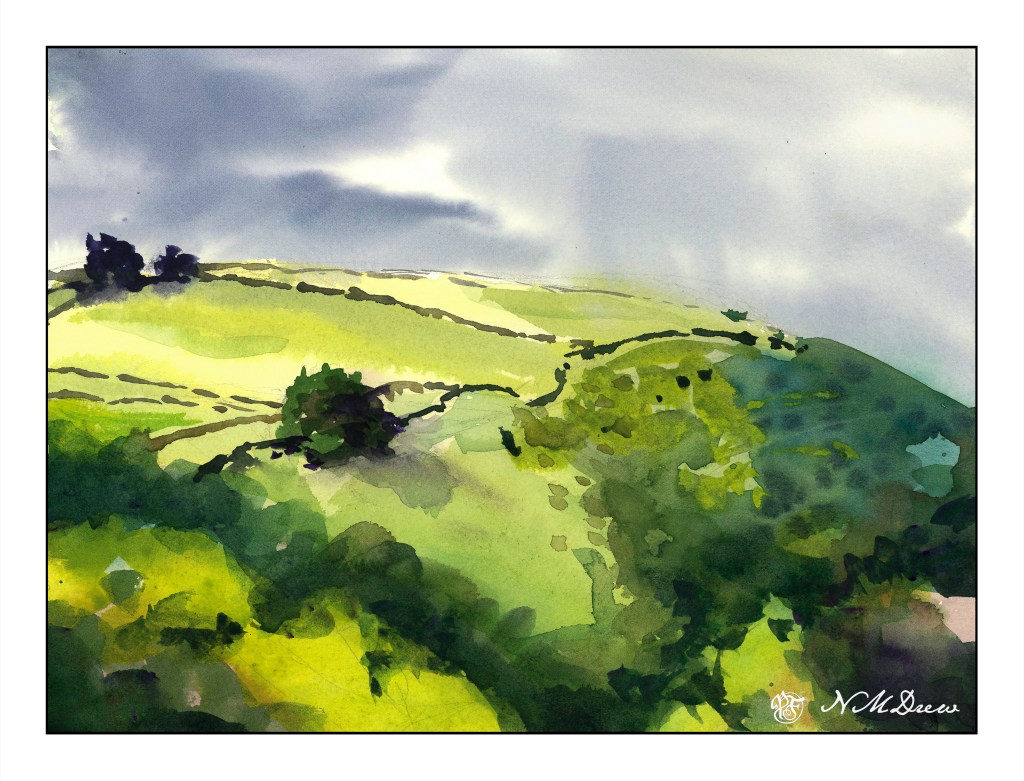
Greens Against the Sky – 2

I was not especially pleased with yesterday’s painting. After leaving it alone, looking at it again, it seemed to have all the same values for the most part. Today I decided to look at shapes and values a bit more in depth.

One thing I did was to change the elements of the picture a bit. I cropped off a lot of the left side and then made a composition out of that. Left side, middle value sky against light land and dark trees. Right side, darker land against lighter sky. In the middle, land and sky of similar value, mainly middle.

Obviously, the right becomes darker, and what I attempted to do was to create a shape of dark values with connections throughout the painting, connecting with right side to bottom and then to the left. Darks were connected throughout with the stone walls and into the trees. The dark trees in the upper left shift into a darker middle value with the sky.

I also tried to work with shapes – dark shapes with the middle ground tree being the focal point. The lighter shape is the land and the slope down the hill from the same tree. I have been reading a bit about how to work values to create focus – such as light and middle values as focal points surrounded by dark. The same can be light and dark to focus, and then surround that by middle values. Maybe that is what I was doing with the tree and shadow on the hilltop.

Anyway, my head is spinning. I know what I was trying to accomplish – shapes, values, warm and cool colors. Words are not easy to find to describe, so I will leave you for now with my mental and painterly chaos!

Greens Against the Sky – 1

Over the past two or three weeks – really, since the last posting – I have not had time to lift up a paint brush or pencil. It makes for a good break up to a point but when I look back, some of the stuff keeping away from watercolor and paint have been the less attractive necessities of life! Today I have finally settled a bit, enough to take the time out of the day to see if I could even focus on paint without creating mud.

Apparently I can!

Whenever I have not painted for a bit, I like to dive into something which is comfortable – landscapes – and makes me happy – brilliant greens against an intense sky. The American Southwest can provide it, as can spring in California, but today I went to Pixabay to look at pictures of Great Britain. I love their landscapes, especially the Dales and the South Downs, and anything along the coast. Here, living in dry California, such lushness always appeals to me.

This is certainly not my best work, but it is not my worst. The usual lack of depth dogs me except perhaps for the hilltop in the upper left below the sky. I do like the simplicity of my colors, though; it is too easy to do detail after detail after detail.

Anyway, I spent a few hours somewhere in England, and it feels pretty good.

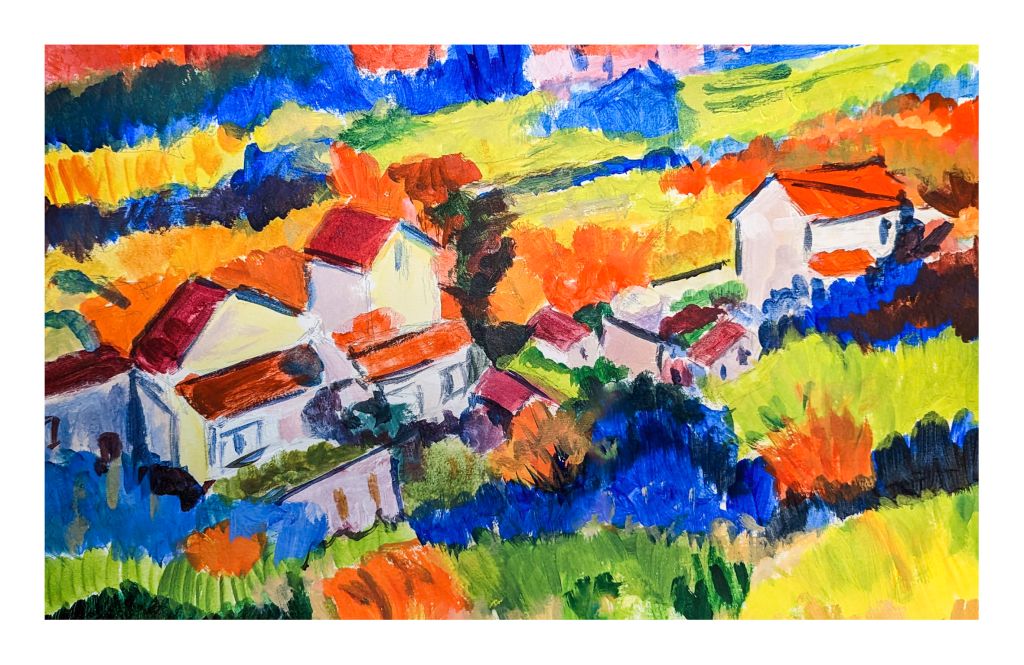
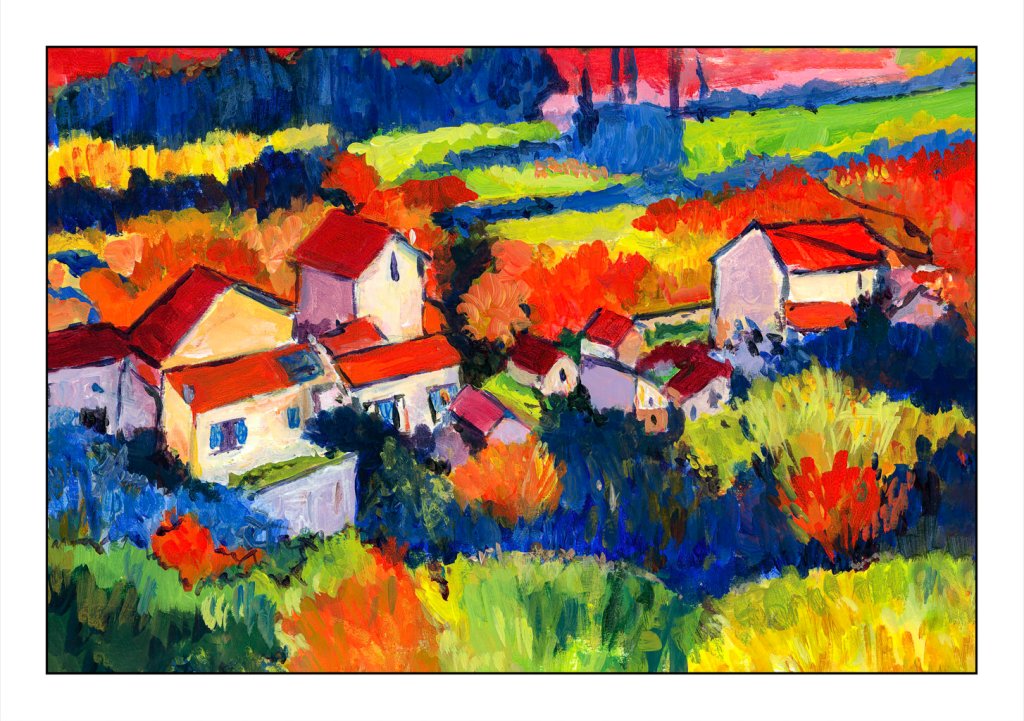
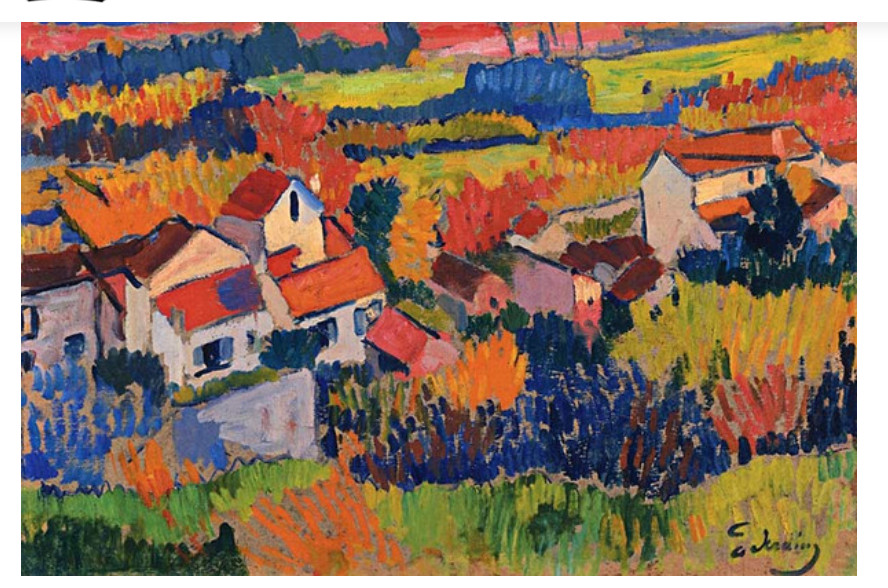
Mastercopy: Andre Derain’s “Landscape Near Chalou”

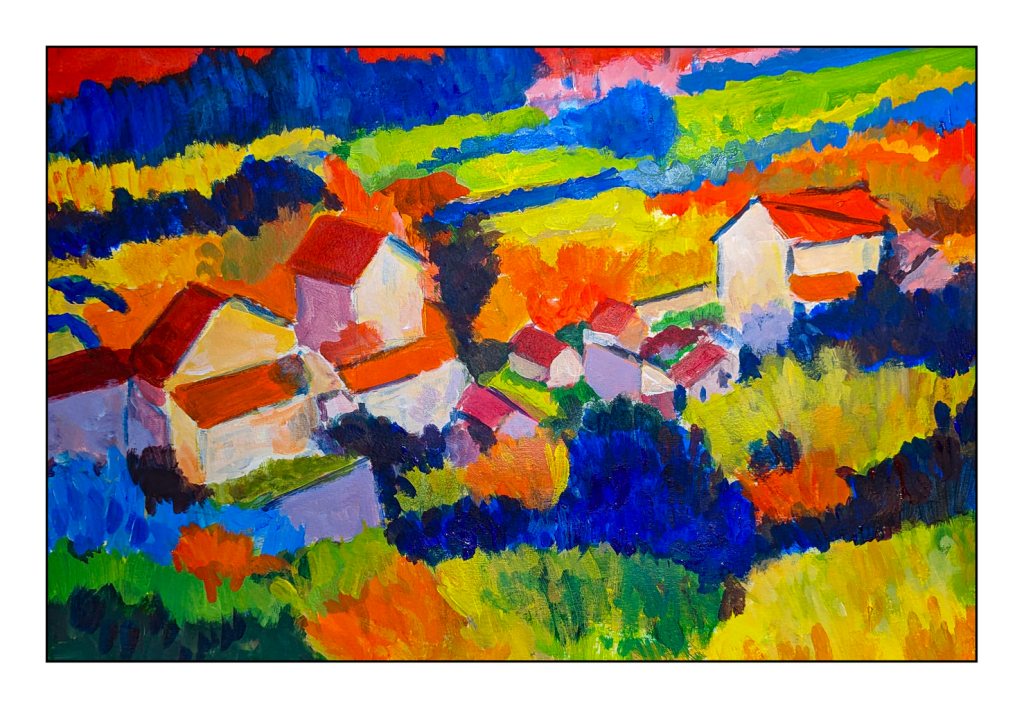
Above is a copy of Derain’s painting, ca 1904, done during his Fauve period. In an online class I am taking, we are encouraged to copy the work of a master artist, new or old, and learn from the experience. This is the second I have done, and certainly one I would not have really considered just because it is so bright! But, the colors and composition caught my eye, and off I went.

The first thing I did was to grid it onto paper. Derain’s work is obviously oils as acrylics did not exist in 1904. I used acrylics on ungessoed paper. As I moved along, looking more carefully, I think he underpainted his canvas with raw sienna or yellow ochre – you can see such colors along the bottom of his painting.

This painting took me probably about 8 hours. I gridded the image, which is about 11.5×17 inches, whereas the original is about 18×22 inches. Then I painted the basic shapes and colors yesterday morning.

This took a lot of time! I am glad I did a grid as the overall areas to be painted were fairly apparent as to shape. What they were – well, some leave me wondering. However, colors are shapes, and Fauvism is not reality, so I could do a bit of my own interpretation, too.

Next, I began to define areas as well as correct mistakes, such as my lopsided building in the lower left side. My paint was thicker, too. Below is this morning’s work.

After lunch, I aimed to complete my copy of Derain’s painting. As I moved along, I looked at Derain’s brushwork. There is a very graphic quality about his painting, which is very pleasing, but the brushwork, too, is fascinating. I did try to emulate it a bit, not just dabbing, but trying to see when he did a dab, a long horizontal push, and so on. Easier to do than to describe!

My final work really does please me. I love the bright colors. My limited palette worked pretty well and there was joy in mixing colors. I usually tend toward more “natural” colors, but the truth is I am a magpie at heart, and bright colors always do get my attention and make me happy. That is an emotional reaction. Classical paintings, though, do appeal to me. Copying a master is opening doors to me and leading me into areas I have never explored.

My final copy of Derain’s masterpiece:

In the Alabama Hills #1

A decidedly more fussy painting than I usually do, but is also a fairly chromatic painting. The primary colors are yellowish greens and grays. More color planes with a few more details.

In a lot of ways this was a more “serious” painting than my trees of yesterday. I plotted more. I did a sketch, a value study, and carefully placed my lines and considered the composition. Steps were thought out on how to approach the painting process itself since there is a lot of plain, white paper left in varying spots.

First step was to lay down a light wash of a neutral color, painting around the white areas at the tops of the plants and a few areas of the rocks. Then, light colors of the plants were added to remind me where they were. In general, I worked light to dark – standard watercolor – but then more intuitively I moved into dark areas while other areas were still covered with the first wash. I needed to establish values and found this worked out fairly well.

Another thing I took into consideration was the paper. This is the 100% cotton student paper I have, and I know it cannot handle a lot of water. Consequently, my washes were not wet and sopping. The light washes I applied were watery, but before picking up the watery wash from the palette, I squeezed or blotted the extra water from the brush, picked up the wash, and then applied it to the paper. It worked as the paper did not get really wet.

The rocks were hard to do. Part of me wanted to be fussy and detailed – hence the dots on the rocks and boulders closer to the viewer – and other parts just wanted to use planes and strokes of color to express their dimensionality. That is something I will try on another version of this painting and on paper that can handle a lot of water.

So, the planes of color continue, even in a more complex painting. I rather like this one as the backlit plants are so pretty, whether painted or in real life, and the pathway itself is alluring. Nothing like a hike in the desert . . .

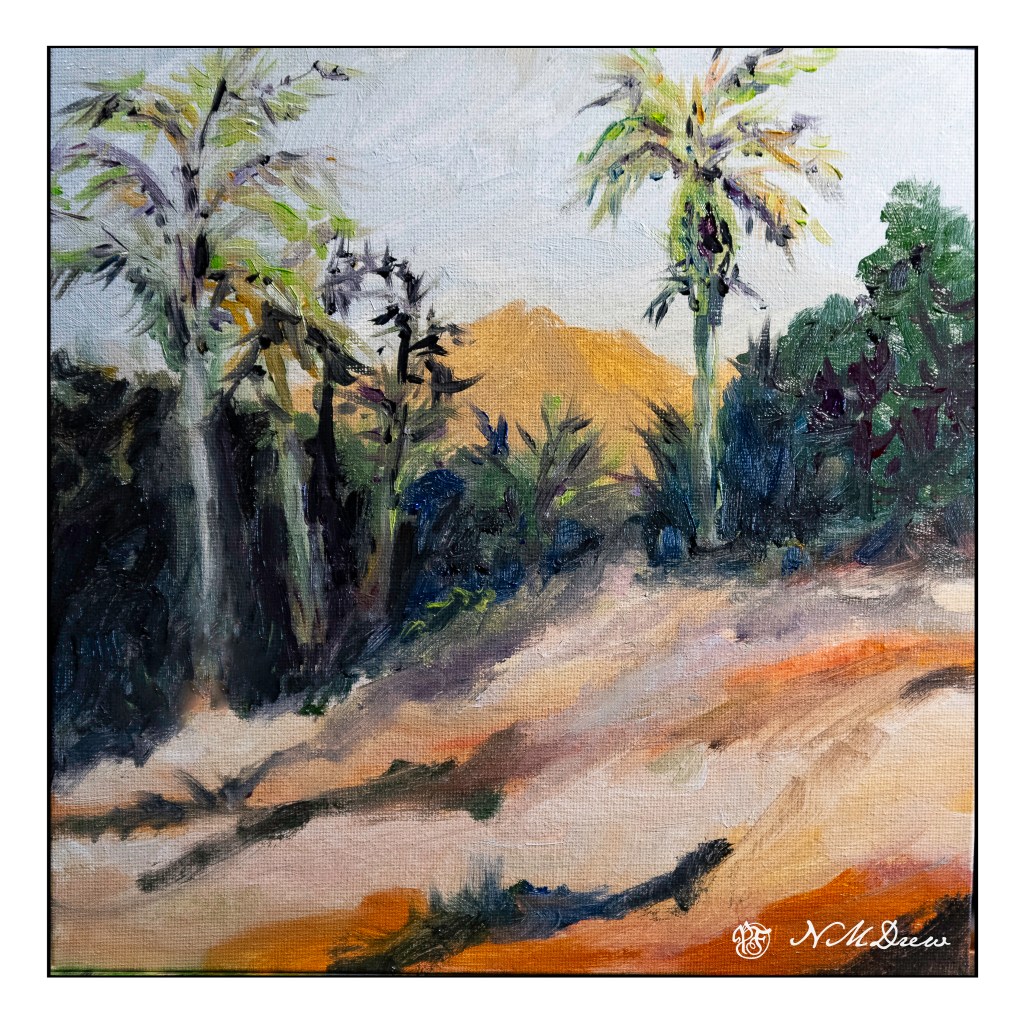
Oasis

Today I decided to just paint and take it from there. No prelim sketch, some reference to this or that, but the point was to just paint and see what happens. It is really practice, and here I used oils. I just need to get comfortable with them and how they handle. That was the whole point of today’s painting. I think I will do more of these, just for practice. The masterpieces can wait.

Oil, 12×12, cotton canvas panel.