Quill & Ink

I have always enjoyed ink and writing with pens.  Years ago – back in the days of my being just out of university – I fell in with a group of evil re-enactors.  Making things from scratch was the trend, and in that time period I learned to weave and spin and dye – the last two I still do – as well as to cut quills and the rudiments of calligraphy.  My Italic is still acceptable, and I can do a good Spencerian and Roundhand and a few others when pushed.  For some reason, it crossed my mind that I should re-learn how to cut feather quills, to write with a la Jane Austen, and from there it evolved into making oak gall ink.

And so, it has begun.  Supplies are in hand.  I have quills (turkey, not goose, but they are pinion feathers it appears) and the makings for ink:  oak galls, ferrous sulfate, and gum arabic.  Now, time to find instructions on how to cut quills (which I have) and recipes for ink.  Oak gall ink is very acidic, and thus not especially archival over the centuries – but who will give much thought to my musings in 300 years if they are still around?  Luckily, not too far from me is a feather wholesaler, and of course there are some excellent online resources; I also have a good supply of pen nibs from the last few centuries and nib holders, ranging from repousse silver to student plastic and wooden.

The fact is, I love making things and creating from scratch.  Quill cutting is an art, and one I was only beginning to master years ago.  I have never made ink, and am looking forward to it, using both “quick” methods, and “slower” ones wherein the oak galls ferment for a few to several weeks.  Meanwhile, I will look up inky recipes and begin my adventures into the 18th century . . .
Life Cycle of the Pomegranate

Well, I’m back!  I’ve spent the last 2 weeks dealing with all the little sticky bits of paperwork and choices for retirement, from choosing a supplemental Medicare program to whatever.  It’s a lot of drudgery, but has to be done.  I’ve everything except one card – the prescription card – but the rest is in place.  Besides that, I have also had the time and desire to focus on conquering some software issues, now resolved but only to have another pop up.  Thus, back to painting – so much more enjoyable and fun, even when things go wrong . . .

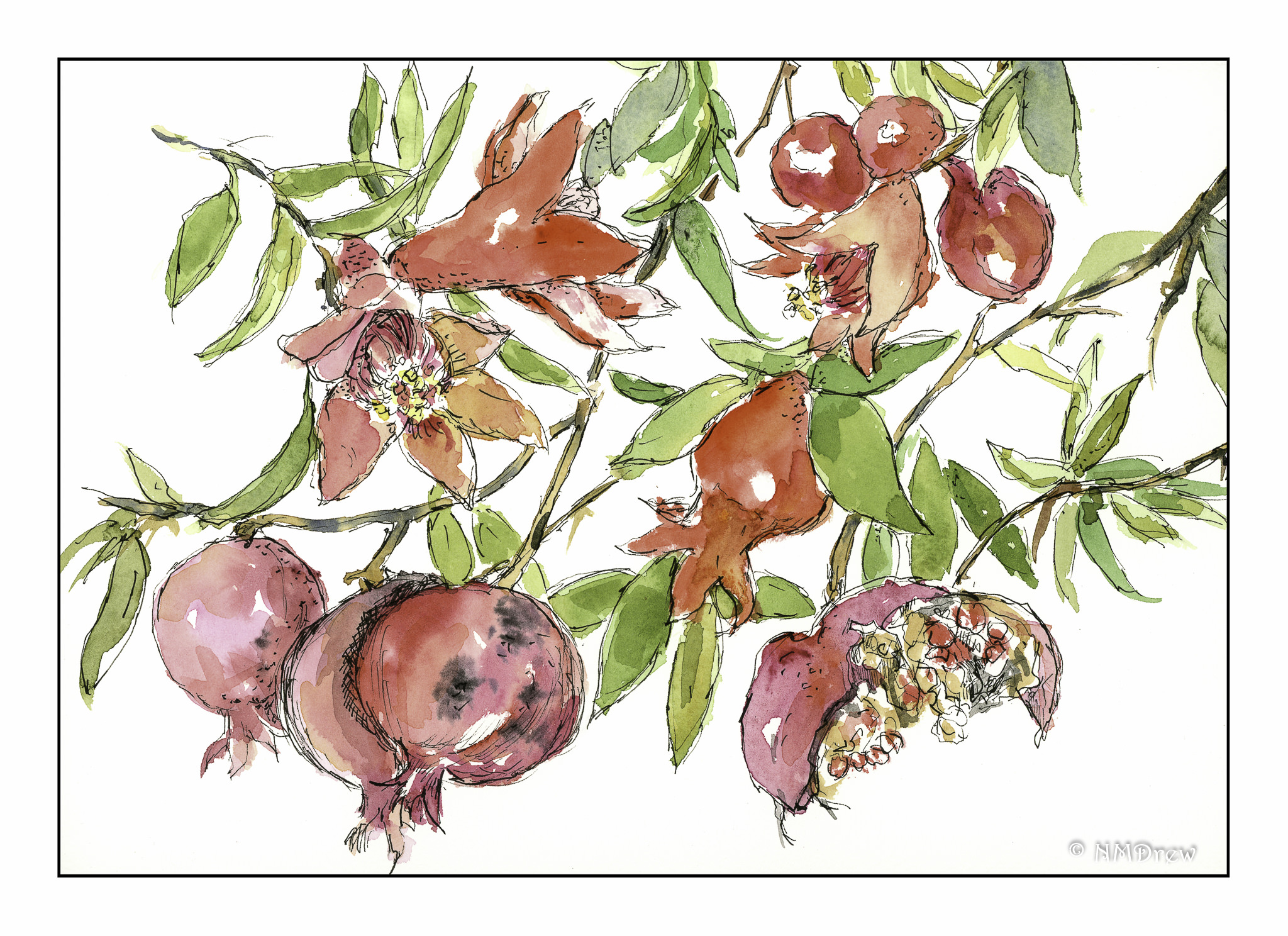
Here, the life cycle of the pomegranate, from flower to fruit to food for birds when it bursts open.  The local botanical garden has several of these lovely trees, now in the stage of bloom and setting fruit.  Large, ripe fruits come later in the year, of course.  I don’t know why I thought of doing a life cycle, but it seemed like a fun thing to do – maybe a mirror of my own life cycle?  Done with the weekly commute and such?

Loquats for the Picking

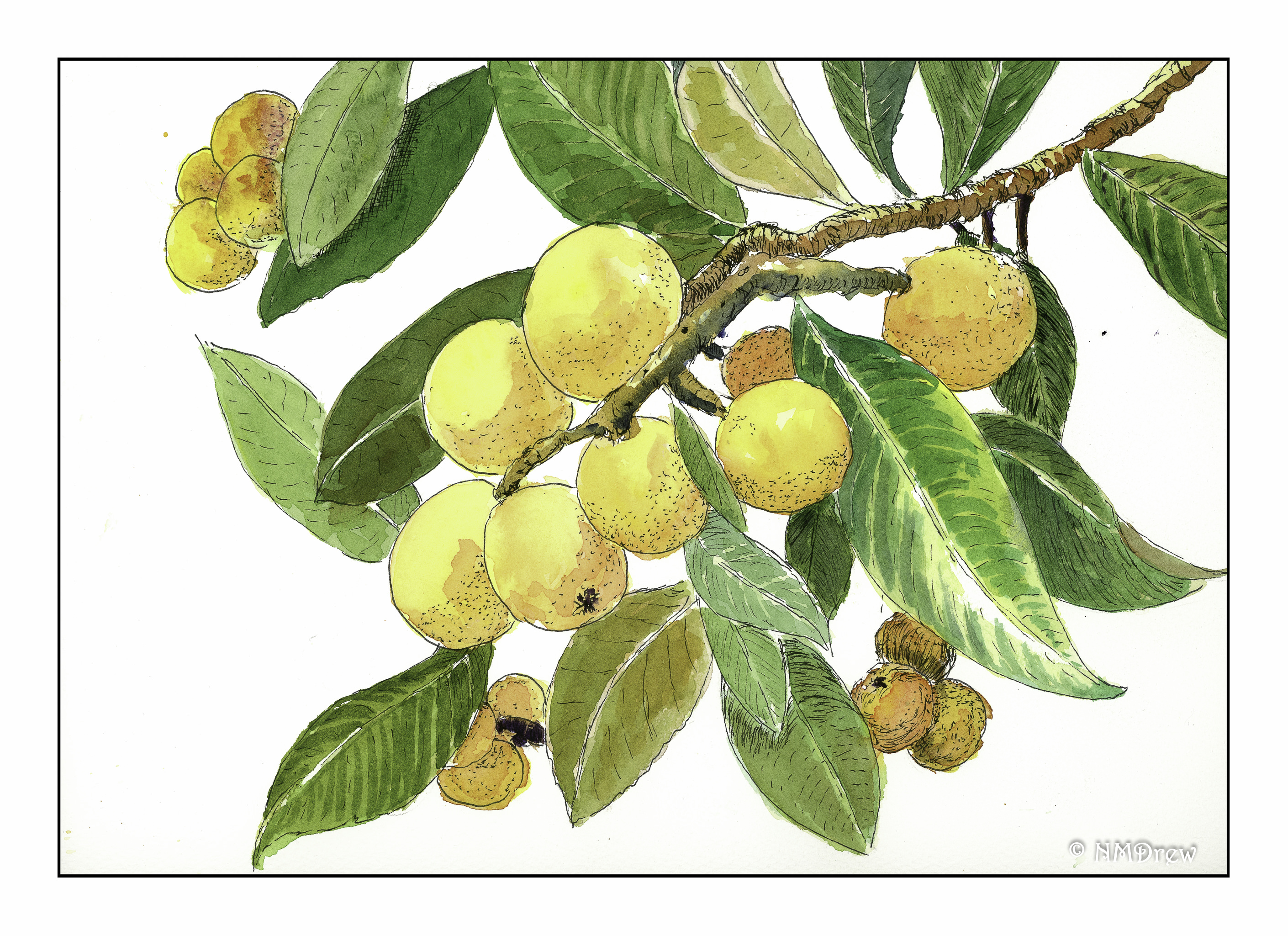
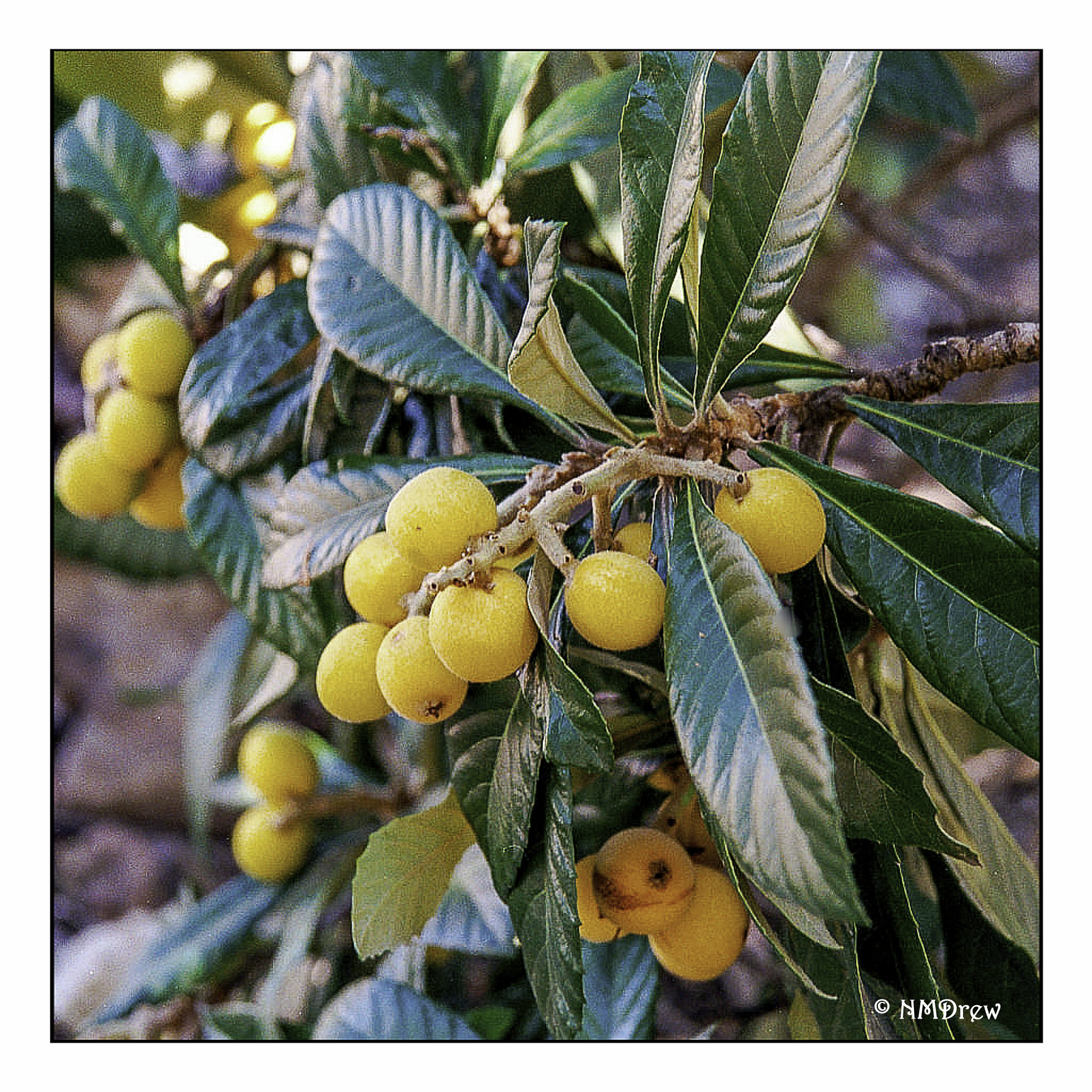
A couple of weeks ago I took a photo of loquats, not really ready to be eaten, but certainly not too much sooner!

The loquat is a fruit tree indigenous to southeastern China. It is frequently grown in California gardens for its fruit and decorative qualities. The fruit is a pale yellow to a golden color, and the leaves are stiff and dark green. The contrast of the roundish fruit with the wide, pointy leaves makes for an interesting painting subject.

The photo from which the drawing evolved:

Painting the loquat has a bit of cross-cultural history behind it, too; ink painting tradition honors the loquat in Asia.

It would be easy enough to paint a loquat in watercolors, without ink, as well.

Lichens on Tree Branches

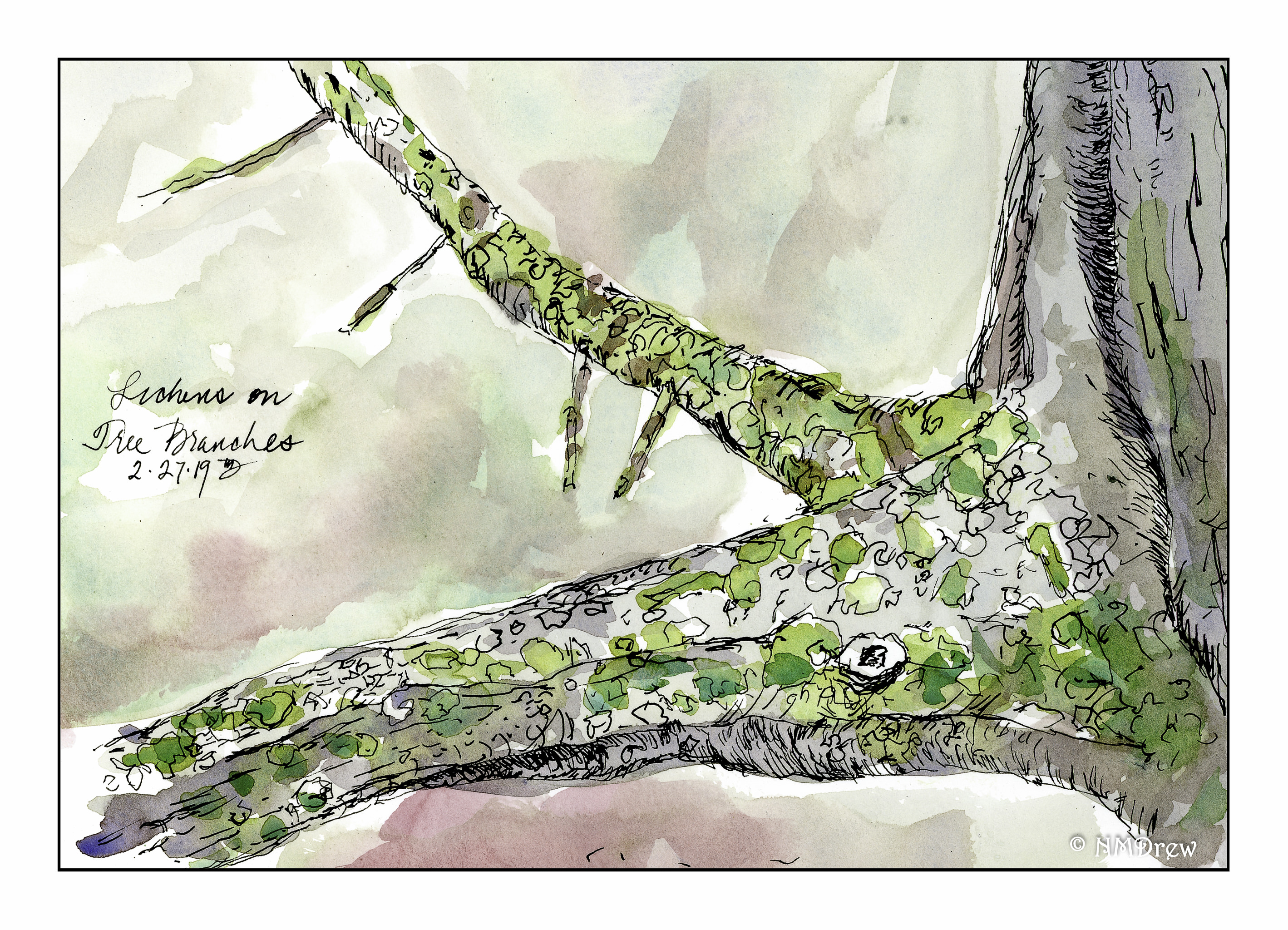
I have finally gotten out to the local botanic garden after a month long hiatus.  I went a couple of days ago on a bright sunny day.  Today, in the foggy gloom, I went again.  Both times, camera in hand.  The sunny day I was accompanied by a friend while this morning one of my dogs came along.

In today’s gloom, the bright green lichens on this tree caught my eye.  I’ve photographed it a number of times, in different seasons, under different lighting conditions.  There are spots of green, white, and dark grey.  Textures range from smooth to rough.  In the textures of the garden – leaves, flowers, critters, stems, branches, – it is easy to overlook the subtle beauty of a couple of branches.

An Afternoon on the Patio

We headed out to San Diego for the last several days, to see the zoo, to walk around, to explore a bit of the city, and to just get out of town.  It was really nice, but no painting or drawing got done!  Lots of photography and fine dining and hiking all over.  It was a very welcome break from the daily routines.

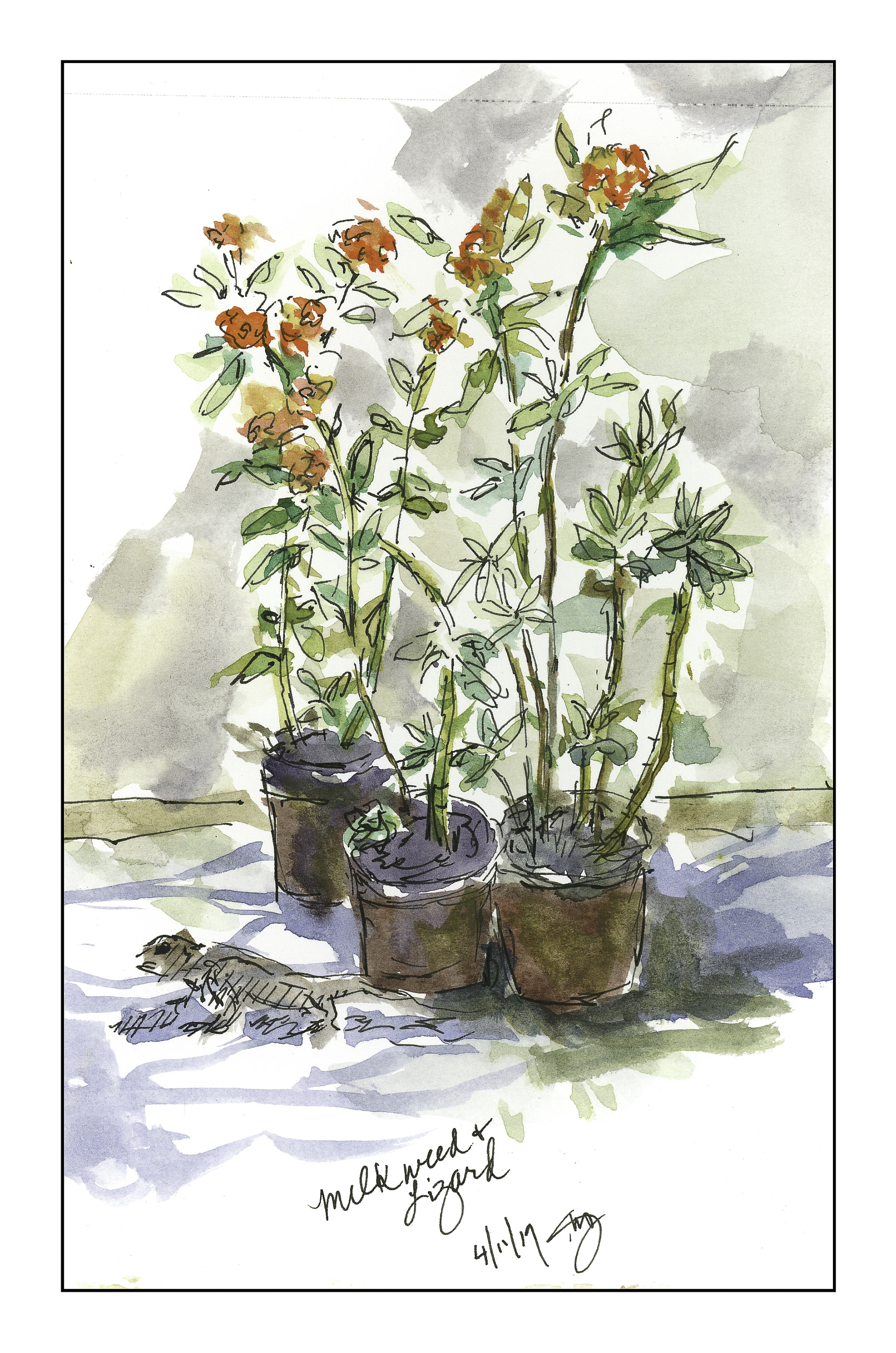
Now, back in town, everything is caught up and time to play!  I moved out to the side patio where we have peppers, flowers, herbs, and sundry plants for our pleasure.  We have a few resident lizards, too; they dart around and sometimes we find them in the house.  When we do, they are gently moved outside.  They are a lot of fun to watch as they do push-ups in the sun.  And that is what we begin with below – a 5 minute ink and watercolor sketch of milkweed and a lizard that flitted in and out of the picture.  Rather a stiff picture – amazing what you lose when you don’t paint or draw every day.

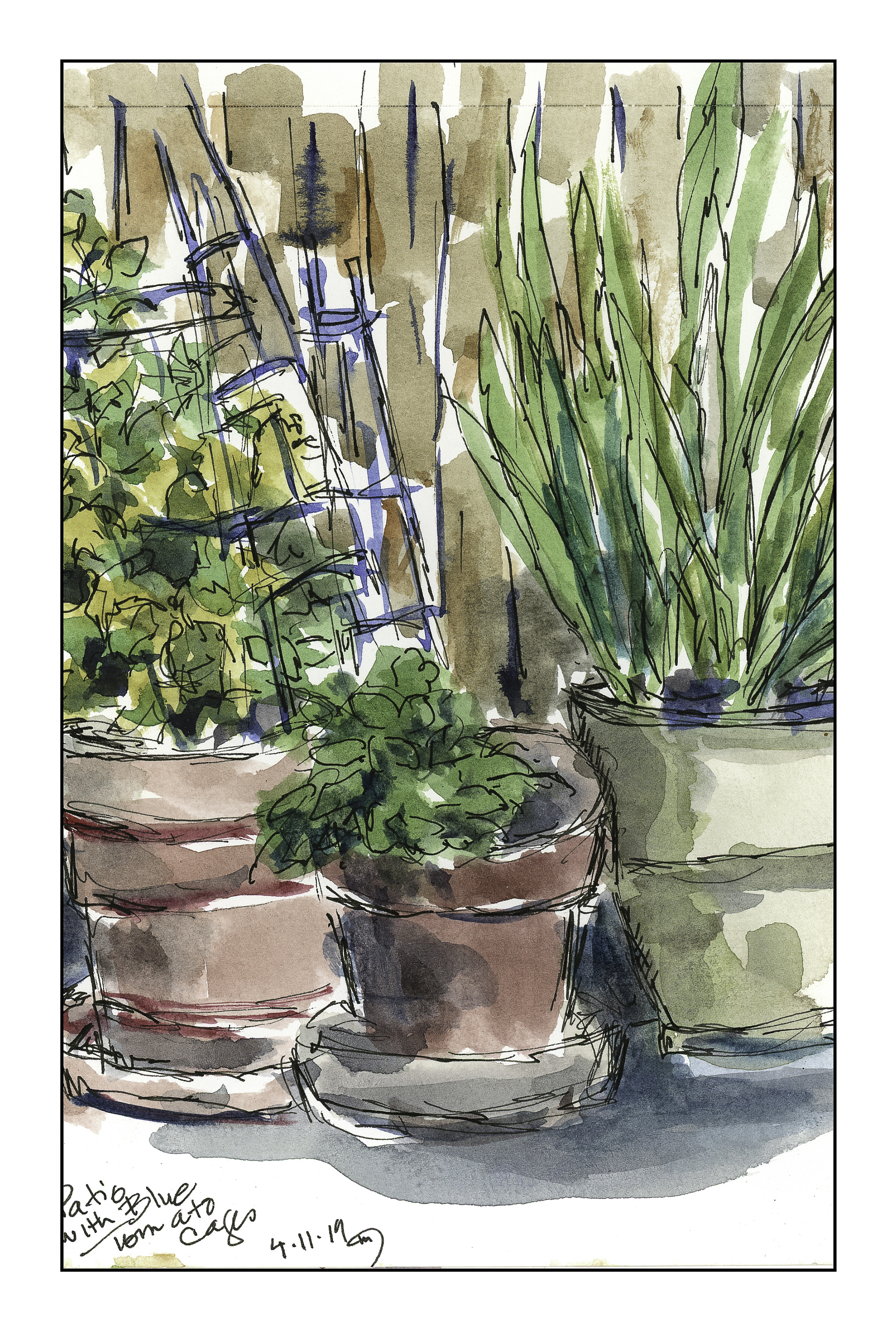
From here, I looked toward the fence facing the front of the house.  Here we have a jasmine, bulbs, and mint.  Behind them are the blue tomato cages, sometimes used to support tomatoes, and sometimes peppers or vines.  Another ink and watercolor sketch; this time, 10 minutes allotted.

Finally, just watercolor.  Lavender is a lovely plant, and this one is making me so happy.  I believe it is English lavender, as opposed to French, as it is shorter and more compact.  I could be wrong.  I could look it up on the internet.  But I don’t feel like it!  Okay, I did.  I have no idea what kind of lavender it is!  There are so many kinds . . .

As an aside, I bought some Holbein water-based gouache when we were in San Diego.  There was a Real Art Store a few blocks from the B&B we stayed at.  And a bookstore.  And a lot of good restaurants.  So, expect some adventures into gouache in the future.  Meanwhile, it felt good to pick up a pen and colors to just diddle around on a sunny afternoon, enjoying retirement.