Crocus – A Flower I Have Never Seen

I am not inclined to enjoy painting classes online unless they are done in chunks of short amounts of time. Shari Blaukopf’s most recent class, Sketching Spring Flowers, is one such class. In fact, all her classes are very much like this. Her style of teaching and painting are very fresh and direct, and up front, I think she is one of the most talented and unique watercolorists of our time.

So, taking the first section of the class, we are doing a small batch of purple crocuses blooming in her garden, bright colors after a long, cold Montreal winter. Well, I have lived in cold places, have seen tulips and hyacinths emerge from the snow, but never have I seen a crocus. One day! Anyway, this is the first of her flower studies. I can only hope someone else can tell what it is supposed to be.
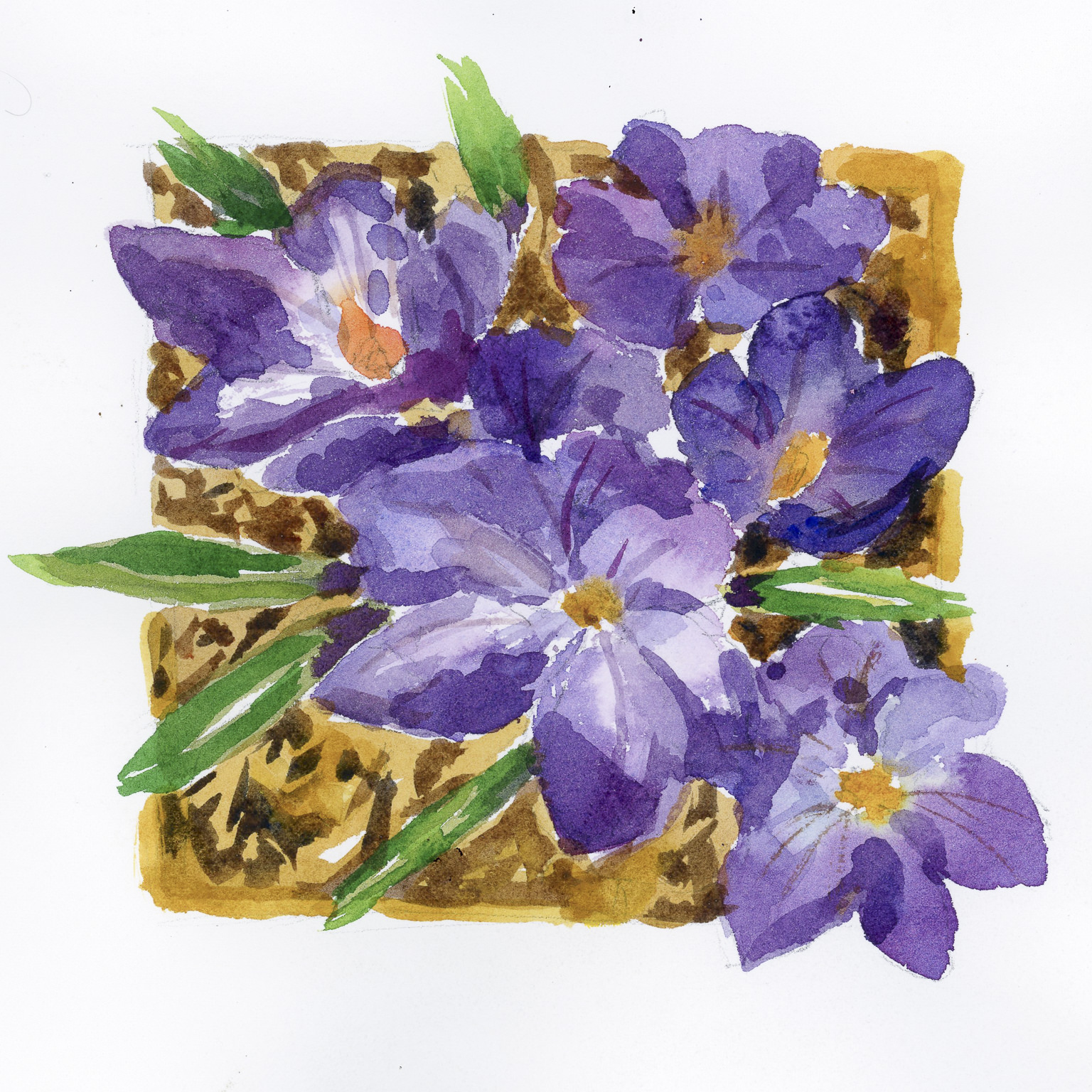
My own painting is a bit muddy-looking as far as I am concerned. My paints were not as fresh as hers, but that is not the point. It is more about learning technique. It is hard to paint something from a photograph, and hard, too, to paint something completely alien. However, technique and color mixing are the point. For instance, thick wet paint. Let water do the work in the lighter areas. The experience is the point – but my problem is I am hasty. This painting took me about an hour, watching the videos and thinking about things. I wonder if ever anything sinks in! Despite that, exercises like this are always valuable …

Shari Blaukopf class; crocus; watercolor on Arches CP 140#. About 8×8.
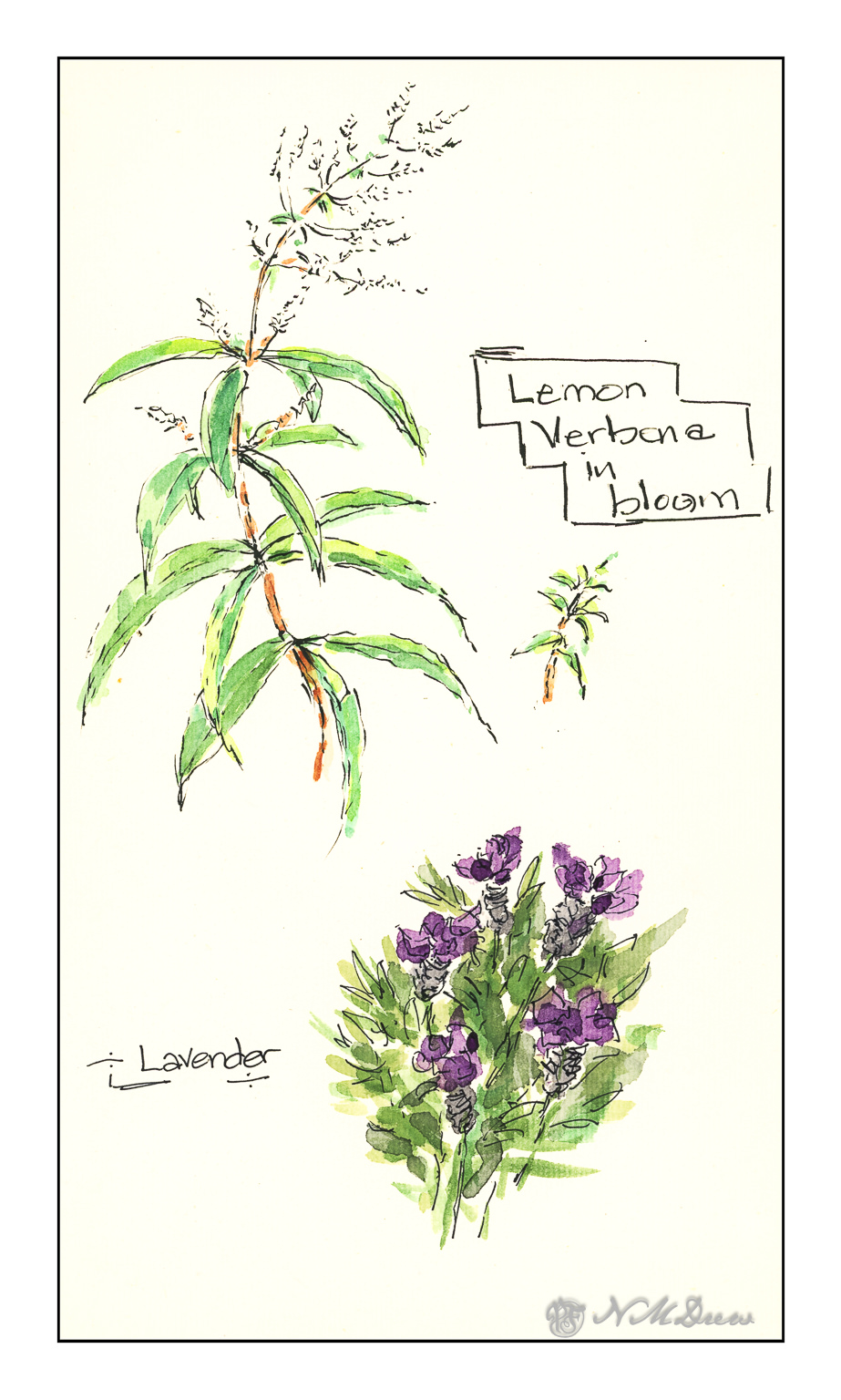
Verbena & Lavender

Years ago I bought a tiny pot of Lemon Verbena, and since then it has been a wonderful presence in the patio garden. It’s hardy and easy to take care of, needing a bit of pruning, water, and occasionally fertilizer. I cut it back every year and sometimes when it’s dried up because of neglect. It always comes back. Lemon Verbena has a wonderful, light citrus scent, and the leaves are actually really good in cake!

Lemon Verbena flowers are nothing spectacular. They are teensy and have a rather frond like appearance and sit atop the branch of the verbena. They develop side branches and leaves, and if you there a lot of them, it’s really quite delicate and pretty.

On the other hand, the lavender plant nearby has rather showy purple blossoms on a stalk. I think this variety is Spanish Lavender – but I dunno! I have about 3 or 4 lavenders running around, each different, but each with a lovely lavender scent.

More in my fanfold sketchbook with ink and watercolor.

Waiting to be Planted

For the past several days I have had a lot of little gardening projects going on. I transplanted a number of seedlings into pots. I also started seeds. I have some seedlings I have sent on to a new home. This season I have vegetables already setting fruit, even it won’t mature for weeks, and seeds which are sprouting, and seeds I am waiting to sprout. Vegetables this year include winter (hard, yellow) squash, bush beans, radishes, lettuce, pepper of the hot variety, tomatoes, parsley and cilantro.

This image has an empty alt attribute; its file name is 1.-waiting-to-be-planted-6-3-2024.jpg

I also have a lot of flowers. These include hummingbird and butterfly mixes all thrown together in the front flower bed as well as foxglove, larkspur, polka dots (which I think are scabiosa or pincushion plants), carnations, nigella, Mexican sunflowers, Titan sunflowers (they can grow 12 feet tall with seed heads 24″ across!), and moonflowers. Herbs include the usual rosemary, sage, parsley, thyme, basil, but I have also added summer savory and a few Asian ones for variety. Mint and lemon balm and lemon verbena.

With all this work, there has been little time for sketching or painting. Thus I decided, much like my “Not Taken Vacation” that a sketchbook dedicated to this year’s gardening efforts would be fun to do. I have a fanfold Chinese calligraphy book I am using. It is a fanfold, so I can spread it out if I want to create a panorama, or use individual pages.

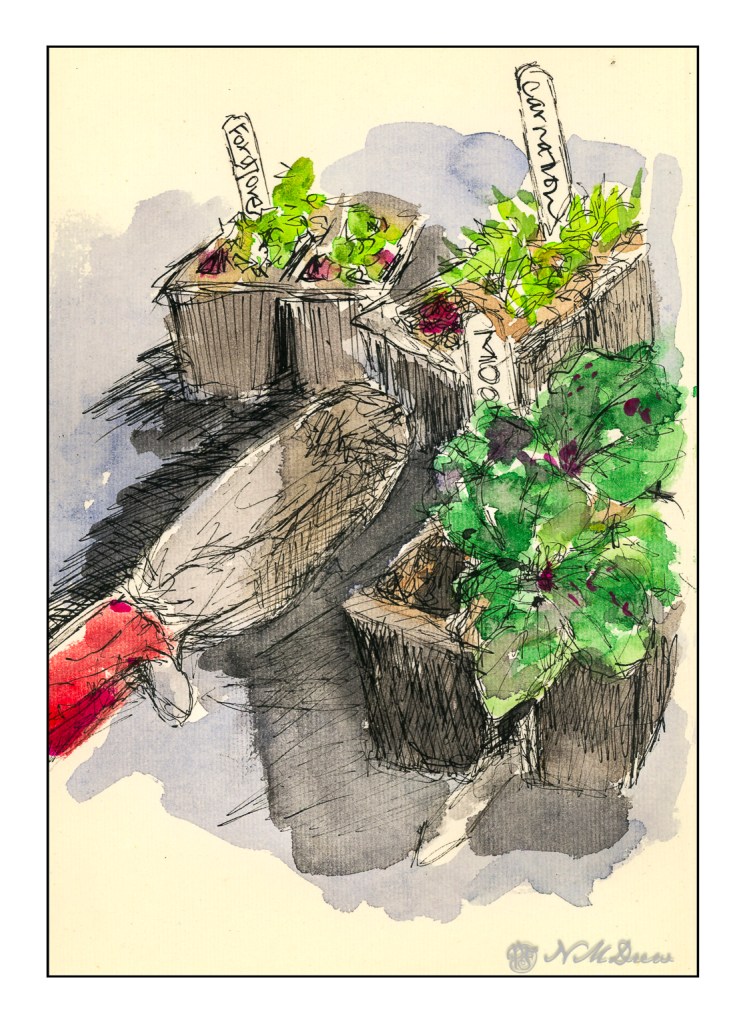
Above, just an individual page to get a sense of the paper. It is very soft and very absorbent, as well as a creamy color that is far from white, but not yellow. I figured my first foray into this documentation would be best served with a simple ink and watercolor drawing to see how the paper handled. Overall, I like it. The soft paper requires a bit more caution with the water, yet it does seem to handle it very well.

So, a few pony packs with seedling waiting for a home on my gardening table. My hand trowel is not well represented, but such is life! Meanwhile, I can enjoy the sweet smell of a freshly turned bit of earth and dream of flowers and garden produce.

Waiting to be Planted

For the past several days I have had a lot of little gardening projects going on. I transplanted a number of seedlings into pots. I also started seeds. I have some seedlings I have sent on to a new home. This season I have vegetables already setting fruit, even it won’t mature for weeks, and seeds which are sprouting, and seeds I am waiting to sprout. Vegetables this year include winter (hard, yellow) squash, bush beans, radishes, lettuce, pepper of the hot variety, tomatoes, parsley and cilantro.

I also have a lot of flowers. These include hummingbird and butterfly mixes all thrown together in the front flower bed as well as foxglove, larkspur, polka dots (which I think are scabiosa or pincushion plants), carnations, nigella, Mexican sunflowers, Titan sunflowers (they can grow 12 feet tall with seed heads 24″ across!), and moonflowers. Herbs include the usual rosemary, sage, parsley, thyme, basil, but I have also added summer savory and a few Asian ones for variety. Mint and lemon balm and lemon verbena.

With all this work, there has been little time for sketching or painting. Thus I decided, much like my “Not Taken Vacation” that a sketchbook dedicated to this year’s gardening efforts would be fun to do. I have a fanfold Chinese calligraphy book I am using. It is a fanfold, so I can spread it out if I want to create a panorama, or use individual pages.

Above, just an individual page to get a sense of the paper. It is very soft and very absorbent, as well as a creamy color that is far from white, but not yellow. I figured my first foray into this documentation would be best served with a simple ink and watercolor drawing to see how the paper handled. Overall, I like it. The soft paper requires a bit more caution with the water, yet it does seem to handle it very well.

So, a few pony packs with seedling waiting for a home on my gardening table. My hand trowel is not well represented, but such is life! Meanwhile, I can enjoy the sweet smell of a freshly turned bit of earth and dream of flowers and garden produce.

Mexican Evening Primrose

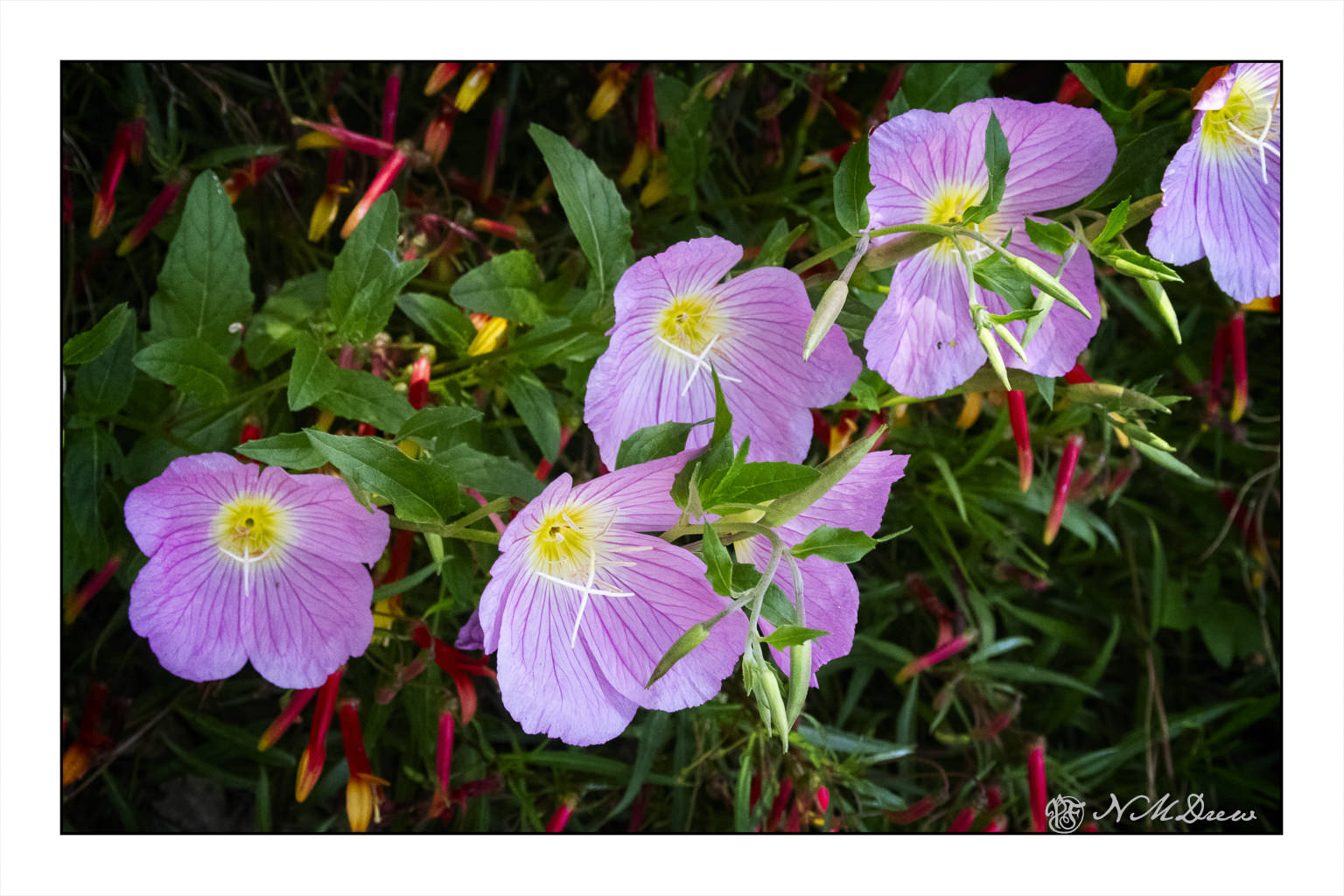
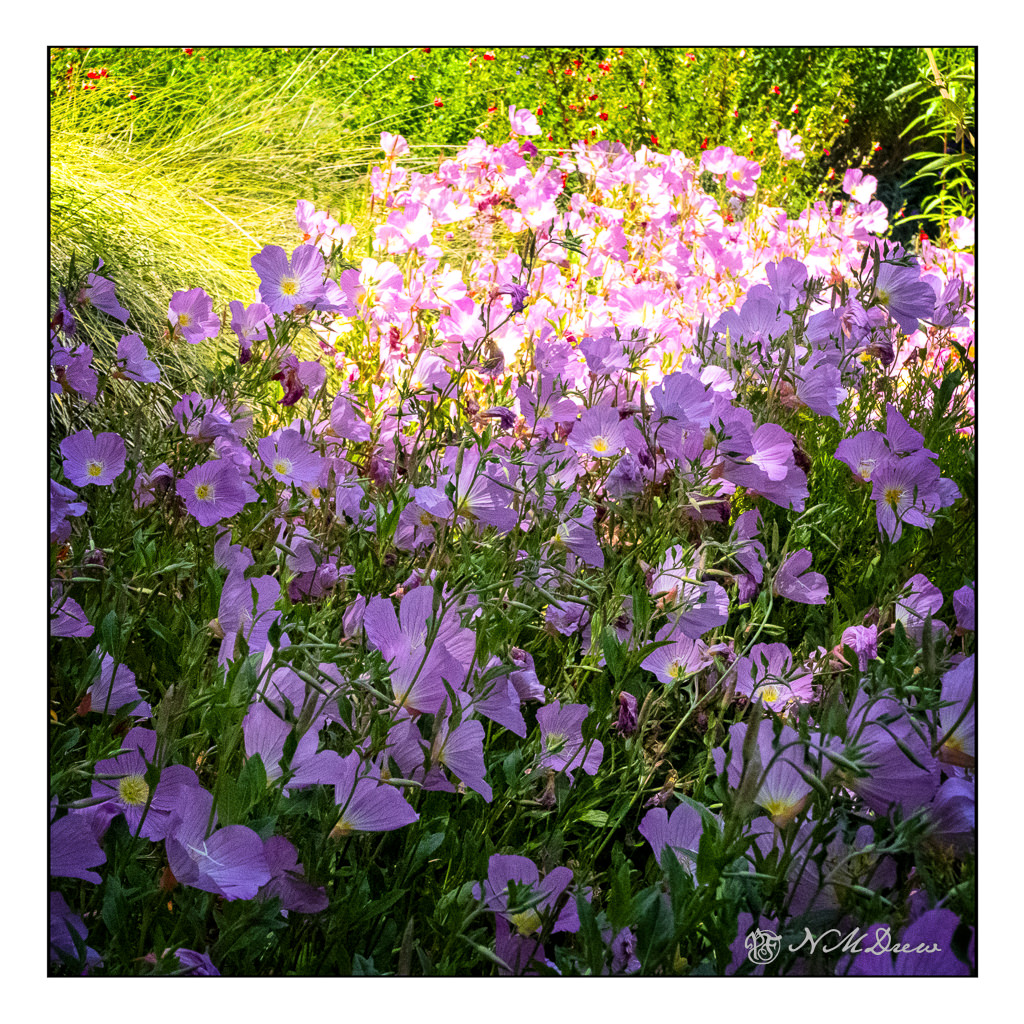
This is one of my all time favorite flowers, except for one thing: it is invasive! Many of my other favorites have the same characteristics, and are best contained in containers unless you want to be taken over. In hard-to- grow areas, this is an attribute, such as covering hillsides, or in wilder areas with seasons. Bulbs are great for this, but in small gardening areas, invasive species can be very problematic.

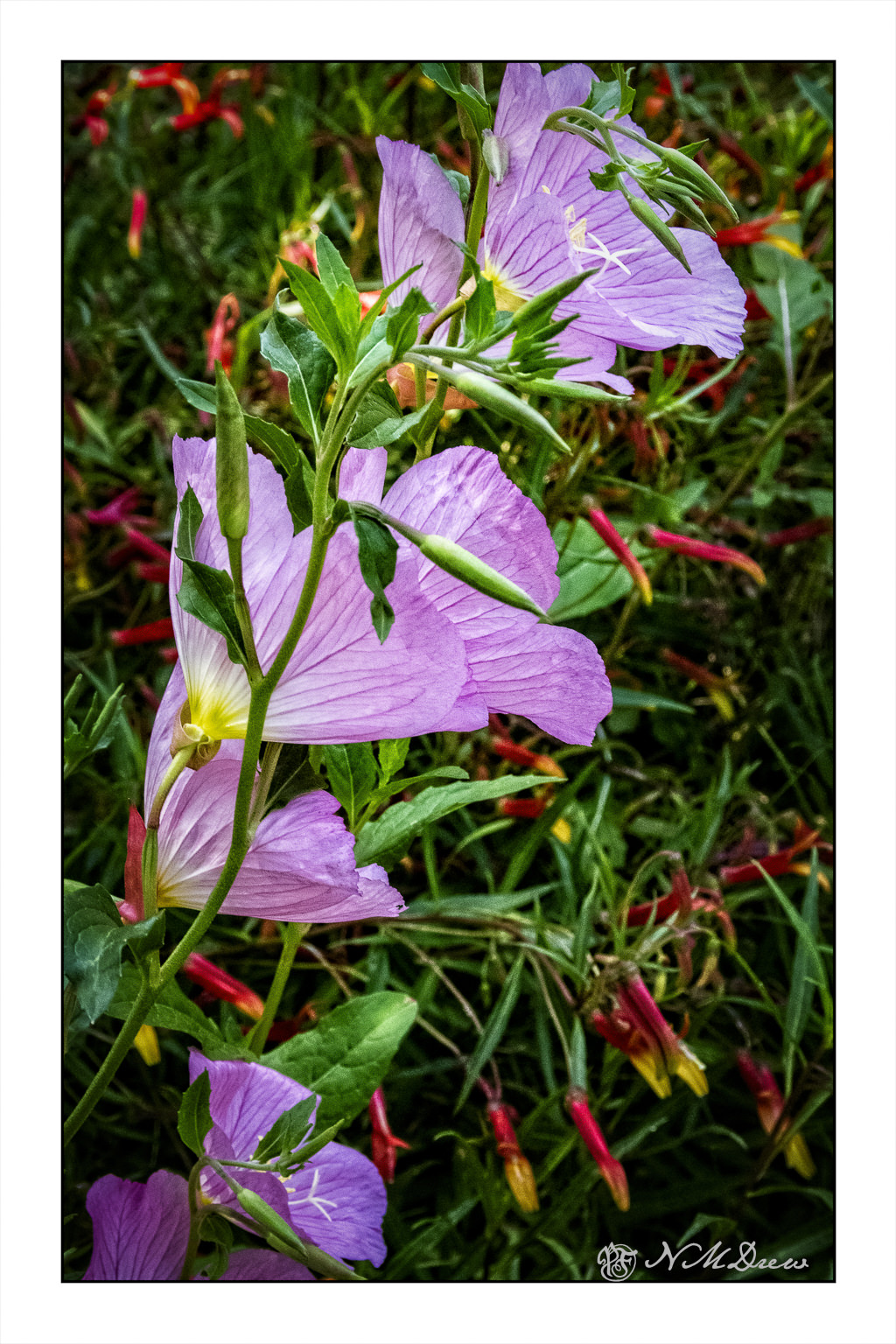
The Mexican Evening Primrose – Latin name oenothera speciosa – is a perennial wildflower that lies close to the ground because it is rather a floppy plant even though it can grow rather long in length. What makes the Mexican Evening Primrose a good garden plant, at least for dry areas, is its tolerance of drought and hanging out despite bad growing conditions.

Spread over a hillside or in a small patch, the cheerful pink and yellow center flowers are striking. They are also abundant in bloom, and this is even better in my opinion! The local botanical garden has a number of patches which mix in with other plants.

These flowers are lovely in bouquets, too, as their drooping nature and vining tendencies add a bit of curve to upright flowers along with their beautiful pink.