
Summer’s Harvest

I might do more drawings of my container garden as the next few days pass, but it’s hard to tell. The heat is up here with it in the mid-90s F, so sitting outside to sketch is an early morning thing rather than a mid-day thing.
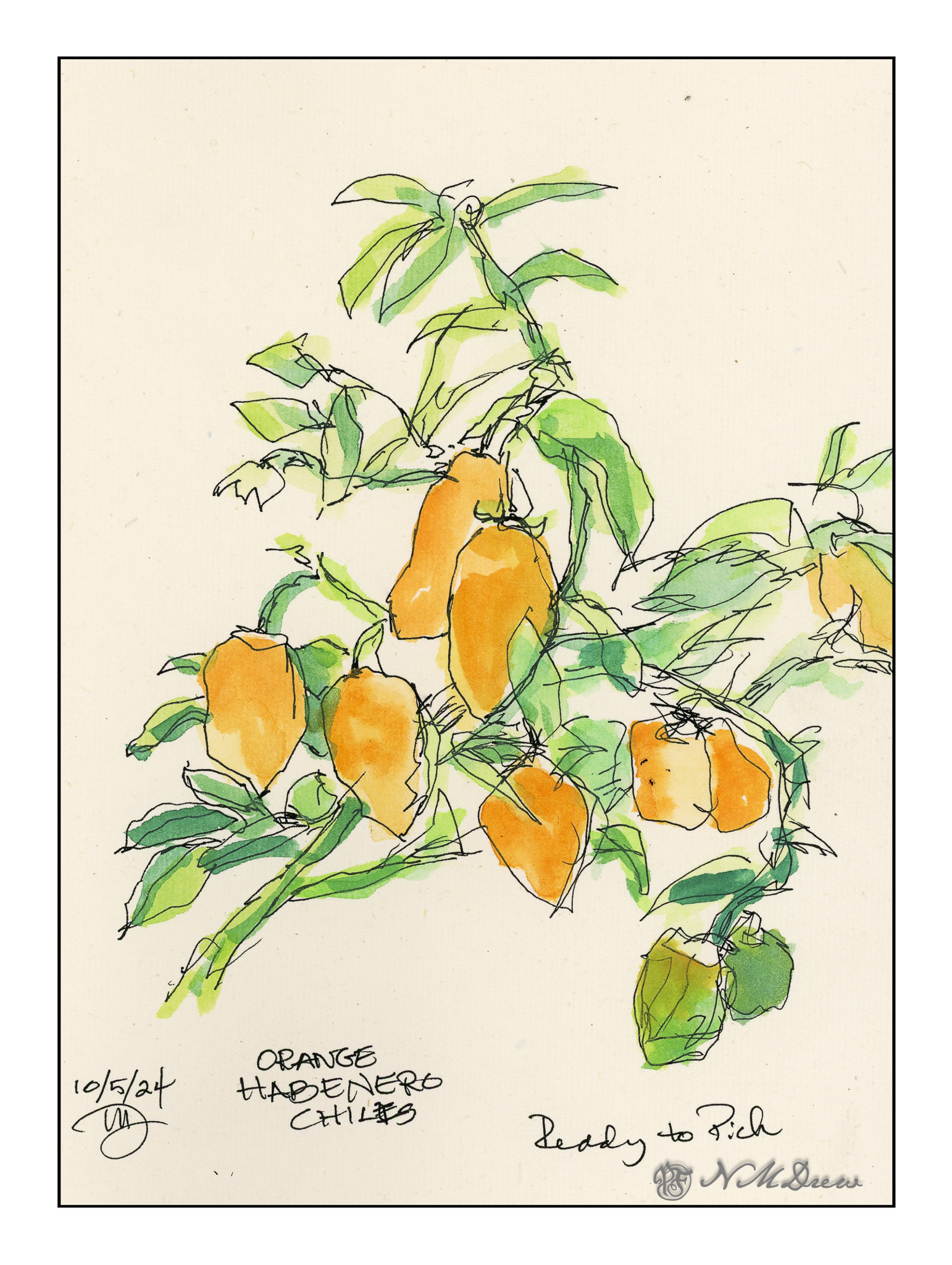
My vegetable garden this year had some oldies which I know work well, and some new ones, some of which worked and some of which aren’t worth the effort. Above, orange habanero chilis. We usually do pretty well with these.
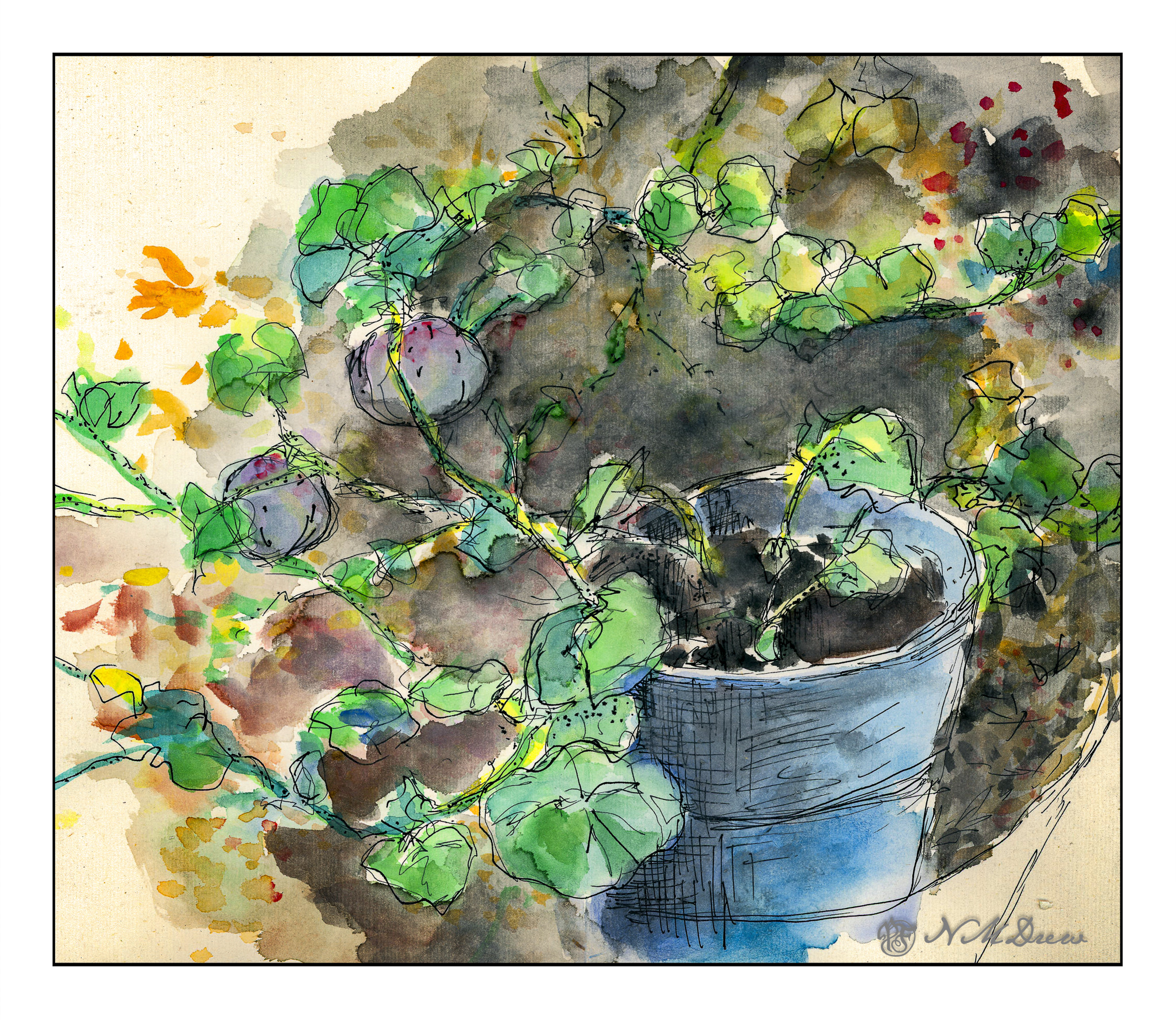
This drawing is of my heirloom Strawberry Crown Squash, a hard winter squash. I planted a bunch of seeds in a 20 gallon pot, and pulled all but 4 out. I have never planted winter squash, much less in a flower pot, but they seem to have done quite well. The vines grew and flourished and produced a lot of flowers. The vines were about 20 feet long each and moved across the dirt of the back yard with the sun.

But, I only have 2 winter squash for all that! I haven’t harvested them yet, but expect I will in a few days. I wonder if I need to learn about the art of winter squash gardening – but why?! Pumpkins are so prolific!

I don’t have room for a garden as I don’t have any place that isn’t lawn or just dirt. The back yard is a disaster as I still need to remove 11 or so trees whose roots jut out at all angles in the back yard. Until the trees and roots are gone, to the tune of a small fortune, container gardening it is.

These were sketched in a fan-fold Chinese sketch book. The paper is a creamy yellowish color, a bit tan, and very absorbent. It sucks color up so I had to do a bit of scrubbing to even lay in a wash of any size. Scanning, too, was difficult and that can be seen in the drawing of the winter squash. The differentiation between the dirt and squash leaves is not as muddied as it is here.

Watercolor and ink on paper.
Patio Potatoes

To be precise, I planted organic Elba potatoes on March 24, 2023. I harvested them today as we will be gone for a while on a trip, and I wanted to see what I got. So, they are officially harvested on August 27, 2023. I planted them in a 15 gallon flower pot with extra amendments, such as recommended by various sites, whose names I forget. Ah, well. More research for the next potato season.

Let’s start with the Elba potatoes. I ordered mine from Wood Prairie Farm in Maine. They were organic seed potatoes and can be harvested 7-8 weeks after planting. They are noted as good for container gardens, hence my choice, as well as being a hardy and disease-free plant.

Reading about potatoes was really interesting, and to me, potatoes and tomatoes are some of the best contributions to world cuisine from the New World. Let’s add squash, too, and corn.

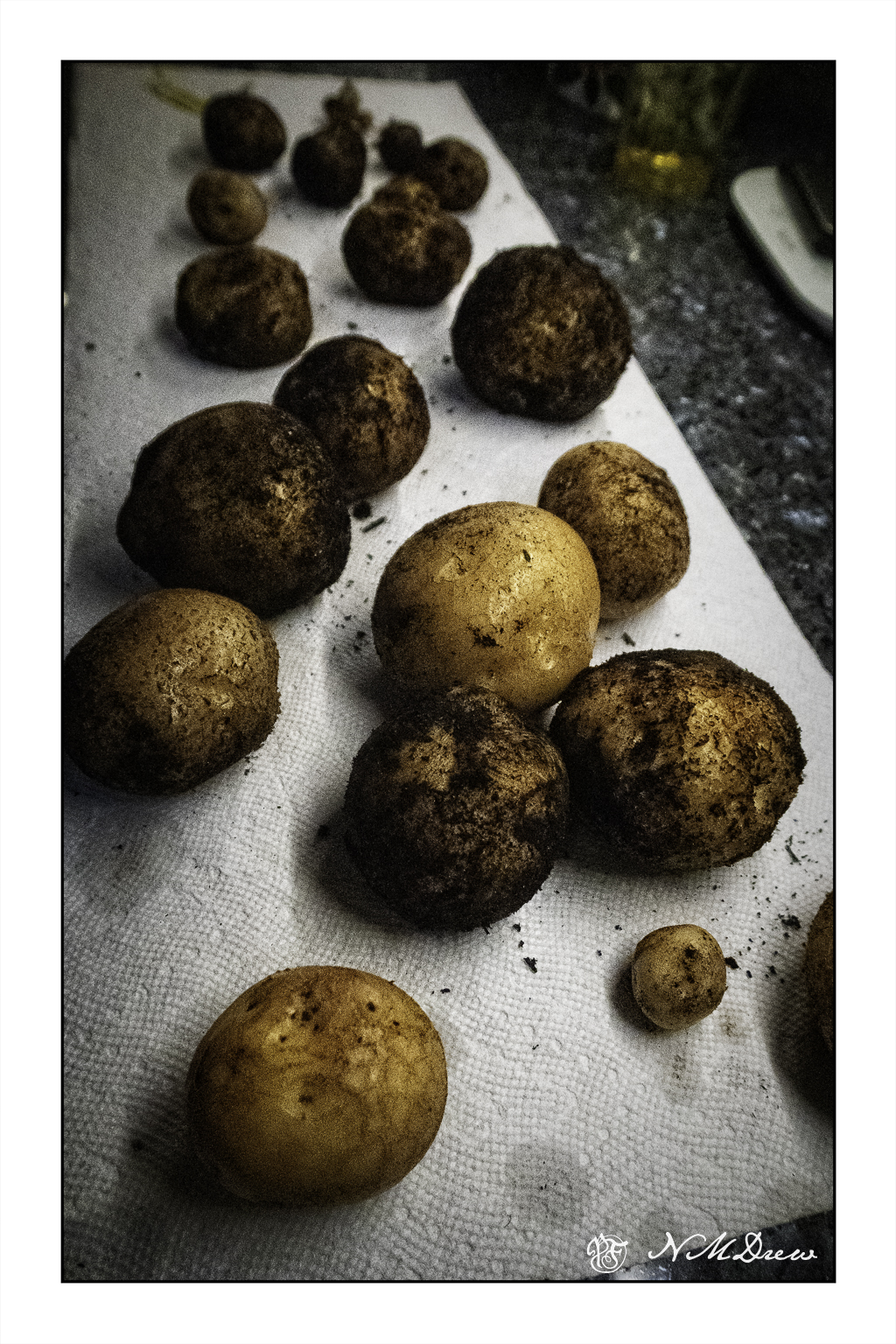
Anyway, my crop is not big. Altogether I harvested about 20 potatoes, of which 10 are fist-sized, and the rest are smaller. I have enough to share a few perhaps with a friend or family member. I have no idea how to store them before I eat them, so per the internet:

  • Do not wash before storing
  • Do not store in the refrigerator
  • Store in a paper bag or bowl, both with holes to allow ventilation, preventing moisture accumulation, leading to spoilage
  • Keep away from light to prevent development of chlorophyll and the toxic chemical solanine

At the moment, my potatoes are sitting on a paper towel so the dirt on them can dry. I won’t wash them, but perhaps brush off some dirt. Then, certainly a bit of a feast! I will also put them in a paper bag in the pantry to see what they do – our garage is too hot, and as the pantry is sort of in a central part of the house, it might not be a bad idea to put them there, or in a closet.

Tomatoes & Roses

Today I noticed the first of the roma tomatoes I planted!

My yard is impossible for gardening.  Along the back fence is a row of about 15 trees, consisting of 10 podocarpus, 2 camphor, and one crepe myrtle.  When I get the chance, the podocarpus are all exiting.  I’ve taken out 2 already in the front of the house, and am just waiting to have a spare bunch of change for the rest.  There is simply way too much shade, and nothing grows except moss and mushrooms.  Yes, the yard is cool, but the darkness is not worth it.  The camphor trees provide shade, are nicely placed, and once the crepe myrtle gets more sun, should be quite lovely.

What this means is absolutely no flower gardening nor vegetable gardening.  Everything is in pots, on the patios.  I have blueberries and tomatoes and herbs and a fig tree and a key lime tree and some roses and a plumeria and some lilies and canna and orchids and galangal and spiderwort.  It gets a bit troublesome as seasons change, and messy, too, when it is time to re-pot.

Despite these limitations, the urge to plant and propagate exists.  Where I teach is a wonderful rose garden in the middle of the shabby buildings.  The roses are well tended by the gardener, and I expect they have been there easily 50 years or more.  During the annual cut-back, he kindly gave me numerous slips, which I have only now taken the time to put into the ground.  That is one of the things so wonderful about roses – you can really abuse them, but it takes a lot to destroy them.  The slips have been living in a bucket of murky water.  Some turned totally black; these I discarded.  The rest, I pulled out, and one by one, split the base and inserted tooth picks, and popped them in the ground.

Empty flower pots were filled with potting soil, watered thoroughly, and then allowed to drain.  I dug down about 4 inches, and placed the cuttings into the soil, firmed the dirt around the slip to keep it upright, and then watered again.  Watching the slips is critical – the soil has to be moist, but not overly so, nor allowed to get too dry.  We’ll see how things go over the next few weeks.

Patio Gardening

With some optimism, I did some container gardening this month.  I transplanted some old roses from another property – a beautiful, delicate pale pink rose that has been in the family for over 50 years – and a Helmut Schmidt, which is a bright yellow rose with a delicious fragrance – and my favorite yellow rose.

Helmut Schmidt Rose

Helmut Schmidt Rose

Besides the roses, I put in a Tradescantia (never heard of that) in a pot with some lobelia, planted herbs together and separately, planted a Tickweed (also known as coreopsis) and re-did the ongoing disaster of a strawberry pot.  (I should have read this before I did this pot yet again!)  Here are the results.

Patio Corner with Brown Turkey Fig Tree, Roses, and Herbs

Orchid Under the Jacaranda

Spanish Basil, Lemon Verbena, Lobelia, and Tickweed

"Potpourri" Pot

Strawberry Pot with Mint (on top) with Lobelia and Nieremberigia

Tradescantia Bloom

Tradescantia in Pot with Lobelia

Another Close-Up of a Tradescantia Flower

Another Tradescantia Bloom

Tradescantia Blooms in the Morning, Closes Up in the Evening