

Tag: Chinese
Breeze

Up

Dragon Stone
We are still moving things around since my brother moved out last year. Needless to say, we are slow! In that process of making room for him, a lot of stuff was shifted, stored, and forgotten. Now that the studio is being revamped, I am refinding things, namely, two ink stones, one Chinese, one Japanese. Today I will write a bit about the dragon stone. Clicking on the image below will take you to a larger image which will allow you to see the in greater detail.
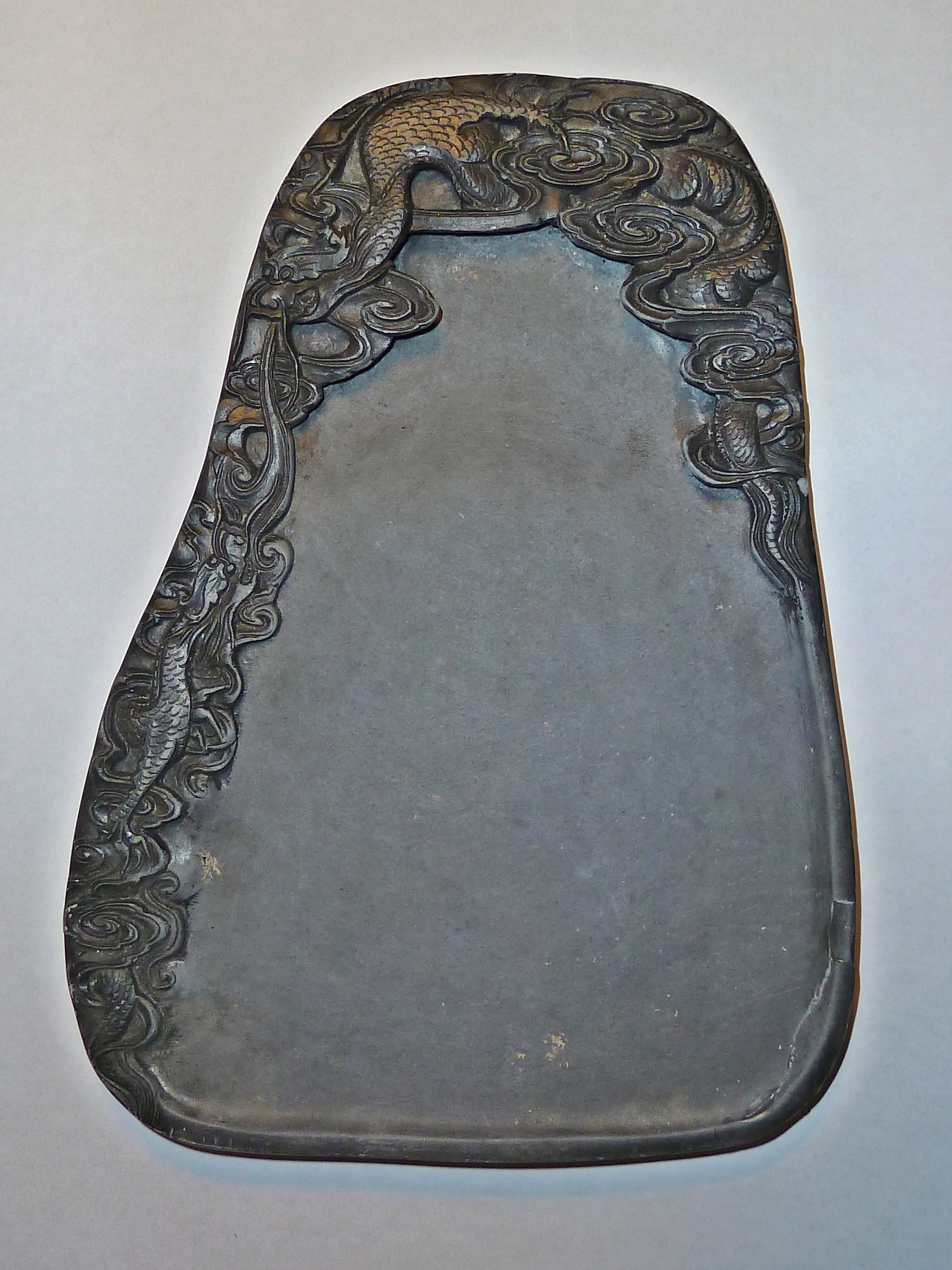
The above stone is Chinese and measures about 8.5 x 6 inches (22 x 15 cm). What kind of stone it is – most likely a slate – I cannot tell you for sure, but I will say the design is more Chinese, from what I know, than Japanese. The stone has a rather bell-like sound to it when tapped. Breathing on the stone shows little retention of surface moisture, as do some other stones, but a thin layer of water holds to the surface, then vanishes. I have not ground any ink on the stone as of this writing. Also, I have no idea where or when I purchased this stone! I expect I bought the stone because I like the carvings of the dragon in the clouds more than anything else – I’m a water dragon myself.

Unfortunately, when I unpacked the stone, a number of chips were in the box. I managed to salvage a few, and, not knowing what type of glue to use, decided to just try white glue. As the stone is porous, and white glue works well on porcelain, I decided to give it a shot. Admittedly, it doesn’t look great, especially in large pictures, but the mending is not too noticeable in the large picture of the stone itself. The stone seems rather soft, which may account for the issue of low moisture retention on its surface, so it may be rather porous as well. However, until I use it to make ink, I really cannot assess its grinding qualities.

I love the energy of the carving! You can just imagine wild, stormy weather, and a fearsome dragon flying through the clouds.

The carving on this stone is quite fine, with thin lines being well expressed in the undulating lines of the dragon’s body as he flies through the clouds. Scales are small and subtle; the whorling clouds undulate gracefully over the carved surfaces.

There are also small, light inclusions in the stone, which probably to the knowledgeable will give a lot more information about the type of stone this is, and its origins.
This stone is enjoyable for its carving and size. I’ll ink it up in the next few days and tell you what I think. And, hey, maybe I’ll even do some painting (at last!).
The August Project: Bone Strokes
Kaishu / Kaisho – standard or regular script, with some variations over time, is what most of us are familiar with as Chinese characters or Japanese kanji. It fits nicely into squares, but it goes far, far beyond that. There are a lot of dynamics at work in this script! Dots and lines, hooks, and so on. It is amazingly complicated in some ways, but not in others. But doing it right is another story.
This is an example of regular script, from a long, long time ago.
 If you look closely, you will find some long, horizontal lines, which are wider at either end and narrow toward the middle. These are called “bone strokes.” Here is one below – and the path the brush should follow as you create it.
 The work of the day. 4 hours. Horizontal accomplished, but initial brush stroke and ending brush strokes are far from attractive.


 Ink, Yarn & Beer