Sometimes I have too much fun making up titles for my posts!
This is a colored pencil exercise I did, just because. I used the more highly textured side of a piece of Mi Teintes pastel paper, choosing a rather grey paper with threads of darker grey running through it. I drew the cherry blossoms on with a graphite pencil and then laid down a rather heavy layer of whites, greens and brown for the blossoms, leaves, and branch. From there, more colors, burnishing and blending. Finally, I scribbled in a turquoise background, followed by layers of blues and lighter colors as well.
Initially, I decided to use a tortillon to blend the background colors, attempting to emulate the bokeh one sees in photographs. Bokeh is a wonderful bit of photography at times, achieved either via the lens itself, or distance between the object in focus and the next object behind the primary one. To blur colored pencil requires a lot of pencil color and a bit of elbow grease. Not quite what you would get when blending pastels.
Never having done it, but interested in the effect, I took a small amount of odorless mineral spirits, a soft brush, and began to blend the colors in the background. Where there were heavier layers, the colors blurred and blended more readily. I waited for the mineral spirits to evaporate and then added more color. More blending, this time painting around the cherry blossoms and branch with the loosened pigment. More drying. Finally, a bit of blending – very little, with a very light touch – of the leaves and blossoms. To complete the drawing, sharp colored pencils were used to enhance the branches and yellow pollen in the center of the blossoms.
I decided to try bokeh in colored pencil as I think that is what my teacher said we will be doing in our class Thursday morning, as well as drawing on black paper. This was a fun exercise and like everything, doing equates learning and understanding. Let’s see what Thursday class will bring . . .
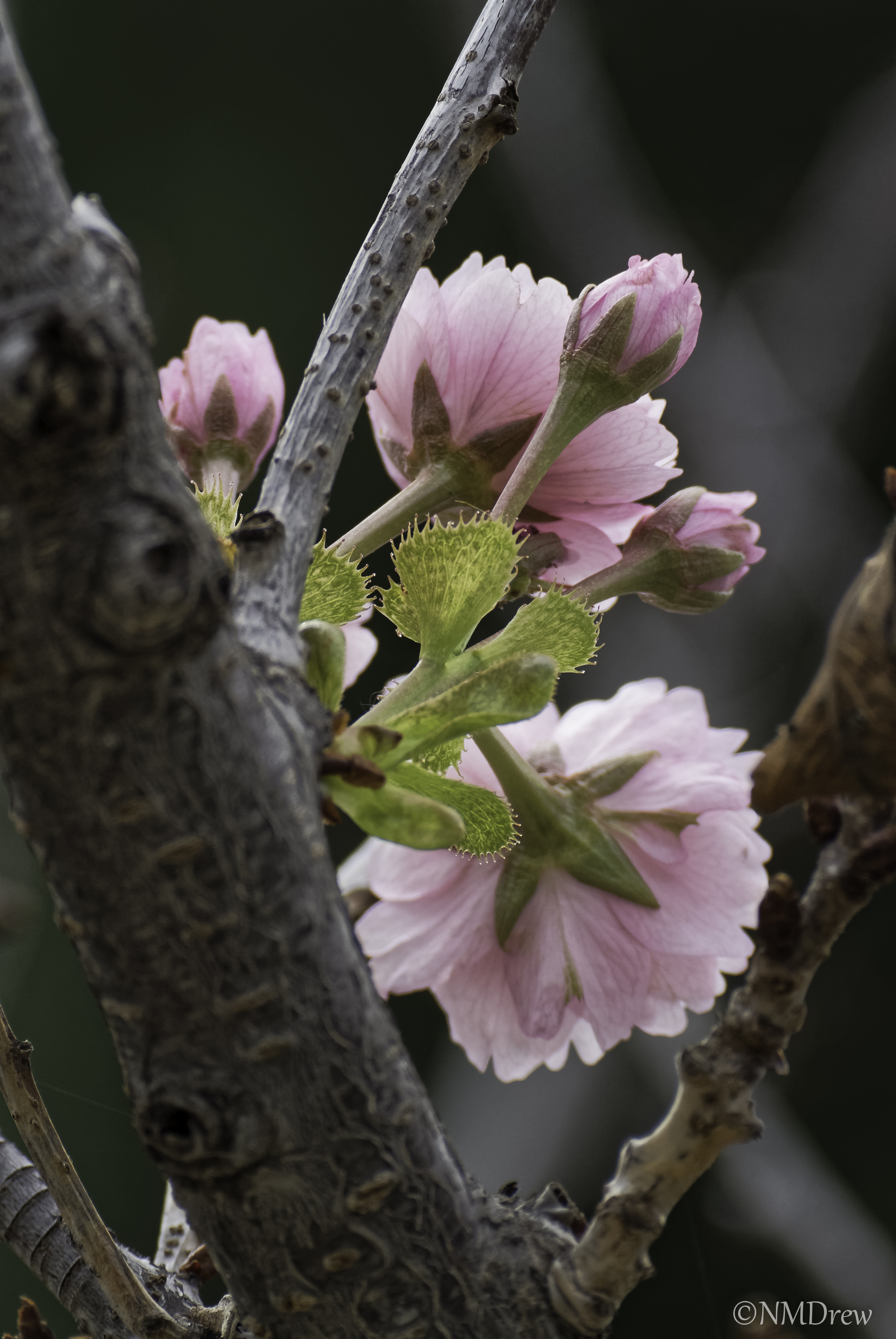
The first cherry blossoms of spring have arrived at a local garden. With our past week’s heat wave (90+ F), the spring bloom in the hills is fading, and I was worried the cherry blossoms would have been blighted. Not so – at least for a few!
According to Wikipedia, and other internet sources, there are four main ink stones historically prized throughout China:
For serious calligraphers and painters, a good inkstone is as important as the quality of the ink. An inkstone will affect the quality and texture of the ink that is ground upon it. Four kinds of inkstones are especially noted in inkstone art history and are popularly known as the “Four Famous Inkstones.”
The first is Duanshi stone (Japanese: Tankei) (端石砚) from Duanxi, Guangdong. Duan stone is a volcanic tuff, commonly of a purple to a purple-red color. There are various distinctive markings such as eyes that were traditionally valued in the stone. A green variety of the stone was mined in the Song period. Duan inkstones are carefully categorized by the mines (k’eng) from which the raw stone was excavated. Particular mines were open only for discrete periods in history. For example, the Mazukeng mine was originally opened in the Qianlong period (1736-1795), although reopened in modern times.
She stone (Japanese: Kyū) (歙砚) from She County, Anhui. This stone is a variety of slate and like Duan stone is categorized by the various mines from which the stone was obtained historically. It is a black color and displays a variety of celebrated gold-like markings. These inkstones likewise date from the late Tang period.
Of great rarity is Tao River stone (洮河砚) from South Gansu. This stone is no longer found today and was gathered from a river bottom in the Song period. The stone is crystalline and like jade. The stone bears distinct markings such as bands of varying shades. This stone can be easily confused with Duan stone of the green variety, but can be distinguished by a careful observation of its crystalline nature.
Chengni ceramic stone (澄泥砚) is a ceramic-manufactured inkstone. This process was begun in the Tang period and is said to have originated in Luoyang, Henan.
She Ink Stones
In particular, the She ink stone has long been prized for its quality.
The history of inkstone goes back to over 5,000 years ago. There is a lot of archeological evidence that Chinese used inkstone for grinding ink. There was a stone inkstone found in a 5,000-year-old archeological site in Jiazhai of Shanxi Province.
As one of the essential tool of ink brush painting, She inkstone, produced in Anhui Province in East China, is one of the most sought collector’s item among the literati and elite for thousands of years. It is one of the Four Great Inkstones in Chinese history.It is named after Shezhou Prefecture, Anhui Province, where it was first produced in the Tang Dynasty (618-907). Many counties under the jurisdiction of this prefecture produce She ink slabs, but the best come from Longwei Mountain in Wuyuan County. Sometimes She ink slabs are referred to as Longwei inkstones.
She inkstone is made of gray, light green, or black rare slate with markings, and the stone appears in layers and is hard. She inkstone has three features: quick forming of ink, no harm done to the brush, and preserving wetness of ink.
She inkstone has a special artistic style with different markings resulting from geological changes with passage of time. Typical markings are Gold Star, Gold Star Patch, Gold Line, Silver Star, Silver Line, Cherry Blossom Gold Star, and Small Water Wave. More rare ones are Eyebrows, Jade Belt, Jade Belt with Gold Star, Big Water Wave, Fish Egg, Dates Kernel Eyebrows, Jade Patch, and so on.
My Suzuri
The inkstone I am writing about today is my favorite. I purchased it a number of years ago from Japan, but it is Chinese in origin. It is a very large, very heavy stone, encased in a custom rosewood box. The box measures 6 3/4 x 9 7/8 inches (17 x 25 cm) and weighs 1 lb 10.2 oz (745 g), while the stone measures 5 3/8 x 9 inches (13.65 x 22.86 cm) and weighs 4 lbs. 10.4 oz (2.1 kg). It is my understanding that this is a She inkstone, and over 70 years old. Acorn Planet has a lot of information about Chinese ink stones – unfortunately, they no longer sell them.
Custom Box for Suzuri
Custom Made Suzuri Box
Boxes are custom made for each high quality suzuri, to ensure protection as well as a fit unique to the shape of each stone. Above, you can see the box for this stone. It is solid and heavy, made of rosewood. The wood is smoothly polished. The bottom half of the box holds the suzuri securely. Underneath, small feet provide support. Altogether, the box is a work of art in itself.
Inside Bottom of the Box
Underside of Box Bottom - Notice the Feet in Each Corner
My stone itself is a beautiful dark grey color, with a single inclusion or marking, which is skillfully centered in the middle of the carvings, like the moon amongst tree branches on a foggy night. The well is deep, and the slope onto the flat surface is evenly carved. There are no rough spots on this stone. Touching the stone, it is cool. The sound of the stone, when tapped, is clear and crisp. Breathing onto the stone, the moisture from one’s breath sits on the surface, and slowly – very slowly – evaporates or is absorbed by the stone, which shows the correct porosity for hand-ground ink. Tilting the stone in sunlight shows fine sparkles, indicating the presence of pyrites.
My Best Suzuri
Ink ground on this stone is very fine, and quickly ground, and rests easily on the surface with little need to replenish the water. I use my finest Japanese ink sticks on this stone – to use ones of dubious quality would possibly ruin its smooth surface if there were coarse grains within the ink stick. To pour liquid ink onto it would be sacrilege!
Suzuri with Lid
Suzuri with Lid
High quality stones, according to some web sources, are well-carved, but without excessive design. Lesser quality stones may be more elaborately carved to increase their value. Various inclusions, such as color streaks or the dots, as seen on this stone, are rare and add to the value of the stone. This stone has a narrow band of elaborate carving at the top, of cherry blossoms, bamboo, and birds. Its style is very Chinese, from what I can tell; Japanese stones have different carving characteristics.
Carving Detail
Carving Detail, Close Up
Carving Detail
Inclusion or Marking
There is no way to describe the intense pleasure which comes from using a fine inkstone – it is an experience unique to itself. Any sumi artist or calligrapher will know what I mean. I am very fortunate to be able to enjoy such a wonderful stone.




 Ink, Yarn & Beer