Between the Mountains

One thing I love about California is the fact that the geography varies so much! Oceans with flat beaches, oceans with cliffs, mountains with snow and mountains with pine trees, and deserts stretching flat and hot, surrounded by mountains and creating a secret world fascinating and forbidding. Worldwide, deserts host animals and plants and insects which survive on little water, are stark and seemingly dead – but of such beauty. Deserts are not for everyone – familiar and comfortable landscapes full of trees and greenery are very different. It took me a long time to appreciate a more stark landscape than the rolling green hills and woods of the midwest and eastern seaboard.
This is a painting I have been working on in my weekly class, inspired by multiple memories and photos taken. I had a limited palette of white, ultramarine blue, Indian yellow, and light green. I tried to catch a golden glow as well as give a yellow-orange cast to the desert floor and hillsides – and create a softly blended painting.

Oil, 12 x 16 canvas panel.

Sand Dunes in Death Valley

Death Valley is up and off Hwy 395 along the Eastern Sierra Mountains in California. It’s a strange and eerily beautiful place with a lot of surprises and history. It is preserved as Death Valley National Park. The website is filled with great information and it is one of the best places to visit – in the right season, and in the right weather. People die in the desert because they do not understand it, so if you go, be careful!

Sand dunes always amaze me. I am still stuck in my child’s view of the world that sand dunes exist only in the Sahara, and can only be found by riding a camel. Silly, yes!

There are sand dunes everywhere – beaches and deserts mostly, but sometimes in places you least expect. Their shifting shape in the wind and blowing away foot prints or burying ancient cities all lead to a fascination as they make everything seem so temporal.

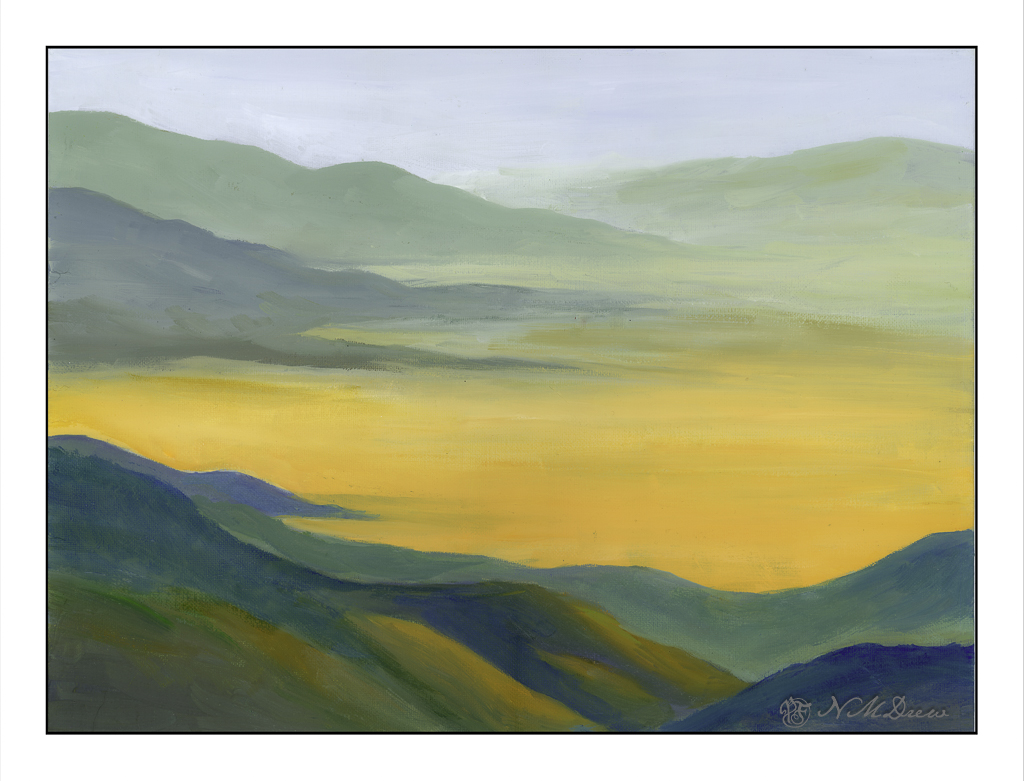
Anyway . . . . this is an oil painting using a limited palette. Some of the goals in doing this painting included smooth, smooth brushwork for the dunes. I tried to catch the gradual gradations and color changes I saw. In the distance is the flat valley before the towering mountains. For each I used directional brushwork and a deliberate vagueness to create a surreal effect. The mountains, when I look at them afresh, can also be visualized as swirling clouds. Interpretation I will leave to your eye.

Oil on canvas panel; 16 x 20 inches.

Winter Road in Hill Country

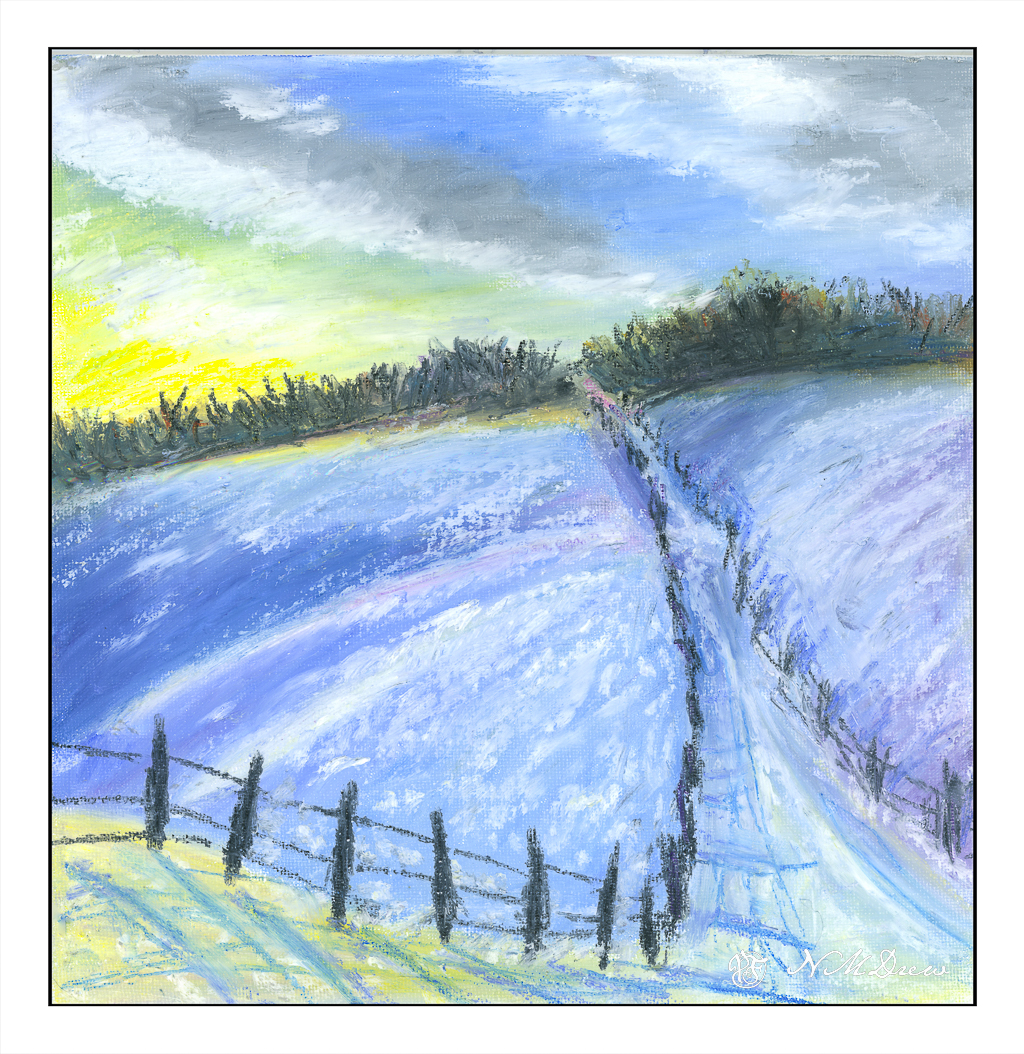
Today I decided to do some oil pastels. This is my second – no, third – painting in the medium. The cat and mandarin were on Strathmore 300 watercolor paper; this is on an 8×8 cotton canvas panel, the kind used for oils or acrylics. I read you could use oil pastels on nearly any kind of surface, so I grabbed this just to try it out.

To tell the truth, oil pastels are fun to use, but they are also tricky. Blending colors makes sense – layer this with that to make thus – but the blending itself is a rather creative experience. I used stumps (tortillons) for the most part, but toward the end I used my finger tips. Also, I found out that if I put on too many layers, eventually the newer layers pull off the underlying colors. While this could work for some desired effect, it was problematic in other ways. Live and learn, right?

I scanned this canvas on my Epson V600 (one of my best purchases!) as photographing paintings is time consuming, tedious, and usually worthless the way I do it. Two scans were needed, and in between I had to wipe of the glass platen to remove little oil pastel bits. Apparently oil pastels never really dry out, but you can apply a finishing spray to them. Sennelier makes one, which I bought along with my pastels, which I will try probably next week.