Even though our trip was stopped by Covid-19, I did get a number of photos along the way. Olancha, CA, is one of those little towns without a lot of amenities, but big in different ways. Here are some – and were some – nice little restaurants that provide comfort to the hungry and a much-needed break from the car. Little dirt roads catch the eye, and trees and houses break up the flat land leading to the grandeur of the Eastern Sierra Nevadas. So, even though my trip was canceled, I d intend to create sketches of what I saw along the way . . .
I have a lot of fun setting the X100V to A (for “auto”) for everything, and just shooting out the window of the car as we drive along. Sometimes reflections in the car show up, but that is really irrelevant when trying to catch the flavor of a place and it’s over 105F in the shade. Here, a shot through the window which shows the lovely barrenness of the Owens Valley.
Manzanar was an interment camp for Americans of Japanese ancestry, native-born, citizens, Japanese-born. All of this because the Japanese attacked Pearl Harbor on December 7, 1941. This event drew America, at last, into World War II, in both Asia and Europe.
The Japanese are a minority within the US, and like many groups, faced discrimination. Other groups, though, because they were European – Caucasian – were not interred. Did the US inter people of German or Italian descent during WWII? No . . . and for sheerly pragmatic reasons . . . probaby 25% of the entire population of the country would have to be locked up, fed, and guarded.
A friend of mine, who is Japanese-American, said that the displays at Manzanar make it look like it was fun to be there rather than a prison. Granted, it was a concentration camp, but it was not like the camps run by Axis powers in WWII. Another friend, who spent her childhood at a camp in Arizona, said it was like going to summer camp. As a child, it could perhaps be seen as such, but as an adult? I wonder how many adults were “broken” by the experience.
Manzanar is in the Owens Valley along Highway 395 in California, on the eastern of the Sierra Nevada mountains. The land was once a fertile valley, but in the early 1900s, Los Angeles began buying up water rights. The result was the water that kept the valley green was sent to L.A., and Owens Lake and Owens River soon disappeared. As the water disappeared, so did farming and wildlife, and in its wake, a dryer, harsher land emerged. It is still beautiful, but it is also the result of politics and greed.
So, this was a perfect place to make an interment camp for people perceived as “the enemy.” It’s always good to have someone to blame and someone at whom to direct hatred. Governments and political forces do this all the time. We have evidence of it throughout history. The Japanese were the American boogey-men of the 1940s. However, the Japanese servicemen in the 442nd Infantry Regiment were the most decorated fighting unit, “enemies” fighting another enemy.
But I digress. Manzanar was one of many concentration camps to inter the Japanese. Today it is a National Historic Site, located between Lone Pine and Independence. It is dry and hot, cold and windy, depending on the time of year. I have driven through this area in summer, in 105+ F heat. We stayed in Independence, in a hotel with minimal modern conveniences, such as air conditioning. It was around 100F – and we were miserable. I can only imagine what it was like without it, in shacks slapped together in haste, insulated with nothing. Hell in winter. Hell in summer.
Life in some ways was normal – and in many ways it was not. Detailing life at Manzanar would take pages. Simply put, people lived and died and were born at Manzanar. Above is a memorial to those who died at Manzanar – people of all ages, from babies, teens, adults, and the elderly – for a variety of reasons. This obelisk is in the far rear of Manzanar, in the cemetery, set against the Sierras. It’s austere lines meet the sky and the harsh beauty of the land. It seems to say it all.
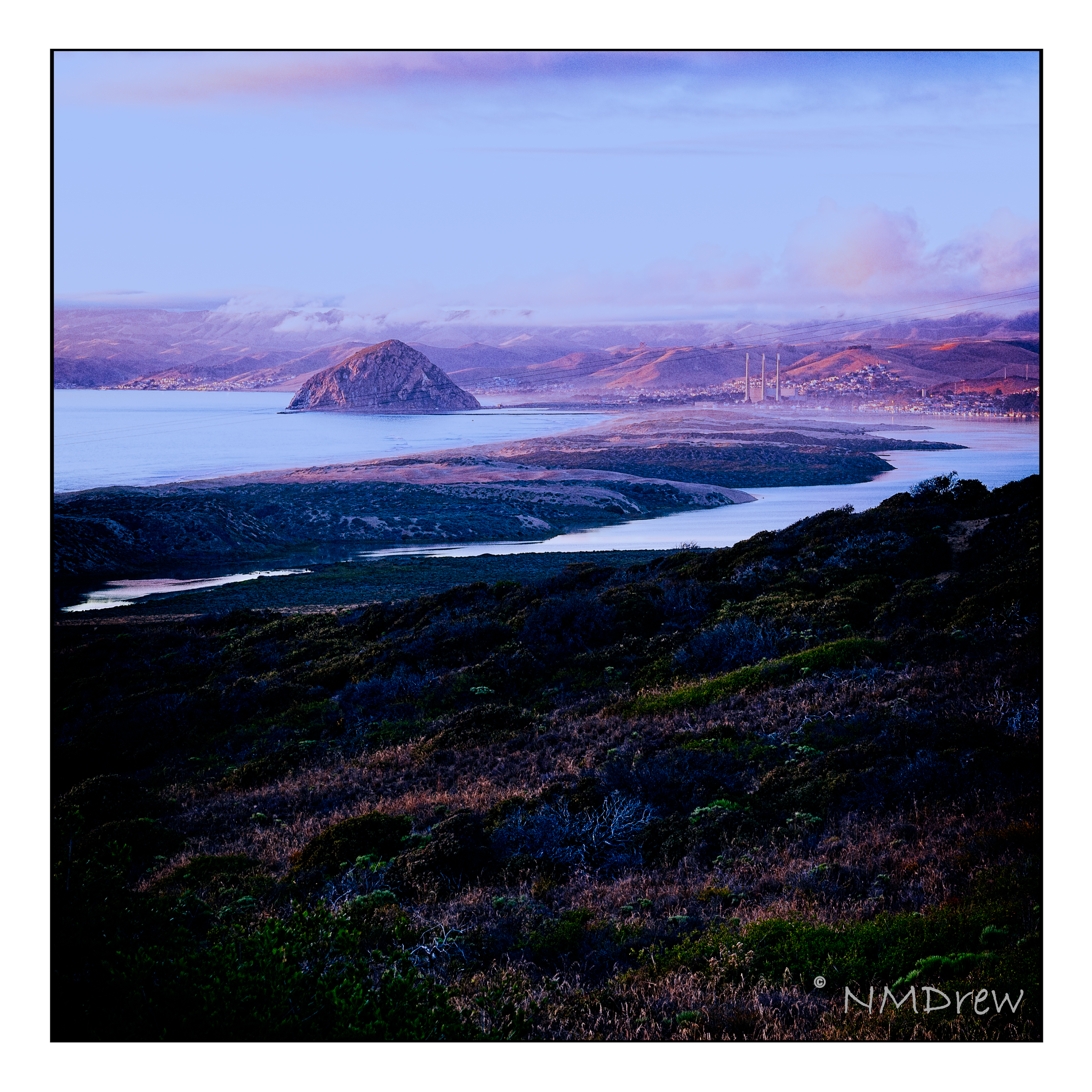
A few months ago, a 4-day trip to Morro Bay. Here, a sunset from Montana de Oro State Park overlooking the coastline and the town of Morro Bay. It was a great way to end a short and pleasant getaway.
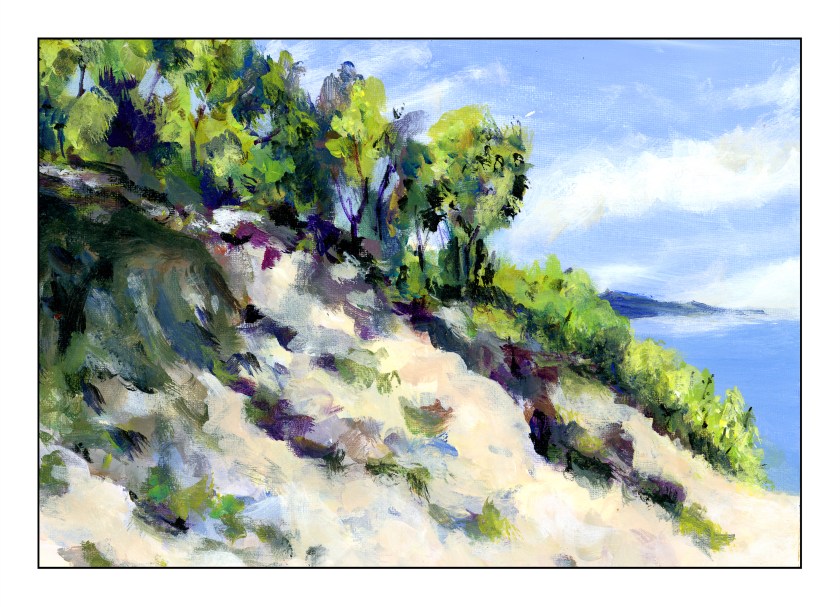
Another attempt at acrylic painting. This time I used a sheet from a Fredrix linen pad. I gessoed it and then used, initially, the Open medium with the paints, but I didn’t like the way it was working, and so switched to regular matte medium to dilute the paints. I tried to use the paints fairly straight out of the tube, blending with white and matte medium. The result was a fairly thick paint that behaved well.
The Carpinteria Bluffs are located in the southernmost section of Santa Barbara County, just above the border of Ventura County, where I currently live. Carpinteria was home for many years and always enjoy returning, especially in summer when the light shifts and everything has a glow of its own. Eucalyptus trees and other plant life make for a wonderful walk along the cliffs above the Pacific, and across the Santa Barbara Channel are the various islands that make up the Channel Island National Park. This might be San Miguel Island, but I can never remember which one is which!



 Ink, Yarn & Beer