Some Thoughts and Extrapolations on Black and White Photography


I am beginning to see why people got so excited about color photography when it became available.  While I love the drama and the graphics that black and white possess, its minimalism and aesthetics, I am suddenly feeling the lack of color in my edited photography.  Because we live in a world of color (most of us, anyway), the lack of color is a form of sensory deprivation, I think.  Our senses enrich our lives on many levels and when one sense is changed or different, our lives change and become different, and more limited.  Editing out color is getting a bit depressing!

Think about clothing and material.  200 years ago, only the rich or moderately comfortable could afford more than one or two outfits to wear.  Colors were expensive and time-consuming to produce; even naturally colored fabrics were labor intensive, but color added to that labor.  The wealthy, the aristocrats, wore amazing clothes – ones we wouldn’t even consider today as far as color and fabrics:  gold, purples, lace.  Today, our clothing is black and white and monochrome because our world today is overwhelmed by the stimulus of color – and the media – and music – and noise – and smells – and politics – and people.  Meanwhile, the natural world becomes ever more remote as land is used up and lost to disasters.  Without the natural world, we become lost.

So, black and white photography, as beautiful as it is, is a restrictive diet.  It’s like eating one thing every day for every meal.  My silent black and white project is making me a bit crazy – I like words, I love color.  On the other hand, it is forcing me to think differently – very differently – than I usually do.  Add to it the fact I now am retired and my entire day – the entire rest of my life – lies ahead of me without commitments – and it becomes overwhelming on one side, and so exciting on the other.

The word is potential.  Black and white photography is filled with it.  Suddenly, mood is becoming more important than subject matter.  How I manipulate subject matter is the focal point of the image.  Mood is, as I think of it, what I am trying to say.

This lack of color is remaking my conceptions of art and life – for the better?  for the worse?  New doors are opening as the restrictive quality of silent black and white continues.
Style

Definition search result for STYLE (straight from Google search “definition style”):  1.  a manner of doing something.  2.  a distinctive appearance, typically determined by the principles according to which something is designed. 

I’ve been thinking a lot about style of late, as in style of music, clothing, politics, painting, drawing, writing.  Since we are all individuals, we all have ways of doing things that earmark them as our own.

I don’t particularly care for what I might consider my native way of drawing and painting.  I have a vision in my mind’s eye about how I want things to look as a finished product.  That doesn’t mean no happy accidents, but it does mean I have a certain vision of clarity with watercolor paints in particular.  I think a lot of what I paint seems labored – and maybe that is because I did the laboring?  My paints seem heavy and more opaque rather than utilizing the transparency of the medium.

Copying

Copying a master’s work is a time-honored tradition for art students, whether sitting in the Louvre and copying a Rembrandt (if they still let people do that, like they did in the 1800s), or a sumi-e student in training.

Today there seems to be a shunning of such, with more of an emphasis on “originality” coupled with a fear of lawsuits for copyright infringement.  If you think about it, nothing is really “original” but derivations of other’s works or our own creative minds, but someone before you or me probably had the same idea.  Forgers can make a bit of money by copying masters, and passing them off as the master’s, but with today’s technology, I expect that becomes a bit more difficult.  By the same token, can using a photograph as a springboard to a painting can be considered under some circumstances as copying – even if you have taken the same picture yourself?  It’s my understanding you cannot take pictures of the Eiffel Tower lit up at night because those photographs are copyrighted by the lighting of the tower!  That is how crazy this world can be.

Learning from Copying

What do you learn when you copy someone else’s work?  What do you have to do to “get” there?  You have to look, think, analyze, plan, and then look, think, analyze, and plan again.  After you do that, where do you go?  How can you apply what you have learned to make your newfound knowledge your own?  I struggle with this as there are artists I admire, whose work inspires me – how do I make what I have learned in the process of copying my own?  I am still trying to figure this out.

One thing I do not want to do is pass something off as original if I have copied it as a learning experience.  That is completely unethical.  I find it interesting that certain art instructors make it well known that, if you have taken a workshop with them, any work derived from learning in that workshop cannot be sold as “original.”  Does that mean their “style” is copyrighted?  Does this mean if you develop a style with your own subject matter which is similar to what you have learned that you can be sued for copyright infringement?  If such is the case, none of us can produce anything – this building is copyrighted, that tree is copyrighted, that person is subject to privacy laws, that color is copyrighted, that song sound is copyrighted, that rhythm is copyrighted.  If you do DNA testing, you may be signing away your rights to your own body’s chemical makeup.

So, What Happens Now?

Well, I know what I want to accomplish in my painting.  To list it:

  • clarity of color
  • economy of composition (meaning not overworking something) and simplicity
  • mastery

I prefer landscapes to portraits or animals.  I can do skies fairly well.  Trees, sometimes; mountains, sometimes.  Cityscapes?  Seascapes?  Challenges for sure.  What about painting cars – part of cityscapes!  Waves – part of seascapes.  Water?  Omigod!  It’s overwhelming.

Enough whining and pontificating – time to get out the brushes and color!


The Studio

I’ve had a room I call “The Studio” for years now – but somehow it has never felt especially complete until yesterday.  Why?  I bought a sewing table.  For the last 30 years I have had to clear off the drafting table or take over the dining table to sew.  It’s a nuisance for someone who really enjoys sewing but hates clutter.  Take things out.  Put things away.  Hate the mess of clutter.  Hate the urgency to put things away.  Thus, on a whim, when I saw this table, I bought it.  Because it was a floor model, it was marked down, but even better, it was already assembled!  At last, my sewing urges can be allowed to stay out in the open, at my whim and will.

Sewing has its corner.

Painting has its own corner.

Computer has its own corner.

Cameras and supplies are on the shelves, as are books and paper and paint and thread.

All is right with the world.

Why Draw?

I am not quite sure what hit me the other day, but I wandered off to the local library to look at kids’ books.

Where I live, we are fortunate to have a well-run, financially sound (so it seems) library system.  There are about 130 K people here, and only two libraries to serve the population, but both libraries are well-designed, light, airy, and busy.  Busy meaning there are kids and teenagers and adults, as well as scheduled activities, such as lectures and movies.

The children’s section of the library is separate from the adult.  There are sections for young adult, for research, for youngish readers (8-12?), and for non-readers and beginners.  The shelves are the right height for kids, and topped with books and displays to catch the eye.

Okay, so what does this have to do with drawing?  A lot!  Good illustrations add so much to a story, for both children and adults.  Textbooks without illustrations are unattractive.  Color adds more.  And children’s books need pictures – just like Alice said, “What is the use of a book if there are no pictures?”

Yeah, there is a lot of use for pictureless books – but they are even more useful with illustrations.

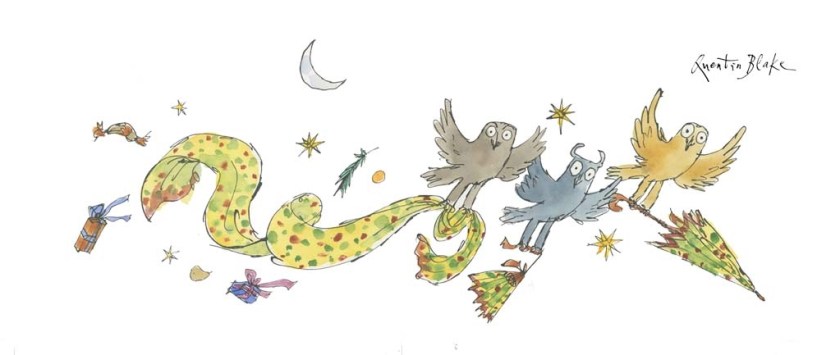
So, here I am, wandering through the children’s section, looking at this book and that.  Most books had written words with pictures to illustrate them.  And then I came across Clown by Quentin Blake.  Blake is the illustrator for many of Roald Dahl’s books (you know, Charlie and the Chocolate Factory).  Clown is a story without words, only pictures.  I had a few good laughs as I “read” the book, and totally enjoyed the illustrations.

Blake is the master of light mood, caught with pen and watercolor.  A loose style that, nonetheless, is filled with details.  When the clown wriggles out of the garbage can, you have to look to see it happening – but you do!  When I looked again and again, so many things showed up.

Then I looked at more of his books.  Cockatoos had me laughing out loud.  Illustrations and story worked so well together – I loved to see all the cockatoos hiding, and I loved the last line in the story.

I blither about art, and drawing, and writing, a lot.  The mental arguments are strange and annoying.  I put up barriers and fill time with meaningless twaddle when I could be out doing something.  I have fought with myself over and over again about my “style” in the painted, colored, drawn world.  It was never technically accurate or realistic enough.  I am confident about my writing style – academically, I can crank out papers at an appalling rate – but with drawing, I drag my feet, tormenting myself with my perceived failures and inabilities.

The light bulb went on with Clown.  I love that loose, fun style.  Is it “art”?  Probably not – but why should that matter?  If it brings pleasure and communicates, I guess that is definition enough.

Yesterday, I took out my own pen and ink and began to doodle.  I didn’t care what I drew.  My imagine was allowed to play without rules.

Thrills.  Intoxication.

How I love paper and pencil and ink!

New Year, New Focus

paint-boxes-1189945_1280

I’ve done watercolor off and on since I was a teenager, back before the dinosaurs disappeared, but I have never made it a resolution to spend time – a lot of time – mastering it.  Rather, the approach I have had has been sporadic and amateurish.  Now, I want to be the “serious student” I never was . . . and while I think I am off to a good start, the real question which lies ahead is how well will I integrate painting into my work life?  I’ve managed to integrate both sumi-e and photography into my life, but I began both of those long before I ended up working 10-hour days.

There are a lot of good books about “how to” watercolor, and I have looked through and purchased a number of them.  As well, there are a number of good YouTube channels with talented artists, with whom you get to cruise along with as they produce a painting.  For me, this visual is what gets me all the time.  While books show you step-by-step photos, some in color, some in black and white, there is absolutely nothing like the video of beginning-to-end, with commentary as the painting develops.

I still plan on pursuing photography – in fact, I have a 365 project planned, with different subjects on a monthly basis.  While I am shifting my focus away from photography as my primary creative outlet, I really want to master watercolor and drawing, and to do so, I need to spend more time doing it rather than thinking about doing it.

So, Happy New Year to everyone!  I hope you have new intentions to keep you happy and creative in your life!