Sparkly Day

The way the light shimmers through leaves on a bright day is something so difficult to capture in a photograph or a painting. The contrasts between light and dark shift and change to be almost blinding.
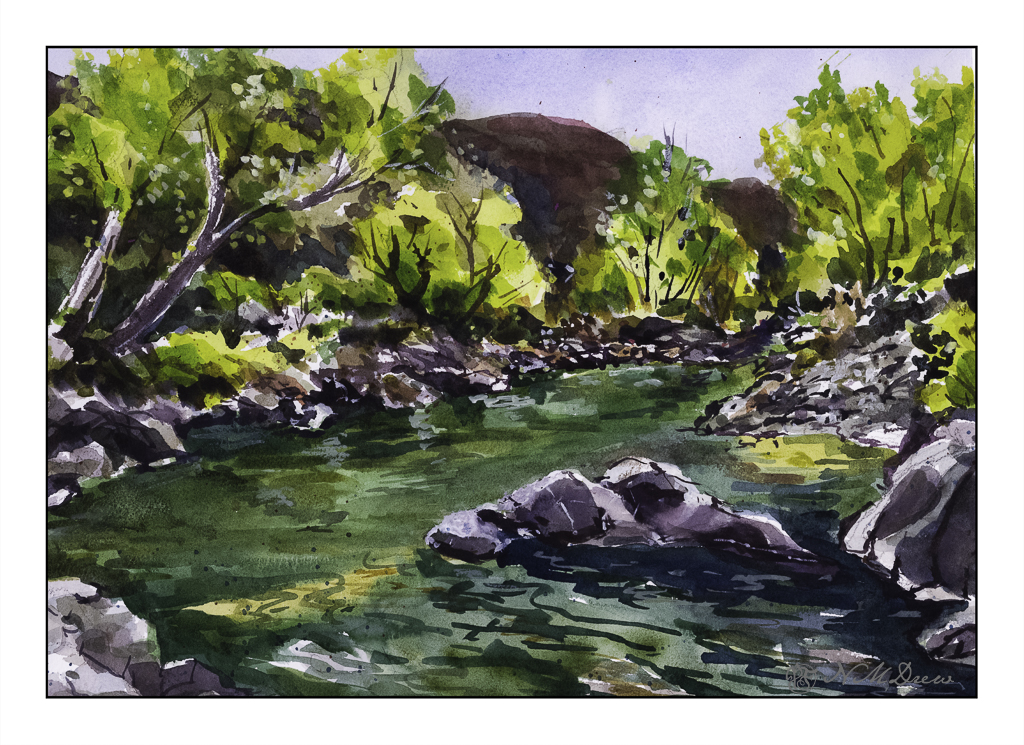
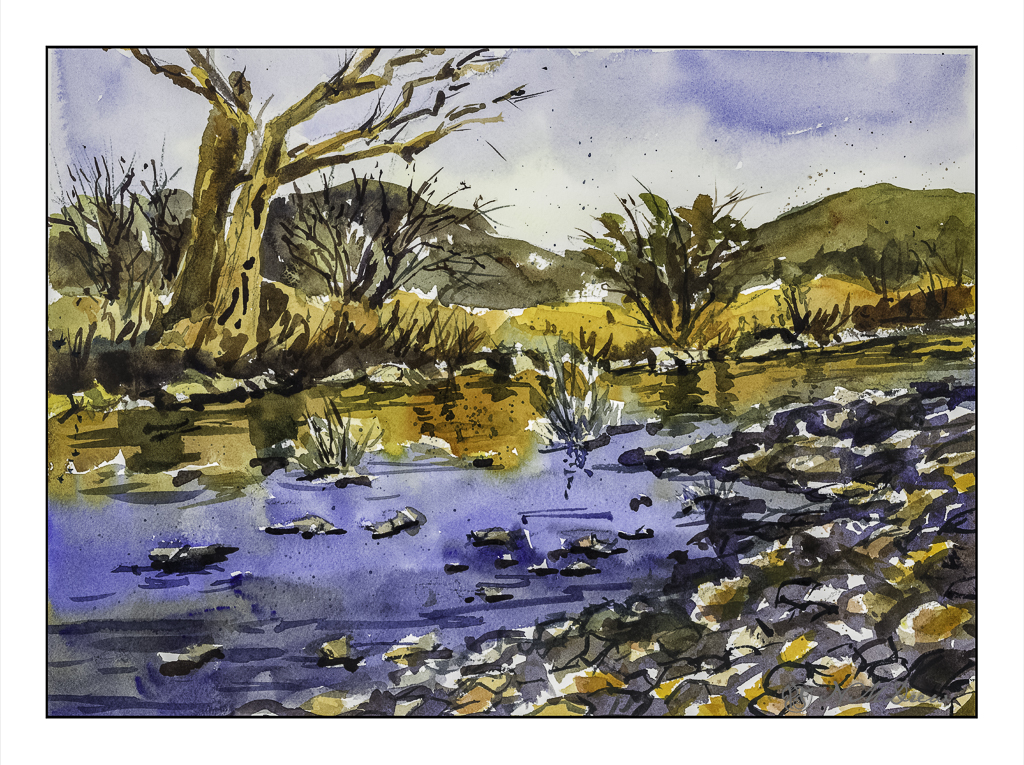
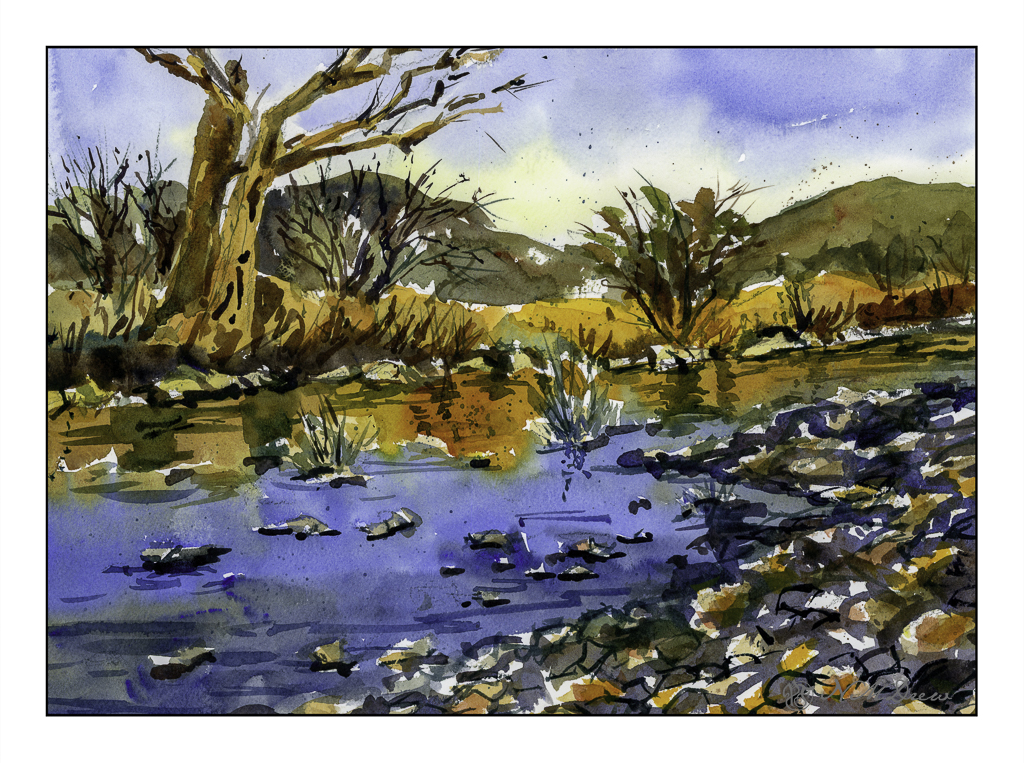
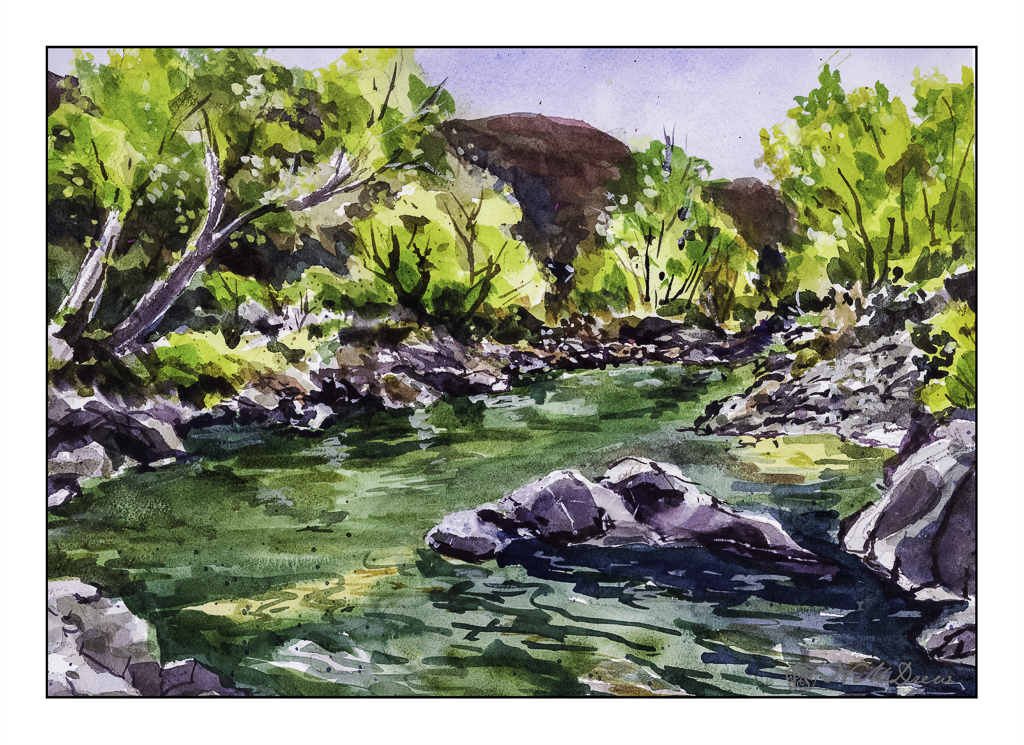
This is a creek running through the Coconino National Forest in Arizona. It is near Flagstaff and Sedona, and the terrain varies from alpine to the red rocks of Sedona and creeks and forests of Ponderosa pines. The above scan is a VueScan image with some corrections. Below is one using Epson Scan.
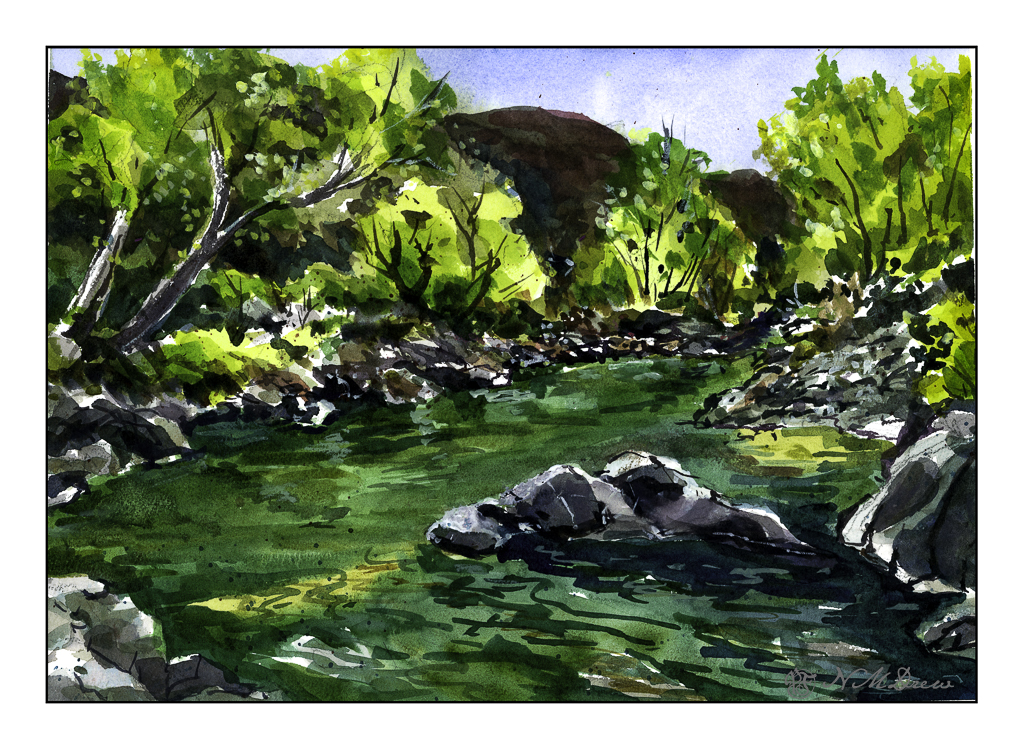
Neither scan really does justice to the colors, but the sparkle is caught. I think like a camera a scanner and software has difficulty with subtle variations from light to dark.

Sigh.

So, what did I try to do today? First, a bit of a limited palette. I didn’t do a triad, as with yesterday’s painting. I used (off the top of my head) mostly ultramarine blue, cadmium yellow, and burnt sienna, but into that mix I added Hooker’s green, cobalt teal, phthalo blue. The greys of the rocks came mostly from ultramarine and burnt sienna. Hooker’s provided a basis for some of the more obvious greens, but the cobalt teal mixed with yellow were used for the lighter, brighter greens you seen in springtime. Some titanium white gouache was applied here and there.

Additionally, besides limiting my colors, I tried some of the techniques for the water. Here, there were swaths of shallow water with an ochre coloring, reflections of rocks and trees in the water, and shadows beneath the rocks in the foreground and lower right. I didn’t use enough color and water to create a bead to allow blending – I have been told I would make a stingy bartender! – but still managed to get some of the colors to blend with one another. I also did glazes to show direction of water and movement. It turned out better than I thought it would – if nothing else, I need to be more generous and allow more paint and water than I think I will need. This something we all need to learn – how much is too little, how much is too much. Of course, the Goldilocks effect is best!

Watercolor, Arches 140# CP paper, 10×14.

Oh, hell – here’s another scan!!
Watercolor Triad – Desert Wash Scene

Well, the electricity is off again. I feel like I am living on a little island because only a few people in my neighborhood are affected. Fortunately, we have our generator! So, light, electricity, internet, and the opportunity to continue with my course on color triads by Shari Blaukopf.

I did the first one, a tropical scene in Florida, and this is the third, the Arizona desert. The second one is winter and since it is cold and rainy outside, the desert appealed to me a bit more. The color triad used here – and easily, too – consisted of New Gamboge (yellow), Ultramarine Blue, and Burnt Sienna. I did not have the New Gamboge, so I mixed Cad Yellow Medium with a bit of Pyrrole Orange to get the color she suggested. These colors are perfect for a late evening in the Arizona desert.

The above scan is with VueScan. It is a bit more subdued than the one below, scanned with Epson Scan. I like both of them, but think the richer colors of the Epson Scan are a bit more to my liking. The warmth of the scene is well done here, and matches my own colors perhaps more closely.

All of Blaukopf’s courses have been a real pleasure to follow. If you like watercolor, I suggest her more than any other online teacher. I never fail to learn something new. For instance, in this class, the golden middle ground, just above the opposite shoreline, included painting the colors up into the trees on the left. From there, at a later point, more detail was added.

The other thing I learned was a really interesting and unique way to do reflections in water. The two colors – golden yellow and then blue – were mixed up in big puddles. First the golden yellow was laid in, with a bead of color at the bottom. Then, with the blue, with space between it and the gold, the blue was brushed in with only a touch onto the golden yellow here and there. This allowed the colors to merge, but not become murky or form blooms. Finally, the darker water of pure ultramarine was mixed with a bit of the golden yellow mixed with burnt sienna.

This triad study was so much fun to do! Time to try some of my own from my own photos.

Watercolors, Arches 140# CP, 9×12. Cad Yellow Med, Pyrrole Orange, Ultramarine Blue, Burnt Sienna.

Structures

Structures

I was rummaging through some LR photos this morning while the gardener weed whacked and mowed away. I came across this one, taken from the car as we drove to or from Tucson, AZ, to get our Global Entry cards verified. When I saw this, I was thinking about “my photographic style” – something I never really think about. I did realize I prefer rather stark things, or bits of something, seldom people unless it is street. I also know I have a lot of fun making a photograph into more than a photograph – something which appeals to me artistically. Heading out next week, I will be bringing a small camera with me as where we will be and where we will be going has a lot of stuff to look at.

Before Class

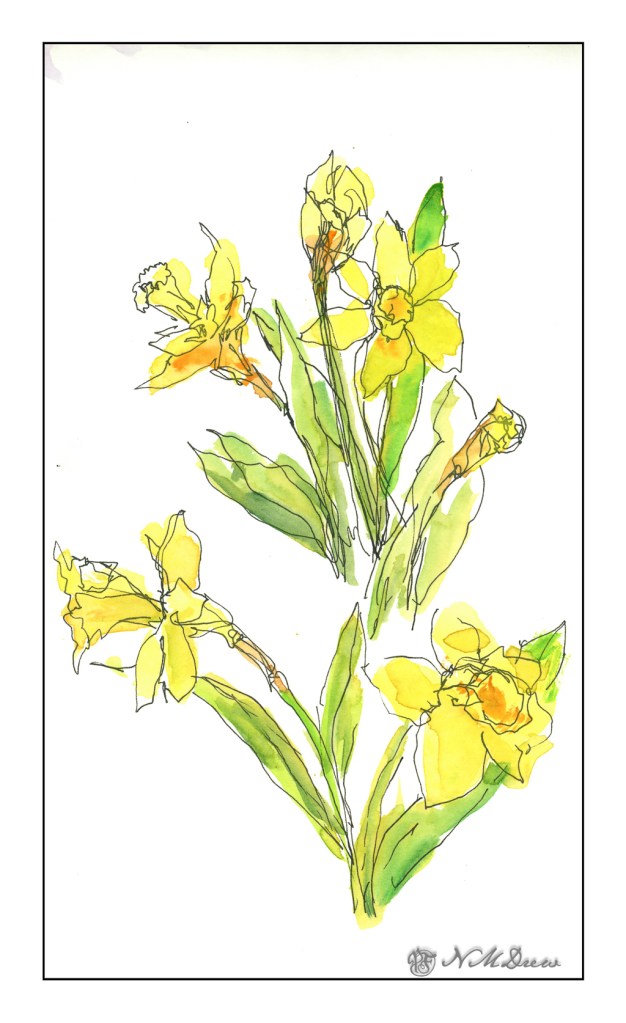
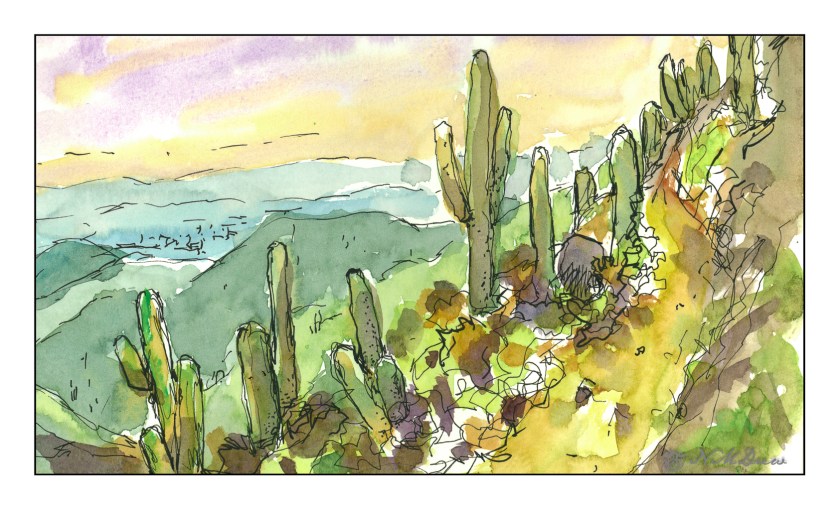
Every Monday afternoon I meet up with a class in oil painting. I paint oils at home, too, and they take far longer to dry than ink or watercolor. Hmmm. I really do miss those two quite a bit, so today, before class, I decided to do two quick sketches and use a bit of watercolor.

The first was daffodils – obviously! I have several in pots, some blooming and fading already, and others sending up leaves and stems and buds. Spring flowers for sure. I have some freesias which are just beginning to bloom, so perhaps some of those later on.

And then some saguaros from the Sonoran Desert. Sunset is always fabulous in Arizona, and here we are overlooking the metroplex that is Tucson / Phoenix in the distance. I am still amazed by these wonderful cacti – so tall and elegant, and silhouetted against the sky they are even more amazing.

Okay – time to pack it up and head out to class!

Winter in the Sonoran Desert

Winter is all over the place today – arctic blasts and cold temperature records. Snow in the South where snow is a rarity. Even the desert sees snow – a fact that never ceases to amaze me because to me a desert is hot, dry, and filled with sand and palm trees. Evidently not here!

First time using Hahnemuhle 140# CP paper, 9×12.