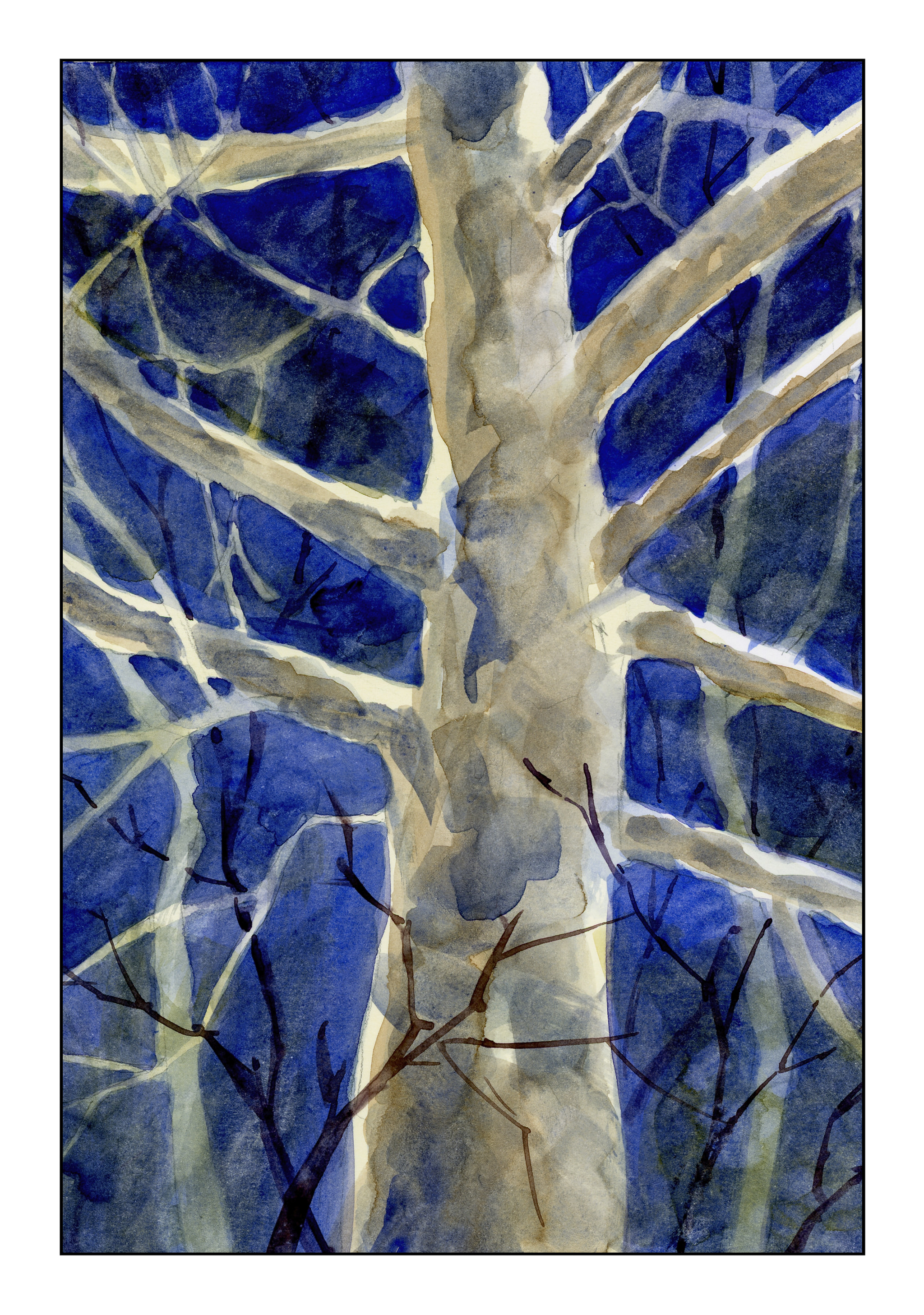
Night is always mysterious and exciting. The moon overhead – clouds – wind- the creaking of branches – the rustles in the undergrowth. This is what I decided to try, using an old sycamore tree as the subject, and a bit of my imagination.
First step was to decide on colors, and approach. I decided warm undertones for the tree and the sky. I used a bit of Quinacridone gold and Yellow Ochre for a thin wash. From there, successive glazes in Ultramarine Blue, Indrathene Blue, and Carbazole Violet. As things progressed, some Burnt Sienna. You can see the different layers below.
Fallen
At times I used a hair dryer to dry the layers . . . other times I painted as I held the hair dryer. I used rounds, flats, and finally a rigger brush (for the very first time!) It was okay to use the rigger in the background, but crossing it along the bottom of the tree – I don’t know – I think it detracts from the rest of the tree – hard to say at the moment.
This morning I decided to do a few things I haven’t been too fond of in the past. One is negative painting. The other is using glazes. That’s what I did here. The first layer was a warm yellowish wash, very thin. From there, about 3 or 4 consecutive layers of blues and violets around the main trunks, and then over the ones to the sides, making them bluish. I then used a rigger brush (for the first time) to create branches.
Overall, the picture works, but the areas I can say shouldn’t have happened are the branches in front of the central trunk. The other thing I need to do is to create better contrast on the branches, in particular it seems on the right. I would like to see more blue in there, in narrow strips using a flat brush. I may do that later.
The idea behind this painting a sycamore tree in moonlight, with the above exercises to accomplish it. I thought ahead more than I usually do, considering colors and such, as well as the approach to creating what I desired as an end product.
One thing I have always loved is the countryside. Open spaces. Wild flowers. Weeds. Where I live, you can find them, but they are the dry places of the West. I have a longing for the plains and grasses, green trees and rain. Peter Sheeler’s video catches a glimpse of this.
Here is my version below. Part of me wants to paint the flowers, but thought it best to stop here. I like the feeling that you have just climbed a hill, and there this scene is at the top, and you look way beyond . . .
In painting, it is really possible to look at a picture and say, “Oh, that is by so-and-so.” If you are familiar with a painter, you become familiar with his / her style. You can tell by the light, by the brushwork, by the colors, by the subject. It’s like your face in the mirror – you know it instinctively. This knowledge of what someone’s style “looks like” makes me question myself: What is my style?
The fact is, I don’t have a style, unless I were to call it messy and scribbly. This occurs when I don’t think about a composition or what I want to do, but just do. I cannot say this produces much which I like. Once I am involved in working on a piece, I do seem to be able to deal with compositional elements, and can say when to finish, and say, oops! shouldn’t have done that!
So, when does one’s own style emerge? Is it a conscious choice? Is it something which develops slowly?
This question came to me last night when I was putzing around, following another Peter Sheeler video and practicing his exercises. There is an ethical question here: is it acceptable to do this? I think it is, as he is posting his videos online for people to learn from – and I have been learning, most certainly! The lack of ethics would be to pass them off as my own.
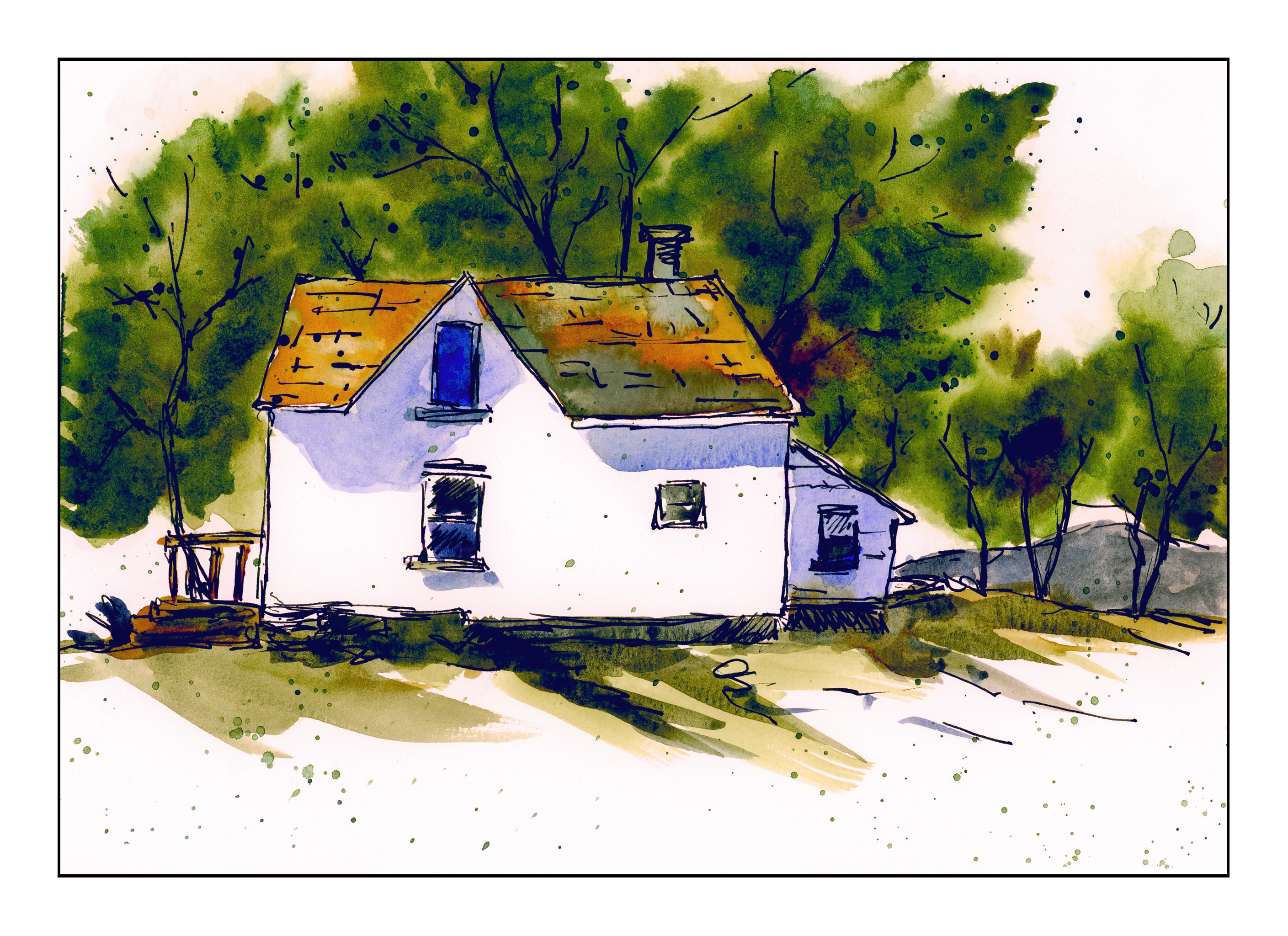
The lesson from last night was using wet-in-wet to paint trees. Mine are not as successful, mostly because my paper is not the same as he uses. The lesson was good, though, as the focus was on the trees and the bloom of the colors on a wet surface. The rest of the lesson was good as I watched him put in shadows which, left to my own imagination, would not have shown up. The lesson there is to think about where the sun is coming from, imagine it, see it in the mind’s eye, and then paint it. That’s a valuable lesson.
Thus: Peter Sheeler’s video on wet-in-wet.
And my own painting.
I found it interesting to see myself adding the spatters and the shingles on the roof, which weren’t in Peter’s original drawing. Is this the beginning of my own style?
Another practice study from Peter Sheeler. Here he uses masking tape – painters tape – to create a frisket. He tore pieces of tape and pressed them into the paper, as a resist to the dry brush technique he used to create the sense of a very windy laundry day. As a kid, I remember those days, pegging the clothes and sheets. It was a lot of fun, a lot of work, but always worth the smell of fresh air on your sheets when you went to bed.
First, here is the picture with the “laundry” masked with randomly torn bits of painter’s tape.
And here is the final picture. To frame the picture, I used more tape around the edges of the picture. If you watch the video, you’ll see why!







 Ink, Yarn & Beer